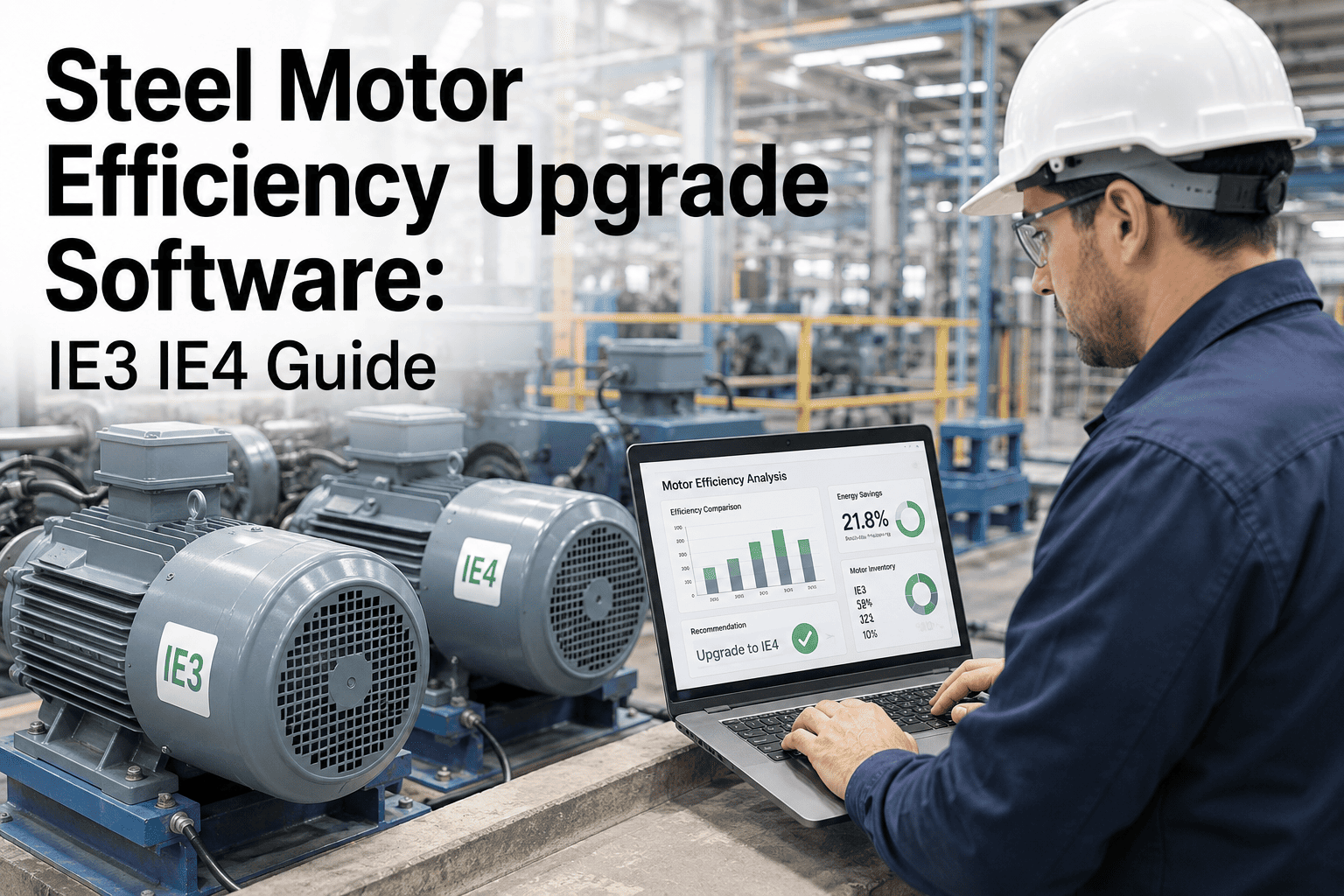
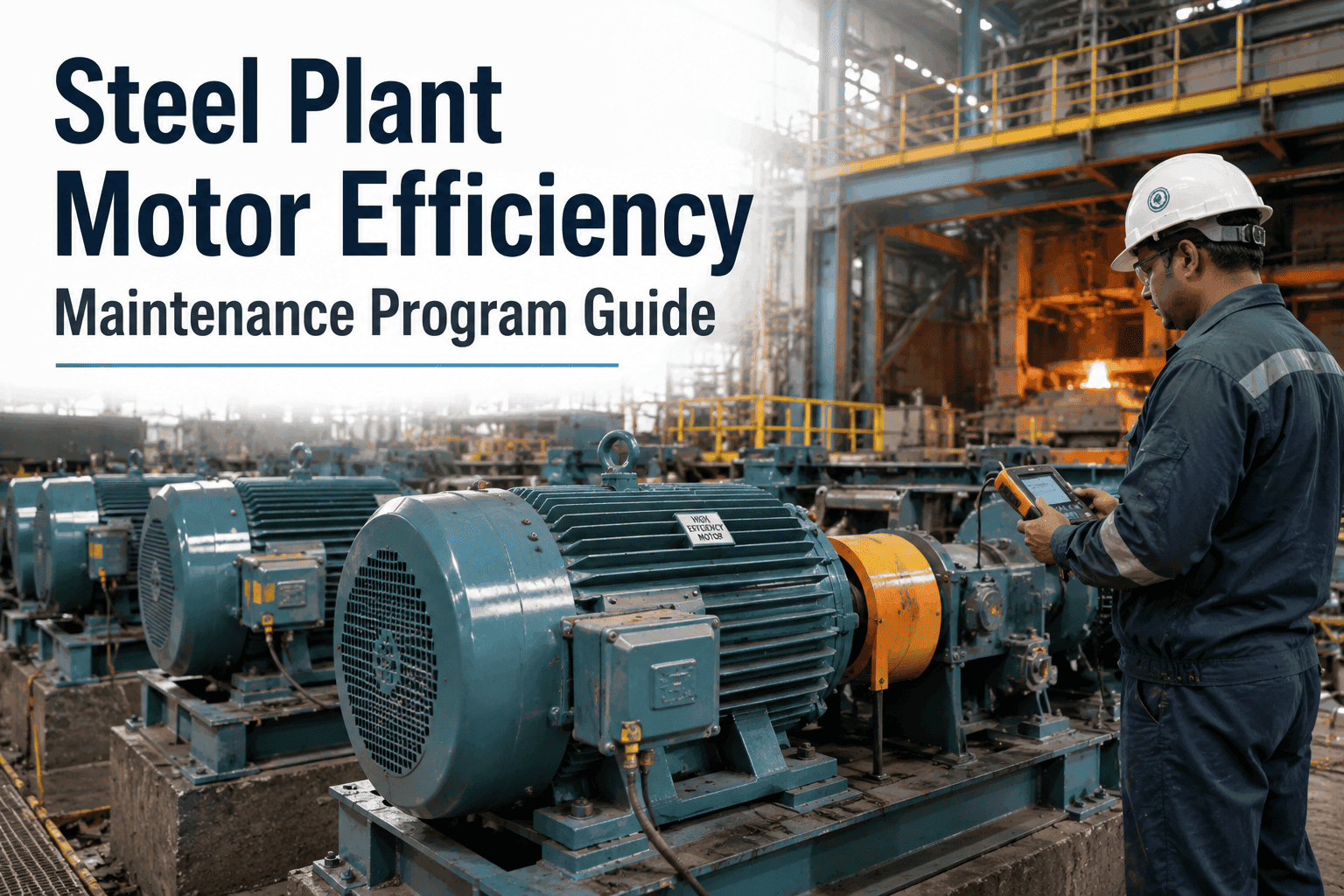
Most steel plants are still running a mixed fleet of IE1 and IE2 motors on fans, pumps, compressors, and conveyor drives that were installed a decade or more ago, and nobody has ever built the business case to replace them because the exercise looks complicated on paper. It is not. A motor efficiency upgrade from IE1 or IE2 to IE3 or IE4 pays for itself in two to four years on any motor running more than 4,000 hours a year, and steel plants run thousands of motors well past that threshold. The barrier is not the payback math — it is knowing which motors to upgrade first, in what order, and how to prove the savings once the new motor is running. See how that prioritization gets built with a free trial of OxMaint.
Efficiency Classes
The IEC Motor Efficiency Ladder — Where Your Fleet Actually Sits
IE1
Standard Efficiency
Legacy design, phased out of new installations in most regions. Highest energy loss per running hour on the fleet.
IE2
High Efficiency
Common installed base across steel auxiliary drives from the 2010s. Still a meaningful upgrade opportunity against IE3.
IE3
Premium Efficiency
Current baseline for new motor purchases in most markets. The standard upgrade target for continuous-duty fans and pumps.
IE4
Super Premium Efficiency
Best available class for induction and synchronous reluctance motors. Reserved for the highest running-hour, highest-load drives.
2–4 yrs
Typical payback period for an IE1/IE2 to IE3/IE4 upgrade on a motor running 4,000+ hours a year
2–8%
Energy loss reduction per upgrade step, compounding across a plant's continuous-duty motor fleet
70%+
Of a motor's lifetime cost is electricity — purchase price is a small fraction of total cost of ownership
6,000+
Annual running hours typical for main draft fans, cooling water pumps, and compressor drives in a steel plant
Prioritization
Which Motors to Upgrade First — A Simple Two-Factor Framework
Not every IE1 or IE2 motor on the plant deserves the same urgency. The upgrade sequence that produces the fastest combined payback ranks motors on two factors only — annual running hours and rated load — rather than trying to build a complicated multi-variable model before making a single decision.
Upgrade First
High hours + high load
Main draft fans, continuous cooling water pumps, air compressors. Fastest payback, largest absolute savings.
Upgrade Next
High hours + moderate load
Conveyor drive motors on primary material handling lines running near-continuous shifts.
Upgrade on Failure
Low hours + high load
Standby pumps and backup drives. Upgrade opportunistically when the existing motor fails or is due for rewind.
Deprioritize
Low hours + low load
Intermittent-duty auxiliary motors. Payback period rarely justifies an early replacement here.
OxMaint · Motor Inventory Tracking
Rank Every Motor on Your Fleet by Running Hours and Load — Automatically
OxMaint tracks nameplate efficiency class, rated load, and actual running hours per motor asset, so the upgrade priority list builds itself instead of relying on someone's memory of which fans run hardest.
Payback Math
How the Payback Period Is Actually Calculated — In Four Steps
1
Confirm Current Motor Loss
Pull the rated efficiency percentage from the nameplate of the existing IE1 or IE2 motor at its typical operating load point, not just full load.
2
Compare Against the IE3/IE4 Replacement
The efficiency gap between classes is usually 2 to 8 percentage points depending on motor size — smaller motors typically show the largest percentage gap.
3
Multiply by Actual Running Hours
Annual running hours, not nameplate duty cycle, determine real savings. A motor logged at 6,500 hours a year returns roughly 75% more annual savings than the same motor run for 3,700 hours.
4
Divide Net Cost by Annual Savings
Net replacement cost, after any rebate or incentive, divided by the annual energy cost saved gives the payback period in years — most continuous-duty steel plant motors land between two and four years.
Rollout Sequence
Sequencing an IE3/IE4 Upgrade Program Across a Steel Plant
OxMaint · Upgrade Tracking
Track Every Phase of the Rollout Against the Savings It Was Supposed to Deliver
OxMaint records the before-and-after efficiency class, running hours, and calculated savings for every motor upgraded, so Phase 3 pilot data can validate Phase 4 budget requests with real numbers instead of estimates.
The OxMaint Advantage
How OxMaint Keeps a Motor Efficiency Program Running After the Pilot Ends
Nameplate and Class Records Per Asset
Efficiency class, rated load, and manufacturer data are stored against each motor asset, so the upgrade candidate list stays current as motors are replaced or added to the fleet.
Automatic Running-Hours Tracking
Running hours are logged from operating data rather than estimated, so the priority ranking reflects actual duty cycle instead of assumed continuous operation.
Upgrade Work Order Workflow
Each prioritized motor moves through a standard replacement work order with before-and-after efficiency data attached, keeping the whole program auditable.
Savings Realization Dashboard
Calculated payback is compared against measured energy use after each upgrade, giving the reliability team real numbers to defend the next phase of the budget.
Impact
What Steel Plants Report After a Structured Motor Upgrade Program
18–24%
Energy cost reduction on the upgraded motor population within the first year
2.7 yrs
Average measured payback across pilot programs on high-hour motors
₹85L+
Typical annual energy saving from upgrading the top 50 highest-priority motors
40%
Fewer motor-related unplanned failures reported after fleet-wide upgrade completion
Reliability Team Questions
Motor Efficiency Upgrades — What Steel Plant Engineers Ask
Is it worth upgrading a motor that still has years of mechanical life left?+
Yes, for high-running-hour motors. Since electricity typically accounts for over 70% of a motor's lifetime cost, the energy savings alone often justify early replacement well before the motor reaches mechanical end of life on continuous-duty applications.
Should a failed IE1 or IE2 motor be rewound or replaced with IE3/IE4?+
A rewind typically restores the original efficiency class at best and often reduces it slightly. For any motor already on the priority upgrade list, a failure is the ideal trigger point to replace with IE3 or IE4 rather than rewind.
OxMaint's motor records flag this automatically when a work order is raised.
How accurate does the running-hours estimate need to be for the payback calculation?+
Reasonably accurate — a motor logged at an assumed 4,000 hours that actually runs 6,000 hours will understate annual savings by roughly 50%. This is why measured running hours produce a far more reliable priority ranking than duty-cycle assumptions.
Do smaller motors really see a meaningful efficiency gain from an upgrade?+
Often more than larger motors in percentage terms. Small and mid-size motors frequently show the widest efficiency gap between IE1/IE2 and IE3/IE4 classes, which combined with high running hours can still produce a two-to-three-year payback.
What is the fastest way to start a motor efficiency program without a full plant audit?+
Start with the twenty highest-running-hour motors on the plant — main fans, continuous pumps, and compressor drives usually account for a disproportionate share of total motor energy cost.
Book a demo to see how that shortlist gets built from existing asset data.
OxMaint · Steel Plant Energy Reliability
The Motors Paying for Themselves in Two Years Are Still Running as IE1
Every year an eligible motor stays on the legacy efficiency class is a year of savings that never gets captured. OxMaint builds the inventory, the priority ranking, and the savings record that turns a motor efficiency upgrade from a one-off project into a running program.