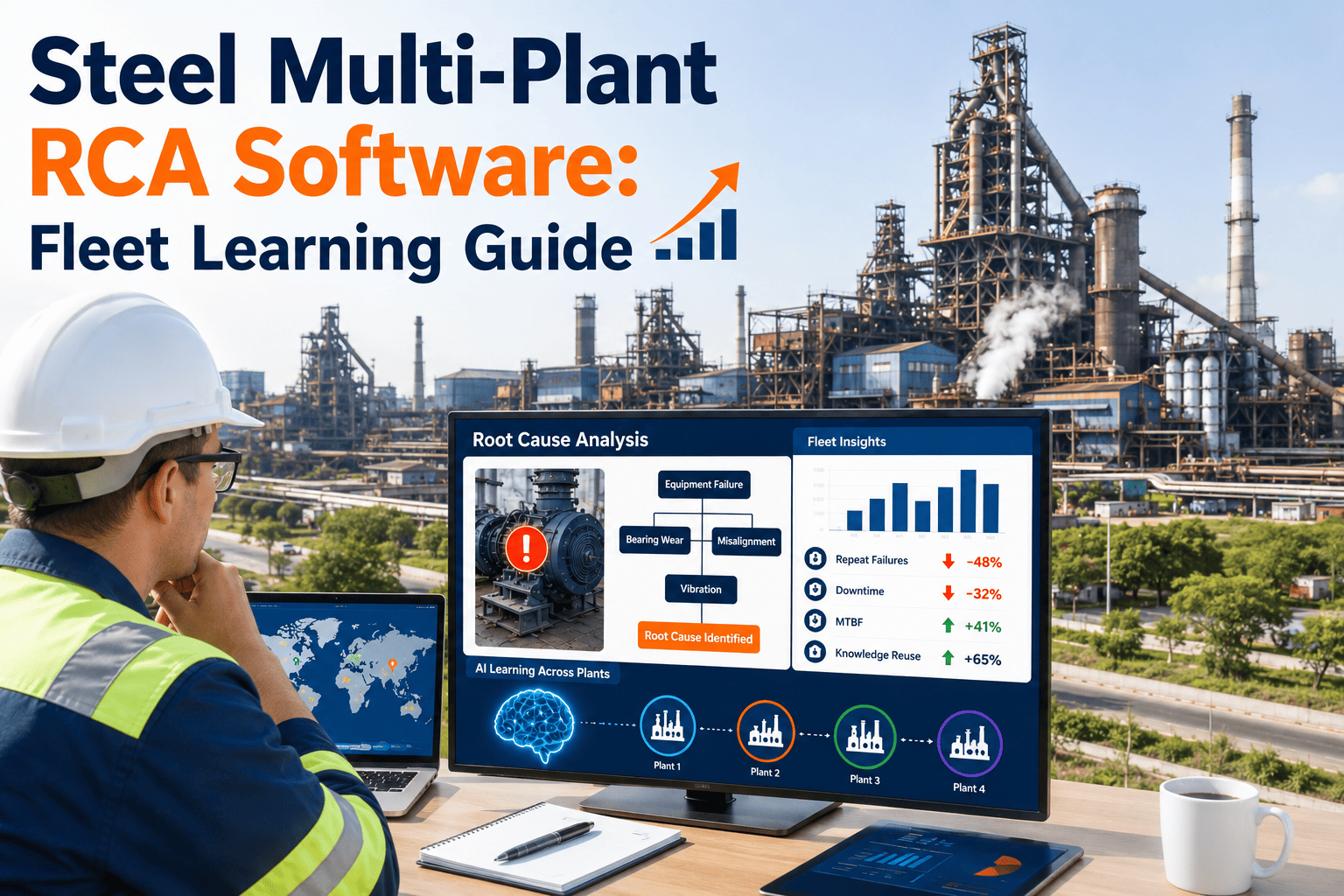
The same bearing failure happens at Plant A in March, gets root-caused, fixed, and documented in a report that lives in one engineer's folder — then happens again at Plant C in October, investigated from scratch by a different team who has never seen the first report. Multi-plant steel groups lose more reliability value to this kind of repeated, unshared learning than to any single catastrophic failure, because nobody notices the pattern spans three sites until someone manually compares work order histories months later. A root cause analysis that stays local to the plant where the failure happened is only half finished — the other half is making sure every sister plant with the same asset type inherits the fix before they experience the same failure. That is the fleet learning discipline steel groups build when RCA findings, corrective actions, and updated PM schedules all flow through the OxMaint CMMS platform across every site in the group. One investigation then protects every plant that owns the same equipment.
Multi-Plant RCA Software for Fleet-Wide Reliability Learning
Turn one plant's root cause finding into a fleet-wide PM update automatically — so the same failure mode never gets independently rediscovered at every sister site.
The Fleet Learning Loop — How One Finding Reaches Every Plant
A single-plant RCA ends when the corrective action is implemented locally. A fleet learning loop keeps going — checking whether any other site in the group runs the same asset type, pushing the finding to those sites as a recommended action, and verifying it actually got implemented rather than just acknowledged. The four stages below are what that closed loop looks like in practice, and skipping any one of them turns a good investigation into wasted effort the moment the finding fails to reach the next plant that needed it.
Local Investigation
Plant A runs a structured RCA on the failure — 5-Why, fishbone, or fault tree — logged against the specific asset, failure code, and corrective action inside the work order closure workflow.
Fleet Asset Match
System checks the asset type, make, and model against the equipment register across every connected plant, identifying every sister asset that shares the same failure exposure.
Bulletin Distribution
Finding and corrective action pushed as a technical bulletin to reliability leads at every matched plant, with the recommended PM or design change attached directly.
Implementation Verification
Each receiving plant's implementation status tracked back to the original finding — acknowledged, scheduled, completed — closing the loop instead of leaving it as an email nobody actioned.
Single-Plant RCA vs Fleet RCA — Why Scope Changes the Outcome
The difference between these two approaches is not depth of investigation — a good RCA is a good RCA either way. The difference is what happens to the finding afterward, and whether it protects one asset or every asset like it across the group.
Local RCA
Finding documented, corrective action applied to the failed asset, PM updated at that plant only. Value captured is real but bounded to one site — every sister plant remains exposed to the same failure mode until it happens there too.
Connected RCA
Same investigation, same finding — but the corrective action and PM update are matched against every site running the same asset type and pushed as a tracked bulletin, so the fix compounds across the fleet instead of staying local.
Stop Letting Every Plant Learn the Same Lesson the Hard Way
OxMaint matches every RCA finding against your equipment register across sites, so a fix at one plant becomes a protected PM update everywhere the same asset runs.
What Unshared Learning Actually Costs a Steel Group
The cost of a repeated failure is never just the second repair bill. It is the investigation hours spent rediscovering a cause someone else already found, the production loss from a failure mode that was preventable in writing, and the slow erosion of trust in the RCA process itself when the same fault keeps recurring across the group. The breakdown below is where that cost typically lands, and it tends to grow quietly year over year because each new repeat event looks, in isolation, like an unrelated one-off rather than part of a pattern spanning the whole fleet.
Engineering hours spent re-investigating a failure mode that was already root-caused at a sister plant months earlier.
Unplanned downtime from the same failure mode recurring at additional sites before the fix ever reaches them.
Preventive maintenance schedules that diverge across sister plants because updates from one site's findings never propagate.
Findings trapped in one engineer's notes or a local file share, lost entirely when that person moves plants or roles.
What Makes a Finding Ready to Travel Across Plants
Not every RCA finding is equally shareable. A finding that stays specific to one site's unique configuration — a one-off installation error, a local process deviation — has limited value elsewhere. A finding tied to the asset's design, its standard operating envelope, or a component that behaves the same way regardless of site is exactly the kind that should travel. The difference matters because flooding every plant with irrelevant bulletins trains reliability teams to ignore them, which defeats the purpose just as thoroughly as never sharing anything at all.
Local-Only Finding
Caused by a one-off installation error, a local process deviation, or a site-specific environmental factor. Corrective action applies to that plant alone and does not need to be pushed as a fleet bulletin.
Fleet-Relevant Finding
Rooted in the asset's design, a component's known behavior, or a standard operating condition shared across sites. This is exactly the category that should be matched and pushed to every plant running the same equipment.
Live Fleet Bulletin Board — What Cross-Plant Learning Looks Like in Motion
The board below shows what a live fleet learning record looks like across a four-plant steel group after a recent RCA finding at one site, tracked through to implementation status everywhere else.
Isolated RCA Programs vs a Connected Fleet Learning System
Most steel groups already run RCA at every plant. The gap is connection — whether a finding at one site can even be searched, matched, or verified against the others. The comparison below is what groups typically see after connecting their RCA process across sites through a shared CMMS. Without that connection, the same reliability team can end up rewriting a nearly identical fishbone diagram for a failure their colleagues two sites over already solved months earlier, simply because there was no shared place to look first.
| Program Element | Isolated (Plant-by-Plant) | Connected (Fleet-Wide) | Typical Impact |
|---|---|---|---|
| Repeat Failure Rate Across Sites | Same failure mode recurs at 2–4 sites typical | Recurrence drops sharply after first bulletin | Fewer repeat events |
| Root Cause Investigation Time | Hours to days, starting from scratch | 50%+ faster using searchable prior findings | Faster resolution |
| PM Schedule Consistency | Diverges across sister plants over time | Stays aligned as fixes propagate automatically | Standardised fleet PMs |
| Knowledge Retention | Tied to individual engineers and local files | Retained in a searchable fleet record | Survives staff turnover |
| Corrective Action Verification | Rarely tracked past the origin plant | Tracked to completion at every matched site | Closed-loop accountability |
The Six Practices Behind a Working Fleet Learning Program
Steel groups that consistently turn one plant's RCA into fleet-wide protection run the same six practices inside their CMMS, treating cross-plant learning as a tracked workflow rather than an occasional email between reliability managers. None of these six practices is expensive or exotic on its own — the value comes entirely from running all six together, consistently, so a finding never quietly stops moving partway through the loop.
Structured Closure Template
Every significant failure closed with a standard 5-Why or fishbone template inside the work order, ensuring findings are structured enough to match and share automatically.
Fleet Asset Matching
Failed asset's make, model, and type checked against the equipment register across every connected site, surfacing every plant exposed to the same failure mode.
Bulletin Issuance
Matched findings pushed as a tracked bulletin to reliability leads at every affected site, with the corrective action and recommended PM change attached directly.
Implementation Tracking
Each receiving plant's status — acknowledged, scheduled, completed — tracked against the bulletin, with automatic escalation when a site stalls.
Fleet Pareto Review
Repeat failure modes ranked across the entire group by frequency and cost, surfacing which asset types most need a fleet-wide standard fix.
Cross-Site Benchmarking
Reliability performance compared plant to plant on the same asset types, surfacing which site's practices should become the fleet standard.
What Fleet Learning Returns Across a Multi-Plant Group
The figures below reflect what multi-site steel groups typically document after connecting their RCA process across plants through a shared, searchable CMMS record.
Investigations resolved faster by starting from a searchable history of prior findings across the fleet.
Failure modes that once recurred across multiple sites closed out after the first fleet-wide bulletin.
Sister plants running the same asset type kept on a consistent, continuously updated preventive maintenance standard.
Findings kept in a searchable fleet record instead of tied to one engineer's memory or personal files.
Frequently Asked Questions
One Investigation Should Protect Every Plant That Owns the Asset
The steel groups turning individual failures into fleet-wide reliability gains all run their RCA findings through one connected system — start closing the loop across your sites.