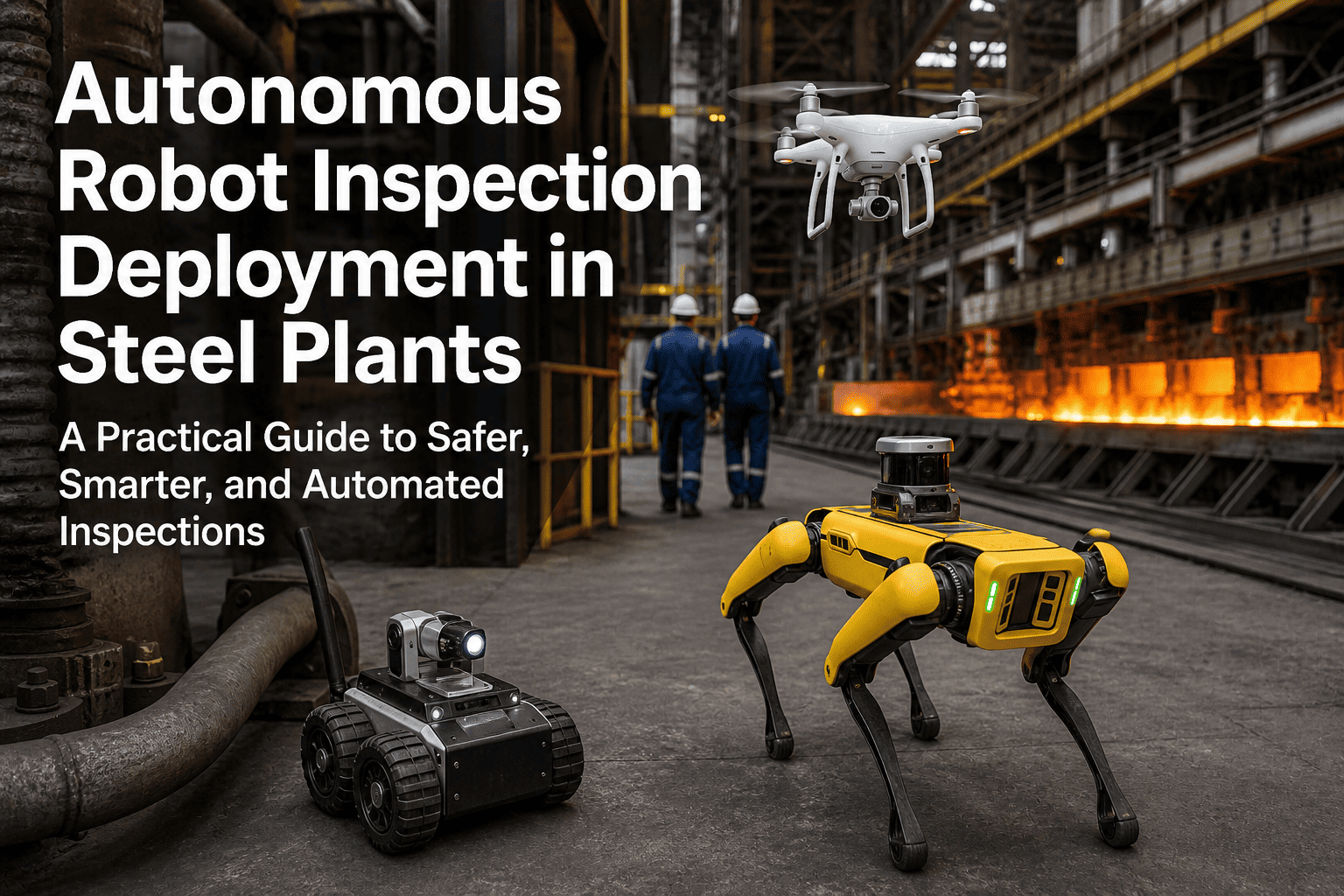
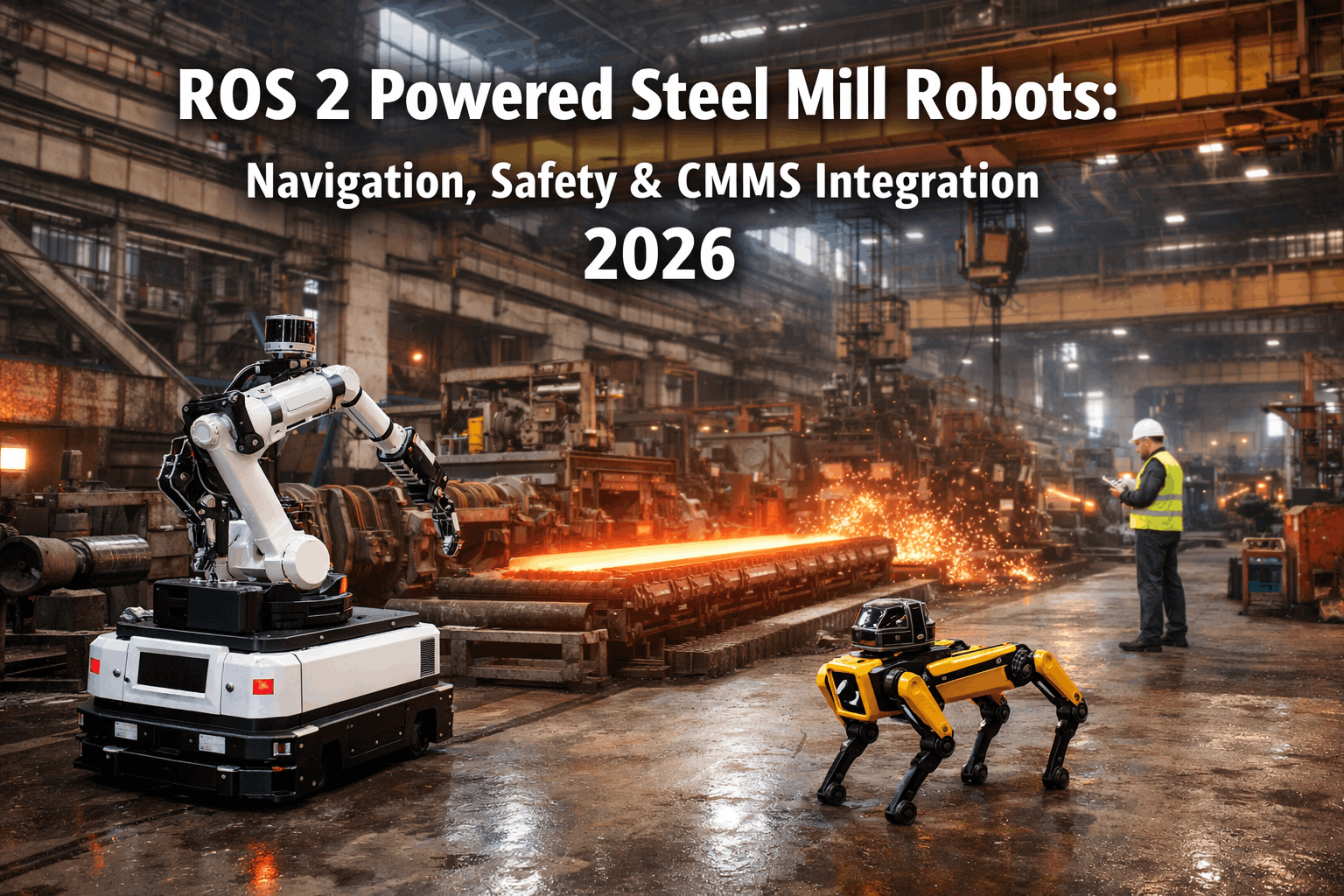
Steel plants are among the most dangerous industrial environments on Earth — 67 workers died in steel industry incidents in 2024, many during routine inspections in blast furnace perimeters, coke oven corridors, and confined vessel spaces. Robotic inspection fleets deployed through OxMaint's Robot Fleet Console reduce hazardous-area worker exposure by 80% while simultaneously capturing 5-10x more inspection data per shift than manual rounds. Whether your programme starts with a single Boston Dynamics Spot quadruped on the casthouse floor or scales to a mixed fleet of drones, crawlers, and ground robots across every process area, OxMaint connects every sensor reading directly to the work order and asset record — so the 35-45% of findings that are lost between clipboard and CMMS in manual programmes become zero. Start your free trial and bring your first robot online in OxMaint's fleet console today.
Steel Plant Robot Fleet Management: Quadrupeds, Drones, Crawlers & CMMS-Integrated Inspection at Scale
From a single pilot quadruped on the blast furnace perimeter to a coordinated fleet of 20 or more robots covering every hazardous zone — OxMaint's Robot Fleet Console schedules patrols, triages findings by severity, auto-generates work orders from anomaly alerts, and tracks every robot's own maintenance schedule. This is how steel plants move from manual inspection rounds to continuous, autonomous asset health monitoring.
Four Robot Platforms — Each Optimised for a Different Steel Plant Environment
No single robot platform covers every inspection requirement in an integrated steel facility. Blast furnace shells need crawler contact UT. Coke oven corridors need ATEX-certified ground robots. Stack exteriors need drones. Rolling mill floors need quadrupeds. OxMaint's Fleet Console manages all four platform types from one dashboard.
How Robot Inspection Data Becomes a Completed Work Order in OxMaint
The gap between robotic detection and maintenance resolution is where most programmes fail. A robot finds a thermal anomaly on a bearing at 3 AM. Without CMMS integration, that finding sits in a fleet management dashboard until someone manually reviews it, creates a work order, assigns a technician, and links it to the asset record. OxMaint closes that gap automatically.
Robot Inspection vs Manual Inspection — Steel Plant Performance Data
| Inspection Activity | Manual Programme | Robotic + CMMS | Improvement |
|---|---|---|---|
| Inspection checkpoints per shift | 80-120 per inspector | 270-900 per robot | 3-8x more coverage |
| Finding capture rate | 55-65% of defects recorded | 95%+ automated record | 35-45% finding recovery |
| Hazardous zone access time | 10-15 min per entry (SCBA limit) | Continuous autonomous patrol | Unlimited coverage |
| BF shell UT inspection | 3-4 days with rope access | 6-8 hours, in-service | 85%+ time reduction |
| Finding-to-work-order conversion | 55-65% (manual entry) | 100% (automated) | Zero finding loss |
| Stack exterior inspection | $50K+ scaffolding per setup | Drone pass, no scaffolding | $50K+ per inspection saving |
| Total inspection programme cost | Baseline | 40% of baseline cost | 60% documented reduction |
| Payback period (fleet + CMMS) | N/A | 3-8 months typical | One prevented BF event covers full cost |
Data sourced from documented Outokumpu Avesta deployment (ANYmal), Gecko Robotics Toka case studies, OxMaint integration deployments 2024-2026, and McKinsey Heavy Industrials robotic inspection benchmarking report. Book a demo to model your plant's specific inspection cost reduction potential with OxMaint.
Industry Perspective on Steel Plant Robotic Inspection and CMMS Integration
The bottleneck in industrial robotics adoption is never the robot. Quadruped platforms like ANYmal and Spot are mature, proven, and capable of operating in the most hostile steel plant environments continuously and safely. The bottleneck is always the workflow behind the robot — specifically, what happens to the data it collects. A robot that generates 2,000 sensor readings per day and feeds them into a dashboard that maintenance planners have to manually review is not a productivity tool. It is a different kind of administrative burden. The plants that achieve genuine transformation are those that connect robot findings directly to CMMS work orders, closing the loop between detection and resolution with zero manual handoff.
What OxMaint Delivers for Steel Plant Robot Fleet Operations
Manual Inspection Programme vs OxMaint Robot Fleet Console
| Capability | Manual Inspection Programme | OxMaint Robot Fleet Console |
|---|---|---|
| Inspection frequency | 1-2 rounds per shift — limited by technician availability and hazard exposure limits | Continuous autonomous patrol — 270+ checkpoints per robot per day, 24/7 |
| Hazardous zone coverage | 10-15 minute maximum exposure — BF perimeter, coke oven corridors require full SCBA | Robots operate indefinitely in ATEX-certified environments without exposure limits |
| Finding documentation | Clipboard to paper report — 35-45% of findings never converted to work orders | Automatic sensor logging at every checkpoint — 100% capture rate with media attachments |
| Anomaly detection consistency | Varies by inspector experience, fatigue, and environmental conditions | Identical threshold comparison every patrol — no degradation with time or conditions |
| Work order generation | Manual entry after shift — average 4-8 hour lag from detection to work order creation | Automatic on Critical finding — work order in planner queue within minutes of detection |
| Fleet own maintenance | N/A | Robot PM schedules managed in OxMaint alongside plant equipment — actuators, batteries, sensors, calibration |
| Compliance documentation | Paper logs — difficult to audit, prone to gaps | Timestamped GPS-tagged digital records — audit-ready for OSHA, ISO 55001, insurance |
Steel Plant Engineering and Maintenance Teams Ask Us These Every Week
Your robots collect the data. OxMaint makes sure every finding becomes a completed repair — automatically, every shift, without a single manual handoff.
Patrol scheduling. Anomaly triage. Auto work orders. Robot PM schedules. Asset health trending. Compliance audit trail. All in one platform. Active from your first robot connection.