Most steel plant control rooms run on a control philosophy developed in the 1970s: PID controllers maintain setpoints, operators adjust parameters manually based on experience and shift history, and the furnace or rolling mill responds to what happened — not to what is about to happen. A reheating furnace running under manual control burns $8–15 million in natural gas annually while operating 8–15% less efficiently than thermodynamic models say it should, producing temperature variations of ±40–60°F across the slab cross-section when rolling requires ±15°F, and generating 2–5% more scale than necessary — because the operator is optimising against a handful of thermocouple readings, not against the thousands of interacting variables the furnace actually responds to. AI process control changes this. Not by replacing the operator, but by replacing the information gap between what the furnace is doing and what the control system knows about it. Machine learning models trained on years of furnace sensor data, quality outcomes, and process history can suggest — or in more mature deployments, autonomously apply — the optimal setpoints for every zone in real time, every shift, every grade, every slab spacing pattern. POSCO deployed this approach and achieved 5% production efficiency improvement, 10% energy consumption reduction, and 3% yield improvement in hot-rolled steel production. ArcelorMittal's AI blast furnace control autonomously adjusts temperature and charge mix parameters, reducing energy consumption by approximately 5% while improving output consistency. The technology is proven. The question for most steel plants is not whether AI process control works — it is how to sequence the transition from reactive PID control to advisory AI to semi-autonomous to fully autonomous operations without disrupting production continuity. Sign up for Oxmaint to begin the AI process control journey at your steel plant today.
Why PID Control Leaves Steel Plants Operating Below Thermodynamic Potential
Traditional steel plant automation uses setpoints and rule-based logic — effective at maintaining stability, but reactive by design. Every control intervention responds to what has already happened. The furnace has already over-heated the slab before the operator reduces the zone temperature. The mill has already produced an out-of-tolerance strip before the pass schedule is adjusted. AI process control introduces a proactive, adaptive strategy where control is continuously optimised against real-time feedback and predictive outcomes. Sign up for Oxmaint to layer AI intelligence onto your existing control infrastructure.
Where AI Process Control Delivers the Highest Value — Five Core Steel Plant Applications
AI process control in steel plants is not a single application — it is a layer of intelligence applied to specific process units where the combination of complexity, energy cost, and quality impact is highest. The five applications below account for the majority of documented AI process control value across the steel industry. Book a demo to discuss which application delivers the highest value at your specific plant configuration.
Walking Beam Furnace AI — Slab Temperature Uniformity and Fuel Optimisation
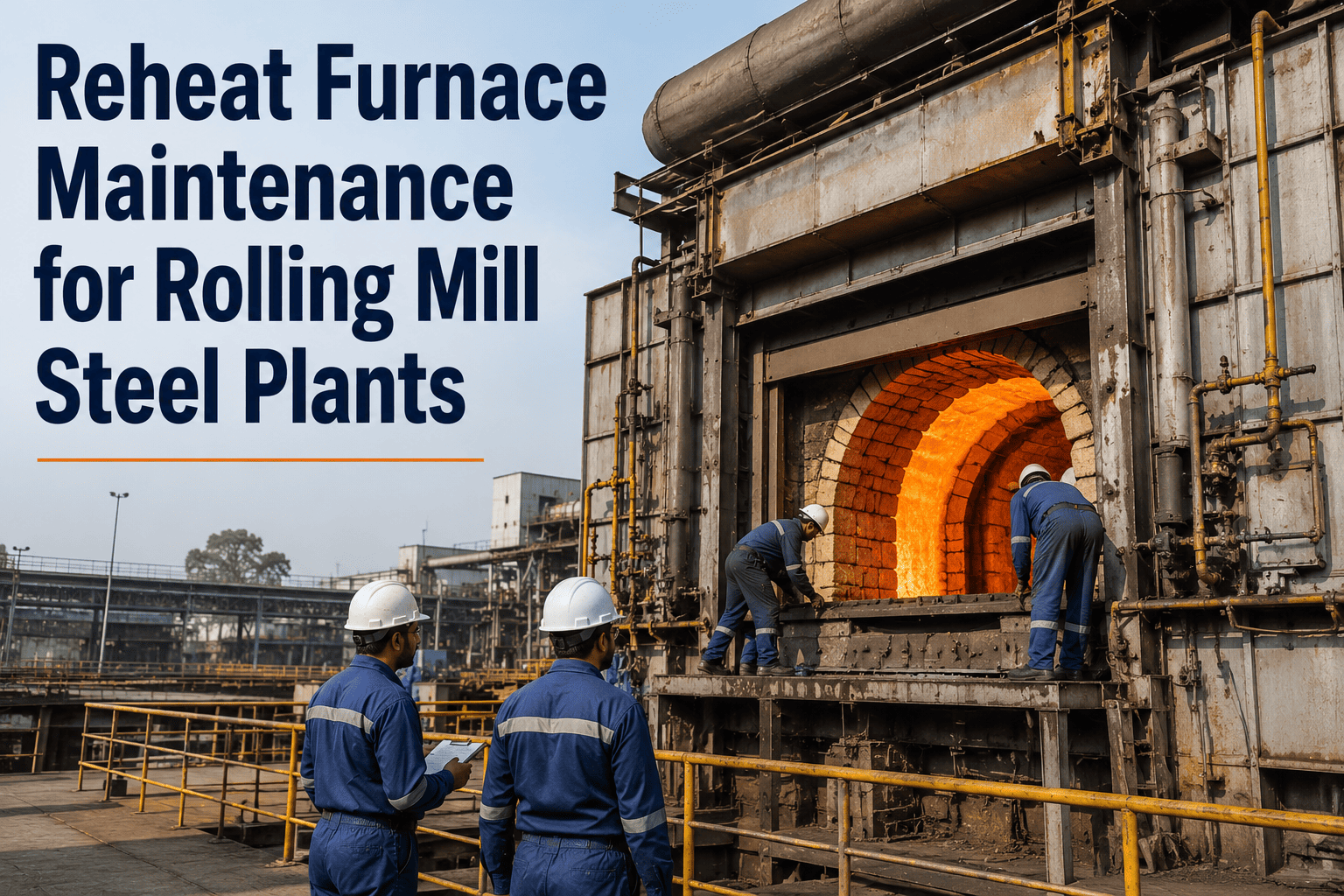
A modern reheating furnace has 5–7 independently controlled heating zones. The optimal setpoints for each zone depend simultaneously on steel grade, slab dimensions, slab spacing, target discharge temperature, rolling mill speed, furnace loading pattern, ambient combustion air conditions, natural gas composition, and the thermal history of each individual slab as it moves through the furnace. No operator can optimise across all of these variables in real time. The standard response is to run hotter than necessary — because the cost of an under-heated slab (mill cobble, quality reject) is immediately visible, while the cost of over-heating is invisible at the operator level. This over-heating adds 3–8% to fuel consumption and 15–30% to scale formation. AI furnace control eliminates this asymmetric risk perception by predicting slab discharge temperature with sufficient confidence to reduce buffer heat while maintaining quality, delivering 5–12% specific energy reduction simultaneously with 50–70% improvement in temperature uniformity across the slab cross-section.
Oxmaint connects to furnace AI outputs — predicted discharge temperatures, zone setpoint recommendations, energy deviation alerts — and generates maintenance work orders when furnace performance degrades below AI-predicted levels, indicating equipment condition issues requiring inspection. Sign up for Oxmaint to link furnace AI outputs to automated maintenance response.
- Slab-by-slab temperature prediction from ML model trained on grade, dimensions, and thermal history
- Mill delay anticipation — furnace reduces firing proactively when mill slowdown is predicted
- Zone optimisation updates every 30–60 seconds rather than every operator shift change
- Scale formation reduction: 15–30% less scale = direct yield improvement and roll wear reduction downstream
Blast Furnace AI — Charge Optimisation, Hot Blast, and Slag Chemistry
The blast furnace is the highest energy consumer in integrated steelmaking and the process unit where AI optimisation has the most complex interaction between input variables. ArcelorMittal's deployed AI system autonomously adjusts blast furnace temperature and charge mix parameters in real time, delivering measurable energy reduction while improving output consistency. The AI model continuously analyses the relationships between raw material quality variations, hot blast temperature and humidity, oxygen enrichment, top gas composition, and silicon content in the hot metal — making adjustments that account for the 6–8 hour delay between charge input at the furnace top and product quality at the tap hole, a prediction horizon that is impossible for operators to manage manually with consistent accuracy.
Predictive analytics on blast furnaces also enable early warning of refractory wear, abnormal energy consumption patterns, and furnace-specific conditions that indicate equipment degradation requiring maintenance intervention. Book a demo to see blast furnace AI maintenance integration in Oxmaint.
- Charge mix optimisation accounts for raw material quality variations that manual operators cannot compensate in real time
- Refractory wear prediction from thermal imaging and heat loss trends — maintenance scheduled before emergency reline
- Silicon prediction model reduces hot metal silicon variance, improving steelmaking converter productivity
- ArcelorMittal deployment: approximately 5% energy reduction with improved output consistency
EAF AI — Electrode Control, Power Profile, and Scrap Mix Optimisation
The EAF has three primary AI optimisation targets: electrode positioning for arc stability and electrode consumption minimisation, power profile optimisation for energy per heat reduction, and scrap mix calculation to achieve target chemistry at minimum raw material cost. AI electrode control replaces the reactive current-based feedback that standard electrode control systems use with predictive arc stability management that reduces electrode breaks, flicker, and reactive power consumption. The combined effect of AI on EAF operations is a 5–15% reduction in energy per heat — a significant impact on a process where energy is typically 60–70% of variable cost. POSCO's AI deployment achieved 10% energy consumption reduction across its steelmaking operations, with measurable yield improvement in downstream hot-rolled production.
- Electrode positioning AI: arc length optimised every millisecond — reduces electrode consumption by 5–10%
- Dynamic power profiles adapted to scrap burden geometry — eliminates hot spots that cause refractory damage
- Scrap mix model: achieves target chemistry at minimum cost per heat accounting for scrap grade availability
- POSCO result: 10% energy reduction, 5% production efficiency gain, 3% yield improvement in hot-rolled
Rolling Mill AI — Pass Schedule Optimisation and Predictive Quality Control
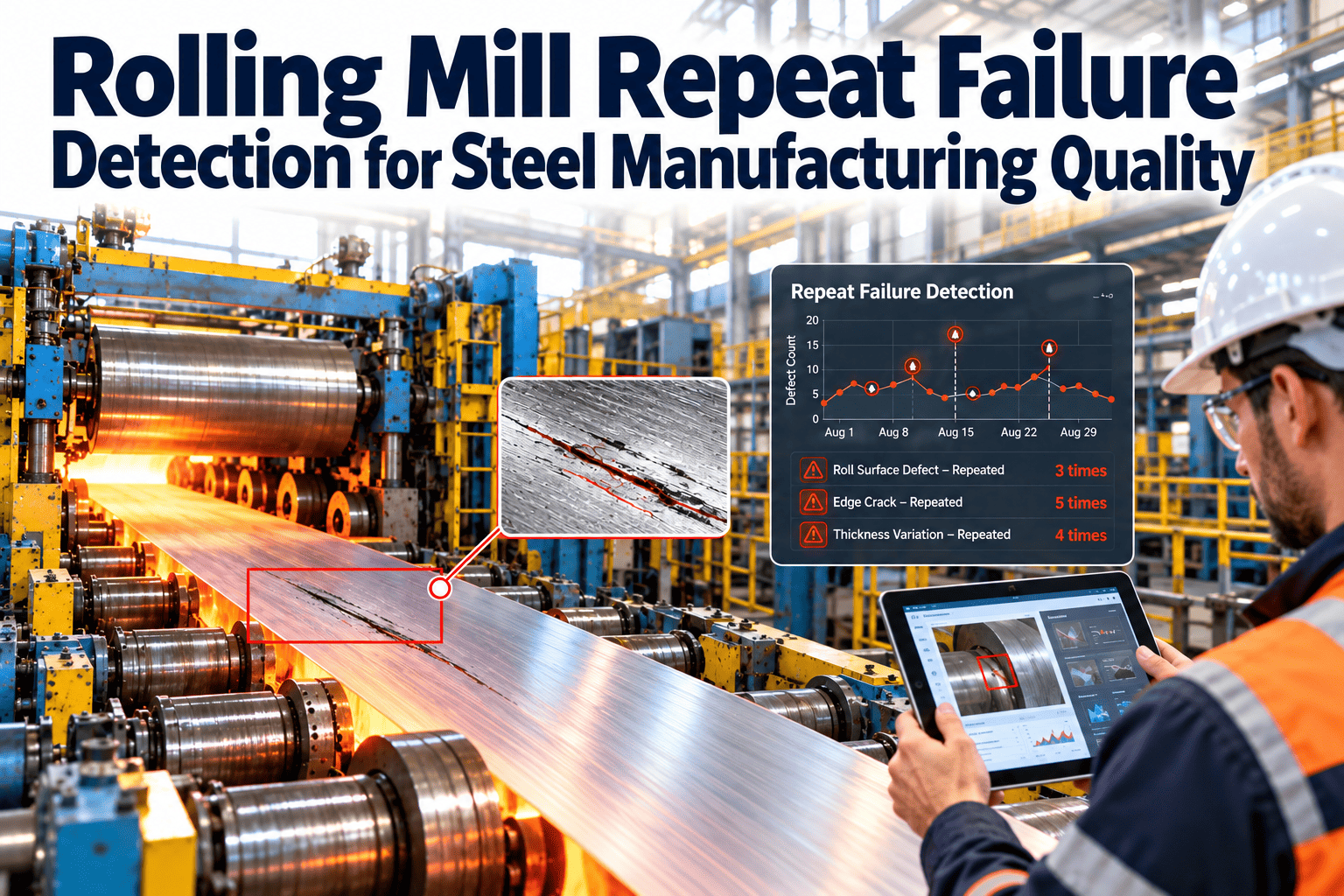
Rolling mill AI operates in two domains: pass schedule optimisation — calculating the optimal reduction sequence, roll force, speed, and temperature for each grade and dimension — and predictive quality control, where ML models predict the final product mechanical properties from in-process measurements before the strip reaches the quality inspection point. The pass schedule optimisation domain is where AI supersedes conventional mathematical models, because it can incorporate the actual measured roll condition, the current temperature profile from the furnace, and the real-time strip behaviour into the pass calculation — rather than relying on nominal values that accumulate error as campaign conditions drift. Tata Steel's AI rolling mill deployment achieved 15% reduction in unplanned downtime by identifying equipment failure precursors before they occurred, alongside measurable improvements in first-pass quality yield.
Computer vision for in-line surface defect detection — detecting micro-cracks, scale inclusions, and surface anomalies at rolling speed — reduces scrap and rework by catching defects during production rather than at the quality inspection point. Voestalpine has deployed AI computer vision for this application with documented defect detection accuracy at microscopic scale. Sign up for Oxmaint to connect rolling mill AI outputs to automated maintenance tracking.
- Pass schedule AI incorporates actual roll condition, incoming temperature profile, and real-time strip response
- Predictive mechanical property model — yield strength and tensile prediction from process parameters before testing
- Computer vision surface inspection at rolling speed — defects detected during production not at shipping
- Tata Steel deployment: 15% unplanned downtime reduction, substantial maintenance cost savings
AI Process Anomalies to Maintenance Work Orders — Closing the Loop with Oxmaint
The final and most operationally valuable integration in AI process control is the direct connection between process anomaly detection and maintenance work order generation. When the AI furnace model detects that a specific zone is no longer responding to setpoint changes with the expected temperature profile — indicating a burner condition problem, refractory local damage, or thermocouple drift — the current practice in most plants is for the process engineer to observe the anomaly, decide it warrants investigation, write an email to the maintenance planner, who creates a work order the next morning. This 12–18 hour delay is where AI process control's maintenance value is lost. Oxmaint eliminates the delay by connecting directly to AI process control system outputs through API integration. When the AI system flags a process anomaly consistent with a specific equipment condition, Oxmaint generates a maintenance work order immediately — with the AI diagnostic, the historical context from the asset's maintenance record, and the priority classification derived from the process impact assessment.
The result is a closed loop: AI detects the process symptom, Oxmaint generates the maintenance response, the technician resolves the equipment condition, and the process returns to the AI-predicted performance baseline — all with a digital record connecting the process anomaly to the maintenance action to the process recovery. Book a demo to see Oxmaint's AI process control integration configured.
The Phased AI Process Control Journey — From Advisory to Autonomous in Four Stages
The transition from reactive PID control to AI-driven autonomous operations does not happen in a single deployment. The proven approach builds confidence incrementally — delivering measurable value at each stage while building the data foundation and operator trust that enables the next level. Sign up for Oxmaint to begin stage one.
Deploy IoT sensors on critical process assets — furnaces, rolling mills, EAF. Establish real-time data connectivity from existing PLC/SCADA/DCS systems to cloud analytics. Launch monitoring dashboards for energy, OEE, and equipment health. First predictive maintenance alerts go live within 60 days. AI begins learning process baselines per grade and production scenario — no changes to furnace or mill operation. Outcome: quantified baseline metrics and identified optimisation potential per process unit.
AI models trained on baseline data begin producing setpoint recommendations displayed alongside current operator settings. Operators adopt, modify, or override recommendations — every decision captured in the training feedback loop. Oxmaint activated for automated work order generation from process anomaly detection. AI-triggered predictive maintenance work orders begin appearing alongside schedule-based PM. Outcome: 4–7% energy reduction from adopted recommendations; operator confidence in AI accuracy builds; maintenance response time improves as anomaly-to-WO delay is eliminated.
AI applies setpoint adjustments automatically within configured operating bounds — the operator's role shifts from manual setpoint management to monitoring AI performance and approving changes that exceed the configured authority boundary. Oxmaint fully integrated with AI outputs — all process anomalies generate immediate maintenance work orders with AI diagnostic context. Rolling mill pass schedule optimisation active. Furnace AI closed-loop on energy and temperature simultaneously. Outcome: 8–12% energy reduction; first-pass quality yield improvement measurable; maintenance backlog begins reducing as predictive response replaces emergency response. Book a demo to discuss semi-autonomous transition planning.
AI controls the full process autonomously — furnace zone temperatures, mill pass schedules, EAF power profiles — with human operators providing strategic oversight, managing exceptions, and directing continuous improvement. Digital twins run process simulations before major grade transitions or maintenance interventions. Baosteel's autonomous EAF cold rolling line model: operator intervention reduced from once every 3 minutes to once every 30 minutes. Oxmaint manages the entire maintenance programme — AI-generated work orders, scheduled PM, condition-based replacement, and regulatory compliance documentation — as a fully digital, automated system aligned with the autonomous production process. Outcome: 10–15% total energy reduction; production consistency independent of operator experience level; maintenance fully predictive. Sign up for Oxmaint to begin stage one today.
Documented AI Process Control Outcomes Across Leading Steel Producers
These results are from confirmed deployments at named steel producers, not projections. Each represents a production environment where AI process control has been operating long enough to produce verifiable performance data.
AI autonomously adjusts blast furnace temperature and charge mix parameters in real time — delivering consistent output improvement alongside the energy reduction.
AI deployment across steelmaking operations achieved 5% production efficiency gain and 3% yield improvement in hot-rolled steel production alongside the energy reduction.
AI predictive maintenance on rolling mills analysed sensor data to identify failures before occurrence — substantial maintenance cost savings alongside the downtime reduction.
Autonomous cold rolling line reduced human intervention from once every 3 minutes to once every 30 minutes — the benchmark for AI process control at the autonomous operations level.
5–12% specific energy reduction on furnaces burning $8–15M annually in natural gas delivers $400K–$1.5M per furnace per year in documented fuel savings.
AI electrode control, dynamic power profiling, and scrap mix optimisation collectively reduce EAF energy per heat — where energy represents 60–70% of variable cost.
AI Process Control — Before and After Comparison by Process Unit
| Process Unit | Key Limitation (Manual / PID) | AI Control Capability | Documented Impact |
|---|---|---|---|
| Reheating Furnace | ±40–60°F temperature non-uniformity; operator over-heats to guarantee min. discharge temp | Per-slab temperature prediction; proactive mill delay response; zone-by-zone optimisation | −5 to −12% fuel; −15–30% scale; ±15°F uniformity |
| Blast Furnace | 6–8 hour lag between charge input and quality output — impossible to manage manually | Charge mix optimisation for variable raw material quality; Si prediction at tap hole | ~5% energy reduction (ArcelorMittal); −3–7 kg/THM coke rate |
| EAF | Reactive electrode control; fixed power profiles; manual scrap mix calculation | Millisecond arc stability control; dynamic power profile; ML scrap mix costing | −5 to −15% energy/heat; −5–10% electrode consumption (POSCO: 10% energy) |
| Hot Rolling Mill | Pass schedule from nominal values; quality measured after production; reactive maintenance | Actual condition-based pass schedule; predictive quality model; computer vision in-line | −15% unplanned downtime (Tata); +2–5% first-pass yield |
| Continuous Caster | Mould level control reactive; breakout prediction from visual observation | Mould level AI; breakout prediction from thermocouple pattern; dynamic spray cooling | Breakout prediction accuracy 90%+; spray cooling energy −8% |
| Maintenance | Process anomaly to work order: 12–18 hours via manual observation chain | Oxmaint API integration: process anomaly to work order < 5 minutes automatically | 150x faster response; complete digital process-to-maintenance audit trail |
Swipe to view full table
From Reactive PID to AI-Driven Operations — Oxmaint Manages the Maintenance Layer Across Every Stage
Whether your plant is at Level 1 (PID) or deploying Level 3 semi-autonomous control, Oxmaint provides the CMMS layer that connects AI process anomaly detection to automated maintenance work orders, closes the loop between process performance and equipment condition, and delivers the digital record that makes the entire journey auditable.
Steel Plant AI Process Control — Common Questions
No. The most effective AI process control implementations layer intelligence on top of existing infrastructure — they do not replace it. The PLC and SCADA systems continue to execute control actions; the AI system provides optimised setpoints to those systems via standard interfaces. The approach is to establish data connectivity from existing Level 1/Level 2 systems to the cloud analytics layer — typically via OPC-UA, Modbus, or historian data export — and then deploy AI models that read the process data and write setpoint recommendations back to the operator HMI or, in semi-autonomous mode, directly to the control system. Most steel plants with Level 2 automation installed in the last 15 years have the data connectivity available to begin this integration. Sign up for Oxmaint to begin the data connectivity assessment for your plant.
Oxmaint integrates with AI process control systems through REST API connections. When the AI process control system detects an anomaly condition — a furnace zone not responding to setpoint changes as expected, a mill bearing vibration signature changing, an EAF power consumption deviating from the predicted curve for the current scrap charge — it sends an alert to the Oxmaint API with the anomaly classification, severity, and process context. Oxmaint generates a maintenance work order immediately, assigns it according to configured routing rules, and logs the AI diagnostic in the work order description field alongside the asset's maintenance history. The work order closure updates the asset health record, which the AI process control system can read to confirm the equipment condition has been restored. Book a demo to see the API integration demonstrated.
For most steel plant process units with established process historians, the initial AI model can produce first advisory recommendations within 30–60 days of data connectivity. The model improves continuously as more production campaigns, grade transitions, and maintenance events accumulate in the training dataset. A furnace AI model trained on 6 months of production history can typically produce temperature predictions within ±10°F of actual discharge temperature — sufficient for reliable advisory recommendations. At 12 months, the model has seen enough grade diversity and seasonal variation to approach its full prediction accuracy. The semi-autonomous transition is typically appropriate after 6–12 months of advisory operation, once the model accuracy and operator confidence in the recommendations are both sufficiently established. Sign up for Oxmaint to begin building the maintenance data foundation that supports AI process model training.
The Gap Between Your Plant's Current Control Performance and Its Thermodynamic Potential Is Recoverable. AI Process Control Closes It Systematically.
Oxmaint provides the CMMS layer that makes AI process control operationally complete — connecting process anomaly detection to immediate maintenance work orders, building the equipment condition history that AI models depend on, and closing the loop between autonomous process optimisation and predictive maintenance response.