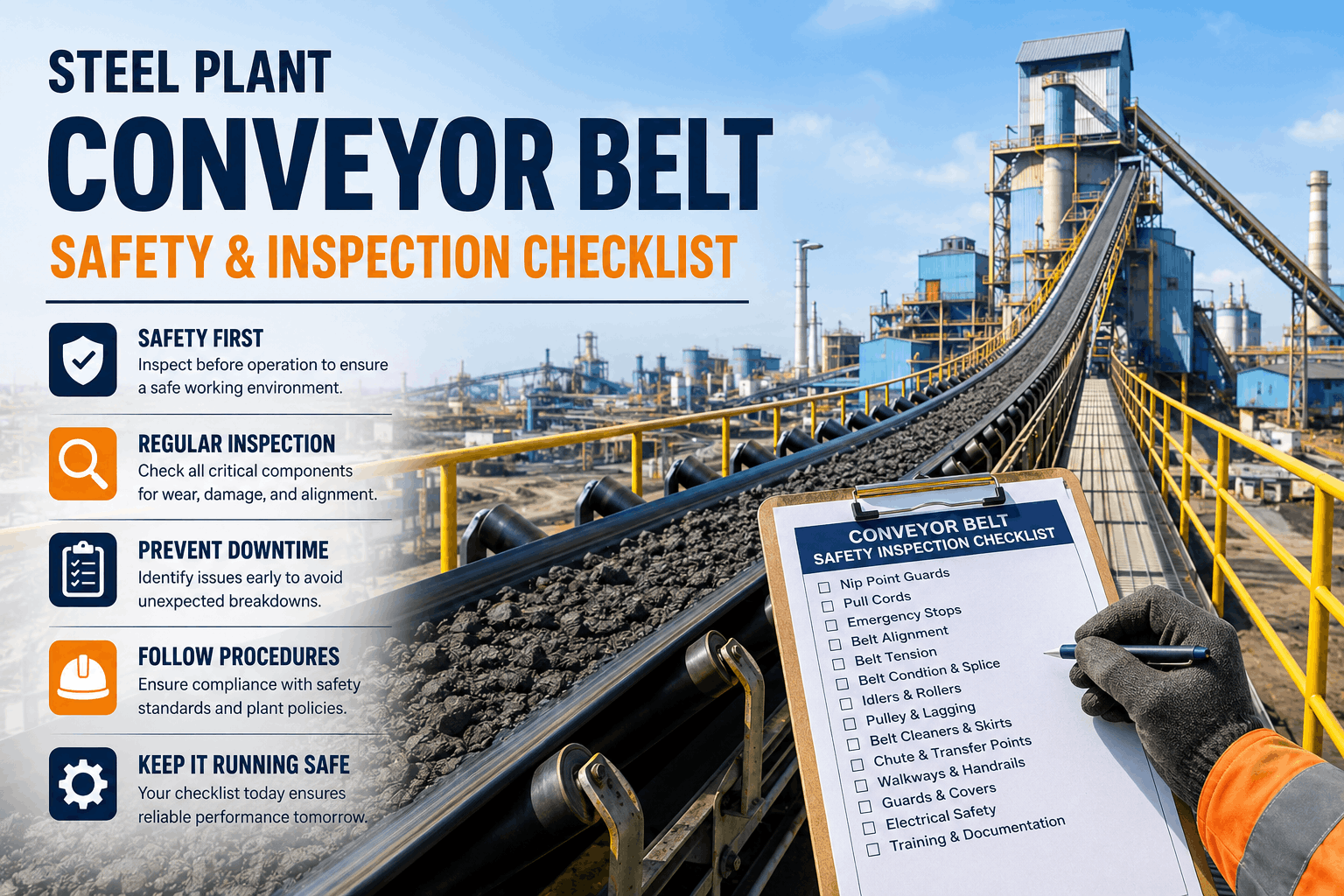
A conveyor belt running through a steel plant's sinter line, coke handling yard, or raw material stockyard carries abrasive, high-temperature material at heavy tonnage every hour of every shift, and it almost never fails without warning signs that a proper inspection would have caught days earlier. A cover that has thinned from tramp iron gouges, a mechanical splice that has started creeping apart under cyclic tension, a belt edge that has frayed until the carcass is exposed, or a tracking fault that saws the belt against the frame steel until it parts mid-shift — every one of these failures begins as a defect that a structured inspection would have flagged long before it became an unplanned stoppage. This checklist gives your maintenance and reliability teams a complete 40-point steel plant belt inspection framework covering cover condition, splice integrity, edge wear, tracking alignment, idler health, structural guarding, and documentation, and every checkpoint here can be logged directly into OxMaint's CMMS platform with photo evidence attached to the exact belt, zone, and shift where the defect was found.
Steel Plant Maintenance · Conveyor Reliability
Steel Plant Belt Inspection Checklist: 40-Point 2026 Template
A zone-by-zone inspection framework covering belt cover, splice, edge, tracking, idler condition, structural guarding, and compliance documentation — built for conveyor networks where one undetected defect turns into hours of unplanned downtime on a high-tonnage line.
40
Inspection Points
7
Belt Zones Covered
100%
Compliance Target
24/7
Shift Coverage
Five Belt Zones Where Steel Plant Conveyor Failures Originate
Cover Wear
Tramp iron gouges and hardened rubber expose the carcass early
Splice Failure
A creeping splice separates under cyclic tension without warning
Edge Fraying
Unraveling edge cords reduce belt strength and cause tears
Tracking Drift
A mistracked belt saws against the frame until it parts
Idler Seizure
A seized idler roll generates heat and cuts through the cover
SPer Shift
DDaily
WWeekly
MMonthly
QQuarterly
Zone 01
Belt Cover Condition — Top and Bottom Rubber
The top cover of a steel plant conveyor belt takes the full impact of loading, tramp iron, and abrasive fines every time material transfers onto it, and it wears from the inside of the rubber compound long before a visible hole appears. A cover that has hardened from heat exposure near a sinter or coke discharge point loses its resistance to cutting and gouging exactly where the belt needs it most.
Top cover thickness measured at high-wear zones with a calibrated cover gauge — measurement taken at loading points, transfer chutes, and skirting zones where wear concentrates; a cover measuring below 30% of original thickness at any point requires scheduling for re-covering or belt replacement before the next major shutdown
WReliability Technician · Cover thickness log
Gouges, cuts, and impact damage inspected along the full belt length during a slow-roll walk-down — any cut deeper than one-third of remaining cover thickness marked with paint and logged with a photo; cuts running parallel to the belt edge are lower risk than cuts running across the belt width
WReliability Technician · Cover damage walk-down log
Cover rubber checked for hardening, surface cracking, and ozone weathering — a durometer reading taken at suspect zones and compared against the original rubber compound specification; rubber that has hardened beyond specification has lost impact resistance and cuts more easily under normal loading
MFleet Mechanic · Cover hardness inspection log
Bottom cover inspected for the idler-roll wear pattern that forms as the belt runs continuously over troughing and return rolls — a wear band that has gone from a matte polish to a scored groove indicates a seized or dragging idler on that section that needs replacement, not just belt monitoring
WReliability Technician · Bottom cover wear log
Carcass exposure checked at any point where cover rubber has worn through — exposed carcass fabric absorbs moisture and abrasive fines, which accelerates strength loss at that point; any exposed carcass longer than 100 mm is treated as an emergency repair item, not a scheduled one
SOperator · Carcass exposure flag log
Belt surface checked for material carryback and buildup past the discharge pulley — carryback that is not cleaned adds dead weight, causes chute plugging, and builds up on return idlers where it accelerates bearing wear and cover scoring on the return strand
DOperator · Carryback inspection log
Zone 02
Splice Integrity — Vulcanized and Mechanical Joints
The splice is the single weakest point on any conveyor belt loop because it is the only place where belt strength is not continuous carcass fabric. A splice that has begun separating internally shows no external sign until the separation reaches the surface, by which point the joint may already be within a few operating cycles of complete failure.
Vulcanized splice inspected for separation, bulging, or edge lifting at the joint line — a splice edge that has begun to lift even slightly indicates internal ply separation that will progress under continued tension; a bulge along the splice line indicates trapped air or incomplete bonding during the original vulcanizing process
WReliability Technician · Splice separation inspection log
Mechanical fastener splice inspected for missing, bent, or loosened fastener plates — every fastener plate along the joint checked individually; more than two consecutive missing fasteners is treated as an immediate stop condition because the remaining fasteners then carry a disproportionate share of the running tension
SOperator · Fastener plate inspection log
Splice alignment checked to confirm the joint runs square to the belt centerline — a splice cut at even a small angle to the centerline creates uneven tension distribution across the belt width, which shows up over time as tracking drift concentrated at that one point in every belt cycle
MFleet Mechanic · Splice alignment log
Splice cover rubber checked for cracking at the transition line between splice and belt body — this transition point flexes repeatedly over every pulley and is the most common location for cover cracking to initiate on a mechanically fastened belt
WReliability Technician · Splice transition inspection log
Fastener hinge pin checked for wear, corrosion, and full engagement across the full belt width — a hinge pin that has worn thin or corroded loses its shear strength and can shear under a sudden load spike, releasing that section of the splice under tension
MFleet Mechanic · Hinge pin wear inspection log
Splice performance monitored under load by listening for an audible slap or thump as the joint passes over the head and tail pulleys — a new or developing noise at the splice location is an early indicator of internal separation before any visible defect appears
SOperator · Splice noise monitoring log
A belt splice that fails mid-shift does not just stop one conveyor — it stops every process downstream of it until the line is cleared and re-spliced. OxMaint lets your team log cover thickness, splice condition, and idler status against every belt asset, then flags any belt trending toward a wear limit before it becomes the next unplanned stoppage.
Zone 03
Edge Condition — Fraying, Wear and Trim Contact
Belt edges carry no cover protection over the carcass fabric on most steel plant belt constructions, which makes them the fastest point of strength loss when they are allowed to fray unchecked. An edge that has lost even a small percentage of its width has lost a proportional share of the belt's total tensile strength at that cross-section.
Belt edge inspected along the full length for fraying or unraveling of edge cords — a frayed section marked with paint and measured; fraying that has progressed more than 25 mm into the belt body from the original edge line requires trimming or edge repair before it reaches load-bearing plies
WReliability Technician · Edge fraying inspection log
Edge wear measured against original belt width at multiple points along the conveyor length — a belt that has lost more than 3% of its rated width at any cross-section is scheduled for edge repair; loss beyond 6% is treated as a strength concern requiring engineering review
MFleet Mechanic · Edge width measurement log
Edge cupping or belling checked by observing the belt profile as it passes over the head pulley — a belt edge that curls upward (cupping) indicates uneven internal tension across the belt width, often from long-term tracking misalignment concentrated near one edge
WReliability Technician · Edge profile inspection log
Edge trim and skirting rubber inspected for excessive wear against the running belt edge — skirting set too tight accelerates edge fraying directly; skirting set too loose allows fine material spillage that then contaminates return idlers and accelerates their wear
DOperator · Skirting clearance inspection log
Edge damage from chute spillage or trapped material checked at every loading and transfer point — trapped tramp material lodged between the belt edge and a fixed structure member will cut into the edge continuously until the obstruction is cleared
SOperator · Transfer point edge damage log
Zone 04
Tracking and Alignment — Pulleys, Frame and Takeup
A belt that has drifted off centerline is not a cosmetic issue — it is a belt that is actively cutting itself against the conveyor frame, structure, or guarding on every pass, and the damage compounds with every metre of belt travel until the line is stopped.
Belt tracking observed at both loaded and empty running conditions along the full conveyor length — a belt that tracks correctly empty but drifts under load indicates uneven loading or a structural sag rather than a pulley alignment issue, and requires a different corrective action
SOperator · Loaded and empty tracking observation log
Self-aligning training idlers checked for free rotation and pivot action — a training idler that has seized on its pivot provides no corrective steering action and allows the belt to continue drifting exactly as if the training idler were not installed at all
WReliability Technician · Training idler function log
Belt centerline position measured at multiple fixed points along the conveyor using reference marks on the structure — a belt drifting progressively in one direction between two fixed points indicates a structural or pulley alignment fault at or before that section, not a random tracking fault
MFleet Mechanic · Centerline position measurement log
Pulley alignment confirmed square to the conveyor frame at head, tail, bend, and snub positions — a pulley that is out of square by even a small angle relative to the belt centerline will steer the belt continuously toward one side regardless of how many training idlers are installed downstream
QFleet Mechanic · Pulley squareness alignment log
Skirting clearance checked at the belt edge to confirm sufficient gap remains under a drifting or mistracked condition — clearance set only for perfectly tracked running provides no margin and results in edge contact the moment any drift occurs
WReliability Technician · Skirting clearance verification log
Belt tension at the takeup confirmed within the design range specified for the belt class and conveyor length — a belt running under-tensioned slips at the drive pulley and mistracks more readily; a belt running over-tensioned accelerates bearing and splice wear across the entire loop
WReliability Technician · Takeup tension verification log
Zone 05
Idler Condition — Troughing, Return and Impact Rolls
A single seized idler roll on a steel plant conveyor generates localized heat and abrasive scoring on every pass of the belt over it, and left unaddressed it will cut through the cover at that one point long before the rest of the belt shows any comparable wear.
Troughing idler rolls checked for freedom of rotation by spinning each roll by hand or with a bar during a slow-roll walk-down — any roll that does not spin freely or that spins with resistance is marked for bearing replacement before it seizes completely and scores the belt
WReliability Technician · Idler rotation check log
Return idlers inspected for wear caused by carryback material buildup on the roll surface — a buildup of hardened material on a return idler creates an uneven rolling surface that scores the bottom cover with every pass and accelerates the wear pattern described under cover inspection
WReliability Technician · Return idler condition log
Impact idlers at the loading zone checked for cracked, missing, or hardened rubber discs — impact idlers absorb the loading impact that would otherwise be transferred directly to the belt cover and carcass, and a missing disc removes that protection entirely at that point
DOperator · Impact idler condition log
Idler bearing noise and vibration checked by listening along the conveyor during operation — a grinding, whining, or rhythmic knocking sound at a specific location indicates a bearing in the final stage of failure and should be scheduled for replacement before it seizes
SOperator · Idler bearing noise log
Idler frame and mounting brackets checked for bent members or missing idlers along the full conveyor length — a missing idler leaves an unsupported span of belt that sags under load and increases stress on the idlers immediately adjacent to the gap
MFleet Mechanic · Idler frame inspection log
Idler spacing verified against the original design specification for belt sag control — idler spacing that has been widened during past repairs to reduce parts usage increases belt sag between rolls, which raises rolling resistance and accelerates cover wear at the sag points
QFleet Mechanic · Idler spacing verification log
Zone 06
Structural Guarding and Safety Systems
Conveyor guarding and emergency stop systems exist specifically because a running belt provides no visible warning before a nip point injury occurs, and a guard or pull-cord that has been left disconnected after a previous maintenance job is a defect that will not be discovered until it is needed.
Belt guarding at nip points, including head, tail, and takeup pulleys, confirmed in place and securely fastened — any guard removed for a previous maintenance task and not reinstalled is treated as an immediate stop condition before the conveyor is returned to service
SOperator · Nip point guarding verification log
Pull-cord emergency stop system tested along the full conveyor length — the pull cord pulled at multiple points along its run to confirm the conveyor stops immediately at each activation point and that the cord tension switch resets correctly before restart
WReliability Technician · Pull-cord function test log
Walkways and access platforms along the conveyor checked for corrosion, missing grating, or damaged handrails — a section of missing grating on an elevated walkway creates a fall hazard that is often not reported until an inspection specifically checks for it
MFleet Mechanic · Walkway and platform inspection log
Conveyor structure, including stringers and support columns, checked for corrosion, cracking, or loosened foundation bolts — steel plant environments accelerate structural corrosion from moisture and process fines settling on structural members over time
QFleet Mechanic · Structural corrosion inspection log
Belt scraper and cleaner blades checked for wear and correct tension against the belt surface — a worn scraper blade allows carryback to pass through, while an over-tensioned blade accelerates cover wear at the discharge pulley faster than normal operation would
WReliability Technician · Scraper blade inspection log
Fire suppression and spark detection systems, where fitted on hot material conveyors, checked for correct function during a scheduled test — detector heads inspected for dust buildup that would delay or prevent activation during an actual event
MFleet Mechanic · Fire and spark detection function log
Zone 07
Documentation and Compliance Records
A belt inspection that finds every defect but is never logged against the asset produces no value beyond the current shift, because the next shift's technician has no record of what was found, what was repaired, and what is still pending.
Shift inspection log completed and signed before handover to the next shift — the log records every defect found, its location by chainage or landmark, and whether it was flagged for immediate repair or scheduled maintenance
SOperator · Shift handover inspection log
Belt defect history reviewed before startup following any maintenance shutdown — the incoming operator confirms that every defect logged before the shutdown has either been repaired and signed off or is still open and being actively monitored
DOperator · Pre-startup defect history review log
Splice repair records confirmed logged with date, location on the belt loop, and the technician who performed the repair — this record is what allows a reliability team to identify a splice that is failing repeatedly at the same location rather than treating each failure as unrelated
MFleet Mechanic · Splice repair record verification log
Belt replacement schedule cross-checked against wear trend data rather than a fixed calendar interval — a belt trending toward its wear limit faster than the scheduled replacement date is flagged for early replacement rather than waiting for a failure to force an unplanned changeout
MFleet Administrator · Wear trend and replacement schedule log
Statutory guarding and safety compliance certificate confirmed current for the conveyor line — expired certification is flagged before the next scheduled safety audit rather than being discovered during the audit itself
QFleet Administrator · Compliance certificate currency log
Reliability KPIs
Six Metrics That Prove Your Belt Inspection Program Is Working
| Metric |
How to Measure |
Target |
Frequency |
| Belt Failure Rate |
Unplanned belt failures / Total belts in service |
Trending downward |
Monthly |
| Splice Life Extension |
Average splice life vs previous baseline |
Increasing |
Quarterly |
| Idler Failure Rate |
Idlers replaced due to seizure / Total idlers inspected |
<2% |
Monthly |
| Downtime per Belt Failure |
Hours lost per belt failure event |
Decreasing |
Per event |
| Inspection Completion Rate |
Inspections completed / Inspections scheduled |
100% |
Weekly |
| Defect Closure Time |
Hours from defect logged to repair sign-off |
<48 hours |
Daily |
FAQs
Frequently Asked Questions
What is the standard method for measuring conveyor belt cover wear in a steel plant?
Cover wear is measured with a calibrated ultrasonic or mechanical cover gauge at fixed high-wear zones such as loading points and skirting areas, then compared against the belt's original cover thickness specification. Readings are logged against the belt asset so wear trend over time, not a single measurement, drives the replacement decision.
What causes belt tracking problems on steel plant conveyors?
Tracking problems most commonly come from a pulley that is out of square to the frame, uneven loading concentrated toward one side of the belt, a seized training idler that provides no corrective steering, or structural sag that shifts the belt path under load rather than under a fixed misalignment.
What idler defects cause the most unplanned conveyor downtime?
A seized idler bearing is the leading cause, since it generates localized heat and abrasive scoring on the belt with every pass until either the idler is replaced or the belt cover is cut through at that point, forcing an unplanned stoppage for belt repair rather than a simple idler swap.
Digitize Belt Compliance
Every Belt Inspected. Every Defect Logged. Every Shift Covered.
OxMaint turns your 40-point steel plant belt inspection into a mobile checklist with photo evidence, wear trend tracking, splice history, and one-click reliability reports — so the next belt failure is a scheduled replacement, not an unplanned stoppage.