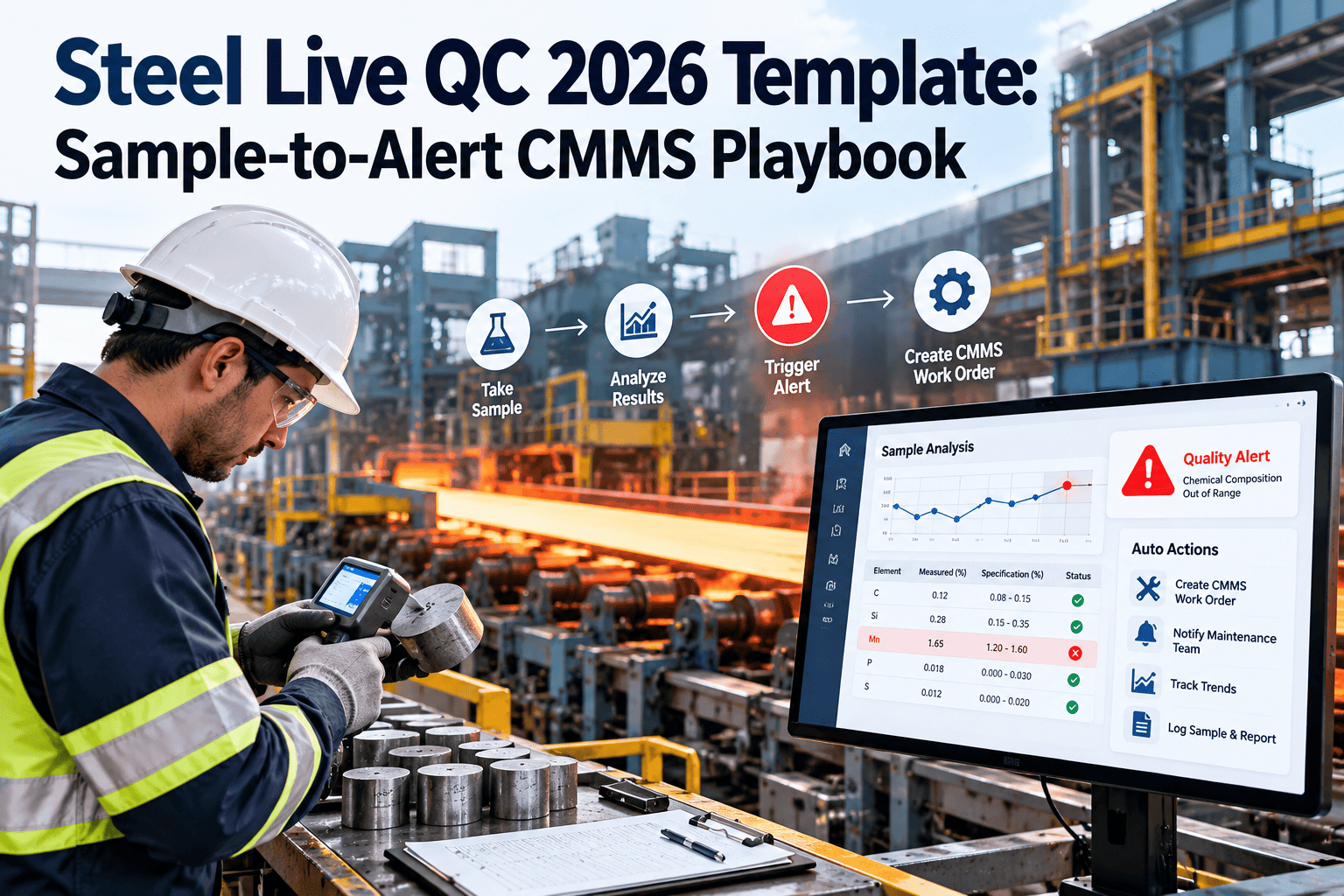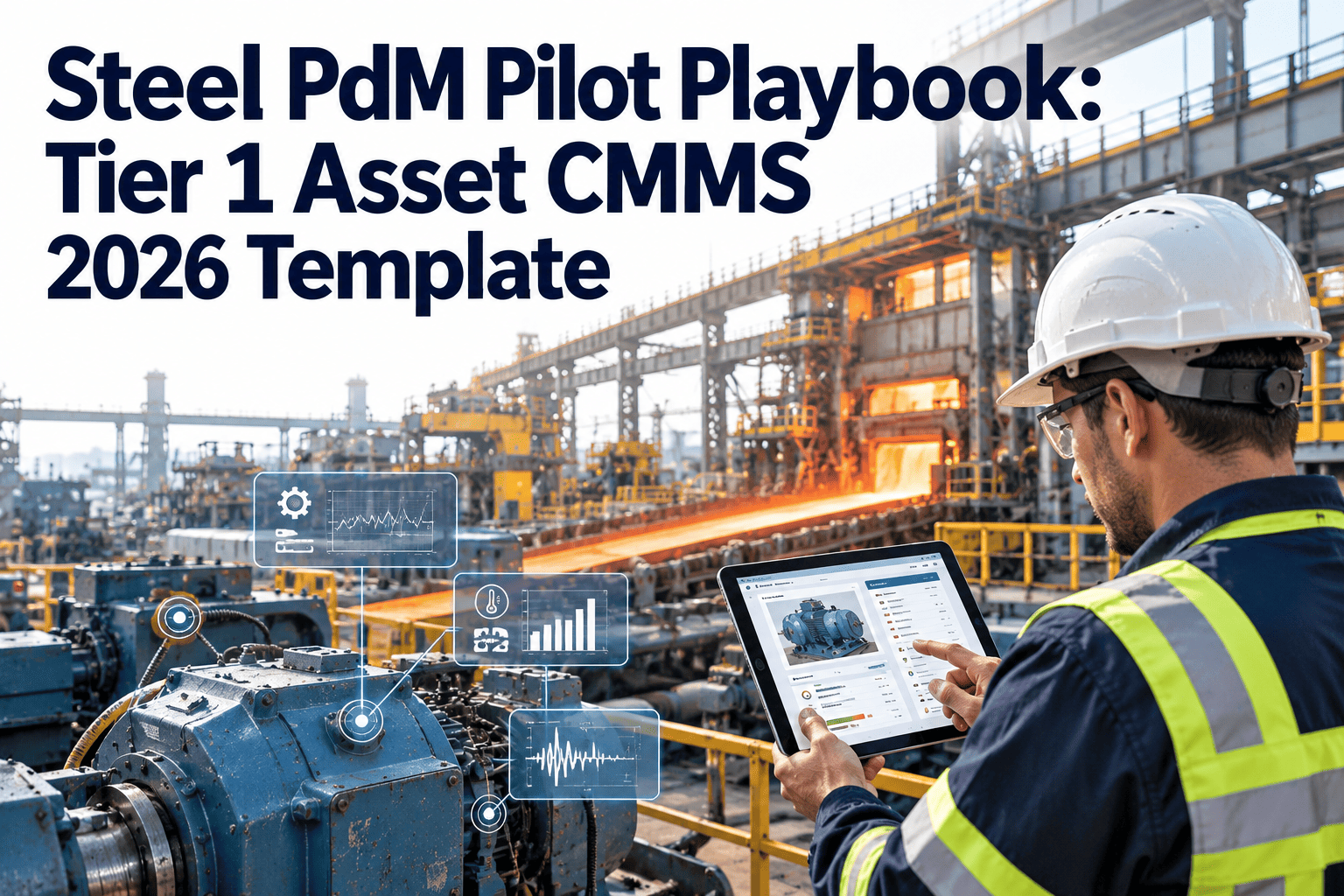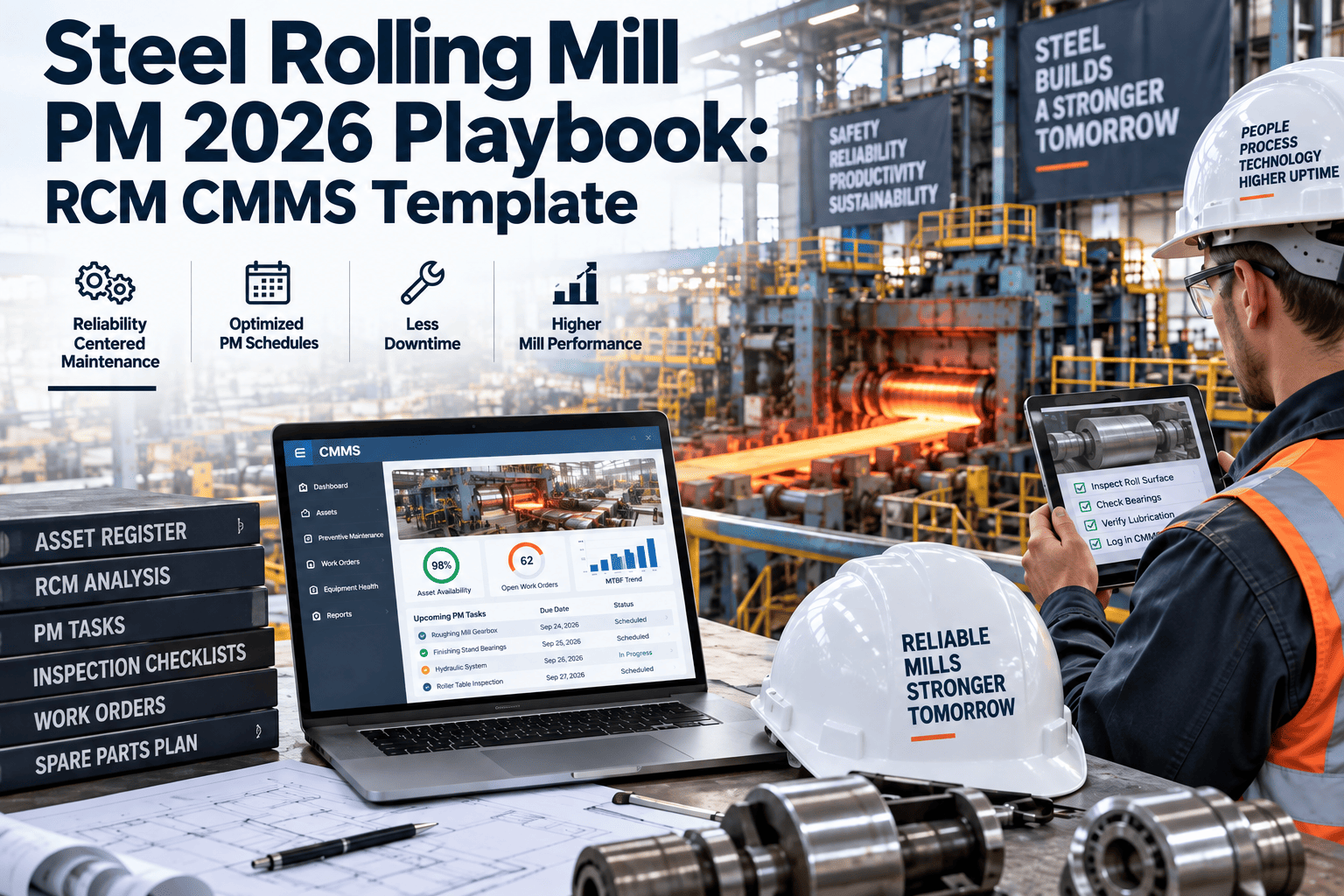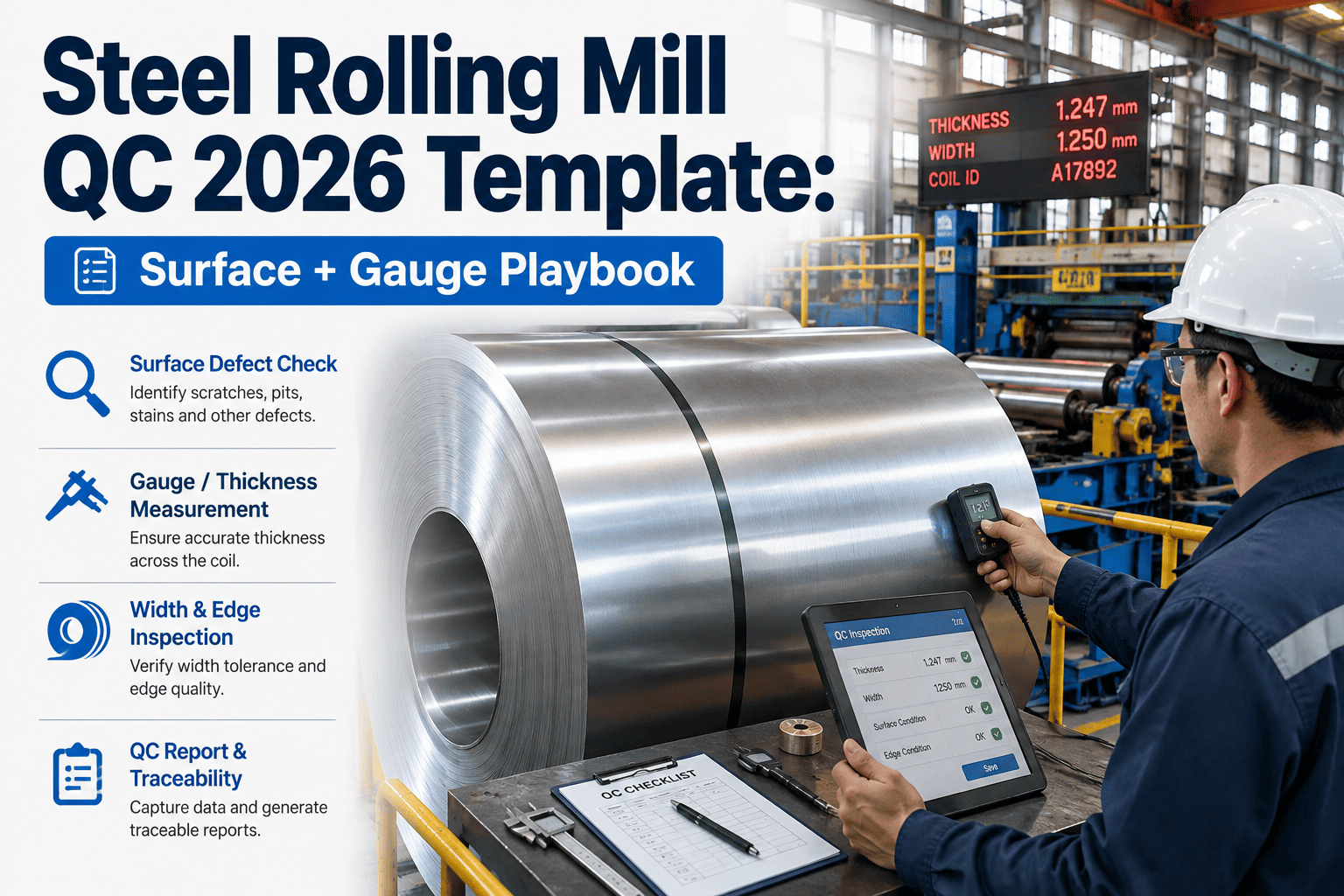
A coil that leaves a finishing line with coating weight variation, roll marks, or stretcher strain does not just fail inspection. It carries the cost of every upstream process and returns as a claim, a downgrade, or a re-run. Continuous galvanizing lines, continuous annealing lines, and temper mills share one trait: small mechanical drift turns into surface and property defects quickly. This 2026 template sets out 30 critical preventive maintenance tasks across CGL, CAL, and temper mill equipment. Teams that schedule them in a preventive maintenance platform keep the playbook running on every shift.
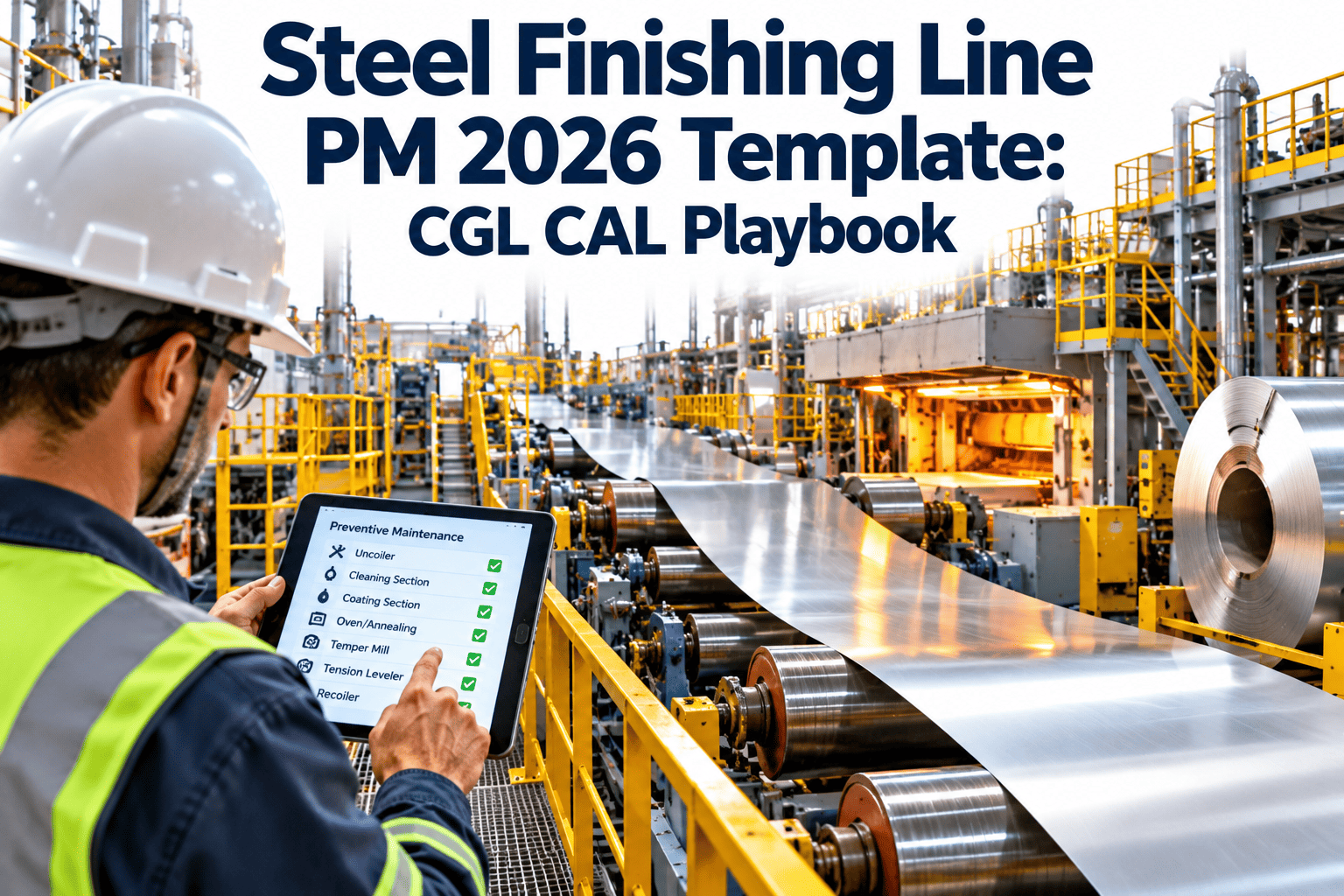
Steel Finishing Line PM 2026 Template: CGL and CAL Playbook
One template for the lines where strip quality is made or lost: entry, cleaning, furnace, coating or cooling, temper mill, and exit.
Three Lines, Three Different Ways to Lose a Coil
Each finishing asset fails differently, so one generic PM plan will not cover all three.
| Line | What It Does | Critical Assets | Typical Failure Effect |
|---|---|---|---|
| CGL | Cleans, anneals, and hot-dip coats strip with zinc | Sink and stabilizer rolls, air knives, zinc pot, furnace rolls | Coating weight variation, dross defects, strip marks |
| CAL | Heats, soaks, and cools strip under protective atmosphere | Radiant tubes, jet cooling fans, furnace rolls, seal rolls | Property scatter, strip wander, furnace rolls marking surface |
| Temper mill | Light cold reduction for flatness, surface texture, and yield behaviour | Work rolls, backup rolls, bending, elongation control | Stretcher strains, flatness defects, texture inconsistency |
Where Finishing Line Downtime Starts
Most stoppages begin with a small degradation that standard rounds do not measure.
- Roll surface pickupFurnace and deflector rolls build deposits that print onto strip until a roll change.
- Atmosphere driftA creeping dew point or analyser error affects surface quality before any alarm trips.
- Hydraulic and steering faultsSlow response in strip steering shows up as edge damage and strip breaks.
- Welder inconsistencyWeak welds at coil joins cause breaks that stop the line and risk the furnace.
- Deferred roll historyRoll hours and defects are not linked, so replacement decisions are made by feel.
The 30-Task Finishing Line PM Template
Each task carries an interval tag: S for every shift, W for weekly, M for monthly, Q for quarterly, and O for planned outage.
Entry and Exit Sections
- S01. Check entry welder trimmer knives, electrodes, and clamps before the first coil, and review weld records for repeat breaks.
- W02. Inspect looper or accumulator carriage rails, rope or chain tension, and drive brakes.
- M03. Check uncoiler mandrel expansion, hydraulic cylinders, and coil car alignment for leaks and wear.
- W04. Inspect exit shear blades, blade clearance, and actuators for cut quality and response.
- W05. Inspect tension reel mandrel, wrapper, and coil handling for wear that causes telescoping or edge damage.
Continuous Galvanizing Line (CGL)
- S06. Confirm zinc pot temperature, pot level, and inductor operation, logging every deviation.
- W07. Inspect sink roll and stabilizer roll bearings, sleeves, and arms for wear and groove condition.
- S08. Clean and check air knife lips, gap, and positioning, and replace damaged lips to protect coating uniformity.
- W09. Inspect snout and dross removal equipment, and record dross build-up trends by week.
- M10. Check furnace roll surface and crown for pickup, nodules, and uneven wear.
- W11. Verify atmosphere analysers and dew point sensors against reference, within site safety procedures.
- M12. Inspect radiant tubes, burners or elements, and seals for leaks and hot spots.
- M13. Check galvannealing furnace sections and calibrate strip temperature pyrometers.
- W14. Check cooling fan vibration, bearings, and damper actuators in the post-coating cooling section.
Continuous Annealing Line (CAL)
- W15. Verify heating and soaking zone thermocouples and controllers, and log any drift.
- M16. Trend vibration on jet cooling fan impellers, bearings, and motors.
- W17. Inspect furnace seal rolls and bridle roll lagging for wear and slip.
- M18. Check overaging section roll bearings, drives, and alignment.
- S19. Verify strip steering sensors, hydraulic actuators, and steering rolls for centring response.
- W20. Test nitrogen purge, hydrogen detection, and interlocks per site procedure.
- Q21. Inspect cleaning section brush rolls, electrodes, rinse, and dryer, since strip cleanliness affects furnace entry.
- O22. Review furnace roll running hours and condition against the outage plan.
Temper Mill
- S23. Inspect work roll surface and texture at each roll change, and link roll history to coil defects.
- M24. Inspect backup roll and chock bearings, mill housing, and hydraulic cylinders for leakage.
- W25. Calibrate elongation measurement and load cells to protect property consistency.
- W26. Check roll bending and force control servo valves and filters.
- S27. Check wet temper fluid nozzles, concentration, and filtration, or dry temper dust extraction.
- M28. Check bridle and deflector roll bearings and lagging for slip and marking.
- M29. Inspect tension leveler bending and backup rolls for wear and marking, where fitted.
- Q30. Clean and verify surface inspection cameras and lighting against known defect references.
The PM Interval Ladder
From Coil Defect to Maintenance Cause
| Defect | Maintenance Suspects | PM Task |
|---|---|---|
| Coating weight variation | Air knife lips, gap, pressure | 08, 09 |
| Repeating roll marks | Furnace, bridle, or deflector rolls | 10, 17, 28 |
| Strip wander or edge damage | Steering sensors, hydraulics, mandrels | 05, 19 |
| Property scatter | Zone temperature drift, cooling fans | 15, 16 |
| Stretcher strain or flatness | Temper mill elongation, bending, rolls | 23, 25, 26 |
| Weld breaks | Welder knives, electrodes, clamps | 01 |
Run the Finishing Line Playbook on Every Shift
Oxmaint schedules each PM task by line and section, so shift checks and outage jobs do not live in separate documents.
Planning the Outage Around the Template
Before
- Review roll hours and defect history
- Reserve spare rolls, sleeves, and bearings
- Raise work orders with parts and permits
During
- Log as-found condition for each asset
- Complete tasks in sequence by section
- Record every change in the work order
After
- Verify restart readings and calibration
- Close work orders with findings
- Update intervals using as-found data
Running the Playbook in Oxmaint
The Oxmaint CMMS lets one template cover three lines without losing the detail of each.
Build the asset hierarchy
Group assets by line, section, and component so roll and fan history stays attached.Load PM templates
The 30 tasks become recurring work orders with shift, weekly, monthly, and outage frequencies.Capture readings on mobile
Technicians record vibration, temperature, and gap measurements with photos at the asset.Track corrective work
Failed checks raise corrective work orders, with parts drawn from inventory.Review reports
Dashboards show overdue PM, repeat failures, and downtime by line.Finishing Line KPIs Worth Tracking
| KPI | Measure | Review |
|---|---|---|
| PM compliance | PM tasks completed on time divided by tasks scheduled | Weekly |
| Unplanned downtime | Unplanned stoppage hours by line | Weekly |
| Strip break frequency | Breaks per period, split by cause | Monthly |
| Roll life | Tonnage or running hours per roll before change | Per roll change |
| Repeat failures | Same asset and failure mode within 90 days | Monthly |
| Outage scope completion | Planned outage work orders closed on time | Per outage |
Frequently Asked Questions
Which finishing line assets deserve the shortest PM intervals?
Items that touch strip every shift: welder components, air knives, steering systems, and roll surfaces.
Can one PM template cover both CGL and CAL?
Share the entry, exit, and furnace tasks, but keep zinc pot and temper mill tasks separate.
How should roll changes be recorded?
Log roll ID, running hours, and surface condition in the work order. Oxmaint keeps that history on the asset.
Should intervals be time-based or tonnage-based?
Use tonnage or running hours for wear items such as rolls, and calendar intervals for inspections.
Can I see this template in a live account?
Yes. Schedule a walkthrough to see PM routes and work orders for a finishing line.
Keep Every Coil Within Spec, Shift After Shift
Put the CGL, CAL, and temper mill PM playbook into one system your whole maintenance team can follow.