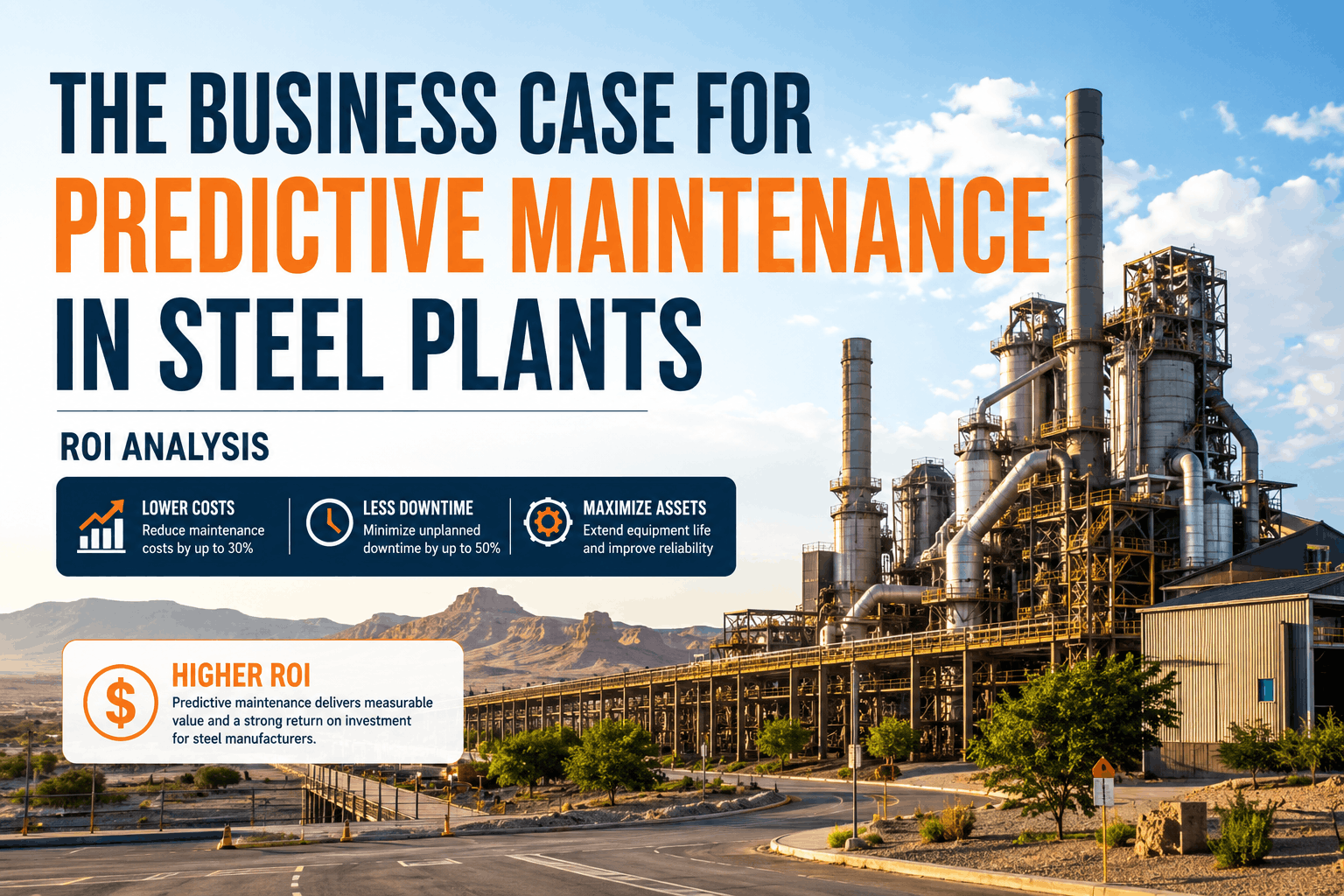
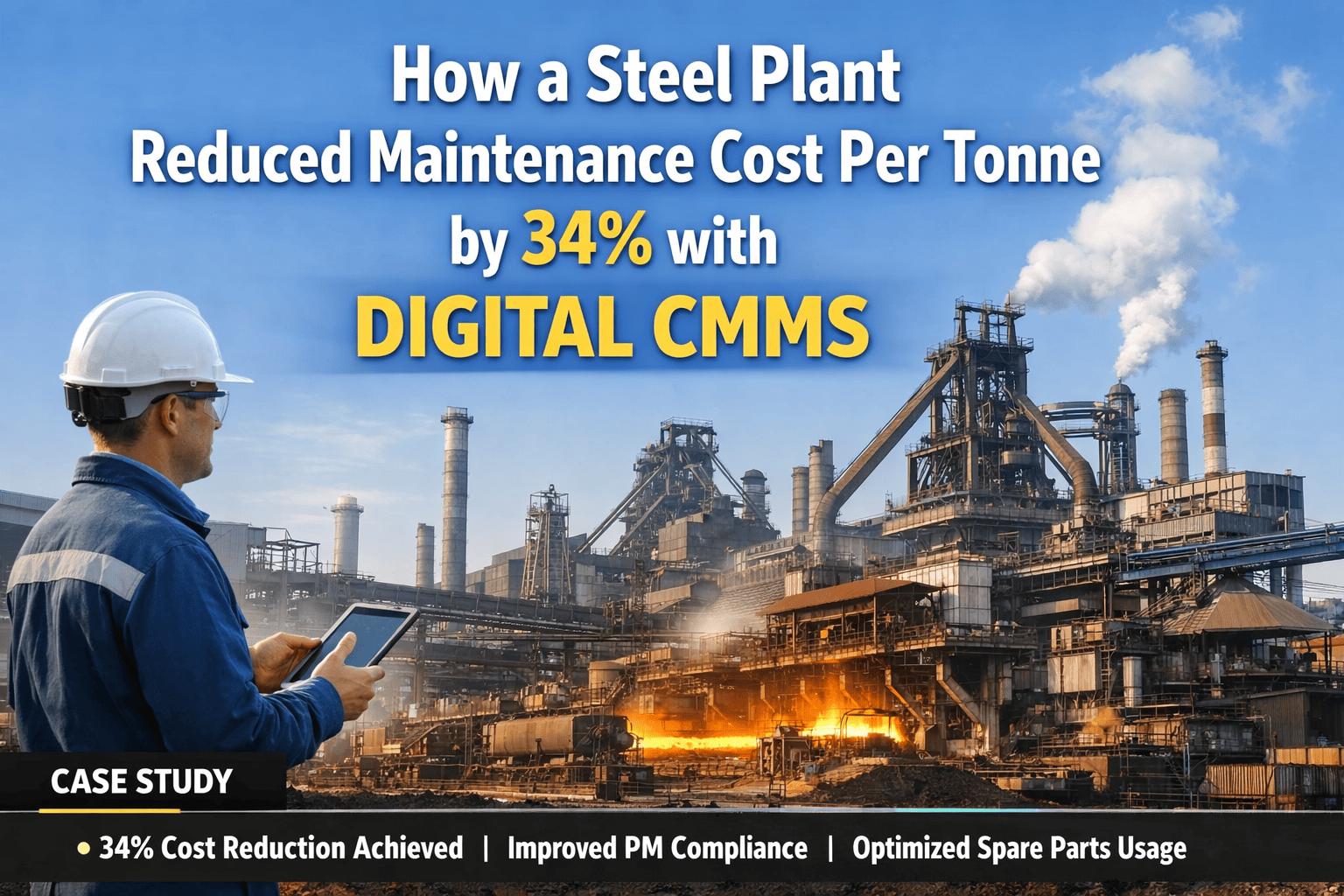
A single unplanned blast furnace outage costs between $2 million and $5 million when you account for lost production at current slab prices, emergency repair at weekend rates, raw material waste in the casthouse, and the customer penalty clauses on order commitments that cannot be fulfilled. One event. Against a full-year Oxmaint license at a facility that size, the math is not close. The challenge for most maintenance directors is not understanding that a CMMS pays for itself — it is translating that understanding into a number that passes a capital appropriation review. This guide provides the framework to do exactly that. Start Oxmaint free and access the ROI tracking dashboard from day one.
Documented average year-one return
8.4×
ROI on CMMS investment at integrated steel facilities — McKinsey / AIST benchmark composite
Breakeven point
4–6 mo
Typical payback period from first prevented major failure event
Planned ratio improvement
+31 pts
Average increase in planned maintenance ratio within 18 months of structured CMMS deployment
Annual savings range
$1.5–6M
Documented annual maintenance cost reduction at 1–4 MTPA steel facilities using Oxmaint
The Four Saving Categories: Where Steel Plant ROI Actually Comes From
Most CMMS business cases in steel plants get rejected not because the numbers are wrong, but because they are not specific enough. "Reduced downtime" is not a number. "Preventing 2 unplanned stops per year on the continuous caster at $180,000 per stop" is a number. The following four categories are the structured framework for building a CMMS business case that survives capital review scrutiny — each with the calculation method and the data inputs you need to quantify it for your facility. Book a session to build your facility-specific calculation with Oxmaint's steel team.
01
Downtime Cost Reduction
$800K – $3.5M / year
Largest ROI driver for most facilities
Unplanned downtime in steel plants is uniquely expensive because the asset that fails does not stop in isolation — it stops everything upstream and downstream that depends on it. A continuous caster stop does not just cost the caster's output; it costs the BOF shop that has nowhere to send liquid steel, the hot strip mill that has no slabs to process, and the order book commitments that cannot be met. CMMS reduces unplanned downtime through two mechanisms: PM compliance that prevents failures before they occur, and condition monitoring that provides advance warning to plan maintenance during scheduled windows rather than emergency windows.
Calculation Method
(Current annual unplanned events × average event cost) × 40–60% prevention rate = Year 1 saving
Prevention rate increases to 60–70% by year 2 as PM compliance improves and condition monitoring matures. Use your actual downtime cost per hour × average duration per event for accuracy.
02
Reactive Repair Premium Elimination
$200K – $600K / year
Fastest-returning category — immediate in year 1
Emergency repairs cost 3–5 times more than the same repair performed as planned maintenance. The premium comes from overtime labor (1.5–2× standard rate), emergency procurement (3–5× standard price plus courier freight), expedited contractor mobilization, and ancillary damage caused by running a failing component to failure rather than replacing it at scheduled inspection. A steel plant spending $1.2M annually on planned maintenance labor is typically spending an additional $340,000–$500,000 in emergency repair premiums on top of that. Shifting 20–25% of reactive work to planned status — achievable in the first 90 days of CMMS deployment — eliminates most of this premium.
Conservative inputs: identify your current planned/reactive ratio from work order history. Every 10-point improvement in planned ratio reduces repair premium cost proportionally.
Steel plant MRO inventories consistently show 25–35% of total value in zero-movement parts — components purchased for assets that have been decommissioned, superseded specifications never cleared from the active register, and over-stocked commodity items from conservative reorder quantities. CMMS deployment surfaces this through parts-to-asset linkage: when an asset is decommissioned in Oxmaint, its associated parts are automatically flagged for review. Additionally, CMMS-driven demand-based reorder points prevent the over-stocking that occurs when reorder quantities are set without consumption data. The year-one benefit is typically a one-time capital release from zero-movement stock disposal plus reduced forward carrying cost from right-sized reorder quantities.
Calculation Method
Total MRO inventory value × 25% zero-movement rate × 60% recoverable = one-time saving. Plus carrying cost × 30% right-sizing reduction = annual saving.
Carrying cost of MRO inventory in steel plants typically runs 18–25% of inventory value annually (capital cost, storage, obsolescence, insurance).
04
Labour Efficiency Gains
$120K – $400K / year
Equivalent to adding 1–2 FTE without headcount
Industry data consistently shows that maintenance technicians in reactive-dominant operations spend only 24–28% of their shift on actual repair work. The remaining 72–76% is split between waiting for parts, searching for job information, travelling to collect tools, waiting for permits, completing paper records, and looking for supervisors to get approval. Oxmaint mobile eliminates most of these delays: parts are kitted before the job, work instructions are on the device, permits are processed digitally, and records are captured in the field. Shifting wrench time from 26% to 48% on a team of 40 maintenance technicians at average steel industry labor cost is equivalent to adding 9 productive FTE-hours per shift without any headcount change.
Calculation Method
Maintenance headcount × shift hours × (target wrench time% − current wrench time%) × fully loaded hourly rate = annual productive hour gain value
Current wrench time baseline: typically 24–28% without digital tools. Target with Oxmaint mobile: 45–55% within 12 months of full deployment.
Build your facility-specific ROI calculation in Oxmaint's business case template. Input your actual downtime cost, repair spend, inventory value, and headcount — the platform calculates projected year-1, year-2, and year-3 returns automatically.
ROI by Facility Type: Expected Returns at Your Scale
The following benchmarks are drawn from documented Oxmaint deployments and AIST member facility data. Use the row that matches your facility type as the input range for your business case — the actual figure within the range depends on your current planned maintenance ratio, existing asset data quality, and implementation scope. Sign in to Oxmaint to access the ROI tracking dashboard and measure your actual returns from deployment day one.
EAF Mini-Mill (0.5–1.5 MTPA)EAF + Caster + Rolling
$400K – $900K
$120K – $260K
$80K – $180K
$60K – $140K
$660K – $1.48M
Rolling Operation (standalone)Hot strip or cold mill only
$200K – $600K
$80K – $180K
$50K – $140K
$50K – $120K
$380K – $1.04M
Specialty Steel (stainless / alloy)Higher value product, tighter quality tolerance
$300K – $800K
$100K – $240K
$60K – $160K
$60K – $140K
$520K – $1.34M
Swipe horizontally on smaller screens to view all columns
Building the Payback Timeline for Capital Appropriation
Capital appropriation committees at steel companies require a payback timeline, not just an annual return figure. The following 30/60/90-day milestone structure is how Oxmaint structures business case timelines — with measurable deliverables at each stage that can be verified against actual data rather than projected assumptions. Book a session to build your facility-specific payback model before your next capex cycle.
Days 1–30
First savings visible — baseline established
Asset register built for top-200 critical assets. PM schedules digitized and running. First digital work orders identify 2–4 PMs that have been missed or deferred without documentation — each representing a risk that was not visible before. Baseline KPIs recorded: planned ratio, PM compliance rate, average reactive response time. The baseline itself is typically a shock — most facilities discover their actual planned ratio is 15–20 points lower than management estimates.
Measurable output: baseline KPI report showing actual planned ratio vs. management assumption
Days 31–60
Repair premium savings begin — first condition alerts
Condition monitoring active on first sensor-linked assets. First condition-based work orders generated proactively — planned in next scheduled window rather than reactive. Emergency procurement count begins to fall as PM schedule compliance improves parts availability forecasting. First month-over-month comparison of reactive work order count vs. baseline available for business case evidence.
Measurable output: reduction in reactive work order count, first planned maintenance ratio improvement report
Days 61–90
Full downtime cost visibility — first major event prevented
Four-category downtime cost calculation active — each downtime event now has a documented total cost (production, energy, quality, penalty). Zero-movement inventory report generated — first capital release from identified slow-moving stock. Typically by day 90, at least one condition-based alert has identified a developing failure that would have become an emergency event — this single prevented event is usually sufficient to close the payback case for the full year's CMMS cost.
Measurable output: total downtime cost report, inventory zero-movement analysis, first documented prevented failure event
Planned maintenance ratio crosses 75% and continues rising. MTBF data accumulating on critical assets — enabling RCM task interval optimization (typically 30–40% of existing PMs can be extended or eliminated as data validates). Energy efficiency gains from condition-maintained compressors and drives. Contractor cost governance through work order documentation of scope versus actual. Full-year audit of CMMS savings versus CMMS cost provides the documented ROI for renewal and expansion business case.
Measurable output: first annual ROI report — actual savings vs. platform cost, facility vs. global benchmark KPIs
Frequently Asked Questions
How do I calculate downtime cost per hour for a steel plant business case?
Downtime cost per hour has four components: (1) lost production revenue — tonnage per hour × current selling price per tonne, adjusted for current order book fill rate; (2) stranded fixed costs — the labor, energy, and overhead still running during the stop; (3) quality and scrap costs — material wasted at sequence start and restart; (4) contractual penalties — late delivery premiums on committed orders. For a 2 MTPA blast furnace and BOF shop running at current slab prices, this typically calculates to $80,000–$150,000 per hour for a full production stop. Document this calculation explicitly in the business case — it is the number that makes the CMMS investment look obvious in comparison. Start Oxmaint free to configure your downtime cost parameters and begin tracking actual event costs from deployment.
What assumptions should I use for "prevention rate" when building the downtime saving?
Use 40% prevention rate for year 1 and 60% for year 2 as conservative inputs for capital review. These figures are deliberately conservative relative to documented outcomes — Oxmaint's steel plant deployments show 50–70% reduction in unplanned failures on PM-covered Tier A and B assets within 18 months. Reviewers are more likely to approve a conservative case that gets beaten than an optimistic case that misses. The 40% year-1 figure also gives you a comfortable margin — most facilities beat it significantly, which then builds internal credibility for the next phase of the program. Book a session to get facility-type-specific benchmark prevention rates from our steel plant dataset.
How does Oxmaint's ROI tracking dashboard work, and what does it actually measure?
Oxmaint's ROI dashboard tracks four running totals against your configured baseline: (1) avoided downtime cost — calculated each time a condition-based work order prevents a failure vs. what the same event would have cost reactively; (2) repair premium savings — the difference between planned and reactive repair cost for each work order pair; (3) emergency procurement reduction — tracked from purchase order history comparing emergency vs. standard order premiums; (4) labor efficiency gain — calculated from work order open-to-completion time trends. The dashboard updates daily and provides the cumulative savings figure that makes the annual ROI case straightforward to document for management reporting.
Is a formal business case required to start with Oxmaint, or can we pilot first?
Oxmaint's free plan allows you to run a full pilot — asset register, PM scheduling, work orders, and mobile — without a formal business case or capital approval. Deploy on your top-50 critical assets for 60 days and use the first two months of data to build the business case with actual numbers rather than projections. In practice, this approach produces a much stronger capital submission because it replaces assumed prevention rates and assumed downtime costs with documented events, actual reactive-to-planned ratio improvements, and one or two specific prevented failures with their exact costs calculated. The business case almost writes itself. Start your free pilot in Oxmaint today — no credit card, no fixed-term commitment.
Your CMMS Business Case Starts With Real Data, Not Projections
Start Oxmaint free on your top critical assets. Build 60 days of actual PM compliance, downtime event, and reactive repair data. Use those numbers — not benchmarks — to make the ROI case for full deployment.