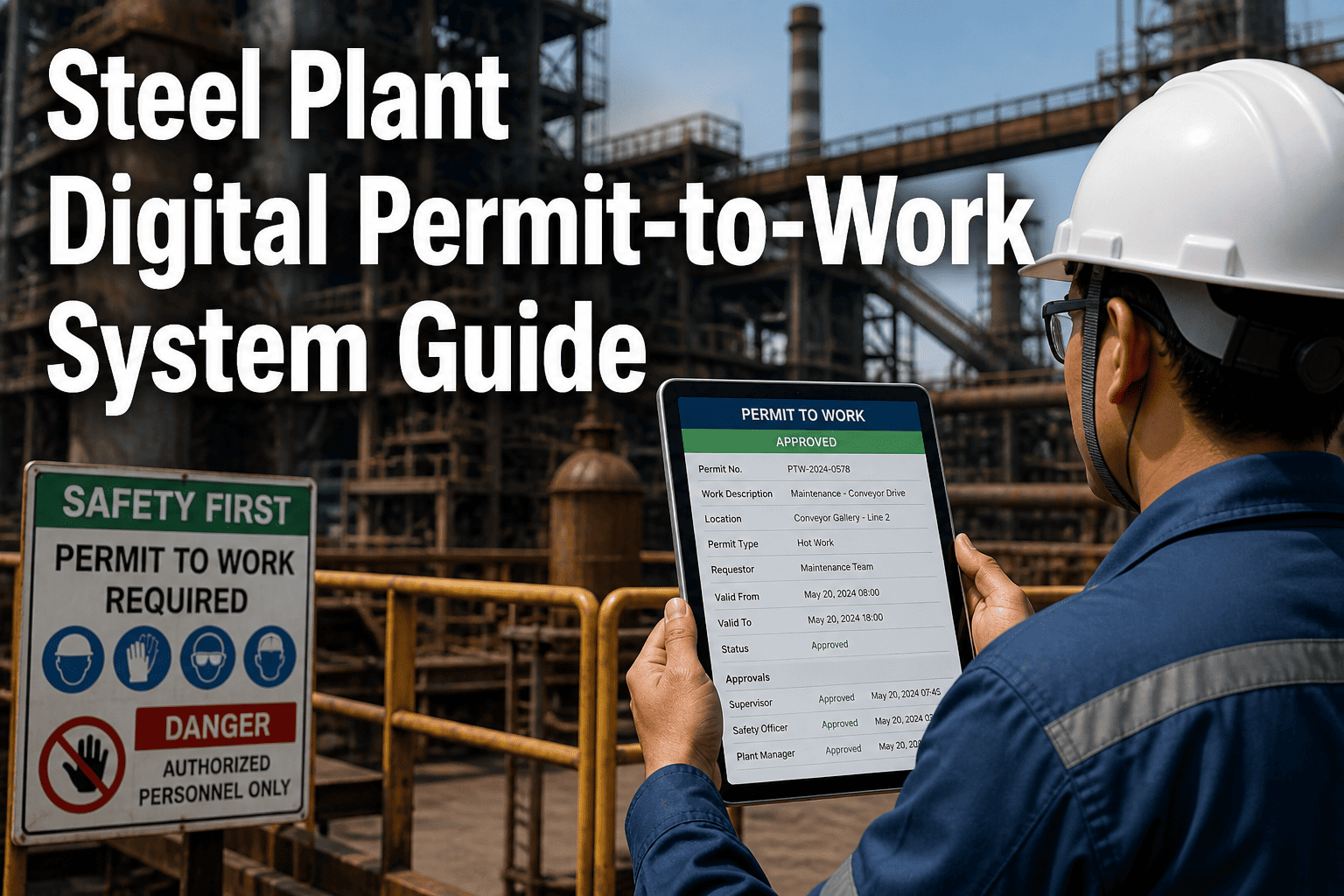
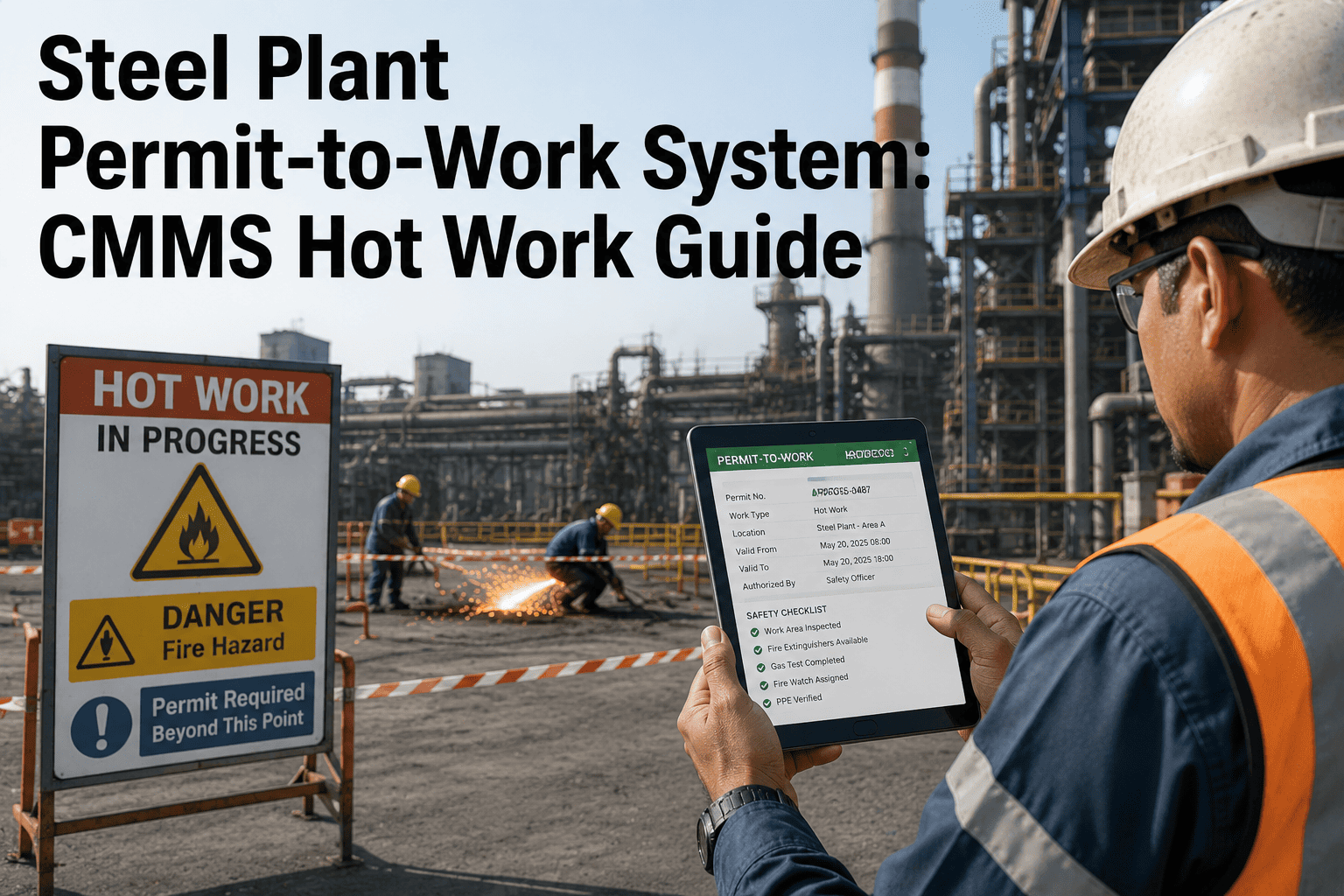
Steel plants perform 50 or more hot work, confined space, and LOTO tasks daily — in environments where a missed authorization step can kill a worker. Yet most facilities still issue permits on paper forms, clipboard sign-offs, and permit logbooks at the gate. In 2023, LOTO violations alone generated 2,554 OSHA citations industry-wide. A single willful violation now carries penalties up to $170,735 — and fatality cases bring criminal liability. This checklist covers every stage of a steel plant digital permit-to-work (PTW) implementation: from the permit types you must manage, to the 7-stage digital workflow, to the compliance evidence your auditors will demand. Start managing permits digitally in Oxmaint or book a walkthrough with our safety compliance team.
Permit Types Reference
12 Permit Types a Steel Plant Must Manage
H
Hot Work
OSHA 1910.252 · NFPA 51B
C
Confined Space Entry
OSHA 1910.146
L
LOTO / Energy Isolation
OSHA 1910.147
H
Work at Height
OSHA 1926.502
E
Electrical Work
NFPA 70E
CR
Crane & Lifting
OSHA 1910.179
V
Vessel / Tank Entry
PSM 1910.119
EX
Excavation
OSHA 1926.651
CH
Chemical Handling
HazCom 1910.1200
R
Radiation Work
NRC / 10 CFR 20
SC
Scaffolding & Access
OSHA 1926.451
CO
Contractor Work
PSM 1910.119(h)
Digital PTW Implementation Checklist
The 7-Stage Digital Permit Lifecycle — Checklist
Requester selects permit type from digital library — no free-text permit creation
Asset linked from CMMS work order — permit cannot exist without work order reference
Hazard checklist auto-populated based on permit type and equipment class
Adjacent zone conflicts checked automatically — conflicting permits flagged before submission
Risk score calculated from hazard inputs — high-risk automatically escalates to senior PAI
Job Safety Analysis (JSA) completed within permit — linked to permit record permanently
PPE requirements auto-specified based on hazard type and area classification
Atmospheric test type mandated for hot work / confined space — test cannot be skipped
Emergency evacuation route and assembly point confirmed and recorded
All energy sources listed per asset record — electrical, hydraulic, pneumatic, thermal, gravity
Photo upload required at each isolation point — no photo confirmation = permit cannot advance
Group lockout tracked — every technician's personal lock recorded; permit cannot clear until all locks removed
Verification step mandatory — pressure gauges, voltage meters, thermal readings documented
LOTO work order in CMMS linked to PTW — hot work permit blocked until isolation confirmed complete
Permit Authorizing Individual (PAI) reviews all completed stages digitally with timestamped sign-off
Concurrent permits in adjacent zones visible to PAI at authorization — simultaneous operations reviewed
Permit time window set at authorization — system blocks work after expiry; no manual extension without re-approval
Authorized workers listed by name — only listed workers may execute the permitted task
Fire watch check-ins every 15 minutes (hot work) — no response triggers supervisor alert automatically
Shift handover requires new permit verification — incoming crew cannot inherit unverified permit status
Permit status visible on plant operations dashboard — real-time view of all active, expired, pending permits
Condition change during work triggers permit suspension workflow — work halts until re-assessment complete
Closeout photo uploaded confirming area restored — no debris, no tools left in isolation zone
All personal locks removed and confirmed in system — permit cannot close with any lock still recorded as active
Re-energization sequence documented — energy restored in reverse isolation order with digital sign-off
All affected workers notified of re-energization via mobile alert — no verbal-only notification
Immutable audit record generated — no field editable after sign-off at any stage
All photo evidence, atmospheric test results, and approval chains retained permanently
OSHA-required retention met: hot work monthly records for 3 months, PSM permits per 1910.119(k)
Permit retrievable in under 60 seconds by permit number, asset, date, or worker name during audit
Every Steel Plant Permit. Digitally Managed. Audit-Ready.
Oxmaint's digital PTW module enforces the complete 7-stage permit lifecycle — LOTO integration, conflict detection, photo verification, and immutable audit trails — all linked to your CMMS work orders. No paper. No compliance gaps.
Paper vs Digital Comparison
What Paper PTW Cannot Do — and What Digital PTW Delivers
| Capability |
Paper PTW |
Digital PTW |
| Conflict detection between adjacent permits |
Manual check only |
Automatic real-time flag |
| Permit expiry enforcement |
No enforcement — work continues |
Automatic block on expiry |
| LOTO status verification |
Assumed complete |
Photo-verified, GPS-confirmed |
| Shift handover re-verification |
Verbal handoff only |
Mandatory digital re-verification |
| Audit record retrieval |
Manual binder search — hours |
Searchable in under 60 seconds |
| Concurrent permit visibility |
No cross-zone view |
Plant-wide dashboard |
| CMMS work order linkage |
Disconnected system |
Permit linked to work order — work blocked until permit active |
Expert Review
What Safety Managers Say About Digital PTW in Heavy Industry
"The paper permit system failed us every single shift change. The incoming crew inherited permit states they hadn't verified personally. That assumption-based handover is where people get hurt. Digital re-verification at every shift handover eliminated that gap — it's the most important feature in the system."
Safety Manager
Integrated Steel Plant — Post-digital PTW rollout review
"Our OSHA audit prep went from two days of binder assembly to a 20-minute permit report export. More importantly, we closed 11 compliance gaps we didn't know existed — including two hot work permits that had been running past expiry for months with no system enforcement."
EHS Director
Steel Manufacturing, Southeast Asia — 6 months post-implementation
Frequently Asked Questions
Digital PTW in Steel Plants — Common Questions
Close Every PTW Compliance Gap Before Your Next Inspection
Oxmaint's digital permit-to-work module enforces every stage of the safety authorization lifecycle — conflict detection, LOTO verification, shift handover re-check, and immutable audit trails. Built specifically for steel plants, refineries, and heavy industry.