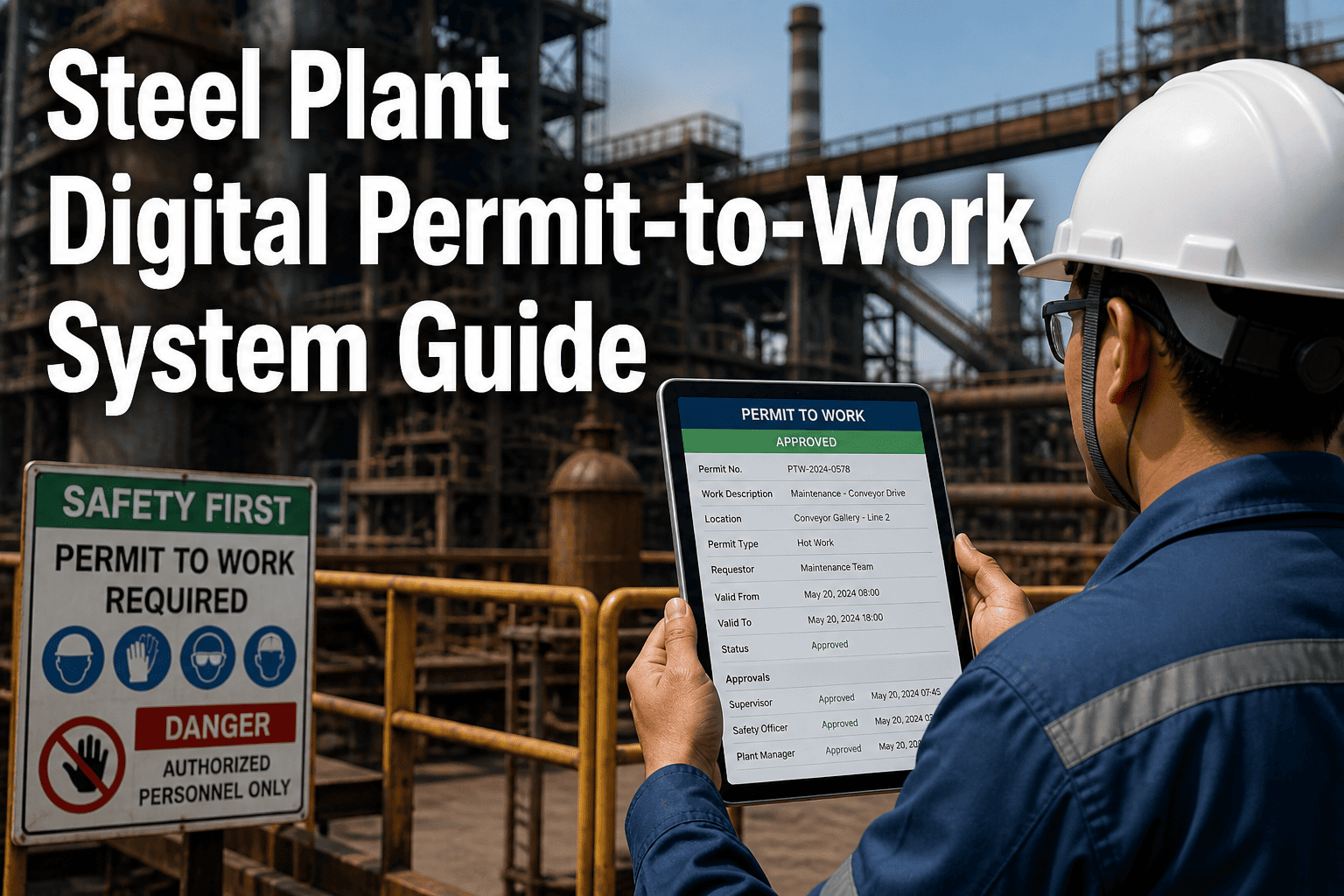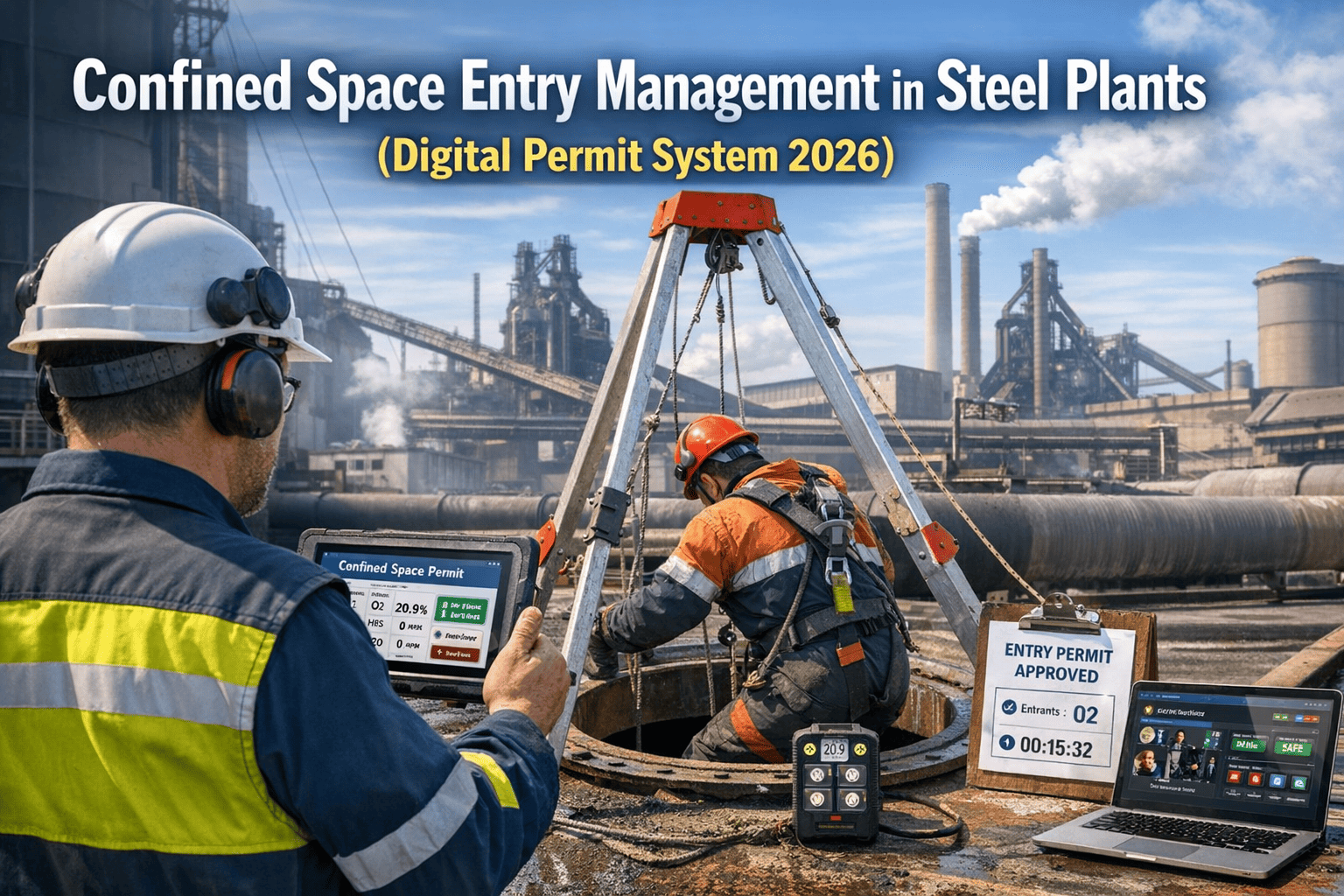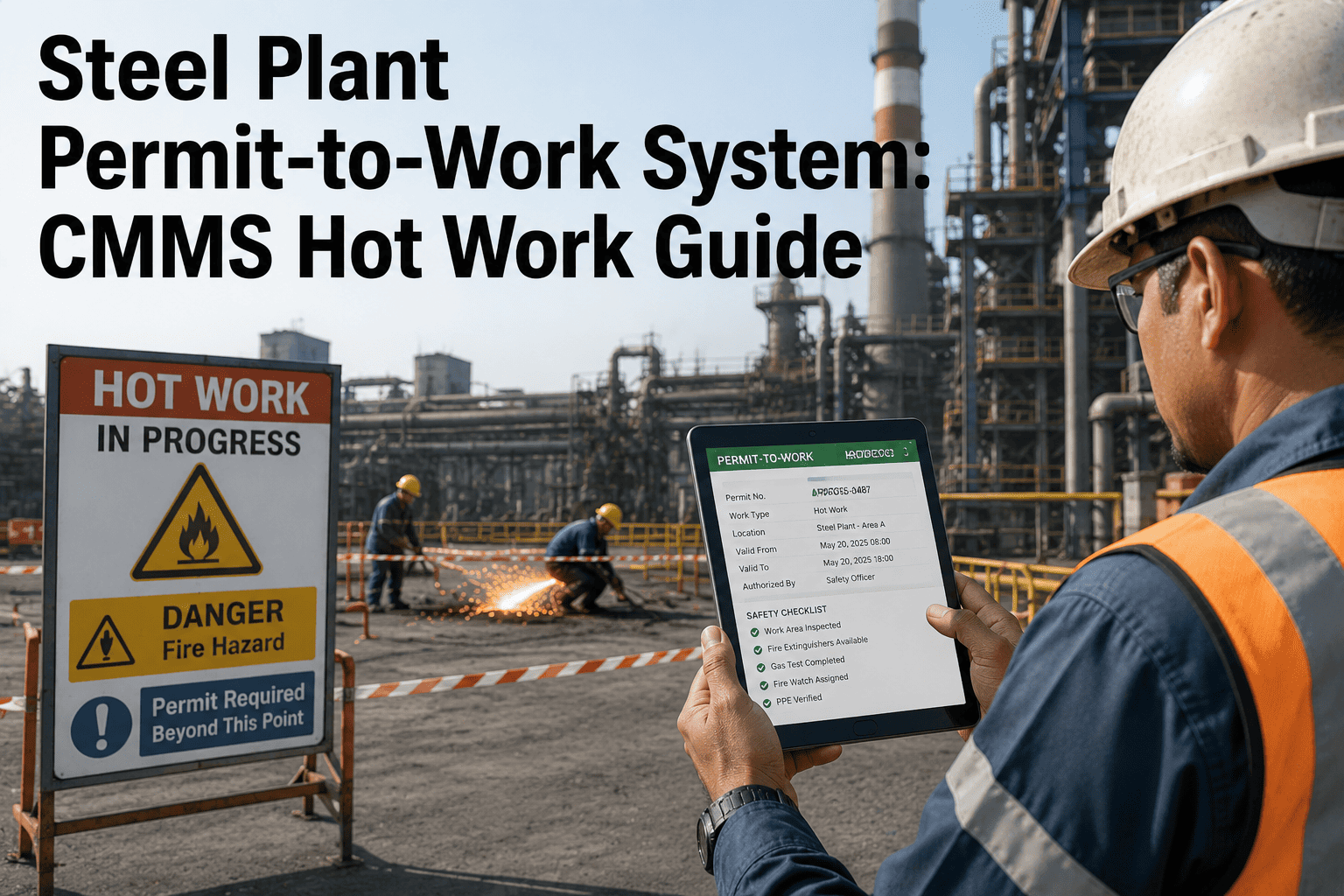
A steel plant permit-to-work system is the formal, documented control procedure that authorizes specific maintenance tasks — hot work near furnaces, confined space entry in casters, and LOTO on rolling mill drives — only after safety conditions are verified and isolated. In integrated and mini-mill environments, a CMMS-based steel PTW system replaces paper permits with digital workflows that tie each permit directly to a work order, ensuring that no hazardous job begins without gas-test clearance, isolation confirmation, and authorized sign-off. This guide covers how modern permit-to-work CMMS software for steel plants structures permit workflow design, LOTO integration, gas testing tracking, and standby-personnel management to close the gap between safety permits and maintenance execution. Ready to digitize your mill's permit system? Start Free Trial and see the workflow on your own assets.
Is a paper permit really protecting your people near a 1,500°C furnace?
Every year, hot work fires, confined-space fatalities, and energized-work injuries happen in steel plants because a paper permit was signed but never enforced on the floor. A CMMS-based permit-to-work system closes that gap — linking every permit to a live work order with real-time LOTO verification and gas-test tracking.
How a steel plant permit-to-work system digitizes the 8-step permit lifecycle
A robust steel PTW system inside a CMMS enforces an eight-stage permit lifecycle — from request to closure — ensuring no stage can be skipped, back-dated, or approved without the preceding safety check. Each stage is timestamped, geo-tagged to the asset, and tied to the parent work order.
Permit request generated from work order
Technician raises a hot work or confined space permit directly inside the CMMS work order. Asset context, location, and job scope auto-populate — no manual re-entry.
Job hazard analysis and risk assessment
CMMS surfaces asset-specific hazard history — prior fires, gas leaks, energy sources — so the assessor sees what actually happened on that furnace or caster before approving.
LOTO and energy isolation verification
For rolling mill LOTO and electrical isolation, the permit blocks approval until each lockout point is confirmed with a photo and technician ID in the CMMS.
Gas testing and atmospheric monitoring
Confined space maintenance in casters requires O₂, CO, H₂S, and LEL readings. The CMMS logs gas-test results, tester name, and timestamp before the permit can be issued.
Authorized issuer approval with digital signature
Area manager or safety officer reviews all preceding checks on a dashboard and applies a digital signature. Permits auto-expire after a defined shift window if not renewed.
Work execution with standby personnel tracking
Hole-watch and fire-watch personnel are assigned inside the CMMS. The system confirms their presence and logs check-ins at intervals defined by the permit type.
Real-time monitoring and periodic re-testing
For long-duration hot work near a steel furnace, the CMMS triggers mandatory re-test alerts every 2–4 hours and flags any expired gas reading for immediate work stoppage.
Permit closure and isolation removal
On completion, the CMMS verifies that all locks are removed, the area is inspected, and the work order is closed. A full audit trail is archived for compliance.
Hot work, confined space, and LOTO permits — what each requires in a steel plant
Different maintenance tasks carry fundamentally different risks. A CMMS configured for steel safety permits enforces type-specific mandatory fields, isolation lists, and personnel assignments — so a hot work permit near a furnace cannot be approved without fire-watch confirmation, just as a confined space permit in a caster demands gas-test results.
Hot Work Permit — Steel Furnace Area
Welding, cutting, and grinding near furnaces, ladles, or coke batteries. Requires combustibles clearance (10 m radius), fire-watch assignment, and extinguisher verification before approval.
- Mandatory fire-watch during and 30–60 min post-work
- Combustible removal or fire-blanket coverage confirmed
- Hot work CMMS steel permit auto-expires after shift
Confined Space Permit — Caster & Boiler
Entry into caster segments, tundishes, dust collectors, or boiler drums. Demands atmospheric testing (O₂ 19.5–23.5%, LEL <10%), retrieval harness verification, and a dedicated hole-watch outside.
- Continuous or interval gas monitoring logged in CMMS
- Retrieval tripod and lifeline verified before entry
- Hole-watch assigned and logged with contact info
LOTO Permit — Rolling Mill Drives
Lockout/tagout on mill stands, pinch rolls, hydraulic systems, and electrical feeds. The CMMS cross-references the asset's isolation points and blocks work until each lock is confirmed with a photo and ID.
- Each isolation point verified and photo-logged
- Try-out / zero-energy verification recorded
- Lock removal tracked to original technician ID
A 180-asset mini-mill spending $42K/yr on permit delays
Consider a rebar mini-mill running 180 critical assets — EAF, caster, reheat furnace, and rolling stands. Maintenance teams average 14 hot work and confined space permits per week on paper. Each paper permit takes 35–45 minutes to route, gas-test, and get signed, and roughly 1 in 6 permits is returned for missing information — adding 2–3 hours of delay per event. At an average downtime cost of $8,000/hour in a rolling mill, those delays cost the plant roughly $42,000 per year in lost production time alone, before counting the compliance risk of incomplete audit trails. With a CMMS-based steel plant permit system, the same permit is generated from the work order, auto-populated with asset data and isolation lists, and approved on a mobile device in under 10 minutes — cutting permit-related delays by 60–75% and producing a fully auditable digital record for every job.
How OxMaint digitizes steel plant permit-to-work in one CMMS platform
OxMaint is an AI-powered CMMS and EAM platform built for maintenance and reliability teams in heavy industry. For steel plants, it eliminates the gap between paper permits and work orders by embedding permit-to-work controls directly into the maintenance workflow — so safety checks are enforced, not optional.
Permits embedded in work orders
Every hot work or confined space permit is generated from — and linked to — the parent work order. No permit, no work order status change. Outcome: eliminate paper permits entirely and cut permit routing time by 60–75%.
LOTO verification with photo proof
Asset-specific isolation checklists appear on the technician's mobile device. Each lockout point requires a photo and ID confirmation before the permit advances. Outcome: zero bypassed isolations and full audit readiness for rolling mill LOTO.
Gas testing & atmospheric tracking
Log O₂, CO, H₂S, and LEL readings directly in the permit. The system auto-flags out-of-range values and triggers mandatory re-tests. Outcome: prevent confined space incidents with real-time, timestamped gas data tied to the asset.
Standby personnel & audit trail
Assign fire-watch and hole-watch inside the CMMS with check-in intervals. Every action — request, test, approval, closure — is timestamped and archived. Outcome: pass safety audits with a complete, exportable digital trail for every permit.
Paper permit system vs CMMS-based permit-to-work for steel plants
Most mills know paper permits are slow and hard to audit — but the real cost is in what paper cannot do: enforce a check before work starts, surface asset hazard history, or alert a supervisor when a gas test expires. Here is what changes when you move from paper to a CMMS-based steel PTW system.
| Capability | Paper Permit System | CMMS-Based PTW (OxMaint) |
|---|---|---|
| Permit-to-work generation | Manual form, re-entered data, often back-dated | Auto-generated from work order, timestamped, geo-tagged |
| LOTO verification | Checkbox on paper, no photo proof | Photo and ID confirmation at each isolation point |
| Gas testing tracking | Handwritten readings, no alerts on expiry | Digital readings logged, auto-expiry and re-test alerts |
| Standby personnel (fire/hole-watch) | Name written on form, no verification of presence | Assigned in CMMS with periodic check-in logging |
| Permit approval routing | Physical signature chase, 35–45 min average | Mobile digital signature, under 10 min average |
| Audit trail & compliance | File cabinet, incomplete records, hard to retrieve | Full digital archive, exportable, searchable by asset |
| Real-time visibility | None — supervisor calls the floor | Live dashboard of all active and expired permits |
| Permit-to-work enforcement | Process dependent on individual compliance | System blocks work order progression without permit |
See OxMaint enforce your mill's permit-to-work live
Book a 30-minute demo and we'll show you how a hot work permit near a steel furnace flows from work order to closure — with LOTO, gas testing, and fire-watch built in.
Steel plant permit-to-work system: frequently asked questions
What is a permit-to-work system in a steel plant?
A permit-to-work system in a steel plant is a formal, documented procedure that authorizes high-risk maintenance tasks — such as hot work near furnaces, confined space entry in casters, and LOTO on rolling mill drives — only after safety conditions like gas testing, energy isolation, and standby personnel are verified. In a CMMS like OxMaint, the permit is digitally linked to the work order so no job can start or close without every safety check being completed and recorded.
How does a CMMS handle hot work permits near steel furnaces?
A CMMS handles hot work permits by auto-generating the permit from the maintenance work order, requiring combustible clearance verification, fire-watch assignment, and extinguisher confirmation before the permit can be approved. The permit auto-expires at shift end, triggers mandatory re-tests for long-duration jobs, and archives a full digital audit trail. You can Start Free Trial to see the hot work workflow on your own assets.
What are the confined space permit requirements in a steel plant?
Confined space permits in steel plants require atmospheric testing for oxygen (19.5–23.5%), flammable gases (LEL below 10%), and toxic gases like CO and H₂S before entry. A retrieval system, lifeline, and dedicated hole-watch stationed outside must be verified. A CMMS-based steel PTW system logs all gas readings, tester identities, and check-in intervals, and blocks entry until every condition is confirmed.
How is LOTO integrated with a permit-to-work CMMS for rolling mills?
LOTO is integrated by linking each asset's specific isolation points — electrical disconnects, hydraulic valves, pneumatic supplies — to the permit inside the CMMS. Technicians must confirm each lockout point with a photo and their ID on a mobile device before the permit advances to approval. The system tracks lock removal and verifies zero-energy state, ensuring rolling mill LOTO is enforced systemically rather than relying on individual compliance.
Can a steel plant PTW system improve audit compliance and reduce downtime?
Yes — a digital steel plant PTW system improves audit compliance by producing a complete, timestamped, and exportable record for every permit, eliminating the gaps and losses common with paper. It reduces downtime by cutting permit routing time by 60–75% and preventing work stoppages from missing or expired safety checks. To see the compliance dashboard on your permit types, Book a Demo with our team.
Stop relying on paper to protect your people and your uptime
Deploy OxMaint's CMMS-based permit-to-work system across your steel plant in days — hot work, confined space, and LOTO permits fully linked to work orders, gas tests, and audit trails.
Free 14-day trial · No credit card