
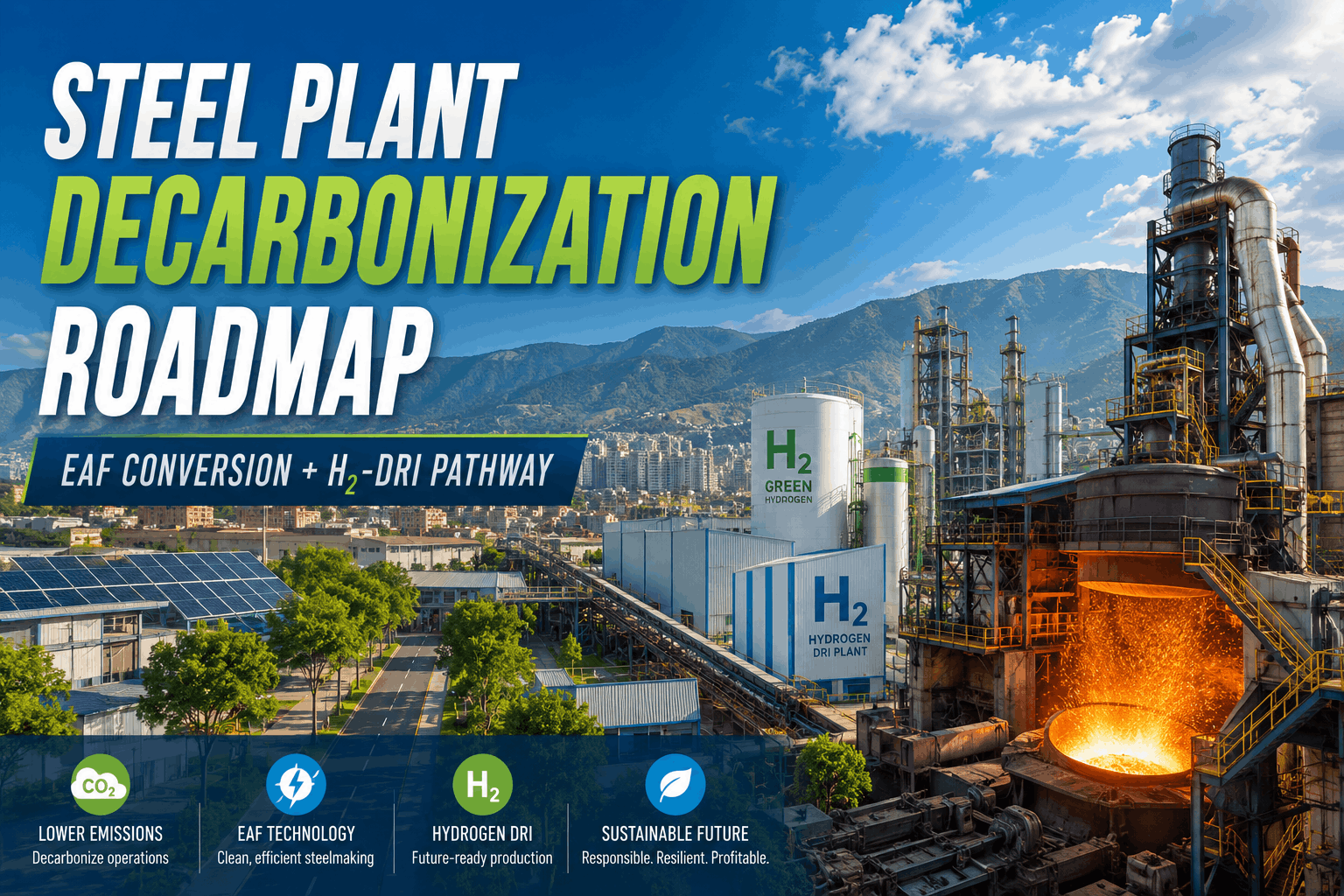
Steel plants face existential pressure to decarbonize — but without a structured roadmap, EAF conversion projects stall mid-execution, H2-DRI pilot plants exceed budgets, and CCUS investments drain capital with unclear carbon accounting. The average integrated steel mill spends $2–4 billion annually on fuel and energy; decarbonization pathways can reduce emissions 40–95% depending on technology selection, but only if execution is flawless. OxMaint's free steel plant decarbonization roadmap template provides a complete project tracking framework: EAF conversion milestones, H2-DRI technical readiness assessments, scrap sourcing strategies, CCUS integration planning, and carbon accounting evidence chains linked directly to your CMMS. Download now and transform decarbonization from a boardroom conversation into documented engineering reality — whether you're planning scrap-based EAF transition, green hydrogen DRI infrastructure, carbon capture utilization, or net-zero blended pathway across your entire steel production footprint.
Steel Decarbonization Roadmaps Built for Execution
OxMaint's free template includes EAF conversion timelines, H2-DRI feasibility matrices, scrap supply chain mapping, CCUS integration checkpoints, and CMMS-tracked carbon accounting — ready to align finance, engineering, and operations teams toward net-zero transformation.
Why Decarbonization Roadmaps Fail Without Operational Discipline
Steel decarbonization is capital-intensive, technically complex, and geographically constrained by scrap availability, green hydrogen infrastructure, and grid decarbonization timelines. A typical EAF conversion requires $300–$500 million in capex, 3–5 year execution windows, and synchronized supply chain transformation (scrap sourcing, alloy management, product qualification). A hydrogen-based DRI facility requires access to green hydrogen production — either through on-site electrolysis (requiring massive renewable power contracts) or hydrogen pipeline infrastructure that doesn't exist in most North American locations. Yet 70% of mills planning decarbonization lack documented project roadmaps with clear milestones, investment triggers, and success metrics. When technology selection decisions occur in executive boardrooms without engineering input, projects execute inefficiently: wrong scrap grades purchased, H2-DRI pilots over-run budgets by 40–60%, CCUS integration points identified too late in design phases. Decarbonization roadmaps must document every decision: technology selection rationale, capital spend gates, regulatory pathway alignment, carbon accounting evidence collection, and operations team readiness. Your CMMS must track decarbonization execution with the same rigor as safety or quality — because decarbonization is now a business-critical risk factor that directly impacts market access, customer contracts, and financing availability.
Map blast furnace retirement and EAF installation milestones. Define scrap sourcing strategy (acquired vs. internal generation), alloy management protocols, and product qualification timelines. OxMaint templates include typical EAF conversion schedules (18–36 months) with critical path tracking and resource allocation.
Evaluate green hydrogen infrastructure availability, electrolyzer scaling timelines, and Direct Reduced Iron plant integration requirements. OxMaint matrices compare cost assumptions, hydrogen purity standards, and DRI quality specifications — enabling realistic feasibility assessment before major capex commitment.
Develop scrap sourcing strategies: internal scrap generation from operations, collection partnerships, purchased scrap markets, and alloy management protocols. OxMaint tracks scrap grades, contamination risk, and supply reliability — ensuring EAF feedstock security before committing to production transition.
Plan carbon capture from blast furnace off-gas, EAF exhaust, or hydrogen production facilities. Define utilization pathways (chemicals, building materials, beverages, or geological storage). OxMaint documents carbon accounting compliance with ISO 14064, GHG Protocol, and emerging voluntary carbon market standards.
Map EU ETS carbon pricing implications, SEC Scope 3 emissions disclosure requirements, customer low-carbon procurement mandates, and emerging carbon border adjustment mechanisms (CBAM). OxMaint tracks regulatory timelines and customer contract deadlines — enabling proactive compliance before mandatory transition windows arrive.
Define technology selection gates (EAF vs. H2-DRI vs. hybrid), capex budgets, operational readiness checkpoints, and go/no-go decision criteria. OxMaint links investment approvals to engineering data, carbon accounting progress, and risk mitigation milestones — enabling board-level confidence in decarbonization ROI.
Decarbonization Technology Pathways and Cost Structures for North American Steel Mills
Steel mills face three primary decarbonization pathways: EAF-based (scrap-dependent), hydrogen-based DRI (capital-intensive, hydrogen-dependent), and hybrid approaches combining both technologies with legacy BF operations during transition windows. Each pathway has distinct cost structures, emissions profiles, and execution timelines. Your decarbonization roadmap must compare pathways quantitatively — modeling capex, operating costs, scrap availability, hydrogen infrastructure requirements, and carbon reduction outcomes across 20–30 year planning horizons.
| Decarbonization Pathway | Typical Capex ($/ton capacity) | Estimated Execution Timeline | Emissions Reduction vs BF/BOF | Key Dependencies & Constraints |
|---|---|---|---|---|
| EAF-Based (100% Scrap) | $300–$500M total (per 1M ton/year facility) | 24–36 months (BF demolition + EAF install) | 85–95% reduction (electricity grid-dependent) | Scrap availability (sourcing strategy critical), grid decarbonization, electricity cost volatility |
| H2-DRI + EAF Hybrid | $800M–$1.5B total (green hydrogen + DRI + EAF) | 36–60 months (phased commissioning) | 50–85% reduction (hydrogen production pathway) | Green hydrogen cost/availability, electrolyzer capacity, renewable power contracts, DRI kiln tech maturity |
| Enhanced BF/BOF (CCS + Natural Gas Injection) | $200–$400M (BF retrofit + CCS units) | 24–36 months (retrofits to existing assets) | 30–50% reduction (if 90% CO₂ capture achieved) | CCUS cost/maturity, CO₂ transportation network, utilization market development |
| Transitional Hybrid (BF + EAF + H2-DRI) | $500M–$800M (phased multi-tech approach) | 48–72 months (BF → DRI → EAF sequence) | 60–80% reduction by year 10 | Phasing discipline, scrap + hydrogen scaling, grid/energy contracts, operations complexity |
| Circular Economy / Scrap Maximization | $100–$200M (scrap supply chain infra) | 18–30 months (collection/sorting centers) | 50–65% reduction (with renewable electricity) | Scrap market development, alloy contamination control, customer acceptance |
Building Your Steel Plant Decarbonization Roadmap in OxMaint
Current State Assessment and Emissions Baseline
Calculate facility-wide carbon footprint (Scope 1: direct fuel/process, Scope 2: purchased electricity, Scope 3: supply chain). Benchmark against industry peers using AISI or World Steel Association data. OxMaint stores baseline emissions and production metrics — enabling year-over-year progress tracking and regulatory reporting.
Technology Pathway Evaluation and Gate Decision Framework
Compare EAF, H2-DRI, hybrid, and enhanced BF pathways quantitatively: capex, opex, timeline, emissions profile, supply chain dependencies. Define decision gates and evaluation criteria. OxMaint creates comparative analysis dashboards enabling C-suite confidence in technology selection.
Scrap Supply Chain Development and Circular Economy Planning
For EAF pathways, develop scrap sourcing strategy: internal generation, collection partnerships, market purchases. Model scrap grades, contamination risk, and alloy management. OxMaint tracks scrap quality, supply reliability, and cost trends — ensuring feedstock sustainability.
Green Hydrogen Infrastructure and DRI Readiness Assessment
For H2-DRI pathways, evaluate electrolyzer availability, hydrogen purity standards, transport costs, and renewable power contract requirements. Model hydrogen cost scenarios and technology maturity. OxMaint compares H2 cost assumptions across global suppliers — enabling realistic feasibility assessment.
CCUS Technology Integration and Carbon Accounting
If pursuing CCUS, plan CO₂ capture from furnace off-gas or hydrogen production. Define utilization pathways and carbon accounting protocols. OxMaint documents ISO 14064 compliance, GHG Protocol alignment, and voluntary carbon market eligibility — supporting revenue from carbon credits.
Execution Roadmap with Milestones, Capital Gates, and Operational Readiness
Create 10-year roadmap with technology deployment phases, capex timelines, emissions reduction targets, and operations team readiness milestones. OxMaint links project schedules to engineering decisions, capital approvals, and carbon reduction evidence — enabling synchronized execution across all departments.
Steel Decarbonization Best Practices from Leading Global Steelmakers
Decarbonization Impact on Steel Mill Economics and Market Position
What's Included in OxMaint's Steel Plant Decarbonization Roadmap Template
Compare EAF, H2-DRI, hybrid, and enhanced BF pathways across capex, opex, timeline, emissions, and supply chain dependencies. OxMaint enables board-level decision-making with quantitative pathway analysis and risk assessment — eliminating ambiguity in technology selection.
Document scrap sourcing routes: internal generation, collection partnerships, purchased market. Model scrap grades, contamination risk, and supply continuity. OxMaint tracks scrap availability constraints that gate EAF feasibility — preventing over-commitment to scrap-dependent pathways without supply security.
Evaluate green hydrogen availability, electrolyzer scaling, hydrogen purity, transport costs, and renewable power contracts. OxMaint models H2 cost scenarios from different suppliers — enabling realistic DRI capex and opex estimates before major investment decisions.
Document CO₂ capture opportunity (BF off-gas, EAF exhaust, H2 production), utilization pathways, and carbon accounting protocols. OxMaint ensures ISO 14064, GHG Protocol, and voluntary carbon market compliance — enabling revenue from carbon credits while supporting audit trails.
Create phased technology deployment schedule, capex timeline, emissions reduction targets, and operations readiness milestones. OxMaint links project schedules to engineering decisions, capital approvals, and carbon reduction evidence — ensuring synchronized execution across all departments.
Customer Success: How Integrated Mills Executed Decarbonization With Structured Roadmaps
"Documented Roadmap Reduced EAF Conversion Execution Timeline by 9 Months"
"We had scattered decarbonization discussions across three business units — zero coordinated roadmap. We implemented OxMaint's decarbonization template and aligned finance, engineering, and operations on phased pathway selection: 200K tons/year EAF conversion over 28 months, followed by H2-DRI pilot at year 4. The structured roadmap enabled us to negotiate scrap supply contracts 12 months earlier, secure IRA tax credits (35% capex support), and compress project timeline. We broke ground 9 months ahead of original planning. Execution rigor from CMMS-tracked milestones prevented scope creep and enabled on-budget delivery. We've reduced facility emissions 52% in 4 years and positioned for 80%+ reduction by 2032 using hybrid H2-DRI pathway." — Chief Sustainability Officer, Tier-1 North American Steelmaker
Steel Plant Decarbonization: FAQ for Executives and Engineers
What is the difference between EAF-based and H2-DRI decarbonization for steel mills?
EAF melts scrap using electricity (85–95% emissions reduction if grid is decarbonized), requiring scrap sourcing discipline and product redesign. H2-DRI reduces iron ore using hydrogen (50–95% reduction depending on H2 source), requiring green hydrogen infrastructure investment and new kiln technology. EAF executes faster (24–36 months) but is scrap-constrained; H2-DRI is more flexible but requires 36–60 months and hydrogen supply certainty.
How do we secure scrap feedstock for a 1-million-ton EAF conversion?
Combine three sources: internal scrap from operations (typically 100–200K tons/year), purchased scrap from collection networks and demolition partners (market price ~$150–$250/ton), and supplier partnerships with automotive/appliance manufacturers. OxMaint tracks scrap supply continuity, grades, and contamination risk — preventing EAF feedstock crises.
What capital expenditure should we budget for a 1-million-ton EAF conversion?
Typical range is $300–$500 million total for integrated facility: EAF equipment ($150–$200M), scrap receiving/handling infrastructure ($30–$50M), grid interconnection upgrades ($40–$80M), environmental controls ($20–$40M), and contingency. OxMaint models capex scenarios based on your site-specific equipment and timeline assumptions.
Is green hydrogen infrastructure available for H2-DRI in North America currently?
Limited green hydrogen is available; most H2 today is gray (steam methane reforming with emissions). Green H2 costs $4–$8/kg (vs. $1–$2 gray) due to electrolyzer capex and renewable power requirements. On-site electrolysis (300–500 MW renewable power) or hydrogen pipelines (if near production centers) are pathways forward. Hydrogen economics improve as electrolyzer costs decline and renewable electricity costs fall.
How do we account for carbon reduction from decarbonized steel production in ESG reporting?
Use ISO 14064 (GHG quantification), GHG Protocol (Scope 1/2/3 reporting), and emerging standards like Science-Based Targets initiative (SBTi) framework. OxMaint documents carbon reduction evidence: baseline emissions, production output, fuel/energy inputs, and technology specifications — enabling rigorous Scope 1/2 reporting and verification for sustainability disclosures.
What regulatory deadlines should influence our decarbonization roadmap timing?
Track EU ETS carbon pricing (increasing ~€2–$5/ton annually), SEC climate disclosure (mandatory Scope 1/2, Scope 3 by 2026), customer decarbonization mandates (automotive OEMs requiring 30–50% emissions reduction by 2030), and emerging carbon border adjustment mechanisms (CBAM penalties for high-carbon imports post-2026). OxMaint flags regulatory deadlines and customer contract commitments — enabling proactive decarbonization timing.
Can we secure government incentives (IRA, state funding) to offset decarbonization capex?
Yes — US Inflation Reduction Act (IRA) provides 30–40% tax credits for EAF, H2-DRI, and CCUS projects. State programs add 5–15% additional support. DOE hydrogen hubs provide infrastructure cost-sharing for H2 production. Timing project approvals to capture available incentives reduces net capex 25–40% — dramatically improving ROI and financing case.
How long does a typical EAF or H2-DRI conversion take from approval to full production?
EAF: 24–36 months (BF demolition, EAF build, grid/environmental tie-ins, operator ramp). H2-DRI: 36–60 months (hydrogen supply development, kiln commissioning, alloy management learning curve). Hybrid phased approach stretches to 48–72 months but reduces single-project execution risk. OxMaint tracks critical path milestones — enabling realistic timeline estimation and compressed execution through parallel workstreams.
Decarbonization Roadmap Template: Download and Align Your Organization Today
Our free steel plant decarbonization roadmap template provides technology pathway comparison matrices, scrap supply chain assessment frameworks, green hydrogen infrastructure evaluation tools, CCUS carbon accounting protocols, and phased execution roadmaps with capital gates. Import your facility baseline emissions, define decarbonization targets, and activate technology selection gates. Within 48 hours, your board has transparent technology roadmap options with quantified capex, timeline, emissions reduction, and risk profiles. No spreadsheet ambiguity. No delayed investment decisions. Decarbonization execution begins immediately.
Get Your Free Decarbonization Roadmap Template Today
Transform decarbonization from boardroom conversation into documented engineering reality. OxMaint's template is free to download and customize — align your organization toward net-zero transformation within minutes.
.png)
.png)
-and-maintenance-budget-template.png)
-justification-template.png)

