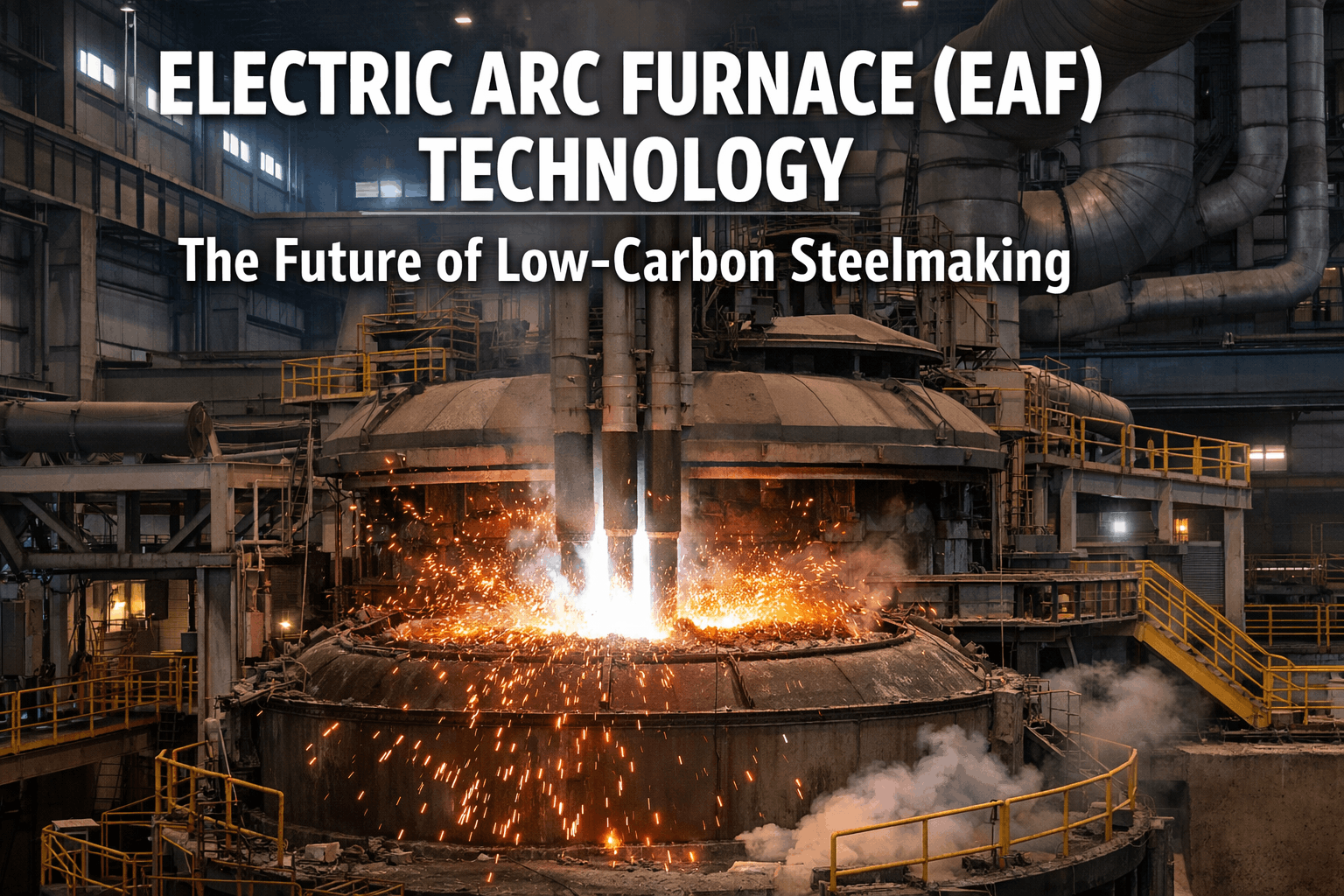
The global steel industry is in the middle of the most significant technology shift since the Bessemer process. In 2024, 93% of all new steelmaking capacity announced used electric arc furnaces — up from just 36% in 2020. EAF capacity under development now represents 49% of the global pipeline, and 88% of planned retirements are blast furnace-based. For integrated steel mills still running BF-BOF, the question isn't whether to convert — it's how to execute the transition without destroying production continuity, product quality, or the business case. This blog is the roadmap.
The numbers are stark: BF-BOF consumes approximately 23 GJ per tonne of steel, while EAF requires just 2.1-2.4 GJ — a 90% energy reduction. Direct CO₂ emissions from EAF mills are more than 90% lower than BF-BOF. In the U.S., 70% of steel is already EAF-produced, with the southern U.S. projected to produce over 74% of total U.S. steel by 2030 — all via EAF. Europe's EAF share is set to rise from 45% to 57% as the EU pursues net-zero by 2050, with 40-50 million tonnes of new green steelmaking capacity coming online by 2030. Oxmaint CMMS is built to manage the parallel operation of legacy BF-BOF and new EAF assets during what will be a multi-year, high-stakes transition.
From Blast Furnace to Electric Arc Furnace
A phased conversion strategy for integrated steel mills — covering technology selection, infrastructure requirements, workforce transition, and maintenance planning.
Why Integrated Mills Are Converting Now
Five converging forces are making BF-BOF operations increasingly uncompetitive and financially risky:
Stranded Asset Risk
Global BF-BOF stranded asset risk reached $554 billion in 2023, falling to $400 billion in 2024 as planned capacity decreased. Average BF age globally is ~13 years (since last reline) — less than one-third of typical lifetime. Operating coal-based assets to end-of-life would exhaust the sector's entire CO₂ budget, leaving zero room for required capacity additions.
Carbon Pricing Pressure
EU ETS carbon prices making high-emission production increasingly expensive. EU CBAM (Carbon Border Adjustment Mechanism) will impose carbon tariffs on imported steel starting 2026. Every tonne of BF-BOF steel carries 2.0-2.2 tCO₂ of embedded emissions vs. 0.4 tCO₂ for scrap-EAF — a cost differential that widens with every carbon price increase.
Energy Economics
BF-BOF requires 23 GJ/tonne (85% coal). EAF requires 2.1-2.4 GJ/tonne (primarily electricity). Energy and raw materials account for 60-80% of steel production costs. As renewable electricity costs decline and carbon-intensive energy costs rise, the economic advantage shifts decisively toward electrified steelmaking.
Customer Demand for Green Steel
First Movers Coalition members (Volvo, Mercedes-Benz, Apple, and others) are committing to near-zero emissions steel procurement. Green longs definition shifting from under 500 kg CO₂/tonne to under 400 kg — and heading toward 300 kg. Automotive OEMs and construction firms increasingly requiring emissions data in procurement.
Government Support
Over €14 billion in public funding dedicated to green steel transition in Europe by end of 2024. UK: £500 million for Tata Steel BF-to-EAF conversion. U.S.: DOE $500 million grant for Cleveland-Cliffs Middletown BF replacement. Subsidies are flowing — but primarily to conversion projects, not BF maintenance.
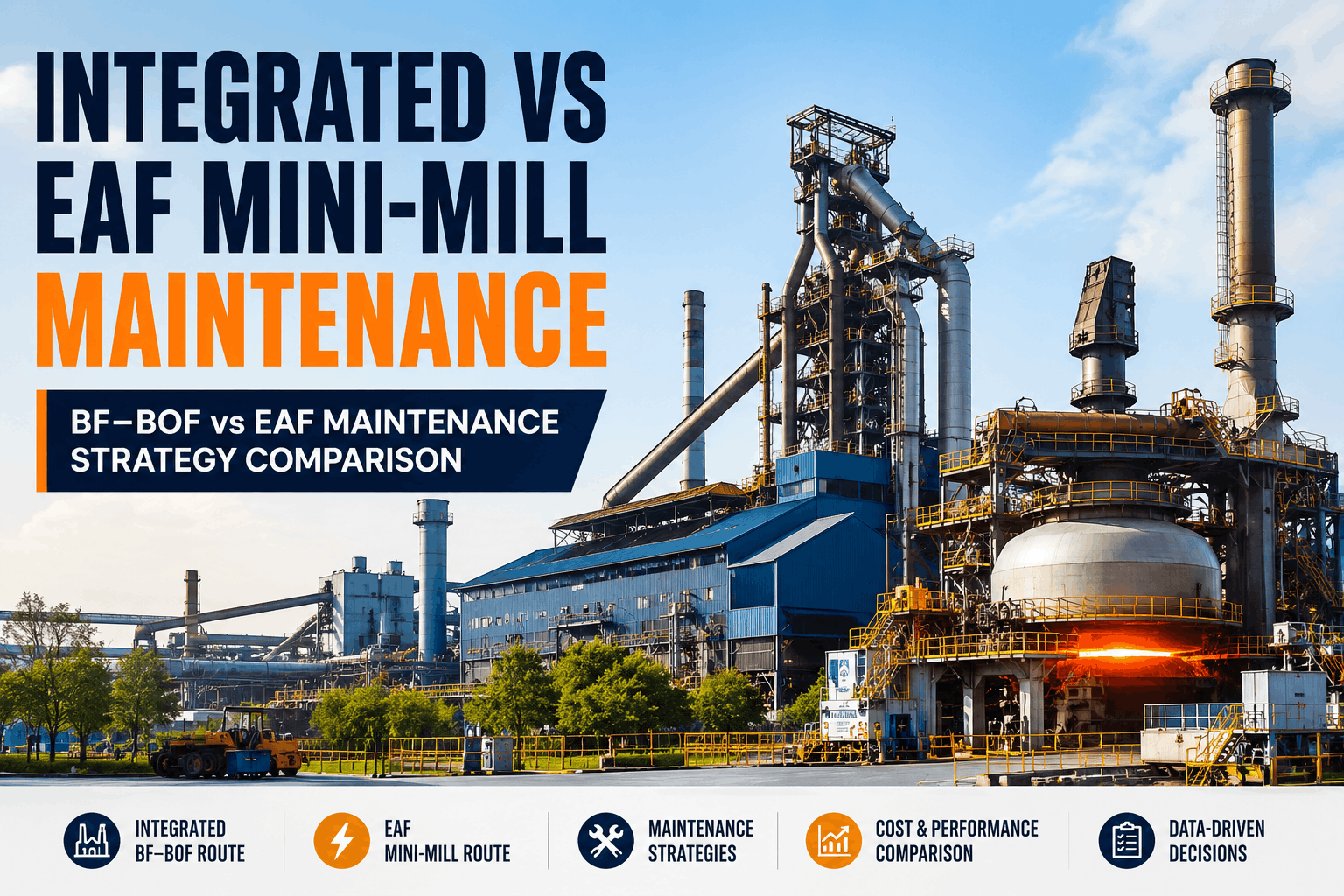
BF-BOF vs. EAF: The Full Comparison
Understanding the fundamental differences between integrated and EAF steelmaking is essential for planning the conversion:
Managing Two Systems During Conversion?
Oxmaint tracks BF-BOF assets being decommissioned alongside new EAF equipment being commissioned — in a single platform with unified work orders, PM schedules, and reporting.
The Conversion Roadmap: Five Phases
Converting an integrated mill to EAF is a 3-7 year process depending on scale, product mix complexity, and infrastructure requirements. Here's the phased approach:
Feasibility & Design
Infrastructure & Grid
EAF Installation & Commissioning
BF-BOF Decommission & Workforce Transition
Optimization & Future-Proofing
EAF Maintenance: What Changes
The maintenance profile of an EAF operation is fundamentally different from BF-BOF. Understanding these differences is critical for planning staffing, spare parts, and CMMS configuration:
Coke oven door sealing, gas main integrity, and pushing machine maintenance are replaced by scrap handling cranes, magnet maintenance, shear/baler equipment, and scrap pre-heater systems. Maintenance shifts from hazardous-atmosphere chemical plant to heavy mechanical material handling.
BF campaigns last 15-20 years between major relines ($200-400M). EAF refractory life is much shorter — sidewall panels last weeks to months, hearth refractories 1,000-3,000 heats. But replacement is faster, cheaper, and doesn't require the plant-wide shutdown of a BF reline. CMMS tracks heat counts against refractory wear curves.
BF gas cleaning, gas holders, stove maintenance, and gas distribution piping are replaced by high-power transformer maintenance, electrode regulation hydraulics, power quality monitoring (SVC/STATCOM), and cable/bus bar integrity. The skill mix shifts heavily toward electrical and automation.
Torpedo car maintenance, hot metal ladle refractory, and runner systems give way to intensive water-cooled panel inspection, cooling circuit integrity, leak detection, and water treatment. EAF cooling system failure = furnace shutdown, making cooling circuit maintenance the #1 reliability priority.
BOF lance replacement, vessel refractory, and slag splashing programs are replaced by electrode consumption optimization, electrode arm and mast maintenance, clamp and holder inspection, and column/gantry structural integrity. Electrode costs are a major EAF operating expense — CMMS tracking per-heat consumption is essential.
One CMMS. Both Systems. Zero Gaps.
Whether you're running a blast furnace in its final campaign or commissioning a brand-new EAF, Oxmaint manages every asset, every work order, and every PM — ensuring nothing falls through the cracks during the most complex operational transition in your plant's history.
Frequently Asked Questions
How much does it cost to convert a blast furnace plant to EAF?
EAF greenfield capacity costs approximately $400-600 million per Mtpa, compared to $1-1.5 billion per Mtpa for an integrated BF-BOF site. The total conversion cost depends on scale, grid infrastructure, and whether DRI is included. Cleveland-Cliffs' Middletown conversion (2.5 Mt/yr DRI + electric melting furnaces) has a total estimated cost of $2.1 billion, partially offset by a $500M DOE grant. The UK allocated £500 million for Tata Steel's Port Talbot conversion.
How long does BF-to-EAF conversion take?
A full conversion typically takes 3-7 years from feasibility study to full EAF optimization. The timeline depends on scale, permitting, grid infrastructure requirements, and whether the plant continues BF-BOF production during construction. The most efficient approach times EAF commissioning to coincide with the natural end of the blast furnace campaign (avoiding the $200-400M cost of a reline that would lock in another 15-20 years of coal-based production).
Can EAF produce the same product quality as BF-BOF?
The quality gap is closing rapidly. Traditional limitations were copper and tin contamination from scrap (affecting surface-critical flat products for automotive). Solutions include: blending DRI/HBI with scrap to dilute contaminants, improved scrap sorting technology, and advanced ladle metallurgy. Many automotive-grade steels are now routinely produced via EAF. The remaining quality-sensitive grades (ultra-low carbon, silicon steels) are increasingly feasible with DRI-fed EAFs.
What happens to the workforce during EAF conversion?
EAF operations require fewer but differently-skilled workers: roughly 500-1,000 per Mtpa vs. 3,000-5,000+ for integrated mills. The skill mix shifts from mechanical/refractory/chemical toward electrical, automation, and process control. Successful conversions invest heavily in retraining: BF operators → EAF operators, coke oven maintenance → scrap yard operations, hot metal specialists → cooling system/electrode management. Cleveland-Cliffs' Middletown conversion adds 170 new positions alongside existing workforce.
What are the biggest risks in EAF conversion?
Five primary risks: (1) Grid capacity — EAFs need 50-100+ MW per furnace with stable power quality; (2) Scrap supply — global end-of-life scrap is projected to reach 600 Mt by 2030 but low-copper scrap generation in Europe is only ~1 Mt/year; (3) Product quality transition — maintaining customer specifications during changeover; (4) Production gap — managing the period between BF shutdown and EAF ramp-up; (5) Stranded knowledge — losing institutional BF expertise before it's documented and transferred.
.png)