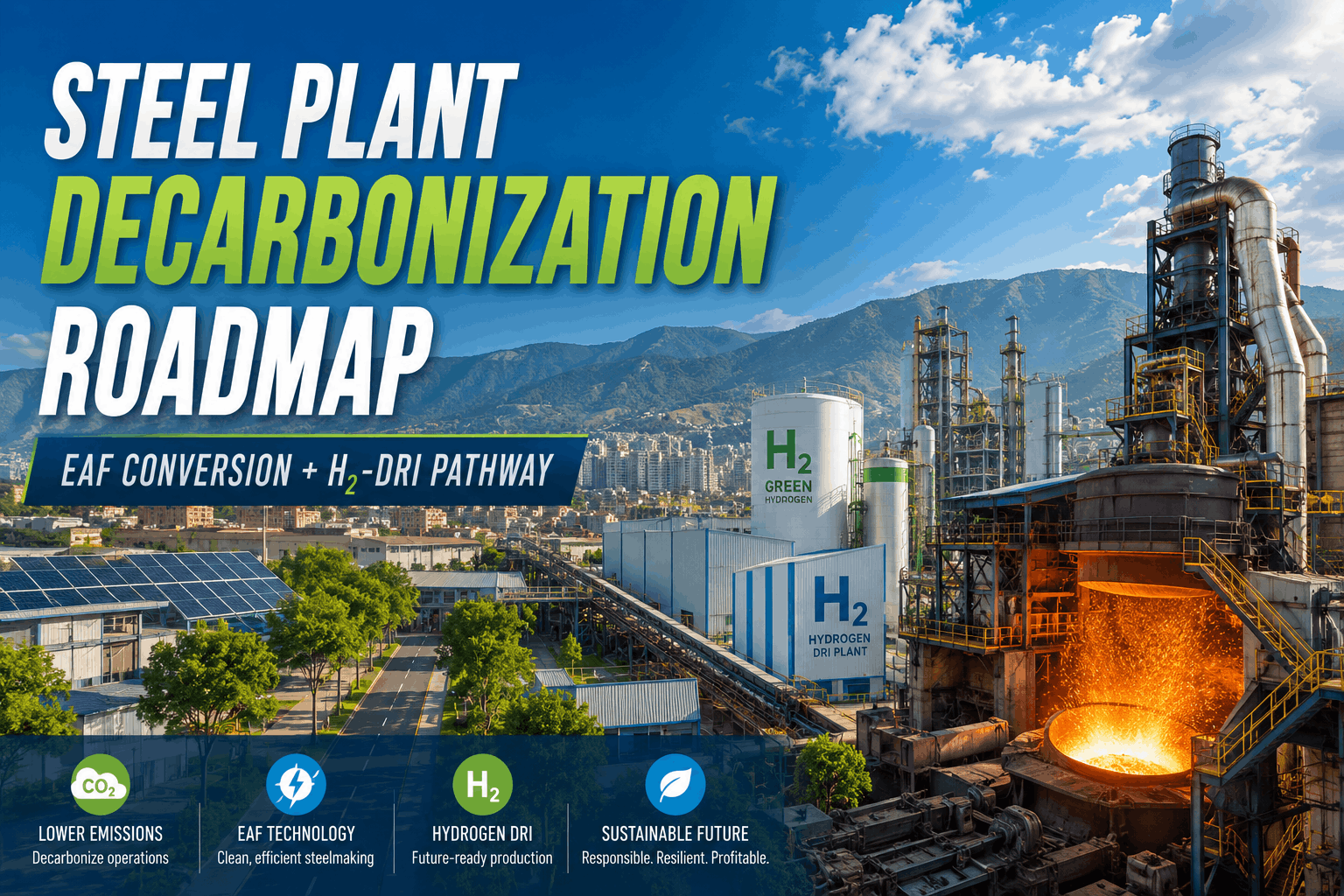
Steel industry decarbonization represents one of the most complex industrial transformation challenges globally — converting century-old blast furnace-basic oxygen furnace (BF-BOF) routes that produce 1.9–2.2 tonnes of CO₂ per tonne of crude steel into alternative pathways that achieve 0.3–0.8 tCO₂/t through electric arc furnaces (EAF) powered by renewable electricity or hydrogen-based direct reduction (DRI) fed into EAF. For North American integrated mills facing CBAM liability, customer decarbonization demands, and investor ESG pressure, decarbonization is no longer a corporate sustainability initiative — it is an existential business strategy that will determine market competitiveness by 2030. The challenge is that decarbonization requires simultaneous decisions across capital investment, supply chain transformation, workforce reskilling, and operational complexity that many mills are ill-equipped to evaluate. A CMMS-enabled decarbonization roadmap transforms strategic planning from boardroom Excel models into an operational discipline where every maintenance interval, energy optimization opportunity, and asset life cycle decision is aligned with carbon reduction targets. The mills that move fastest to actionable decarbonization plans will capture first-mover advantage in low-carbon steel markets; those that delay face stranded asset risk as EAF and DRI capacity grows globally and premiums for high-carbon conventional steel compress.
Three Decarbonization Pathways for North American Steelmakers: Technical & Economic Comparison
Every integrated mill operates within specific economic, geographical, and technical constraints that determine which decarbonization pathway is viable. The three primary pathways — BF-BOF efficiency improvements, EAF conversion with scrap/DRI feedstock, and hydrogen-based DRI-EAF — represent distinct capital requirements, supply chain dependencies, and timeline horizons. Understanding the trade-offs is essential to developing a credible roadmap that your board, customers, and capital markets will accept.
Pathway 1: BF-BOF Energy Efficiency & Fuel Switching involves optimizing existing blast furnace operations through improved hot blast recovery, advanced burden distribution, oxygen enrichment, and switching natural gas usage from natural gas to renewable methane or hydrogen blending. This pathway preserves your existing asset base and requires the lowest capital investment ($50–150 million for a typical facility), but achieves only modest carbon reductions (5–15% from baseline), reaching perhaps 1.6–1.7 tCO₂/t at best. The appeal is that efficiency improvements can be implemented quickly (12–24 months), using existing maintenance infrastructure. The limitation is that CBAM and customer demands are driving toward sub-0.8 tCO₂/t targets by 2030–2035, making efficiency-only strategies insufficient for long-term competitiveness. Most mills pursuing this pathway are treating it as a bridge strategy to buy time while developing larger decarbonization investments.
Pathway 2: EAF Conversion with DRI/Scrap Feedstock
Pathway 3: Hydrogen-Based DRI-EAF
Most credible mill decarbonization roadmaps envision a phased approach: near-term (2024–2028) efficiency improvements on existing BF-BOF to reduce emissions 10–15% and lower CBAM exposure; medium-term (2028–2035) EAF conversion with DRI/scrap supply chain development to achieve 0.6–0.8 tCO₂/t; long-term (2035–2045) hydrogen-capable infrastructure to enable sub-0.4 tCO₂/t production for premium markets. The financial case for this phased approach rests on CBAM cost escalation (prices expected to reach €120–140/tonne by 2030), customer willingness-to-pay premiums for low-carbon steel (currently 3–8%, expected to grow), and capital cost learning curves for DRI and hydrogen technology (typical 20–30% cost reduction every 5 years as deployment scales).
Blast Furnace Campaign Management for Decarbonization Transition
One of the most underestimated challenges in decarbonization planning is the management of existing blast furnace campaigns during the transition period. A blast furnace campaign typically lasts 15–20 years, with full refractory lining life of 12–15 years before major reline investment. If your blast furnace was relined in 2019, the existing lining has 7–10 years of campaign life remaining (through 2026–2029). A critical decision point emerges: do you invest in another $150–250 million major reline to extend the campaign to 2035–2040, or do you plan a campaign wind-down and EAF conversion in the 2028–2030 window? This decision must be made 2–3 years in advance to allow maintenance and capital planning to align.
Many mills face the blast furnace dilemma in 2026–2027 as major relining investments come due. If you commit to a reline, you're implicitly endorsing BF-BOF operation through 2035 — and you'll be managing a high-carbon asset in a low-carbon market for the final 5–7 years of operation, facing escalating CBAM costs. If you forgo the reline and plan a campaign wind-down, you must begin building DRI/scrap supply relationships, securing EAF equipment and installation capacity (increasingly constrained globally), and preparing your workforce for transition roles. The operational burden falls on maintenance planning — keeping a blast furnace in reliable operation during a planned multi-year wind-down requires different maintenance discipline than a full-campaign environment. A CMMS configured for campaign lifecycle management allows you to track furnace condition evolution, plan maintenance intervals aligned with wind-down targets, and manage refractory wear prediction to avoid unexpected outages during the transition period.
Supply Chain Transformation: DRI, Scrap, & Hydrogen Logistics
EAF and hydrogen-DRI pathways are fundamentally supply-chain-dependent in ways that traditional BF-BOF mills are not. A BF-BOF mill controls the entire production chain from raw materials (iron ore, coal, coke) to finished steel through internal operations. An EAF mill depends on external DRI suppliers, scrap suppliers with specific chemistry and size specifications, and potentially hydrogen suppliers with novel supply contracts. This external dependency creates both opportunity (decoupling iron and steel production, sourcing low-carbon DRI from regions with abundant natural gas or renewables) and risk (supply disruption, supplier financial instability, pricing volatility). For North American mills, DRI supply is geographically constrained to Mexico (largest merchant DRI producer in North America) and imports from Middle East, India, and Venezuela. A mill committing to EAF conversion must secure long-term DRI supply contracts 18–24 months before production startup, with penalties for supply interruption built into financial models. Hydrogen supply is even more nascent — green hydrogen electrolyzer capacity in North America is still below 1 GW; several announced projects targeting 2–3 GW by 2030, but supply will remain tight and prices elevated through mid-2020s.
A decarbonization roadmap must include detailed supply chain risk assessment and contract execution timelines. Many mills have announced EAF conversion projects without securing feedstock contracts — a material execution risk that delays startup and creates cost overruns. CMMS integration with supply chain management systems (supplier contracts, logistics tracking, inventory forecasting) allows you to stress-test supply assumptions and plan procurement workflows that minimize startup risk.
Workforce Transition & Skills Development in Decarbonization Pathways
Decarbonization is not just a technical and capital transformation — it is a workforce transformation. Blast furnace operations require specialized skillsets (furnace operators, cokemen, hot blast stove operators, taphole maintenance specialists) that have developed over decades. EAF and DRI operations require entirely different technical knowledge — electrolyzer operation, hydrogen safety systems, DRI plant refractory management, and EAF metallurgical control. A mill transitioning from BF-BOF to EAF faces the challenge of managing an aging workforce (average furnace operator age 52–58 in North America) who will retire within 5–10 years, requiring simultaneous recruitment, training, and knowledge transfer to new operators in a low-unemployment industrial labor market.
Successful mills are treating workforce transition as a 5–7 year program beginning 2–3 years before EAF or hydrogen facility startup. This includes apprenticeship partnerships with community colleges, early retirement incentive programs for BF operators (costing $100,000–200,000 per early retiree but freeing headcount for new roles), and cross-training programs where existing maintenance technicians learn DRI and hydrogen-specific maintenance. CMMS can support this transition by providing job-shadowing documentation, competency certification tracking, and training hour recording that creates audit trails for workforce readiness at facility startup.
Decarbonization Roadmap FAQs: Technology, Timeline & Financial Strategy
Should we wait for hydrogen to become cost-competitive, or convert to EAF now with natural gas DRI?
Most North American mills are planning EAF conversion with natural gas DRI supply for 2028–2032 operation, with hydrogen-readiness built into equipment design (hydrogen-compatible DRI furnaces, H₂-safe refractory, hydrogen-capable compressors). This path provides near-term carbon reduction (0.7–1.0 tCO₂/t) while preserving optionality for hydrogen transition as costs decline and supply scales.
What is the ROI on decarbonization investments when accounting for CBAM cost avoidance and carbon premiums?
A 2 MTPA EAF facility reducing carbon intensity from 1.9 to 0.8 tCO₂/t saves ~2.2M tCO₂ annually. At €85/t CBAM, that's €187M annual CBAM cost avoidance. Even modest 2–3% carbon premium on low-carbon steel (@$100/t baseline price) generates €12–18M annual incremental revenue. Combined, carbon value can exceed €200M annually, providing 15–20 year payback on €1B+ capital investment — attractive returns given commodity downside protection.
Can our mill manage both BF-BOF and EAF production in parallel during transition, or must we choose one or the other?
Most mills plan a sequential transition — continuing BF-BOF operation at reduced rates during EAF startup, then ramping down BF as EAF reaches full capacity. Parallel operation requires managing two fundamentally different steelmaking processes, supply chains, and workforces simultaneously, adding significant complexity. Plan for 12–24 month overlap period at minimum.
How do customers currently price low-carbon steel, and is the premium sustainable?
Current carbon premiums average 3–8% depending on customer and market. Automotive OEMs and sustainability-focused customers (renewable energy equipment, green building) pay premiums; commodity customers resist. As CBAM pushes all European imports to higher cost and customer ESG mandates intensify, premiums are expected to widen to 8–15% by 2030, but remain vulnerable to carbon price collapse and commodity cycles.
What is the risk that our decarbonization investments become stranded if technology shifts or markets collapse?
EAF technology risk is low (proven, operating globally for 40+ years); hydrogen-DRI risk is higher (early commercial stage, supply chain unproven). Stranded asset risk increases in commodity downturns when carbon premiums compress — mills that overinvest betting on carbon pricing escalation face financial stress. Portfolio approach (EAF for near-term, hydrogen-readiness for optionality) mitigates this risk better than all-in hydrogen or all-in EAF bets.
Are government subsidies (Inflation Reduction Act, EU carbon border revenue recycling) material to decarbonization investment case?
Yes — IRA clean hydrogen production tax credits ($3/kg in some configurations) can reduce hydrogen project economics significantly. EU carbon border revenue recycling (directing CBAM certificate sales revenue back to Member States for climate investment) may fund up to 10–20% of decarbonization project costs in supported regions. Subsidies are material but uncertain (subject to political change, budget constraints, and administrative delays). Plan investment cases assuming subsidies are partial offset, not core assumption.
What is the timeline pressure to begin decarbonization planning? When is it too late to start?
Mills with blast furnace relining decisions due in 2026–2027 are at the critical decision point now. Those with relining decisions deferred to 2028–2030 have 12–18 months to develop credible EAF conversion plans before capital markets expect visibility on long-term asset strategy. Waiting beyond 2027 to begin serious planning risks being reactive to customer demands and regulatory pressure rather than proactive. First-mover advantage in low-carbon markets is real — mills that publish decarbonization roadmaps in 2026 are gaining customer and investor preference over those still evaluating options in 2027–2028.
What are the top 3 execution risks that cause decarbonization projects to fail or miss timelines?
Risk 1: Feedstock/supply chain instability — securing DRI, hydrogen, scrap contracts 18–24 months before startup is harder than anticipated. Risk 2: Capital cost escalation — equipment, labor, and permitting costs continue to inflate; many projects approve budgets based on 2022–2023 estimates that are now 15–25% too low. Risk 3: Permitting delays — EAF and hydrogen projects trigger environmental and local agency reviews that compress timelines. Plans accounting for 24-month permitting buffers outperform those expecting 12 months.
.png)