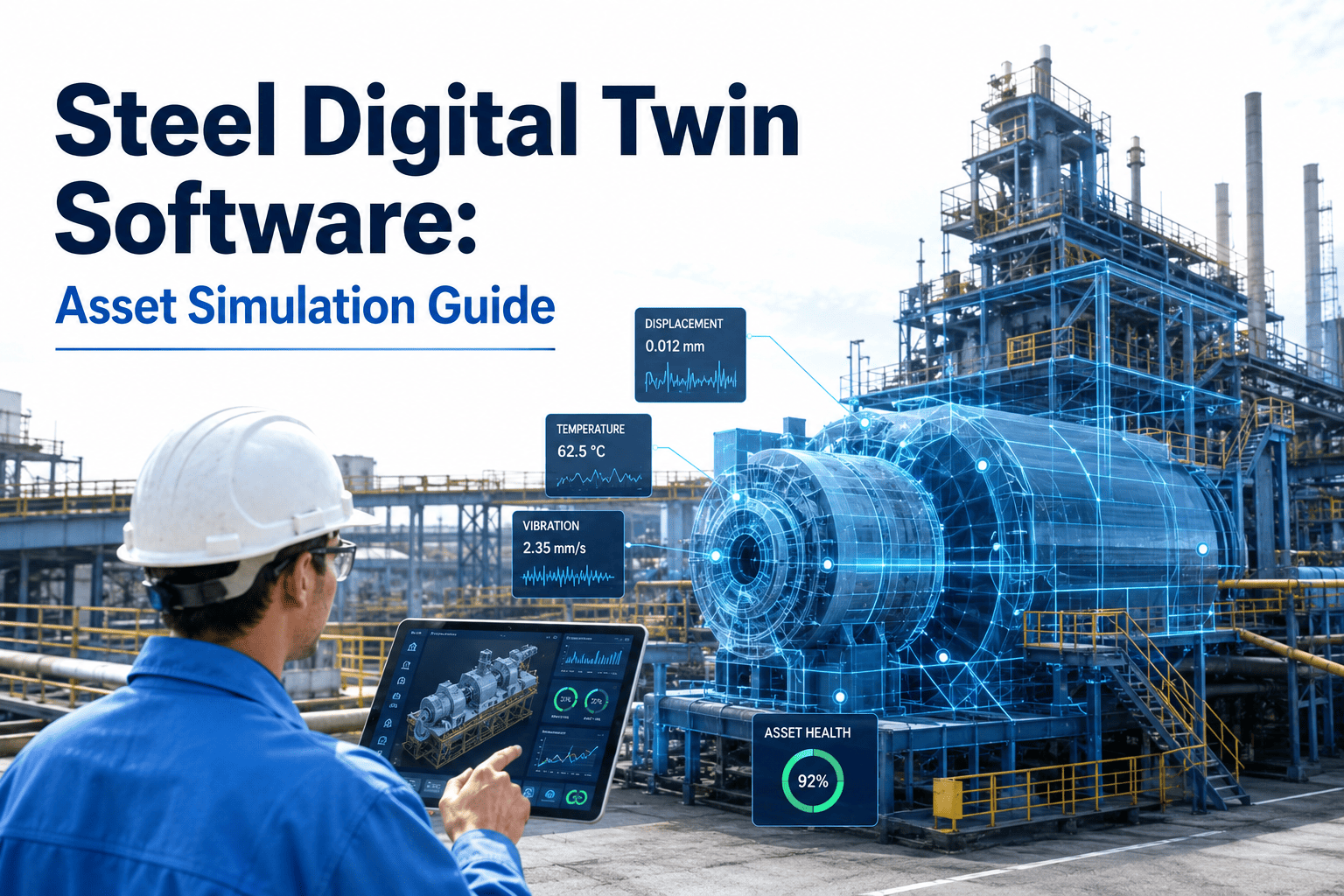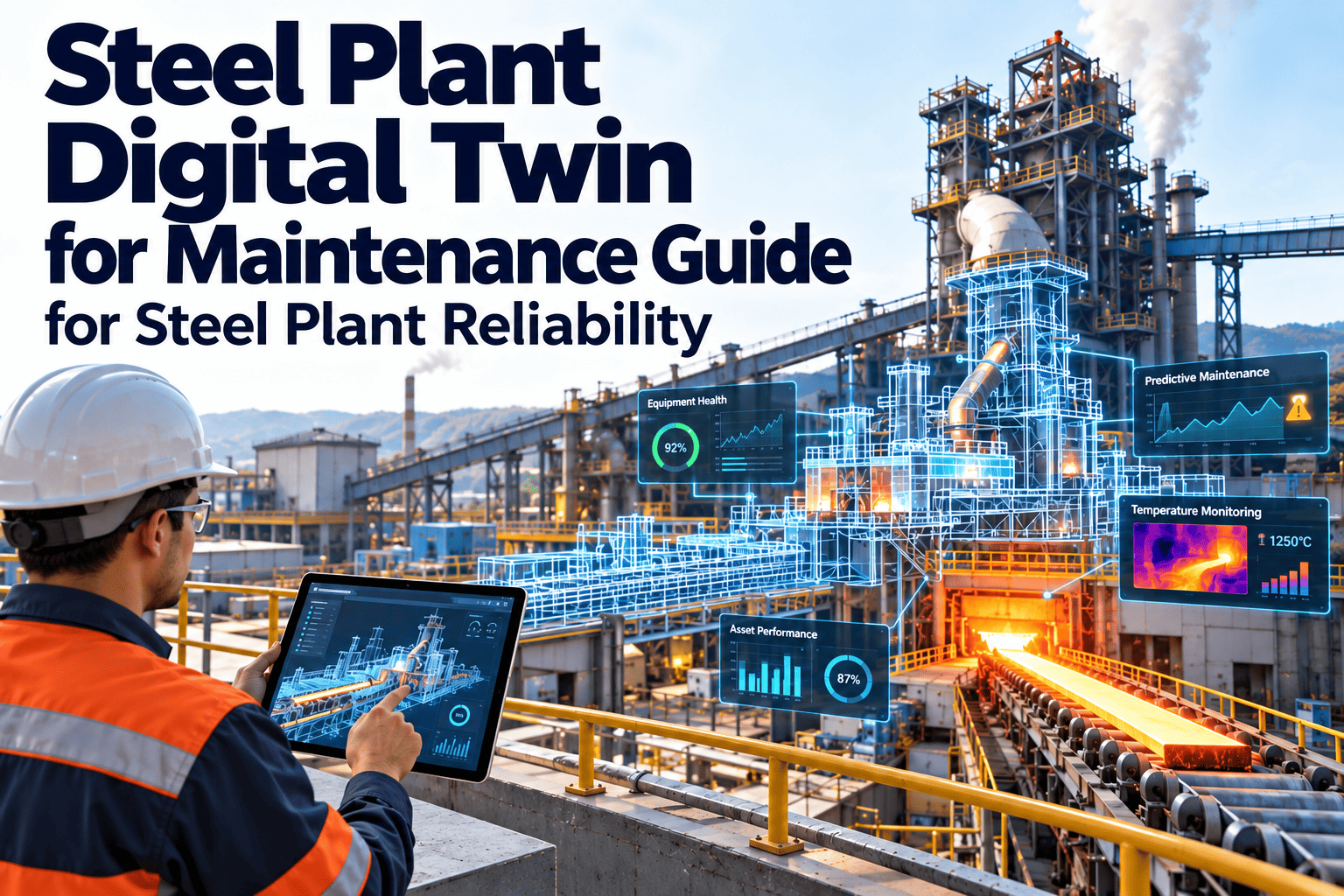
A digital twin in a steel plant does not have to start as a 3D model or a physics simulation. For maintenance teams, the most useful twin is a living record of each machine: where it sits in the plant, what it is made of, how it is behaving, what has been done to it and what the process is asking of it. That is a practical step in digital transformation, and a steel plant maintenance management platform is where much of that record already lives.
Digital Transformation | Maintenance-Focused Digital Twin
Steel Plant Digital Twin for Maintenance: Build It From Data You Already Have
Combine asset hierarchy, condition data, maintenance history and process context into one connected model of your furnaces, casters, mills and utilities.
Decisions: plan, defer, inspect, replace
Process context: heats, tonnage, speed, load
Condition and history: readings, failures, repairs
Asset hierarchy: plant, line, machine, component
What a Maintenance Digital Twin Actually Is
Common Misconception
- A 3D visual of the plant
- A project that needs every sensor installed first
- Something only large integrators can deliver
Maintenance Reality
- A structured digital representation of each asset and its state
- Built in stages from existing records
- Judged by whether it improves maintenance decisions
Physics-based or 3D twins can sit on top later. The foundation is clean asset data and trustworthy history.
The Four Building Blocks
01
Asset Hierarchy
Consistent parent-child structure from melt shop to rolling mill, with tags, criticality and documents.
02
Condition Data
Temperature, vibration, oil results, thermography and inspection findings tied to the right component.
03
Maintenance History
Work orders, failure causes, parts used, downtime and repairs in a form that can be compared.
04
Process Context
Heat counts, tonnage, casting speed, load and campaign data that explain why wear happens.
Data Sources and How They Feed the Twin
| Source | What It Adds | Maintenance Use |
|---|---|---|
| Asset register | Structure, tags, specifications | Correct job targeting and spares lookup |
| Work order history | Failures, causes, repair effort | Repeat failure analysis, interval review |
| Inspections and rounds | Human observations and readings | Early defect detection |
| Condition monitoring | Vibration, temperature, oil, thermography | Condition-based triggers |
| Process data | Loads, cycles, production rate | Usage-based maintenance and context |
| Inventory and purchasing | Parts, lead times, consumption | Spares planning for critical assets |
A Maturity Ladder for Steel Plants
Level 1: Registered
Every critical asset exists in one hierarchy with clear ownership.
Level 2: Recorded
Work, inspections and failures are logged consistently against assets.
Level 3: Monitored
Condition readings are trended and tied to work triggers.
Level 4: Contextual
Maintenance data is read together with process and load data.
Level 5: Predictive
Models and rules support remaining life and intervention timing.
Start the Twin at Level 1 and Prove Value Early
Load your critical assets, link history and see where the data gaps are before investing in anything heavier.
Where the Twin Pays Off in a Steel Plant
Electric Arc Furnace
Link transformer, electrode, cooling and hydraulic history to heat counts and power loading.
Continuous Caster
Compare mould, segment and spray system wear against casting hours and grade mix.
Rolling Mill
Connect gearbox, bearing and roll-related events to tonnage and campaign length.
Cranes and Utilities
Track duty cycles, inspections and statutory checks across fleets and systems.
What Good Looks Like Versus What Fails
Common Failure Patterns
- Different tag names across departments
- History stored as free text only
- Sensor data with no link to maintenance records
- Failure causes left blank
- No owner for data quality
Practices That Work
- One tagging standard and hierarchy
- Failure codes and cause fields used consistently
- Condition limits linked to work orders
- Criticality ranking to focus effort
- Named data owner per area
How Oxmaint Supports the Maintenance Layer
Asset managementHierarchy, criticality, documents and specifications in one structure.
Work ordersCorrective, preventive and condition-based jobs with failure and parts data.
InspectionsMobile checklists capturing readings and photos against each asset.
Preventive and condition-basedTime, meter and threshold-based triggers that evolve as the twin matures.
InventoryCritical spares linked to the equipment that needs them.
ReportingDashboards for downtime, repeat failures and compliance across lines.
Oxmaint organises the maintenance record. Detailed simulation or real-time analytics usually come from your automation and monitoring systems alongside it.
A Phased Rollout
Phase 1
Clean the hierarchy for critical assets and agree tags and criticality.
Phase 2
Standardise work orders, failure codes and inspection templates.
Phase 3
Add condition readings and thresholds for the highest-risk machines.
Phase 4
Bring in process data and review intervals against actual usage.
Measuring the Value
Data Completeness
Critical assets with full hierarchy and history
Planned Work Share
Planned versus reactive jobs
Repeat Failures
Same cause recurring on the same asset
Unplanned Downtime
Hours lost on critical lines
Frequently Asked Questions
What is a digital twin for maintenance?
It is a connected digital model of equipment combining hierarchy, condition data, history and process context to guide maintenance.
Do we need sensors on every machine?
No. Start with critical assets and existing inspection data, then add monitoring where risk justifies it.
Is a CMMS part of a digital twin?
Yes, it holds the asset structure and history. Oxmaint provides that maintenance foundation.
How long does a first version take?
It depends on data quality, but a critical-asset hierarchy with linked history can be a first milestone.
Can I review a roadmap for my plant?
Yes, book a demo to map your assets and data sources.
Turn Asset Records Into a Maintenance Twin Your Team Trusts
Build the hierarchy, history and condition record first, then extend it as your plant digitalises.