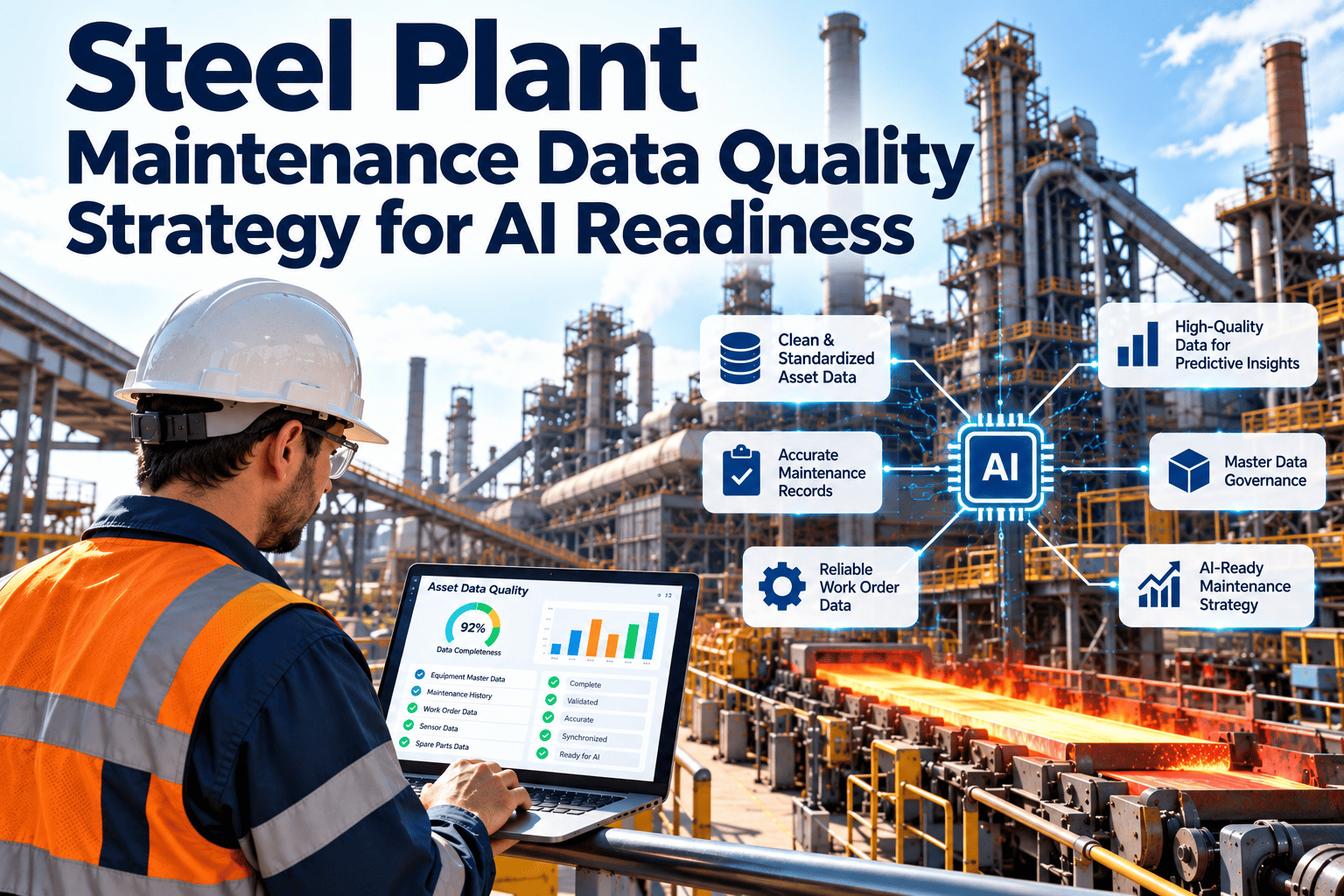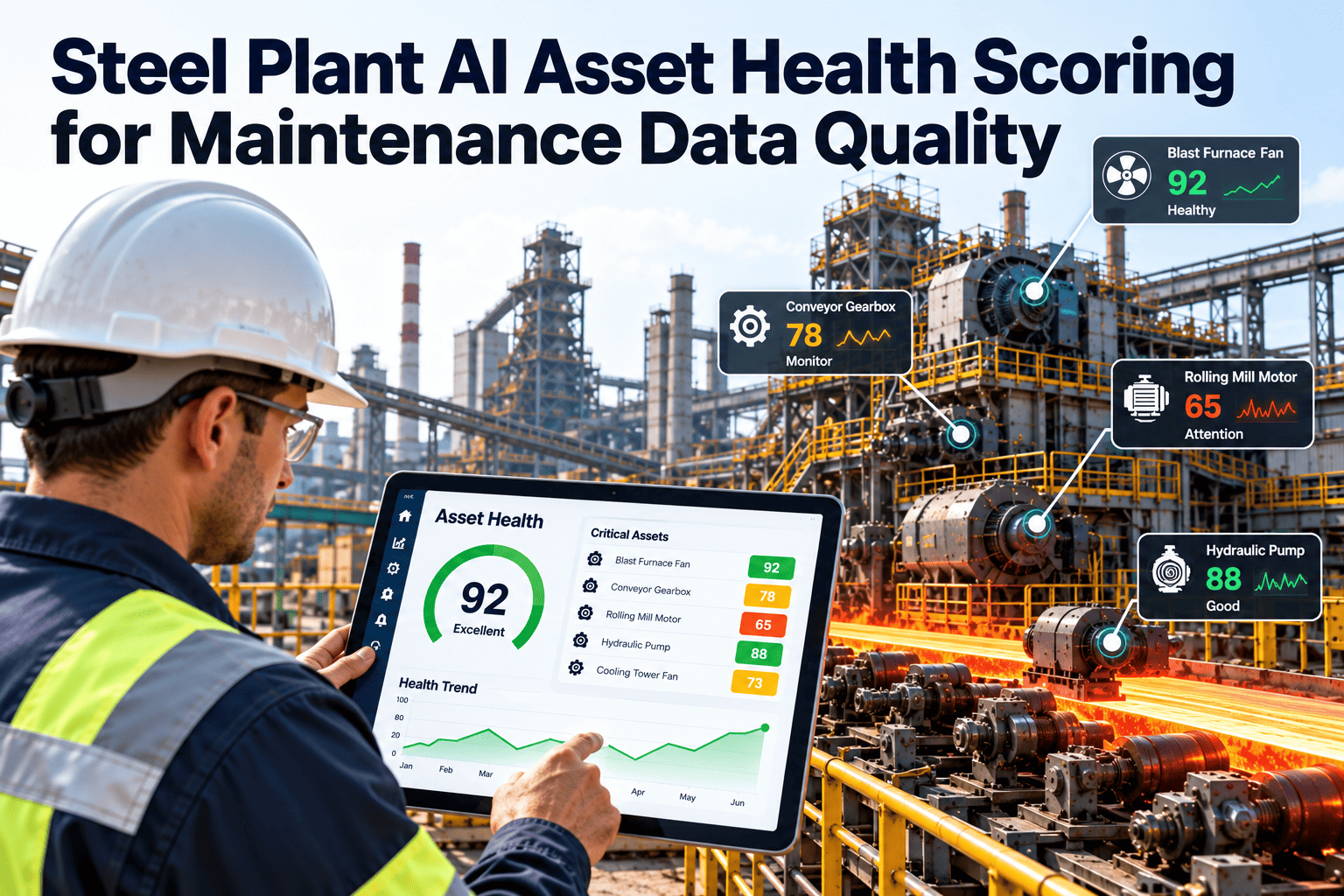
Edge AI promises faster decisions close to the machine, but in a steel plant the real limit is rarely computing power. It is the quality of the data feeding the models: mislabeled assets, missing timestamps, unreliable sensors and work orders that never record what failed. Good architecture decides where data is filtered, scored and stored, while good maintenance records decide whether any of it can be trusted. This guide covers edge, plant and maintenance layers, data quality checks and AI readiness, and shows how Oxmaint CMMS supports the maintenance record side.
AI and Data / Steel Plant Architecture
Steel Plant Edge AI Maintenance Architecture for Maintenance Data Quality
Plan where AI runs, what data it needs and how maintenance records keep models accurate across mills, casters, furnaces and utilities.Edge tierSensors, PLC taps, gateways. Filter, time-stamp, score locally.
sends summaries
Plant tierHistorian, data platform, model management and monitoring.
sends events
Maintenance tierAssets, work orders, findings, history and feedback.
Why Edge Processing Makes Sense in Steel Plants
Edge computing is a design choice, not a goal. Use it where it solves a real constraint.- High-frequency data: vibration and current signals can be too heavy to send raw from hundreds of machines, so summarizing features locally reduces load.
- Network limits: remote pump houses, crane bays and outlying utilities may have weak or intermittent connectivity.
- Response time: some protective decisions cannot wait for a round trip to a central system.
- Data control: sensitive operating data can stay within the plant network while only results are shared.
- Resilience: a local node can keep scoring and buffering when upstream links fail.
What edge AI does not solve
- It does not repair a wrong asset hierarchy or inconsistent tag names.
- It does not create failure labels that nobody recorded.
- It does not replace safety systems or interlocks.
- It does not make alerts useful without people and a process to act on them.
Edge, Plant or Maintenance Layer: What Belongs Where
| Task | Best placed | Reason |
|---|---|---|
| Signal filtering and sampling | Edge | Reduces noise and bandwidth before data leaves the machine area |
| Feature extraction such as RMS or spectral bands | Edge | Keeps raw waveforms local and sends compact values |
| Simple anomaly scoring | Edge | Fast and continues running if the network drops |
| Model training and retraining | Plant or central platform | Needs history across many assets and compute capacity |
| Model version control and monitoring | Plant or central platform | Requires governance, approvals and drift tracking |
| Work orders, inspections and findings | Maintenance tier (CMMS) | Records what was done and what the technician found |
| Failure labels and outcome feedback | Maintenance tier (CMMS) | Turns repair records into training data |
Six Data Quality Dimensions That Decide AI Results
Accuracy
Calibrated sensors and correct engineering units. A mis-scaled temperature teaches the model nonsense.Completeness
Gaps in readings or missing work order fields such as failed component, cause and downtime.Consistency
One asset naming standard and one set of failure codes across shifts, areas and systems.Timeliness
Work orders closed close to the actual event, not days later from memory.Time alignment
Synchronized clocks so sensor events and maintenance events line up correctly.Traceability
Every record shows source, author, date and change history for audits and model review.Start With the Maintenance Records AI Will Learn From
Organize assets, failure codes and work orders in Oxmaint so future models learn from consistent, traceable maintenance history.Where Steel Plant Maintenance Data Goes Wrong
Typical problem
Free-text notes such as "motor tripped, reset, running"
Fix: structured failure code, component and cause fields
Typical problem
Same pump listed under three names across departments
Fix: one asset ID and a clean hierarchy by area and line
Typical problem
Breakdown jobs closed in bulk at end of month
Fix: mobile completion at the equipment with timestamps
Typical problem
Sensor replaced but history not linked to the same asset
Fix: record sensor changes as asset events with dates
Typical problem
Alerts reviewed but outcome never recorded
Fix: require confirmed fault or false alarm on the closing step
AI Readiness Ladder for Maintenance Teams
Move one step at a time. Skipping steps usually produces a pilot that cannot scale.Level 1: RecordedAssets and work orders exist in one system, with consistent IDs.
Level 2: StructuredFailure codes, causes, downtime and parts are captured on every corrective job.
Level 3: ConnectedOperating and condition data are linked to assets and to maintenance events.
Level 4: PredictiveModels score assets, alerts become work orders and outcomes retrain the model.
Data Pipeline Checks Before Scoring Goes Live
At the sensor
- Range and flatline detection
- Calibration date recorded
- Sensor mounting position documented
At the gateway
- Clock sync verified
- Buffer during network loss
- Asset ID attached at source
At the platform
- Schema and unit validation
- Drift monitoring on inputs
- Model version logged with each score
At the CMMS
- Mandatory failure fields
- Alert-to-job link kept
- Technician confirmation captured
How Oxmaint Supports Maintenance Data Quality
Oxmaint is the maintenance record. It does not replace sensors or model platforms, but it gives them reliable context.- Asset management with hierarchy, criticality, documents and lifetime history for each machine.
- Work orders with structured fields, checklists, assignments and completion records.
- Preventive maintenance and inspections that generate consistent condition readings over time.
- Mobile workflows so technicians record findings, readings and photos at the point of work.
- Inventory records that connect parts use to specific failures.
- Reports and dashboards for repeat failures, backlog, compliance and data completeness.
Governance habits that protect data quality
- Name an owner for the asset register and failure code list.
- Audit a sample of closed work orders each month for missing or vague entries.
- Control changes to codes and hierarchy through a short approval step.
- Document model versions, thresholds and who approved changes.
- Review cyber security and access rights with IT before connecting edge devices.
Metrics That Show Data Is Getting Better
Coded corrective jobsShare of repairs with component, cause and failure mode filled in.
Late closuresJobs closed long after completion, a sign of lost detail.
Unmapped signalsTags with no clear asset link.
Alert outcomes recordedAlerts marked confirmed or false alarm by technicians.
Duplicate assetsRecords describing the same machine more than once.
Edge Hardware Realities in a Steel Plant
Equipment that works in a lab can struggle near a furnace or a mill stand. Plan the physical layer as carefully as the models.Heat and dust
Use enclosures rated for the area, plan ventilation or cooling and keep gateways away from radiant heat where possible.Vibration and shock
Mount sensors rigidly and use cabling and connectors that survive constant movement and cleaning.Electrical noise
Drives and large motors add interference. Shielding, grounding and cable routing affect signal quality directly.Power and connectivity
Provide stable power, buffer data during outages and avoid single points of failure for critical monitoring.Model Lifecycle at the Edge
Treat each model like a maintained asset with its own history, owner and review schedule.Train
Use cleaned history with confirmed failures and normal operation across different loads and products.Validate
Test on past events the model has not seen, and check missed events and false alarm counts.Deploy
Push a versioned model to the edge node and record which assets use which version.Monitor
Watch input data for drift, missing readings and score patterns that no longer match reality.Retrain
Add confirmed outcomes from work orders, retest and approve before replacing the running model.A Practical Failure Labeling Workflow
Models learn from labels, and labels come from technicians. Make that step quick enough that people actually do it.- When an alert is raised, create or link a work order so the event has a record from the start.
- Ask the technician for a small number of choices: confirmed fault, no fault found or sensor problem.
- For confirmed faults, record the component, failure mode and cause from a standard list.
- Capture one or two photos or readings that show the condition found.
- Note the repair date so the model can relate signals to the period before failure.
- Review a sample of labels monthly and correct vague or inconsistent entries.
Edge AI Use Cases by Plant Area
| Area | Candidate use | Data needed | Maintenance record needed |
|---|---|---|---|
| Rolling mill drives | Bearing and gear wear detection | Vibration features, load, speed, temperature | Past bearing and gearbox failures with dates |
| Fans and blowers | Imbalance and buildup detection | Vibration, motor current, bearing temperature | Cleaning and balancing history |
| Pump houses | Cavitation and seal wear | Flow, pressure, power draw, vibration | Seal and impeller replacement records |
| Hydraulic systems | Pump degradation and contamination | Pressure, temperature, filter differential | Filter changes and oil analysis results |
| Overhead cranes | Brake and hoist condition | Motor current, cycles, load, brake tests | Inspection and brake adjustment history |
Security and Governance Checklist
- Place edge devices in a defined network zone and restrict traffic to the paths they need.
- Use read-only access to control data wherever possible so analytics cannot change process settings.
- Apply updates and patches through a controlled process agreed with IT and automation teams.
- Give each user a role, and keep access to models, thresholds and maintenance records separate.
- Log changes to models, thresholds and asset mappings with who approved them and when.
- Keep an offline procedure so inspections continue if an edge node or connection fails.
Common edge AI pitfalls
- Buying hardware before choosing use cases or confirming that failure data exists.
- Assuming one model works on every motor, gearbox or fan without checking operating differences.
- Sending too much raw data to the center and overloading networks.
- Leaving alerts with no response owner, so scores never reach the maintenance plan.
- Forgetting to retire alerts and models for equipment that has been replaced or rebuilt.
Context Data: The Inputs Models Forget
A vibration reading means little without knowing what the machine was doing. Context turns a raw signal into evidence.Operating state
Running, idle, starting, stopping or in a planned outage
Why: a startup transient can look like a fault if the state is unknown
Load and speed
Motor current, drive speed, tonnage or flow at the time of the reading
Why: normal vibration changes with load, so limits must follow it
Product and grade
Product type, section or thickness from production records
Why: harder products stress equipment differently
Maintenance events
Rebuilds, alignments, lubrication, sensor changes and repairs
Why: a step change after a repair is expected, not an anomaly
Why maintenance events matter most
- They mark the points where an asset effectively becomes a different machine.
- They explain sudden changes that models would otherwise score as faults.
- They provide the labels used to judge whether earlier alerts were correct.
- They show which interventions actually extended asset life.
First 60 Days: A Realistic Starting Plan
- Weeks 1 to 2: choose one asset group with a costly failure history, and review its asset records, failure codes and sensor coverage.
- Weeks 3 to 4: fix naming gaps, add mandatory failure fields to corrective work orders and confirm clock synchronization on data sources.
- Weeks 5 to 6: collect clean condition data, run models in shadow mode and compare their warnings with technician rounds.
- Weeks 7 to 8: release alerts to a named planner, record outcomes on every job and hold a short review of what the model got right and wrong.