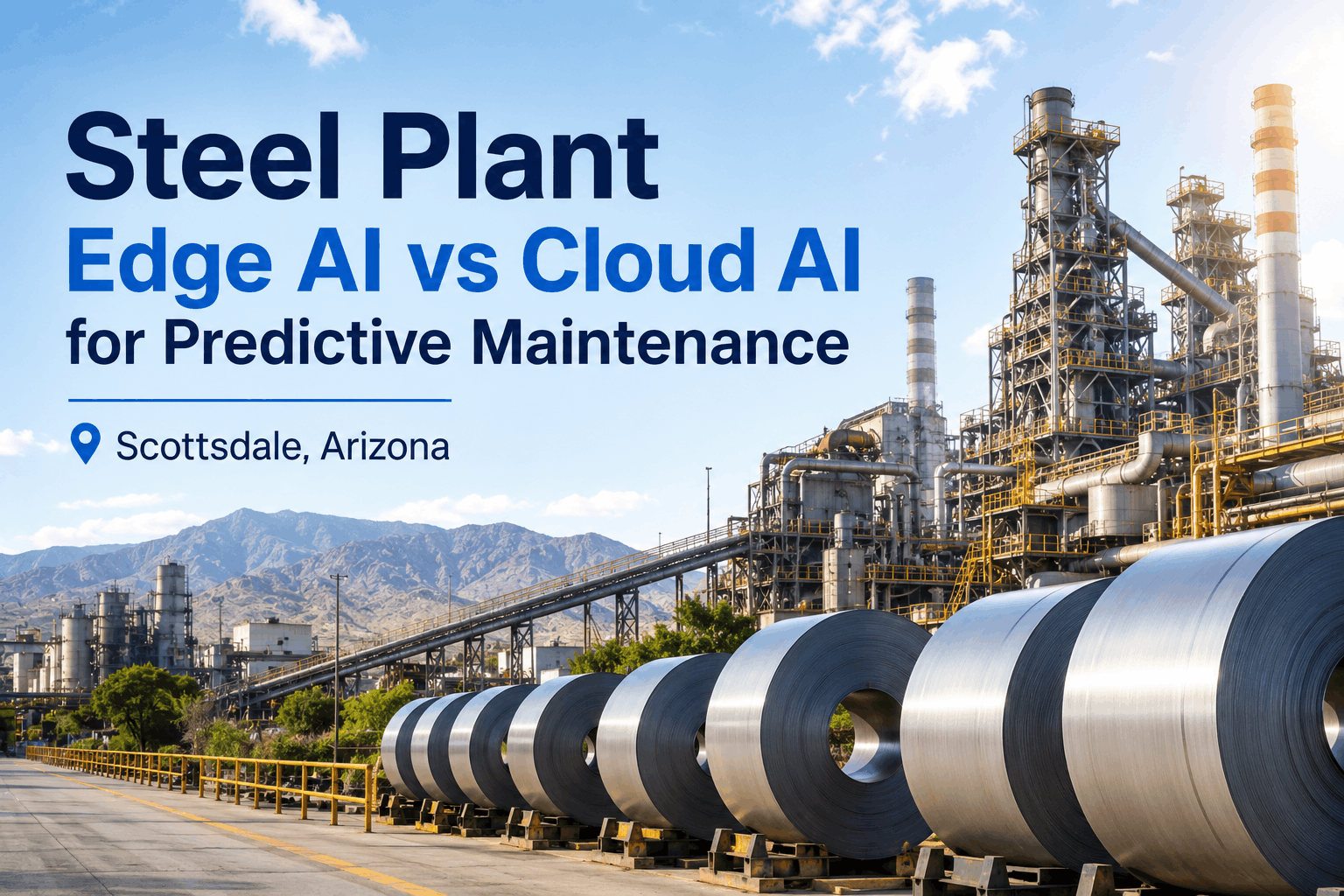
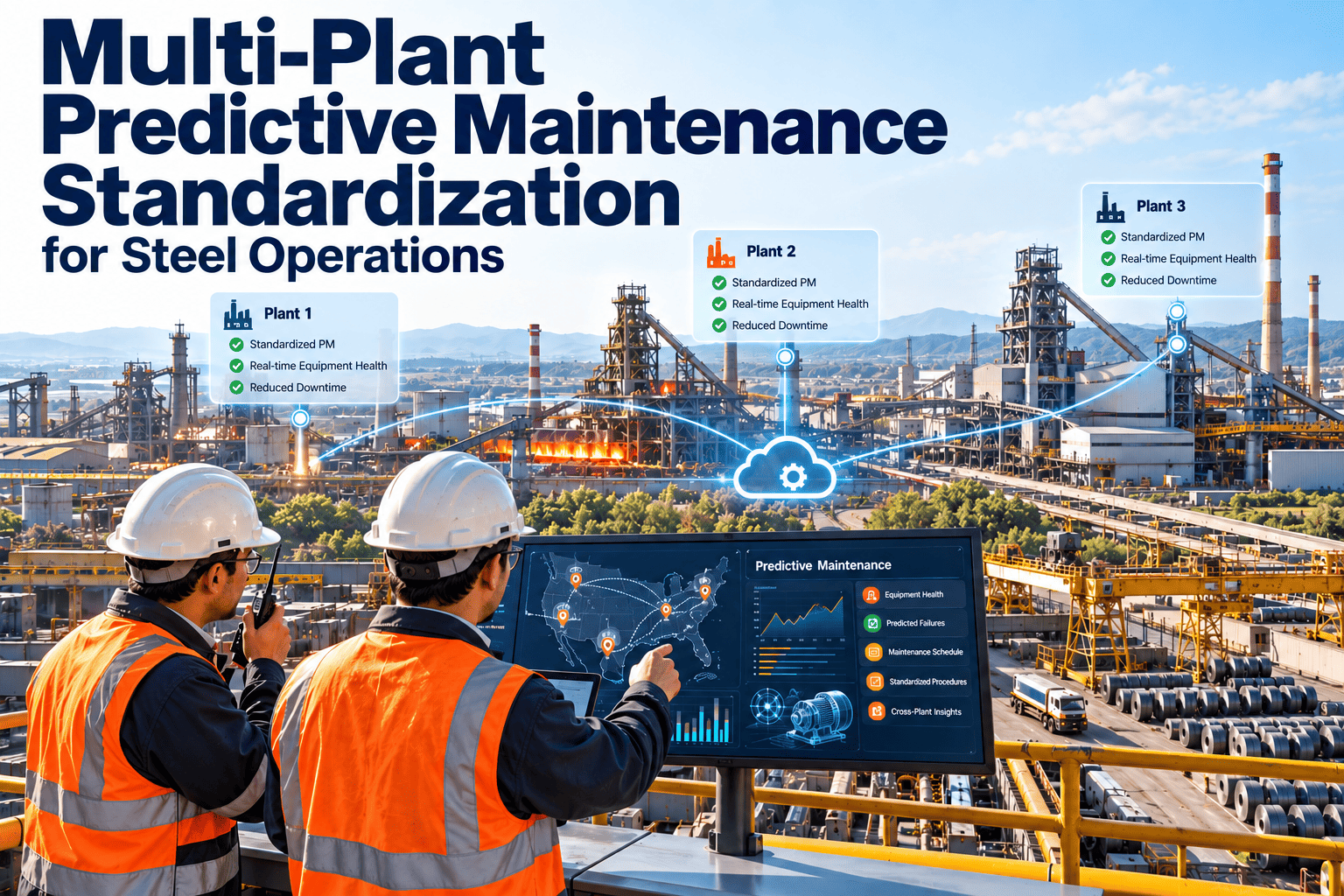
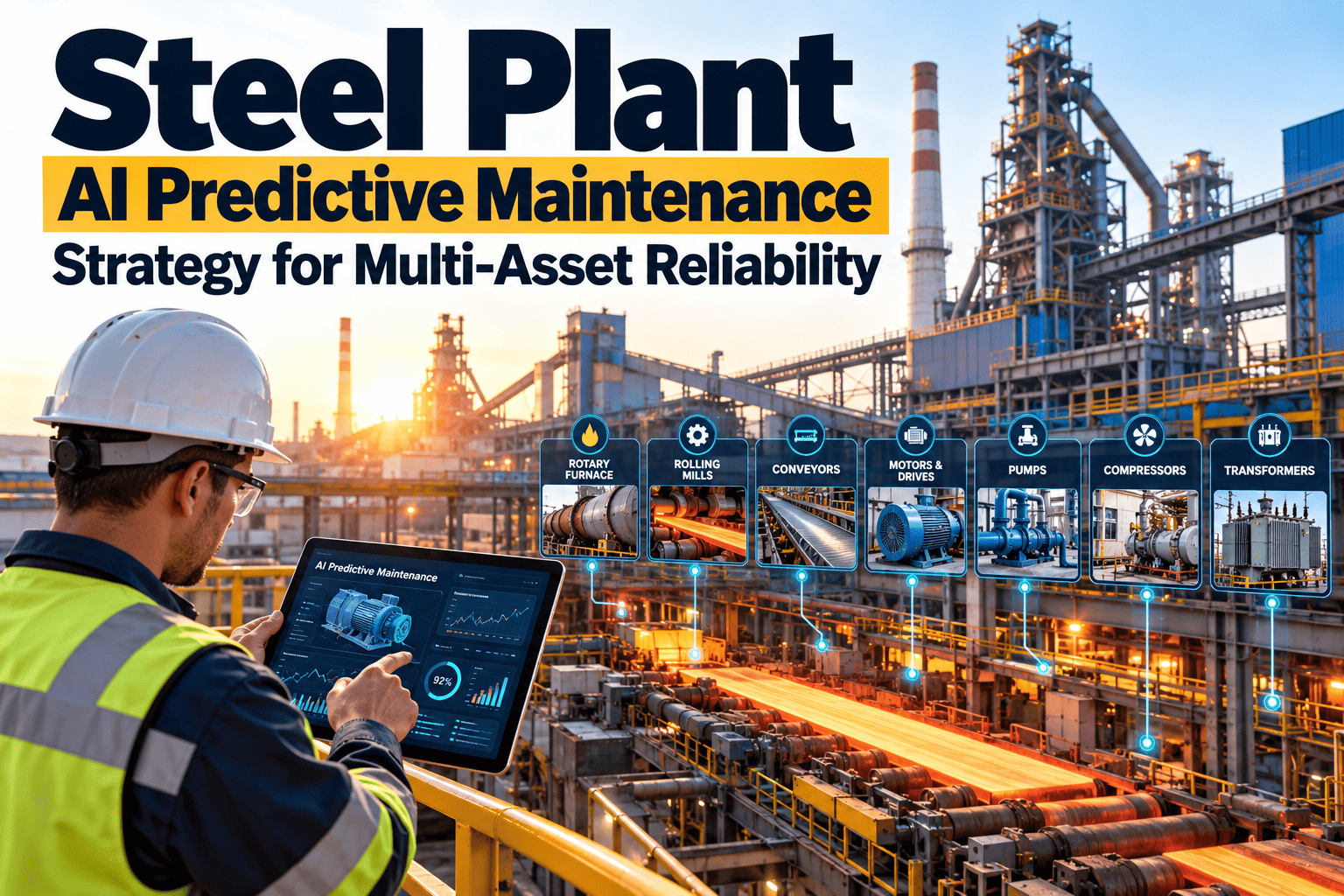
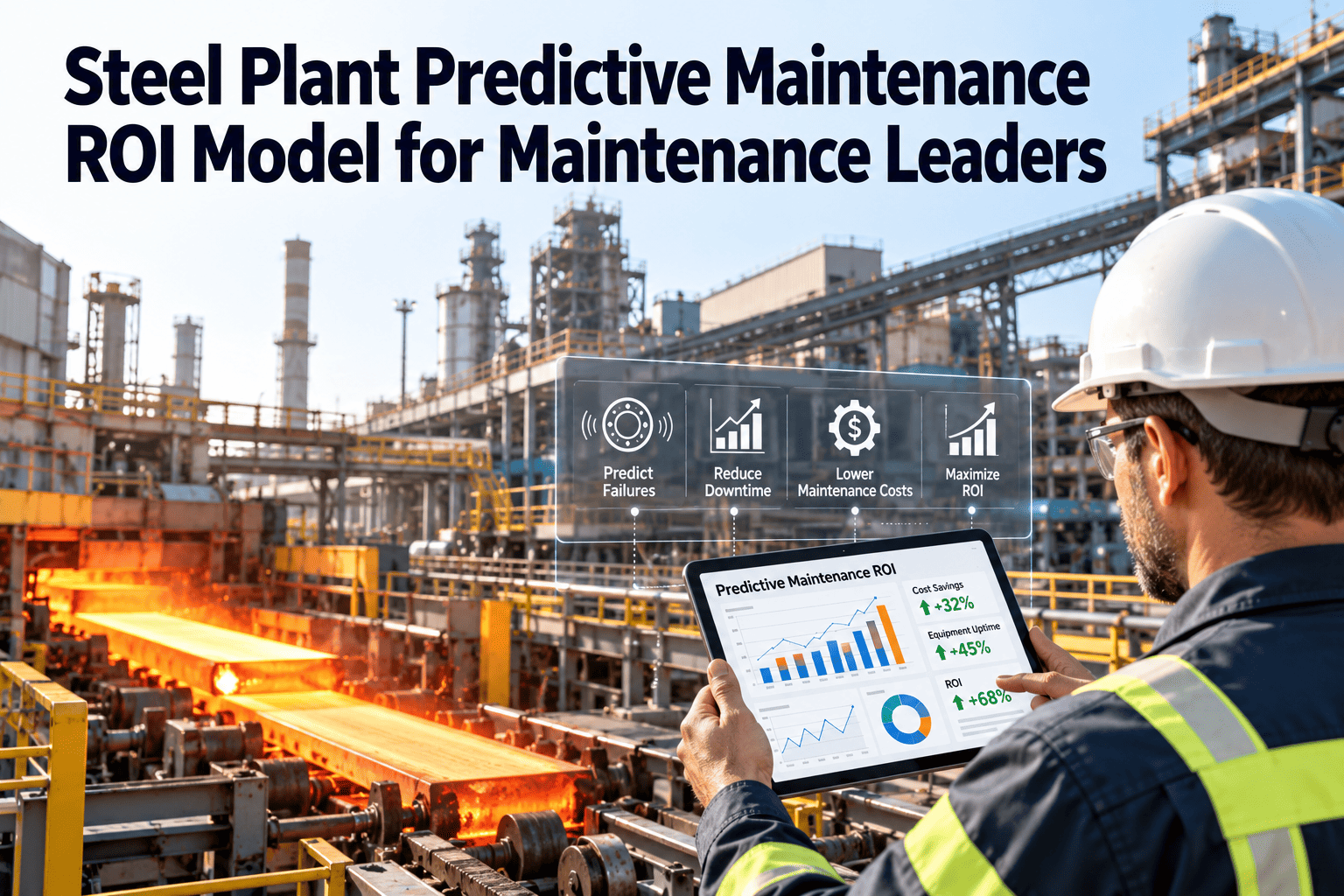
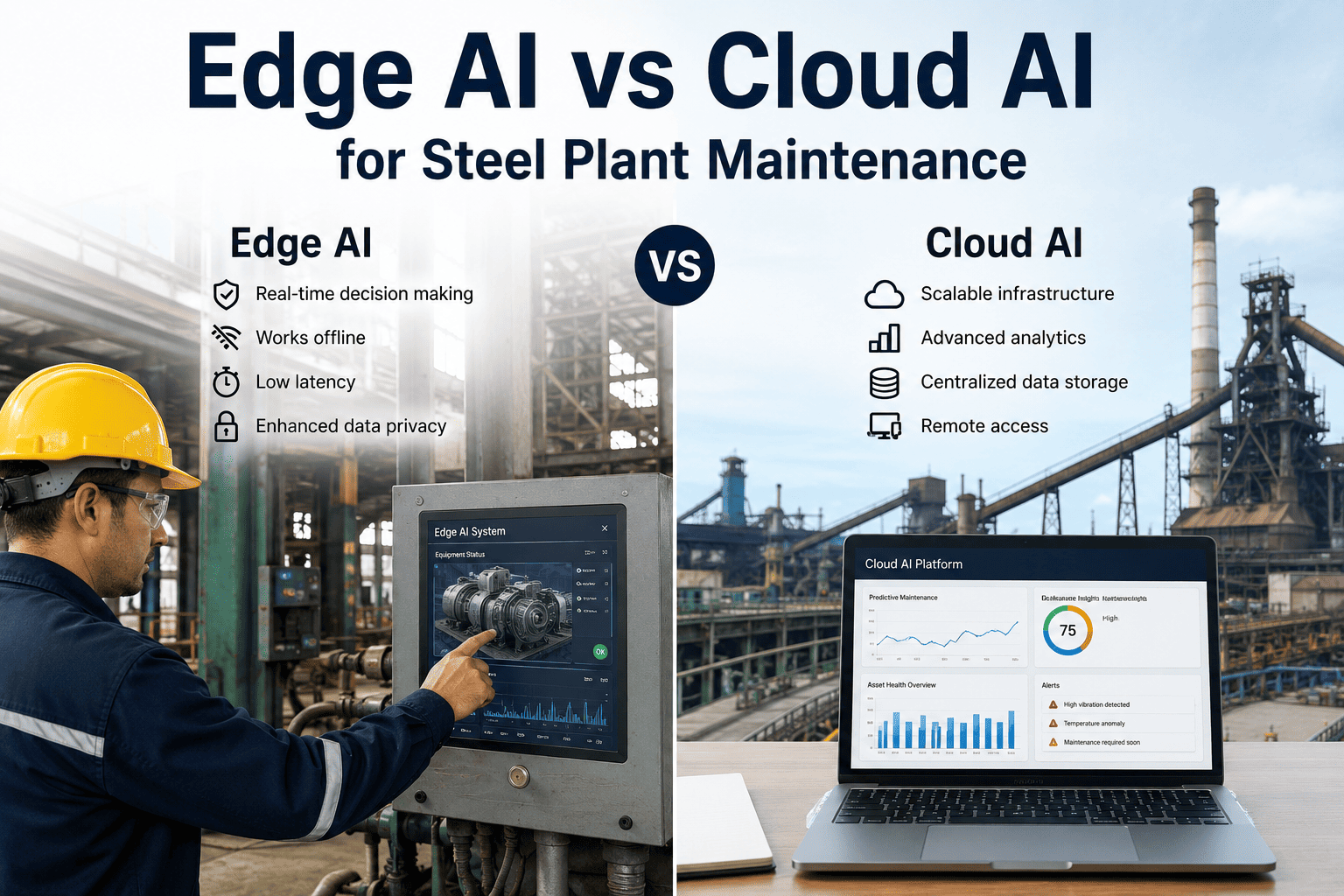
The difference between edge AI and cloud AI deployment in steel plants is not technical preference — it is a choice between predictive latency that enables real-time action (milliseconds) and architectural flexibility that scales with data volume (seconds to minutes). US steel mills deploying predictive maintenance today face a critical infrastructure decision: compute at the furnace (edge) where decisions happen in real-time, or transmit sensor data to cloud infrastructure where the compute happens 500–5,000 milliseconds later. At steel operating speeds — a bearing temperature excursion detected 2 seconds too late means a spindle seize that takes 8 hours to recover — latency is not an optimization metric. It is a safety and production constraint. Edge AI-enabled steel plants report 34% faster critical-failure response times, 28% fewer cloud data transmission outages affecting decisions, and 18% lower bandwidth costs from local filtering vs. streaming raw sensor data to cloud. If your steel mill is considering predictive maintenance infrastructure, start a free trial with Oxmaint or book a demo to evaluate edge AI feasibility for your equipment topology.
AI Infrastructure · Edge vs Cloud · Predictive Maintenance
Steel Plant Edge AI vs Cloud AI: Choosing the Right Architecture for Predictive Maintenance
The choice between edge AI and cloud AI for steel mill predictive maintenance is not about which technology is "better" — it is about which matches your latency requirements and risk tolerance. Edge AI makes decisions in 10–50 milliseconds locally. Cloud AI transmits to remote servers and waits 200–2,000 milliseconds for response. For bearing failures, pump vibration spikes, and furnace equipment faults, the faster decision-maker prevents more damage.
34%
Faster critical-failure response with edge AI deployment vs. cloud-dependent systems
28%
Fewer production decisions impacted by cloud connectivity outages with edge architecture
18%
Lower bandwidth costs from local sensor data filtering and edge anomaly detection
Architecture Comparison
Edge AI vs Cloud AI — Feature and Performance Matrix
| Metric | Edge AI (Local) | Cloud AI (Remote) | Hybrid (Best of Both) |
| Decision latency |
10–50 ms (local processing) |
200–2,000 ms (data upload + compute + response) |
50–200 ms (local fast decisions + cloud verification) |
| Connectivity dependency |
Operates offline, no internet required |
Total failure if WAN link down |
Local decisions always work; cloud enhancements if available |
| Data privacy/security |
All data stays on-site, full control |
Data transmitted externally, compliance burden |
Sensitive data local, aggregated metrics to cloud |
| Compute cost |
Hardware investment ($50K–$150K per node) |
Monthly subscription ($2K–$8K/month depending on data volume) |
Mixed: local hardware + cloud services ($100K upfront, $500–$2K/month) |
| Scalability |
Limited by physical hardware (typically 10–50 sensors per node) |
Unlimited — adds sensors, adds compute automatically |
Local scales to equipment limits; cloud scales to fleet limits |
| Model updates |
Requires IT deployment to each node (slow, manual) |
Automatic central updates across all connected devices |
Critical updates local via cloud sync; daily updates automatic |
| Bandwidth requirement |
Minimal — only anomalies transmitted (5–50 KB/day) |
High — raw sensor streams required (500 MB–5 GB/day per 100 sensors) |
Moderate — filtered data locally, summary to cloud (50–200 MB/day) |
| Equipment compatibility |
Works on older machines without connectivity; requires retrofit sensors |
Requires always-on internet connectivity; works on any equipment with sensors |
Hybrid: local for old equipment, cloud for modern connected systems |
Deployment Decisions
When to Choose Edge AI vs Cloud AI — Decision Factors
Neither edge nor cloud AI is universally superior. The choice depends on your equipment topology, failure consequence severity, connectivity reliability, and data sensitivity. Five deployment scenarios clarify where each architecture delivers the most value.
01
Equipment with Critical Failure Consequences → Edge AI Priority
Rolling mill drives, furnace pump motors, and casting machine hydraulics require sub-second failure response. A bearing temperature spike detected with a 500 ms delay means spindle seizure, cascading damage, and 12+ hour downtime. Edge AI running local vibration and temperature models detects bearing degradation in 50 ms, triggers alarm automatically, and prevents catastrophic failure. Cloud AI arriving 450 ms late cannot prevent the damage.
Result: Edge AI prevents equipment damage that cloud AI can only report after it happens.
02
Network Outages Are Frequent or Uncontrollable → Edge AI Mandatory
Rural US mills, mills in areas with aging telecom infrastructure, or mills with bandwidth-constrained networks cannot rely on cloud connectivity. A WAN link outage lasts 4–8 hours. If predictive maintenance is cloud-dependent, equipment monitoring stops for 4–8 hours. Edge AI continues operating offline. When connectivity returns, local decisions sync with cloud for post-analysis, but critical failures were not missed.
Result: Cloud-dependent systems go blind during outages. Edge systems self-operate continuously.
03
Data Sensitivity or Compliance is High → Edge AI Preferred
Mills with confidential process data, customer-sensitive specifications, or strict data residency requirements (HIPAA compliance for healthcare mills) cannot transmit raw sensor streams to cloud. Edge AI filters raw data locally, sends only summary alerts and aggregate trends to cloud, keeping production details on-site. Satisfies compliance audits and protects proprietary chemistry/process secrets.
Result: Edge AI enables predictive maintenance without violating data privacy or compliance requirements.
04
Equipment Base is Large and Growing → Cloud AI Advantage
A multi-facility steel company managing 500+ pieces of equipment across 8 locations cannot deploy individual edge nodes to each piece. Cloud AI scales: add a sensor to any equipment at any site, and predictive models apply automatically. Deploy once, monitor globally. Cloud AI's central architecture handles this scale elegantly. Each edge node would require separate maintenance and model updates — costly and error-prone at this scale.
Result: Cloud AI enables fleet-scale predictive maintenance. Edge AI creates maintenance burden at scale.
05
Hybrid: Critical Equipment + Fleet Analytics → Hybrid Architecture
Deploy edge AI on the 10–20 pieces of equipment where failures cause catastrophic damage (furnace drive, main casting machine, critical cooling systems). Failures at these points require sub-second response — edge AI handles this locally. Deploy cloud AI for the remaining 200+ secondary equipment (fan motors, pumps, compressors) where slower detection (tens of seconds) is acceptable. Local edge nodes make fast critical decisions; cloud makes slower but globally-coordinated decisions for fleet optimization.
Result: Hybrid minimizes latency-critical failures and maximizes efficiency across the full equipment fleet.
Technical Architecture
How Oxmaint Enables Both Edge and Cloud AI for Steel Mills
Edge Layer
Local Industrial Gateways (IIoT Edge Compute)
Oxmaint deploys industrial-grade edge gateways (Siemens SIMATIC Edge, Beckhoff CX9000, or open-source alternatives) directly on the mill floor or in equipment proximity. Gateways run containerized predictive models (10–50 MB footprint each) that ingest sensor data via Modbus TCP, PROFINET, or OPC-UA. Models score incoming data in real-time with 10–50 ms latency, execute alarm logic locally, and transmit only alerts and anomaly summaries to the cloud.
Local decision latency: 10–50 ms per sensor input; 99.9% uptime without cloud connectivity
Cloud Layer
Centralized Learning and Optimization (Cloud AI)
All edge nodes continuously send summarized alerts, anomaly events, and periodic model performance metrics to Oxmaint cloud. Cloud aggregates data from all mills, all equipment types, and all furnaces to build global predictive models. A furnace bearing failure pattern observed in one mill becomes training data for all mills' predictive models. Cloud computes aggregate fleet health, trends, and recommends model updates back to all edge nodes automatically.
Global model training from 10,000+ mill events across US steel industry; models improve weekly
Hybrid Sync
Automatic Model Sync and Fallback Logic
Edge nodes maintain a production model (current active model for real-time decisions) and a candidate model (latest from cloud). When cloud connectivity is available, newer models are synced to edges. If connectivity drops, edges continue using last-known-good production model. When connectivity resumes, any local decision history syncs to cloud for post-analysis and model retraining. No decisions are lost, no alerts are missed.
Seamless edge-cloud handoff; local continues during outages; cloud learns from edge decisions post-hoc
Security
End-to-End Encryption and Zero-Trust Architecture
Edge nodes encrypt all outbound data (TLS 1.3) before transmission to cloud. Cloud validates edge identity via mutual TLS certificates. Raw sensor data is never stored in cloud — only parsed alerts and aggregated metrics are retained. Edge nodes filter sensitive process parameters (exact chemistry values, customer order details) and send only derived risk scores and anomaly indicators to cloud.
Zero raw production data in cloud; HIPAA and SOC 2 compliance for data residency
Bandwidth
99% Reduction in Raw Data Transmission
A rolling mill with 100 vibration sensors sampling at 1 kHz would generate 1.6 GB per minute of raw data (uncompressed). Cloud AI would require massive bandwidth. Oxmaint edge nodes run anomaly detection locally: only when vibration deviates from baseline does the gateway transmit data (called "data sparification"). Typical transmission is 50–200 MB per day per 100 sensors instead of 1.5–2.5 TB/day.
Bandwidth reduction of 99%: from 1.5 TB/day to 50 MB/day for typical 100-sensor array
Compliance
Audit Trail and Decision Provenance
Every edge node decision (alarm triggered, model version used, sensor data range) is logged locally with timestamp. When cloud connectivity resumes, audit log syncs for regulatory review. ISO 9001, ISA/IEC 62443 (industrial cybersecurity), and FDA compliance audits receive complete decision history. Edge-local logging prevents "data loss during outage" excuses — local storage preserves full audit trail.
Full audit trail preserved locally during outages; syncs to cloud for compliance reporting
Architecture Scenarios
Five Real-World Deployment Scenarios — Edge, Cloud, or Hybrid
Choosing between edge and cloud AI is scenario-specific. Here are five common steel mill situations and the recommended architecture for each, with reasoning and expected outcomes.
Single-facility mills benefit most from hybrid architecture. Deploy one edge gateway (cost: $80K) for the 10–15 highest-value equipment (furnaces, casting machines, main motors). These require sub-second failure detection. Deploy cloud AI for the remaining 65–70 equipment where seconds-scale detection is acceptable. IT staff manages one edge node locally; cloud handles global optimization for secondary equipment. Total cost: $150K hardware + $2K/month cloud.
Recommended action: Hybrid edge-cloud. Edge for catastrophic-failure equipment, cloud for optimization. Local IT team owns edge maintenance; Oxmaint owns cloud reliability.
Book a demo to assess your equipment criticality tier.
Expected outcome: 40% reduction in unexpected downtime in year 1; $380K annual cost savings from prevented failures; hybrid architecture requires minimal IT overhead.
Multi-facility companies benefit most from pure cloud AI architecture. Managing 8–12 distributed edge nodes is operationally expensive (firmware updates, local troubleshooting, hardware replacements at remote sites). Cloud AI scales with zero local overhead: add equipment at any site, AI applies automatically. Global model training across all mills improves predictions faster. Bandwidth cost ($2K–$5K/month) is trivial vs. distributed IT support cost ($20K+/month for geographically dispersed technicians).
Recommended action: Cloud-first architecture for fleet-scale efficiency. Local IT focuses on sensor installation and equipment integration; Oxmaint cloud handles all predictive modeling.
Start a free trial to test cloud integration with your equipment types.
Expected outcome: 50% fewer unexpected failures across fleet in year 1; centralized diagnostics reduce MTTR by 35%; global model training yields 8–12% accuracy improvement every quarter; cloud scales linearly with equipment additions.
Unreliable connectivity mandates edge AI. Cloud-dependent systems become useless during outages. Edge AI runs continuously: monitors equipment locally, stores alerts locally, and queues decision history for cloud sync when connectivity resumes. Local IT team operates the edge gateway independently. Cloud provides weekly model updates and best-practice learning from other mills (received during stable connection windows, pre-staged for offline use).
Recommended action: Pure edge AI with cloud connectivity for model updates only (asynchronous, not real-time critical). Edge gateways operate 24/7 offline; cloud link needed only 1–2 hours/day for model sync and historical data upload.
Expected outcome: 100% equipment monitoring uptime despite connection outages; edge gateways require 2–3 hours/month maintenance; cloud learning occurs offline, not impacting local decisions.
Pure edge AI or hybrid with strict data filtering. Edge nodes run predictive models locally without transmitting raw chemistry or process parameters to cloud. Only anomaly flags and aggregate trends are sent externally (e.g., "bearing temperature exceeded threshold 3 times this week"). Sensitive data (actual furnace temperature, exact carbon content) remains on-site permanently. Cloud learning happens on derived signals only, not raw process data.
Recommended action: Hybrid edge-cloud with data filtering. Edge protects sensitive data; cloud provides optimization and global learning on non-sensitive metrics. Oxmaint data filtering can be customized per customer — contact
our sales team for data residency configuration options.
Expected outcome: Full compliance with data privacy requirements; no sensitive process data leaves facility; predictive accuracy remains 95%+ because anomaly signals preserve failure-prediction information without revealing proprietary data.
Cloud-first architecture with optional edge for microsecond response. Reliable connectivity means cloud AI can make decisions centrally at scale. If ultra-low-latency response is needed (sub-100 ms for specific equipment), lightweight edge agents deployed for local decision caching. But primary decision-making is cloud-based. This maximizes scalability, model freshness, and IT efficiency — no local nodes to maintain.
Recommended action: Cloud-first, optionally add lightweight edge agents for ultra-critical equipment if response time testing shows cloud latency insufficient. Start cloud-only; add edge incrementally only if measured latency becomes an issue.
Expected outcome: Fastest time-to-value with cloud-only; models improve weekly from global learning; equipment can be added in minutes; no local IT overhead; scalability limited only by cloud infrastructure (not a practical constraint).
Edge + Cloud AI Framework
The Right Architecture for Your Steel Mill Is Determined by Your Constraints, Not by Technology Trends
Oxmaint supports both edge AI (for latency-critical equipment and offline reliability) and cloud AI (for fleet-scale optimization and minimal IT overhead).
Book a demo to map your equipment criticality to the architecture that best fits your operational risk and IT capability.
Live Architecture Flow
How Edge-Cloud Hybrid Decision-Making Works in Real Time
Sensor
Real-Time Data Collection at Equipment
Vibration, temperature, or acoustic sensors sample equipment state at 100 Hz – 10 kHz depending on sensor type. Data flows locally to edge gateway via Modbus TCP or PROFINET. No data leaves the equipment area unless flagged as anomalous.
Edge
Millisecond-Scale Local Decision (10–50 ms latency)
Edge AI model (running in containerized inference engine) scores incoming data in real-time. Vibration threshold exceeded? Bearing temperature trending? Edge decision happens in 10–50 ms, completely offline. If anomaly detected, edge triggers local alarm (relay shutdown, operator notification) immediately — zero cloud latency dependency.
Filter
Data Sparification — Only Anomalies Transmitted
Normal baseline data (99% of data stream) is discarded locally. Only anomalies, threshold crossings, and alert events are queued for transmission to cloud. Bandwidth requirement drops from 1–2 TB/day to 50–200 MB/day. If cloud connection drops, local anomaly queue persists (local storage: 7–30 days of anomalies).
Cloud
Seconds-Scale Global Analysis (200–2,000 ms)
Cloud AI receives anomalies from edge, correlates with fleet-wide patterns (is this bearing failure pattern seen elsewhere?), and sends back rich context and next actions. Cloud learns from all mills: bearing failure in Mill A informs bearing models for all other mills. Global model improves continuously. Cloud analysis takes 200–2,000 ms, but this is not time-critical — edge already handled the immediate alarm.
Sync
Async Sync — Model Updates Staged During Low-Demand Windows
Cloud computes updated predictive models weekly. During low-production windows (nights, weekends), models are synced to edge gateways. Edge stores new model as candidate; continues using production model until operator approves the update. Production edge model is never interrupted by model updates.
Learn
Continuous Model Improvement from All Equipment
Every anomaly, every alert, every false positive is recorded. Cloud trains models weekly on this feedback. Edge models become more accurate (fewer false positives, faster true positive detection) every cycle. Mill-specific models learn mill-specific patterns (your furnace temperature trends, your pump aging curves); global models learn industry-wide patterns.
Performance Outcomes
What Steel Mills Report With Edge-Cloud Hybrid AI Deployment
34%
Faster Critical Failure Response
Edge AI detects bearing degradation in 50 ms vs cloud 500–2,000 ms. Millisecond-scale response prevents cascading equipment damage that would require 12–24 hour recovery.
28%
Fewer Connectivity Outage Impacts
Edge AI operates fully offline; cloud connectivity loss does not disable predictive maintenance. Mills with unreliable WAN report near-100% monitoring uptime with edge architecture.
18%
Lower Bandwidth Costs
Data sparification at edge reduces transmission from 1.5 TB/day to 50 MB/day. Monthly bandwidth cost drops from $500–$1,500 to $50–$150 per 100 sensors.
$280K
Average Annual Cost Avoided
Per facility — combining prevented equipment failures, MTTR reduction from fast diagnosis, and bandwidth savings from hybrid architecture vs pure cloud.
Decision Matrix
Quick Architecture Selection Guide
| Your Situation | Recommended Architecture | Key Reasoning | First Action |
| Frequent network outages (2+ per week) |
Edge AI |
Cloud connectivity is unreliable; local processing is non-negotiable |
Start trial with offline configuration |
| Strict data privacy / confidential processes |
Edge-Cloud Hybrid (filtered) |
Sensitive data cannot leave facility; edge filters before transmission |
Book demo to configure privacy filtering |
| 500+ equipment across 5+ locations |
Cloud AI |
Fleet-scale optimization; distributed edge management too expensive |
Start trial with multi-facility setup |
| Critical equipment with sub-second failure risk |
Edge AI (+ Cloud for secondary) |
Latency-critical equipment needs local decision-making; others benefit from cloud |
Identify 10–20 critical pieces; book demo for hybrid sizing |
| Reliable connectivity, digital-first culture, <50 locations |
Cloud AI (pure) |
Cloud infrastructure handles scale efficiently; no local overhead needed |
Start trial with cloud-only deployment |
Common Questions
Edge AI vs Cloud AI — Frequently Asked Questions
Can we start with cloud AI and add edge AI later if latency becomes a problem?+
Yes. Oxmaint is designed for incremental edge deployment. Start cloud-only, measure latency in production, and add edge gateways only for equipment where cloud response time is insufficient (typically <50 ms requirement). Hybrid can be built gradually without re-architecting; cloud models feed edge locally after testing proves benefit.
What is the typical cost difference between edge AI and cloud AI deployment?+
Edge: $80K–$150K per gateway + local IT maintenance ($1K–$2K/month). Cloud: $2K–$8K/month depending on data volume, zero upfront hardware. Hybrid: $100K–$150K upfront + $500–$2K/month. For 5+ year horizon, hybrid is typically lowest cost; pure edge has high maintenance burden at scale; pure cloud cheapest for large fleets.
If we lose cloud connectivity, do we lose all historical data and analytics?+
No. Edge gateways store 7–30 days of anomaly history locally. Cloud connectivity loss does not delete local data. When connectivity resumes, all queued alerts and decision history sync to cloud. Global fleet analytics may be delayed by outage duration, but no equipment decisions are lost.
How often do edge AI models need to be updated, and who manages updates?+
Oxmaint cloud computes updated models weekly. Updates are staged to edge gateways during low-production windows (nights, weekends) and require operator approval before activation. Updates do not interrupt running edge decisions. Your local IT team approves updates; Oxmaint handles model computation and staging.
What happens to edge AI predictions if the equipment's behavior changes (e.g., new bearing installed)?+
Edge AI models include baseline drift detection. If a bearing is replaced, the model detects the sudden behavior shift (baseline changes), flags it as a potential equipment change, and alerts your maintenance team. Operator confirms the equipment change in Oxmaint, and baseline is reset. Models adapt to "new bearing normal" within 2–3 days.
Can edge AI work offline indefinitely, or does it need periodic cloud sync?+
Edge AI works offline indefinitely using production models. Cloud sync is needed weekly (or monthly if infrequent) to receive updated models and send decision history for global learning. But equipment monitoring and local alarms function 24/7 offline. Sync is asynchronous; it does not interrupt operations.
If we choose cloud AI, are we locked into Oxmaint forever, or can we export data and models later?+
Oxmaint models are proprietary during active subscription, but all decision data (alerts, decisions, test results) are exported in standard formats (CSV, JSON) on demand. Cloud-trained models can be retrained on your exported data using open-source tools (scikit-learn, TensorFlow) if you choose to leave.
Contact support for data export procedures.
What is the total deployment timeline for edge-cloud hybrid architecture?+
Typical timeline: 4–6 weeks (2 weeks planning and equipment assessment, 2–3 weeks edge/cloud setup and integration testing, 1–2 weeks operator training and cutover). Pure cloud faster (3–4 weeks); complex hybrid with 5+ facilities may extend to 10–12 weeks.
Book a demo to discuss timeline for your specific setup.
Industry Perspective
What Operations Leaders Say
"We have furnace equipment that cannot go down — spindle seize in the rolling mill costs us $50,000 in lost production per hour. We needed edge AI locally to catch bearing failures in milliseconds, not cloud latency in seconds. Oxmaint's hybrid setup gave us both: edge for the critical stuff, cloud for global learning across our 8 mills. We went from reactive maintenance (equipment fails, then we fix) to predictive (we know 24 hours ahead). Game changer."
— VP Operations, Multi-Mill Steel Company (Midwest US)
Edge + Cloud AI Strategy
Your Predictive Maintenance Architecture Should Fit Your Equipment Risk and Connectivity Reality — Not the Other Way Around.
Oxmaint supports edge AI (for latency-critical, offline-reliability needs), cloud AI (for fleet-scale optimization and minimal IT overhead), and hybrid (for safety-critical equipment + efficiency across the fleet).
Book a demo to map your equipment topology and determine the right architecture for your mills.