Steel plant AI deployments are hitting a critical fork in the road: run intelligence at the edge — directly on sensors, PLCs, and gateway hardware inside the plant — or route data to the cloud for processing and analysis. Both architectures can deliver predictive maintenance, AI vision inspection, and anomaly detection. But the choice between them has real consequences for latency, data sovereignty, network dependency, and total cost when deployed across blast furnaces, rolling mills, and BOF converters. OxMaint's Predictive Maintenance AI is designed to operate across both deployment models — giving steel plant teams the architecture that fits their infrastructure without locking them into a single approach.
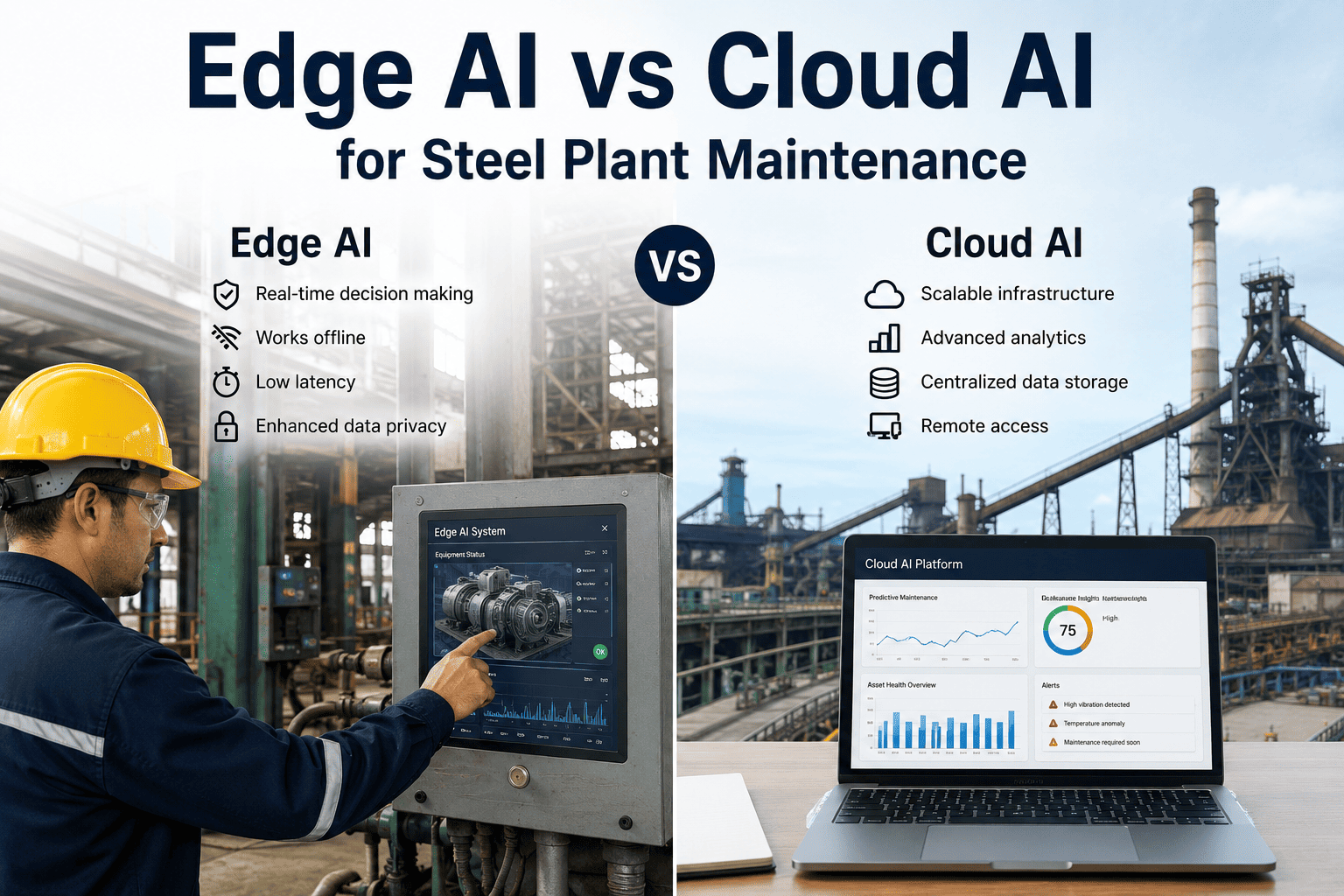
Edge AI vs Cloud AI for Steel Plant Maintenance
Latency, AI vision inspection, connectivity, data sovereignty, and deployment cost — the complete architecture comparison for industrial AI in integrated steel facilities.
The Architecture Decision: What's Actually Different
Edge AI processes sensor data and runs inference models locally — on hardware installed inside the plant, near the asset. Cloud AI sends data upstream to remote servers, runs analytics there, and pushes results back. In theory, the difference is just geography. In practice, it determines whether your rolling mill gets a real-time shutdown alert at 12ms or a delayed notification at 2–8 seconds — a difference that determines whether a bearing failure is caught in time or becomes a 148-hour unplanned outage.
AI inference runs on local hardware — industrial PCs, edge gateways, or hardened controllers installed within the plant. Processing happens without internet connectivity. Data stays on-site unless explicitly sent upstream.
Sensor data streams to cloud servers where AI models run at scale. Results, alerts, and work order triggers are pushed back to on-site systems. Unlimited compute resources, easier model management and updates.
Steel Plant Use Case Fit: Which Architecture for Which Asset
Not all steel plant AI use cases have the same latency or connectivity requirements. The table below maps common predictive maintenance and AI inspection scenarios to the architecture that delivers the best outcome — and identifies the hybrid cases where both matter.
| Steel Plant Use Case | Asset | Required Latency | Best Architecture | Why |
|---|---|---|---|---|
| Rolling mill bearing anomaly shutdown | Roll neck bearings, drive spindles | Under 100ms | Edge AI | Latency to OPC-UA shutdown signal must be sub-cycle |
| Blast furnace thermal profile analysis | Blast furnace stack, tuyeres | 1–5 seconds | Cloud AI | Complex multi-parameter model; compute intensive; not time-critical |
| BOF converter AI vision inspection | Converter vessel, lance, mouth | Under 200ms | Edge AI | Vision inference during active heat; zero latency tolerance |
| Coke oven battery predictive analytics | Oven doors, offtake pipes, refractory | Minutes acceptable | Cloud AI | Long trend analysis; connectivity stable in battery area |
| Conveyor belt tear detection | Raw material and finished goods conveyors | Under 500ms | Edge AI | Remote conveyor locations often have limited WAN; immediate stop required |
| Fleet-wide maintenance pattern analytics | All plant assets — multi-site | Hours acceptable | Cloud AI | Cross-asset pattern detection requires aggregated data at scale |
| Hydraulic screwdown pressure anomaly | Rolling mill hydraulic systems | Under 150ms | Edge AI | Pressure excursion during rolling pass requires immediate valve response |
| ESG emissions analytics — furnace | Reheating furnaces, sinter plant | Daily batch acceptable | Cloud AI | Scope 1 calculations need centralised reporting across all furnaces |
Latency Impact: Why Milliseconds Matter on a Rolling Mill
A hot rolling mill stand operates at strip speeds of 8–25 m/s. At 15 m/s, a 1-second detection delay means 15 metres of steel has passed through an out-of-tolerance pass before the anomaly alert fires. The graph below shows the detection-to-action window for both architectures across typical steel plant scenarios.
Event Timeline: AI Anomaly to Work Order — OxMaint Hybrid Flow
OxMaint operates across both edge and cloud tiers — edge inference fires the real-time alert and safety response, while cloud analytics builds the predictive model and generates the CMMS work order for the maintenance team.
Vibration sensor on Rolling Mill Stand 3 bearing housing crosses 6.8 mm/s RMS threshold. Edge AI model classifies signature as inner race fatigue — 91% confidence.
Edge gateway sends OPC-UA alert to PLC. Operator HMI alarm triggered. Speed reduction protocol initiated on mill pass — no WAN connectivity required.
Anomaly packet uploaded to OxMaint cloud. Cross-asset model compares signature against 2,400 historical bearing failures — confirms failure within 18–36 hrs at current load profile.
OxMaint CMMS creates Work Order #WO-4821 — priority P1, bearing replacement, asset history attached, spare part #BRG-0441 reserved from inventory. Dispatched to shift technician A. Sharma's mobile.
Bearing replaced during planned maintenance window. Work order closed with technician digital signature, post-repair vibration readings attached. Asset record updated. Zero unplanned downtime.
See OxMaint AI in Action on Your Steel Plant Assets
Book a 30-minute technical walkthrough and see how OxMaint's hybrid AI architecture connects to your rolling mill sensors, generates predictive work orders, and closes the loop from anomaly detection to maintenance sign-off.
Data Sovereignty & Security: The Steel Plant Compliance View
For steel plants in regulated markets — or those with export controls on production data — data sovereignty is not a preference, it is a compliance requirement. Edge AI keeps all raw sensor data on-site. Cloud AI requires data to leave the plant boundary, triggering data classification, residency, and transfer obligation reviews under DPDPA (India), GDPR (EU), or plant-level IP protection policies.
| Data & Security Dimension | Edge AI | Cloud AI | OxMaint Hybrid |
|---|---|---|---|
| Raw sensor data location | On-site only | Leaves plant to cloud | Raw stays on-site; summaries to cloud |
| Production process data | Never transmitted | Transmitted in full | Anonymized pattern data only |
| DPDPA / GDPR compliance | Fully compliant by design | Requires DPA / data residency controls | Configurable per jurisdiction |
| Failure during WAN outage | Fully operational | Detection blind during outage | Edge detects; syncs when reconnected |
| Model IP protection | Models run locally, not exposed | Models on vendor cloud | Inference local; training on cloud |
Total Cost Comparison — 3-Year TCO for 50-Asset Steel Plant Deployment
The cost gap between edge and cloud narrows significantly when connectivity infrastructure, data transfer costs, and the financial impact of detection latency are included. The graph below models a 50-sensor deployment across rolling mill, blast furnace, and conveyor assets.
Expert Review
The edge-versus-cloud debate in steel is often misframed as a binary choice. In practice, the steel plant use cases that matter most split almost perfectly by latency requirement: rolling mill shutdown signals, BOF vision inspection, and hydraulic anomaly detection are edge problems by definition — no WAN round-trip can serve them. Fleet analytics, ESG reporting, and cross-plant pattern learning are cloud problems by definition — local compute cannot build models from 2,400 historical failure signatures. The plants achieving 85%+ preventable downtime reduction are not the ones that picked a side in this debate. They are the ones running a genuine hybrid — edge for real-time response, cloud for long-range intelligence. Platforms like OxMaint that bridge both tiers and connect the output to a live CMMS work order system are where the actual ROI lives.
Frequently Asked Questions
Build Your Steel Plant AI Architecture on the Right Foundation
OxMaint connects edge AI inference, cloud analytics, and CMMS work order automation in a single platform — giving your rolling mill, blast furnace, and BOF assets real-time protection and long-range predictive intelligence without choosing one or the other.