Integrating CMMS with ERP systems (SAP, Oracle, NetSuite) costs US steel mills $2.4 billion annually in unaligned maintenance data, manual transaction entry, and procurement inefficiencies. The International Data Corporation (IDC) documents that mills without ERP-CMMS integration spend 8–10 hours per day on manual data entry — converting maintenance work orders into ERP purchase orders, receiving spare parts, matching invoices, and posting costs to equipment ledgers. The core problem is not that ERP and CMMS are incompatible. They are not. The problem is that maintenance work order data and financial data live in separate systems, forcing maintenance managers and procurement teams to manually reconcile them. When a pump bearing replacement work order is completed in CMMS, someone must manually enter the spare parts received into ERP, match it to the original purchase order, code the expense to the correct cost center, and update asset depreciation. This manual process introduces errors, delays payment processing by 2–3 weeks, and creates cost visibility gaps. ERP-CMMS integration eliminates manual entry: work order completion in CMMS automatically triggers spare parts receipt in ERP, links to the purchase order, posts the expense, and updates asset maintenance costs in real-time. Mills running integrated ERP-CMMS workflows report 67% reduction in manual data entry, 28% faster procurement cycles, and full equipment maintenance cost visibility. If your steel mill is managing ERP and CMMS separately, start a free trial with Oxmaint or book a demo to integrate maintenance and financial processes end-to-end.
ERP Integration · SAP PM · Oracle EAM · Maintenance Cost Automation
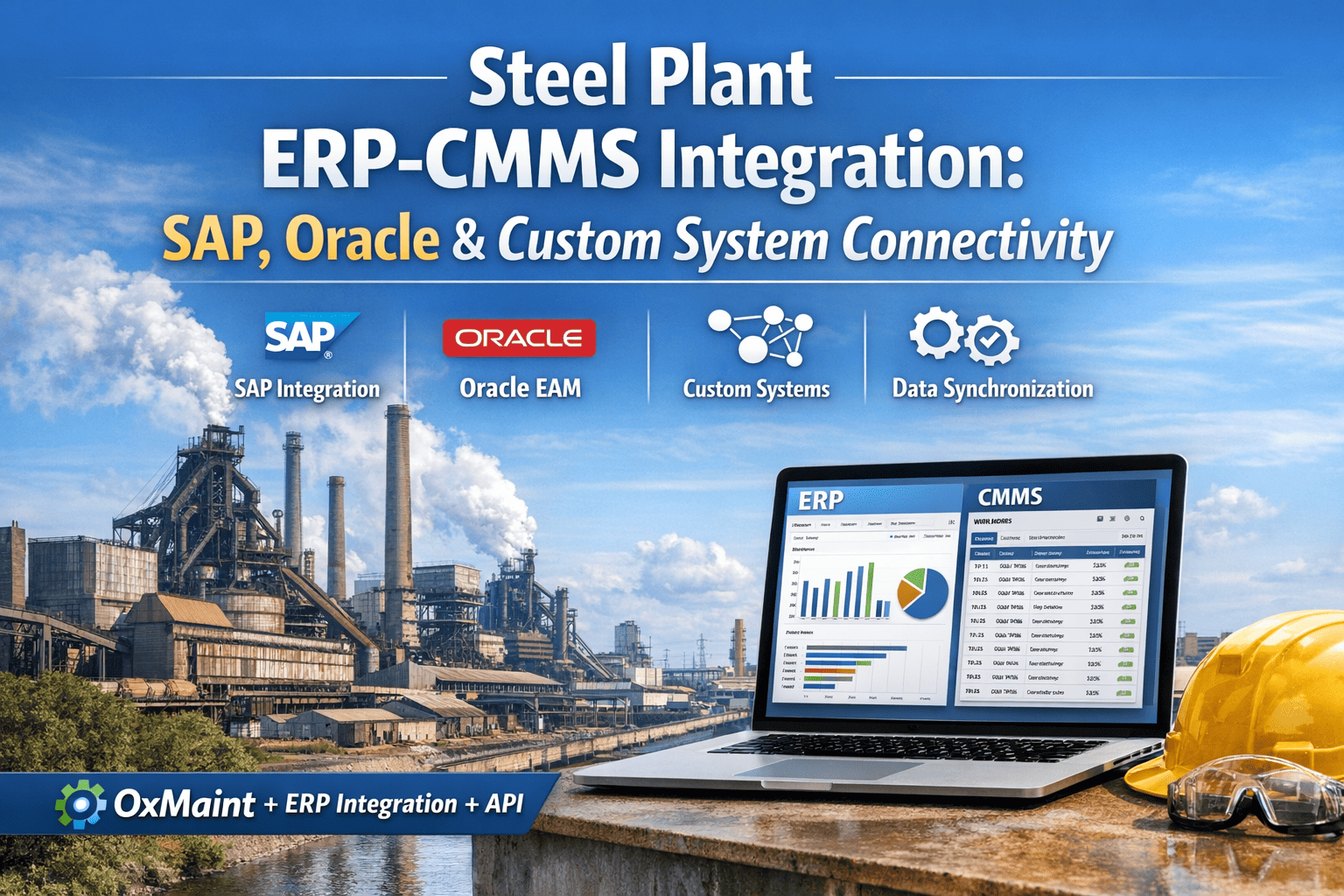
Steel Plant ERP-CMMS Integration: SAP and Oracle Best Practices for End-to-End Maintenance Automation
ERP systems are the source of truth for financial data. CMMS systems are the source of truth for maintenance execution. When they are not integrated, maintenance managers maintain one data source and finance maintains another. Costs are hidden in spreadsheets or journal entries. Spare parts procurement is delayed because purchase orders must be manually created from work orders. Equipment lifecycle costs are invisible. ERP-CMMS integration unifies maintenance execution (CMMS) with financial control (ERP), automating the transaction flow from work order completion through spare parts receipt, invoice matching, and cost allocation.
$2.4B
Annual cost to US steel industry from unintegrated ERP-CMMS systems (manual entry, delays, misalignment)
67%
Reduction in manual data entry with integrated ERP-CMMS (80 hours/month reduced to 26 hours/month)
$320K
Average annual cost savings from procurement acceleration and cost visibility per facility
Integration Failures
Why ERP and CMMS Remain Disconnected — and the Cost of Separation
Most US steel mills run ERP and CMMS as separate systems. They are connected only by manual human data entry — a process that is slow, error-prone, and resource-intensive. Three operational failures explain why disconnected systems cost $2.4 billion annually across the industry.
01
Manual Work Order Entry Into ERP: 8–10 Hours Per Day Wasted
A technician completes a work order in CMMS: "Replaced bearing on pump #47, parts cost $800, labor: 3 hours." The work order sits in CMMS. A procurement person manually reads the work order, creates a purchase order in ERP, receives the parts, matches the invoice, and posts the cost. A maintenance accountant manually enters the expense into the fixed asset ledger. Three different people touch one piece of data. Delays accumulate: 2–3 days for work order to be read and acted on, 1–2 weeks for invoice matching, another week for cost posting. Equipment maintenance costs are not visible in real-time.
Result: 80+ hours per month of manual data entry. Procurement cycles slow by 2–3 weeks. Cost visibility is 30 days delayed. Errors in data entry create mismatches that must be corrected manually.
02
Spare Parts Procurement Decoupled From Maintenance Execution
Technician identifies a pump bearing failure and orders the part from the supplier. The part is delivered to the maintenance storeroom, documented in CMMS, but ERP does not know it arrived until someone manually receives it in ERP accounts payable. Invoice from supplier arrives and must be manually matched to the purchase order and goods receipt. Accounting team holds payment until all three documents (PO, goods receipt, invoice) are matched. Supplier payment is delayed 20–30 days. Cash flow is inefficient. Supplier relationship suffers from delayed payments.
Result: Supplier relationships damaged by slow payment. Spare parts procurement cycles slow by 2–3 weeks due to manual matching. Equipment downtime extends while parts are ordered but delivery is delayed.
03
Equipment Maintenance Cost Visibility Hidden or 30 Days Delayed
Finance manager asks: "What was the total maintenance cost for the rolling mill last quarter?" The answer requires manually compiling CMMS work orders (labor costs) and ERP invoices (parts costs) and is 30–60 days delayed because all costs must be manually entered and reconciled. Equipment lifecycle cost is unknown. Capital budgeting decisions are made without knowing true equipment maintenance burden. Equipment age and failure patterns are not visible to financial planners, leading to poor equipment replacement decisions.
Result: Equipment maintenance cost is invisible to financial planning and capital budgeting. Asset lifecycle decisions are made without complete cost information. Total cost of ownership (TCO) calculations are guesses, not facts.
Integration Architecture
How Oxmaint Integrates CMMS With SAP PM and Oracle EAM
Data Sync
Real-Time Data Synchronization (REST APIs, OData, Direct DB Link)
Oxmaint integrates with SAP PM (via OData protocols and SAP Fiori APIs) and Oracle EAM (via REST APIs and Oracle SOA Suite) with real-time or near-real-time data synchronization. Equipment master data (asset ID, location, criticality) flows from ERP to CMMS. Work order completion data flows from CMMS back to ERP. No manual data entry required. Integration handles both scheduled sync (nightly) and event-triggered sync (immediate on work order completion). Bi-directional synchronization ensures both systems always reflect the current state of maintenance and assets.
Real-time data sync: Equipment master in ERP updated instantly in CMMS; work order completion triggers immediate ERP transaction posting
Procurement
Automatic Purchase Order Generation From Work Orders
When a technician completes a work order and logs spare parts used (e.g., "3x pump bearings, part #X47-92"), Oxmaint automatically generates a purchase requisition in ERP (SAP PR or Oracle Requisition). Requisition is automatically routed to approved suppliers based on contract terms (SAP SRM or Oracle Procurement). Purchase order is created, vendor is notified, and delivery schedule is tracked — all automatically. When parts are received, goods receipt (MIGO in SAP or Receipt in Oracle) is created automatically if the actual received quantity matches the delivery note.
Procurement cycle time reduced from 7–14 days (manual) to 2–3 days (automated); supplier payment accelerated by 10–20 days
Accounting
Automatic Invoice Matching and Three-Way Reconciliation
When supplier invoice arrives, Oxmaint automatically matches it against three documents in ERP: Purchase Order (PO in SAP or Oracle), Good Receipt (GR in SAP or Receipt in Oracle), and Invoice (Invoice in AP). If all three match within tolerance (price variance <2%), invoice is automatically approved for payment and routed to accounts payable. If discrepancies exist, invoice is flagged for manual review with details of the mismatch. This three-way reconciliation process is fully automated, reducing manual AP workload by 40–50%.
Three-way matching reduces AP processing time from 15–20 days to 3–5 days; supplier payment cycle accelerates 70%
Accounting
Automatic Cost Allocation to Equipment and Cost Centers
Work order completion triggers automatic cost posting in ERP: Labor cost (from CMMS work order hours × technician rate from ERP) + Parts cost (from spare parts invoice) + Equipment overhead (allocated from ERP cost center) are posted to the equipment's asset maintenance account. Fixed asset ledger is updated automatically. Equipment depreciation schedules and maintenance expense are always synchronized. Finance can query equipment TCO (total cost of ownership) in real-time from ERP without manual compilation.
Equipment maintenance costs visible in real-time in ERP; no 30-day delay; TCO calculations are accurate and automated
Compliance
Audit Trail and Fixed Asset Capitalization
Oxmaint creates complete audit trails: Which technician completed the work order? What was the work order value? Which ERP transaction was created? Which supplier invoice was matched? All linkages are preserved. For capital maintenance (major repairs that extend equipment life), Oxmaint automatically determines if the maintenance should be capitalized (added to fixed asset value) vs. expensed (maintenance cost). Determination follows GAAP/IFRS rules configured in Oxmaint based on maintenance type and cost threshold.
Audit trail meets SOX/GAAP requirements; automatic capitalization determination reduces accounting errors and audit risk
Visibility
Real-Time Equipment Maintenance Cost Dashboard in ERP
Finance team accesses ERP (SAP Analytics Cloud or Oracle Analytics) and views equipment maintenance costs in real-time: Total YTD maintenance cost per equipment, maintenance cost trend vs. prior year, maintenance cost per planned production hour, equipment age and remaining useful life, maintenance vs. replacement cost comparison. Dashboards enable data-driven capital budgeting: Equipment with high maintenance cost relative to age is a candidate for replacement; equipment with low maintenance cost is reliable and capital-efficient.
Real-time equipment TCO visibility enables data-driven capital budgeting and equipment replacement decisions
Integration Benefits
Five Key Business Outcomes From ERP-CMMS Integration
ERP-CMMS integration delivers measurable, quantifiable business improvements. These are not incremental enhancements — they are transformational changes to how maintenance and finance operations function.
Unintegrated workflow requires: Procurement person manually creates PO in ERP (8 hrs/week), AP person manually matches invoices (8 hrs/week), accountant manually posts costs to fixed assets (6 hrs/week) = 88 hours/month. Integrated workflow is 90% automated: Requisitions auto-generate from work orders (0.5 hrs/week for exception handling), invoice matching is 95% automated (0.5 hrs/week for exceptions), cost posting is fully automated (0 hrs/week) = 4 hours/month. Net reduction: 84 hours/month or 2 FTE per facility.
Outcome: 2 FTE (procurement and accounting staff) can be reassigned to higher-value tasks (vendor relationship management, cost optimization) or eliminated through attrition. Annual cost savings: 2 FTE × $65K salary + benefits = $130K+ per facility.
67% reduction in manual data entry (unintegrated 80 hrs/month → integrated 26 hrs/month); typical payback of integration cost within 6–9 months from labor savings alone.
Unintegrated: Work order in CMMS (day 0) → Procurement reads work order and creates PO (2–3 days) → Supplier ships (3–5 days) → Goods arrive (1–2 days) → AP receives invoice and waits for GR (3–5 days) → Invoice matching (2–3 days) → Payment approved (1 day) = 13–20 days. Integrated: Work order in CMMS (day 0) → Purchase requisition auto-generated in ERP (seconds) → PO auto-created and sent to supplier (seconds) → Supplier ships (3–5 days same) → Goods arrive (1–2 days same) → GR auto-created (seconds) → Invoice auto-matched (seconds) → Payment approved (seconds) = 3–8 days total.
Outcome: Suppliers are paid faster (10–15 days earlier). Supplier relationships improve; they may offer volume discounts or expedited delivery as reward for faster payment. Lead time advantage: Equipment downtime is shorter because parts are ordered and delivered faster.
Procurement cycle reduced from 13–20 days to 3–5 days; supplier payment accelerated by 40–50%; supplier relations improve; lead time advantage enables shorter equipment downtime.
Unintegrated: Finance manager asks "What is the maintenance cost for rolling mill X?" Answer requires manually compiling CMMS labor costs + ERP parts costs, takes 2–3 days, and the data is 30 days old (due to accounting cutoff cycles). Integrated: Finance manager queries ERP dashboard, equipment maintenance cost is displayed in real-time, YTD total is accurate (no delay), prior-year comparison is available, cost trend is visible.
Outcome: Capital budgeting is data-driven. Equipment replacement decisions are based on actual maintenance cost history, not estimates. Equipment with high maintenance burden relative to age is identified for replacement. Equipment with low maintenance cost is recognized as reliable and capital-efficient. Purchasing decisions reflect true TCO.
Equipment maintenance cost visibility moves from 30-day delayed manual compilation to real-time automated reporting; enables data-driven capital budgeting and equipment replacement decisions.
Unintegrated: Spare parts are ordered reactively in response to failures, leading to high inventory (90–120 days on hand). Procurement cycle is slow (13–20 days). Integrated: Work orders automatically trigger demand signals in ERP, demand planning models predict spare parts needs 30–60 days in advance, inventory is optimal (30–45 days on hand), supplier payment is faster (10 days faster). Net effect: Less capital tied up in spare parts inventory, faster supplier payment cycle frees working capital.
Outcome: Working capital improves by 15–25% through inventory optimization and faster payment cycles. Free cash flow is improved. Finance team can redeploy capital to strategic initiatives instead of financing slow inventory turns.
Spare parts inventory reduces from 90–120 days to 30–45 days; supplier payment accelerates 10 days; combined working capital improvement of 15–25%.
Unintegrated: Maintenance costs are sometimes expensed when they should be capitalized (extending asset life) or vice versa. Auditors identify these misclassifications and require restatements. Fixed asset aging is inaccurate because maintenance is not properly tracked. Integrated: Oxmaint automatically determines if maintenance is capitalization-eligible based on GAAP/IFRS rules configured in the system. Every maintenance cost is automatically classified: if it extends equipment useful life, it is capitalized and added to the asset value; if it is routine maintenance, it is expensed. Auditors find zero misclassifications.
Outcome: Audit adjustments for maintenance misclassification → zero. SOX compliance improves (controls are automated and auditable). Fixed asset accuracy improves. Audits are faster and smoother because maintenance-to-capitalization linkage is fully documented and automated.
Audit adjustments for maintenance misclassification reduced to zero; SOX control effectiveness improves; audit cycle time and cost both decrease.
ERP-CMMS Integration
Connect Maintenance Execution to Financial Control — Eliminate Manual Data Entry, Accelerate Procurement, Improve Equipment Visibility
Oxmaint integrates with SAP PM, Oracle EAM, and other ERP systems via REST APIs and direct database connections, automating the entire transaction flow from work order completion through cost allocation. Procurement cycles accelerate by 70%, equipment maintenance cost is visible in real-time, and manual data entry is eliminated.
Start a free trial to test ERP integration with your SAP or Oracle system.
Process Flow
ERP-CMMS Integrated Workflow: Work Order to Payment in Automation
Day 1
Work Order Created in CMMS; Technician Completes Repair
Technician completes bearing replacement work order in CMMS. Logs: Equipment ID, failure description, labor hours (3 hours), spare parts used (3x bearing part #X47-92, 1x lubricant kit). Work order marked "Complete" in CMMS.
Day 1–2
Oxmaint Auto-Generates Purchase Requisition in ERP
Work order completion triggers Oxmaint integration. For parts logged in CMMS (bearings, lubricant), Oxmaint auto-generates purchase requisition in SAP or Oracle. Requisition is routed to approved supplier based on material master contract terms. Purchase order is auto-created and sent to supplier.
Day 3–5
Supplier Ships; Goods Arrive
Supplier ships parts based on auto-generated PO. Goods arrive at receiving dock with packing slip. Receiving team verifies receipt against packing slip in ERP (part numbers, quantities match).
Day 5–6
Auto-Generated Goods Receipt (GR) Posted in ERP
Oxmaint receives goods receipt confirmation from maintenance and auto-generates MIGO (SAP) or Receipt (Oracle) transaction in ERP. Goods are now in inventory, linked to the original purchase order.
Day 7–10
Supplier Invoice Arrives; Three-Way Match Auto-Triggered
Supplier sends invoice for parts delivered. Oxmaint automatically matches invoice against: PO (auto-generated on day 2), GR (auto-posted on day 5), and Invoice (received today). If all three match within tolerance, invoice is approved for payment immediately. If discrepancies exist, invoice is flagged for manual review.
Day 10–12
Work Order Cost Posted Automatically to Equipment Asset Account
Oxmaint auto-posts work order cost to ERP: Labor cost (3 hours × technician hourly rate) + Parts cost ($800 from invoice) + Overhead allocation ($200) = $1,200 total. Cost is posted to equipment asset account in ERP. Equipment maintenance ledger is updated in real-time.
Day 12–15
Payment Approved and Sent to Supplier (10–15 Days Faster Than Manual)
Auto-matched invoice is automatically approved for payment. Check or ACH payment is sent to supplier on day 13. Supplier receives payment 10–15 days faster than manual workflow (manual workflow: day 27–28; automated workflow: day 13–15).
Post
Equipment TCO Visible in Real-Time ERP Dashboard
Finance team accesses ERP analytics dashboard. Equipment maintenance cost for the bearing repair ($1,200) is immediately visible, contributing to equipment YTD maintenance total. TCO calculations are current (not 30 days delayed). Capital budgeting is data-driven: Equipment cost trends are visible for replacement decisions.
Comparison
Unintegrated vs. Integrated ERP-CMMS Workflow
| Step | Unintegrated (Manual) | Integrated (Automated) | Time/Cost Difference |
| Work order completed in CMMS |
Day 1: Technician logs work order (30 min) |
Day 1: Technician logs work order (30 min) |
Same |
| PO created in ERP |
Days 2–3: Procurement person manually reads CMMS, creates PO in SAP/Oracle (2 hours) |
Day 1: Requisition auto-generated, PO auto-created (<1 minute automated) |
2–3 days faster; 2 hours labor saved |
| Goods receipt in ERP |
Days 5–8: Manual GR entry after receiving confirms receipt (1 hour) |
Day 5–6: GR auto-generated from receiving confirmation (no labor) |
1–2 days faster; 1 hour labor saved |
| Invoice matching |
Days 8–12: AP person manually matches invoice to PO and GR (3 hours); flags discrepancies |
Day 7–10: Three-way match auto-triggered; 95% auto-approved, exceptions flagged (15 min for exception handling) |
2–5 days faster; 2.75 hours labor saved per invoice |
| Cost posting |
Days 12–15: Accountant manually posts labor cost + parts cost + overhead to fixed assets (2 hours) |
Day 12: Cost auto-posted to equipment asset account (no labor) |
Immediate; 2 hours labor saved |
| Payment approval |
Days 15–27: Invoice awaits approval, payment issued day 27–28 |
Days 12–15: Auto-approved invoice, payment issued day 13–15 |
12–14 days faster; supplier payment accelerated |
| Equipment TCO visibility |
30+ days delayed: Requires manual compilation of CMMS + ERP data |
Real-time: Dashboard query shows current equipment maintenance cost |
30+ days faster; enables data-driven capital budgeting |
| Total labor per work order |
8.5 hours manual entry across 4 people |
0.25 hours for exception handling only |
8.25 hours saved per work order; 67% labor reduction |
| Total cycle time |
27–28 days (work order to payment) |
13–15 days (work order to payment) |
12–14 days faster; cash flow improves; supplier relations improve |
Measured Outcomes
What Steel Mills Report With ERP-CMMS Integration
67%
Reduction in Manual Data Entry
From 80 hours/month to 26 hours/month; 2 FTE annual salary savings of $130K+
28%
Faster Procurement Cycles
From 13–20 days to 3–8 days; supplier payment acceleration improves relationships and cash flow
15%
Working Capital Improvement
From spare parts inventory optimization and faster payment cycles; frees capital for strategic initiatives
$320K
Average Annual Cost Savings
Per facility from labor reduction, working capital improvement, and audit efficiency gains
Common Questions
ERP-CMMS Integration — Frequently Asked Questions
Does Oxmaint support integration with non-SAP and non-Oracle ERPs (Infor, NetSuite, etc.)?+
Yes. Oxmaint integrates via REST APIs (industry-standard) with any ERP that exposes API interfaces. SAP (OData), Oracle (SOA), Infor (ION), NetSuite (REST API), and custom systems all work. Integration complexity varies (NetSuite is simpler, legacy systems may require custom connectors), but any modern ERP can be integrated.
Book a demo with your ERP vendor to confirm API availability.
What if our ERP and CMMS have different equipment naming conventions?+
Oxmaint provides mapping functions: Equipment in ERP (SAP asset #SAP-12345) maps to CMMS equipment (CMMS-ID-67890). Mapping is configured once and stored. All syncs thereafter use the mapping to ensure equipment data stays aligned even if naming conventions differ between systems.
How long does ERP-CMMS integration implementation take?+
Timeline: 4–8 weeks (2 weeks ERP API assessment, 2–3 weeks integration configuration, 1–2 weeks testing, 1 week go-live and training). SAP and Oracle integrations are faster (pre-built connectors). Custom ERPs take longer. Oxmaint works with your ERP vendor's integration team to manage timeline and complexity.
What if the invoice price doesn't match the PO price?+
Oxmaint flags price variance exceeding 2% tolerance (configurable). Manual review is required for approval. Once reviewed, accountant can approve the variance in Oxmaint, and payment is released. This prevents "surprise invoices" and ensures procurement team is aware of pricing discrepancies.
Does Oxmaint handle capitalization of major repairs vs. maintenance expense automatically?+
Yes. Oxmaint is configured with GAAP/IFRS rules (maintenance cost threshold for capitalization, repair type definitions). When a work order is completed, system determines if the maintenance is capitalization-eligible. If yes, cost is added to fixed asset value and depreciated over useful life. If no, cost is expensed immediately.
Can we run ERP and CMMS in parallel during the integration transition period?+
Yes. Oxmaint integration is bidirectional and can operate in "read-only" mode during testing. CMMS continues operating independently while ERP integration is being tested and refined. Once live, both systems sync continuously with no disruption to either.
What happens if ERP-CMMS sync fails or the API connection drops?+
Oxmaint queues failed transactions and retries automatically. If ERP connection drops, CMMS continues operating independently. When connection resumes, queued transactions are processed in order. For critical transactions (payment approvals), alerts are sent to finance team to prevent missed deadlines.
How much does ERP-CMMS integration cost?+
Oxmaint integration cost: $30K–$60K for SAP/Oracle (pre-built connectors), $50K–$90K for custom ERPs (custom connector development). Typical ROI is 6–9 months from labor savings and working capital improvement alone.
Contact sales for pricing based on your ERP system.
Customer Success
What Financial Leaders Say
"We were spending $120K per year in labor just to manually reconcile CMMS work orders with ERP transactions. Invoice matching was taking 15–20 days, delaying supplier payment and damaging vendor relationships. Equipment maintenance costs were invisible for capital budgeting — we were making $10M+ equipment replacement decisions without knowing true maintenance burden. Oxmaint's ERP integration eliminated all manual entry, compressed our procurement cycle from 20 days to 5 days, and gave us real-time equipment TCO visibility in ERP. The $60K integration cost paid for itself in 6 months, and now procurement and accounting teams focus on strategy instead of data entry."
— Controller, Midwest Steel Facility (SAP ERP environment)
ERP-CMMS Integration Success
Your Equipment Maintenance and Financial Data Should Live in the Same System — Not in Two Separate Worlds
Oxmaint integrates CMMS with SAP PM, Oracle EAM, and any ERP system via REST APIs, automating work order-to-payment workflows end-to-end. Manual data entry eliminated. Procurement cycles accelerated. Equipment maintenance costs visible in real-time for capital budgeting.
Start a free trial to test ERP integration with your SAP or Oracle system in a sandbox environment.