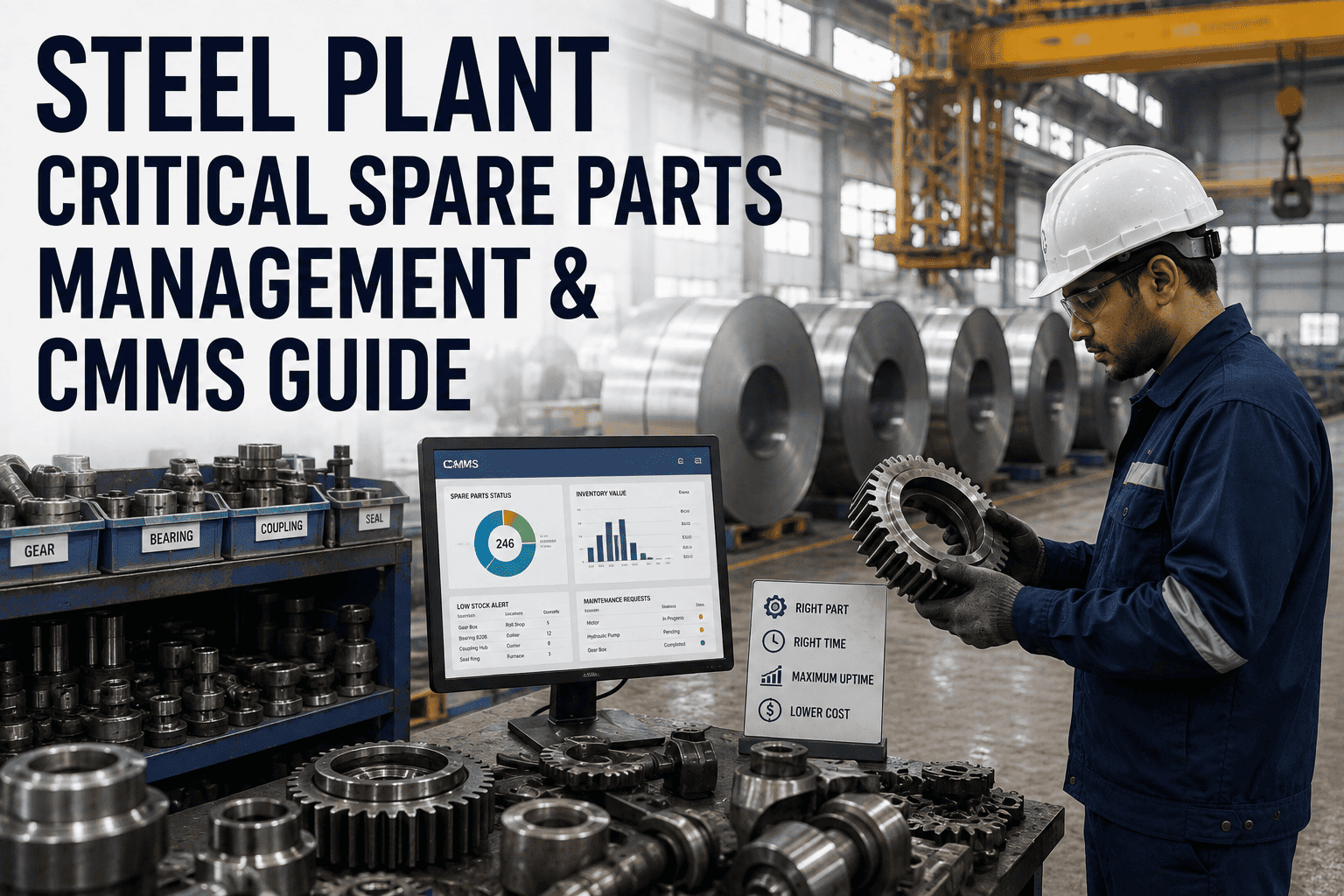
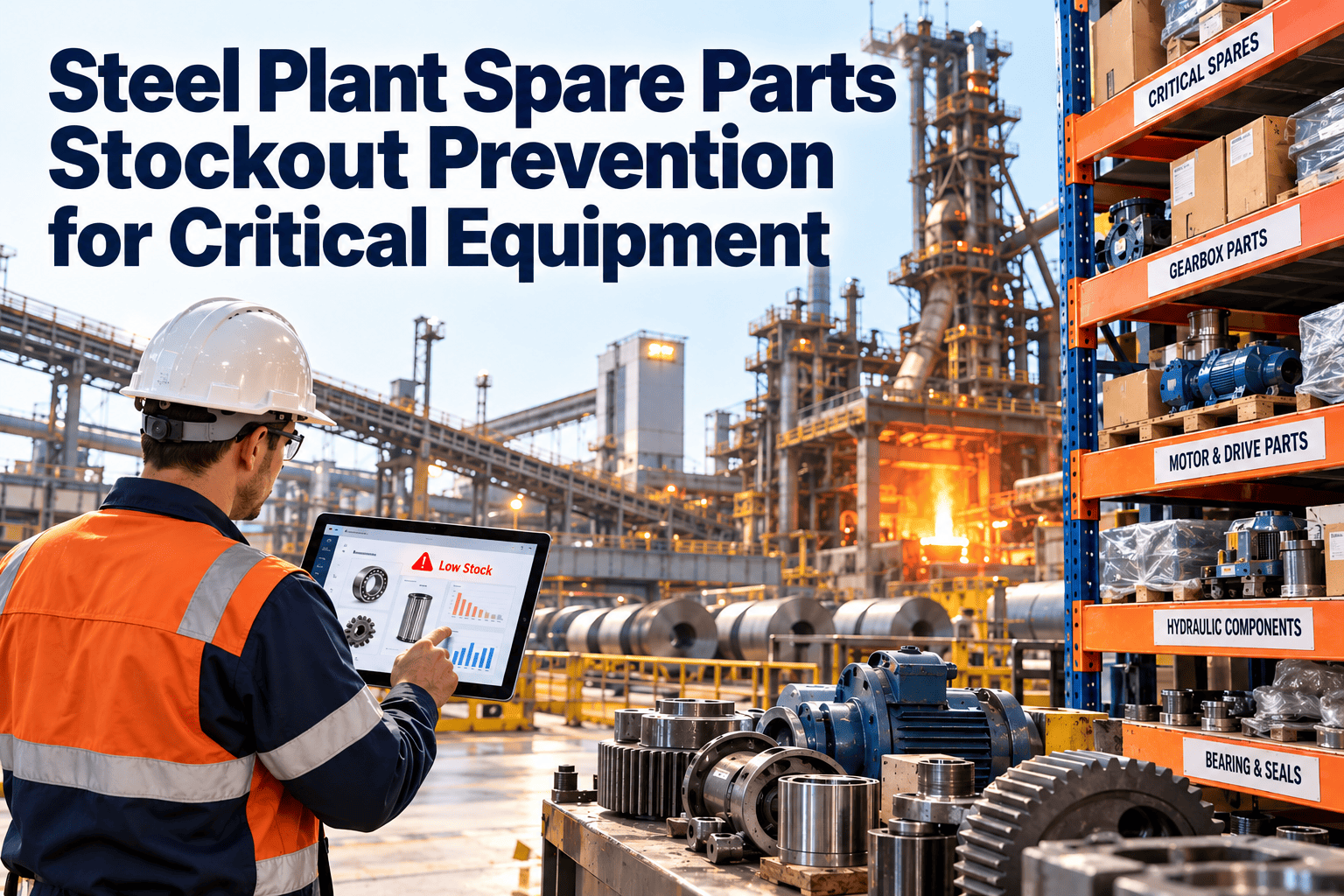
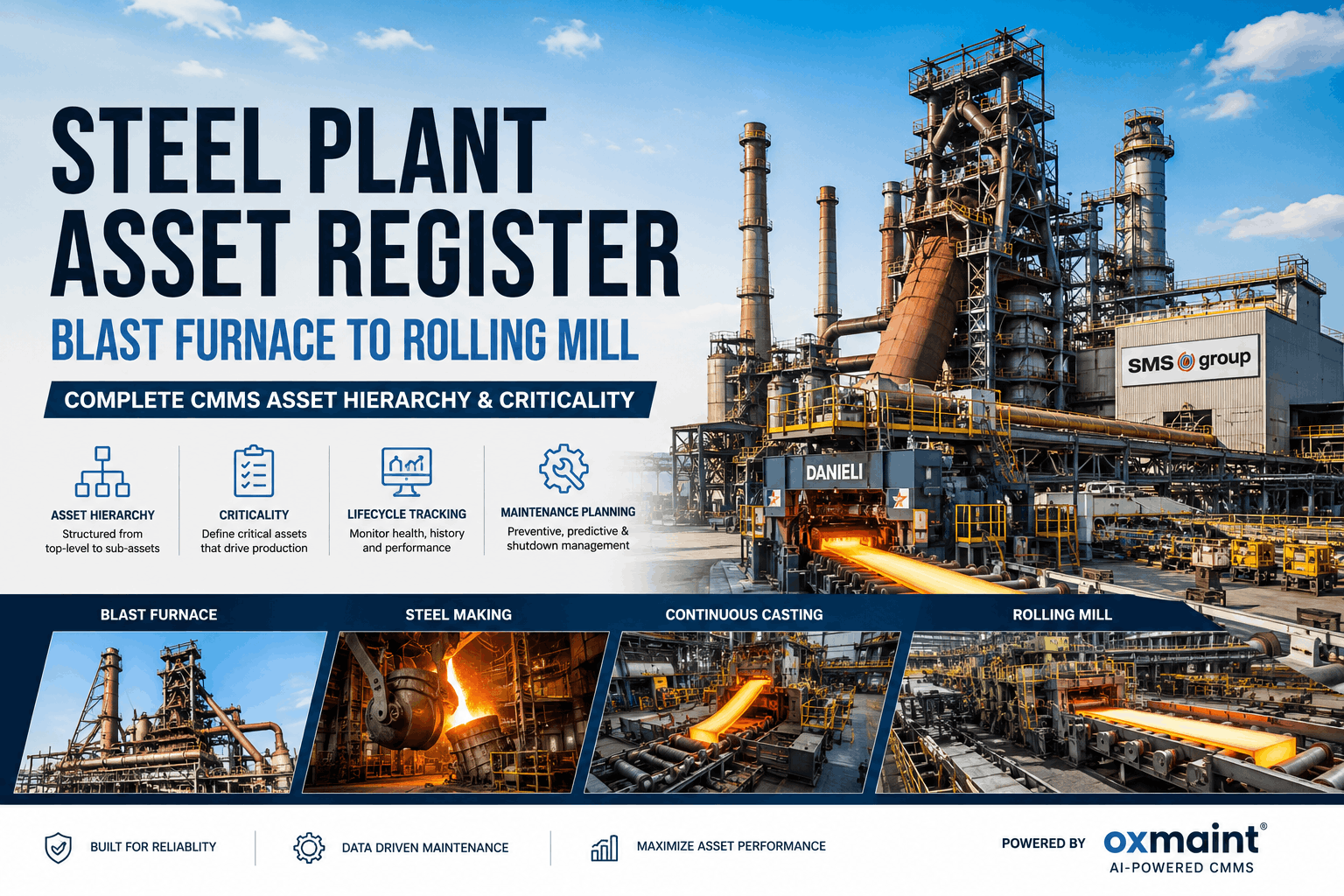
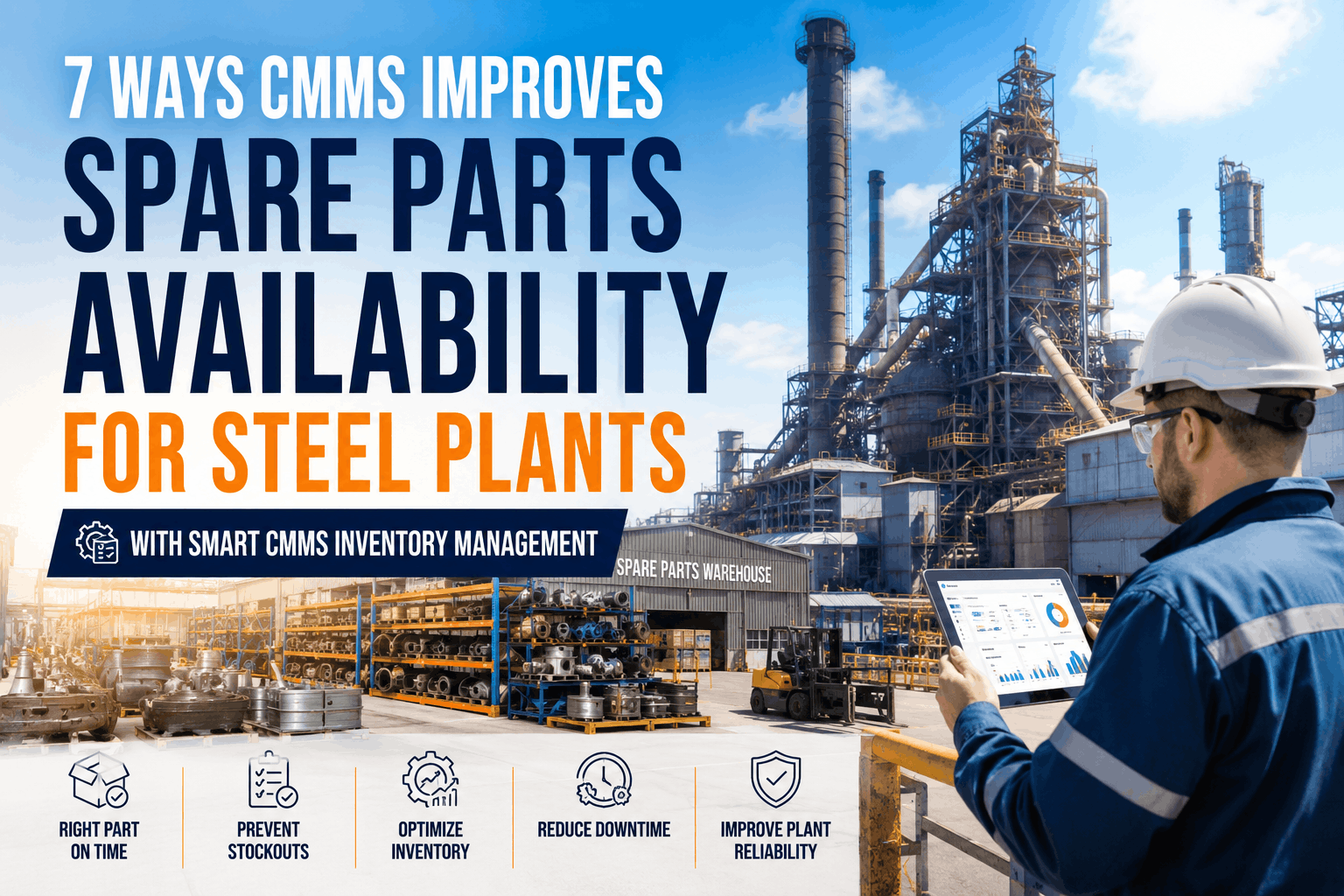
A blast furnace in Chhattisgarh sat idle for eleven hours because a single tuyere cooling element was not on the shelf. The part cost less than a lakh. The production loss did not. Steel plants run thousands of SKUs across blast furnace, rolling mill, and caster storerooms, yet the plants that avoid this trap are not the ones holding more stock — they are the ones holding the right stock, classified correctly, with reorder logic that fires before the shelf goes empty. That distinction is what separates disciplined critical spare parts management from expensive guesswork.
Steel Plant CMMS Guide 2026
Critical Spare Parts Management for Steel Plants
Criticality scoring, min/max policy, and exchange pool discipline — protecting availability without letting working capital pile up on the shelf.
Of Replacement Asset Value Is The MRO Inventory Sweet Spot
Of Parts Account For 80% Of Total Spare Parts Spend
Emergency Procurement Cost Versus A Planned Purchase Order
Class A
Parts Require 100% Availability And Quarterly Cycle Counts
Why Spare Parts Strategy Breaks In Two Opposite Directions
Most storerooms fail in one of two ways, and both look reasonable from inside the plant. Understock a critical part and a routine failure turns into a multi-day stoppage while procurement scrambles. Overstock a low-value part for years and capital sits on a shelf collecting dust instead of funding the parts that actually protect production. Neither problem is visible until the part is needed and the shelf tells the truth.
3-5x
Higher cost of an emergency repair compared to the same job completed with parts already staged and a planned work order — the real price of a stockout is rarely the part itself.
Stop finding out about a missing spare when the line is already down. Book a demo and see criticality-linked stocking policy running automatically across every storeroom.
The Three-Layer Framework Behind Every Reliable Storeroom
Spare parts strategy is not a single decision — it is three linked layers, each answering a different question about the same part.
1
Criticality Scoring
Every part inherits the criticality of the asset it serves, then gets a supply risk score based on vendor count, lead time, and substitutability.
Watch: Single-vendor parts, long-lead items, safety-critical tags
→
2
Min/Max Stocking Policy
Consumption history, PM schedules, and lead time combine to set reorder points per risk tier, so purchase requests fire automatically at the threshold.
Watch: Reorder point drift, safety stock against actual lead time
→
3
Lifecycle Protection
Repairable spares are tracked from failure through the repair shop and back to the shelf, and slow-moving stock is flagged before it becomes obsolete capital.
Watch: Repair turnaround time, dead stock aging
Link Every Spare Part To The Asset It Protects
Oxmaint inherits asset criticality down to the parts level and auto-generates purchase requests before the shelf runs dry.
Where Spare Parts Programs Actually Break
These are recurring patterns behind stockouts and overstock — and how linking criticality to consumption data catches each one early.
Initial Situation
A gearbox bearing stockout halted a rolling line for two shifts. The delay was blamed on a slow vendor, and the purchase order was expedited at premium cost.
Discovery Path
1
What did the reorder history show?
The reorder point had not been updated since the part was first added to the system
2
What had changed since then?
The vendor's lead time had grown from three weeks to nine over the previous year
3
Why was the longer lead time missed?
Lead time was recorded once at setup and never linked to the reorder point calculation
4
What was the root cause?
FINDING: Reorder points were static values, not recalculated as actual vendor lead times drifted
Actions Taken
Immediate: Reorder point raised to match current vendor lead time and safety stock added
CMMS Enhancement: Lead time linked live to reorder point, recalculated on every purchase order cycle
Systemic Fix: Annual lead time review scheduled for every Class A and Class B part
Outcome
No repeat stockout on that gearbox line in the following twelve months of production.
Initial Situation
A caster segment failure needed the backup spare, but the backup had been sitting in the "to-be-repaired" pile for eight months, leaving zero usable capacity.
Discovery Path
1
What did the exchange pool records show?
The unit was marked "in repair" with no status update since it left the plant
2
Where was the unit actually located?
Still sitting at the offsite rewind shop, queued behind other customers' work
3
Why did nobody follow up sooner?
Repair status was tracked on a spreadsheet nobody was assigned to update
4
What was the root cause?
FINDING: No closed-loop repair lifecycle tracking from failure to offsite shop to shelf
Actions Taken
Immediate: Unit expedited and returned to the plant within two weeks
CMMS Enhancement: Repair lifecycle status tracked in the system from removal to shelf return
Systemic Fix: Exchange pool availability now checked before any repairable spare is counted as backup capacity
Outcome
Exchange pool now shows real, verified availability instead of an assumed spare that was never actually on hand.
Initial Situation
A working capital review found several storeroom bins holding parts for equipment retired years earlier, tying up capital nobody was tracking.
Discovery Path
1
What did the consumption data show?
Several high-value SKUs had zero issues recorded in more than three years
2
Why were the parts never flagged?
Nobody was running a scheduled review of slow-moving or zero-movement inventory
3
What connected these parts?
All were linked to an asset that had been decommissioned without a matching BOM update
4
What was the root cause?
FINDING: Equipment retirement was never reconciled against the parts bill of materials it left behind
Actions Taken
Immediate: Flagged inventory reviewed and dispositioned through vendor return or write-off
CMMS Enhancement: Zero-movement consumption analytics run automatically each quarter
Systemic Fix: Asset decommissioning now triggers an automatic parts BOM reconciliation step
Outcome
Obsolete stock value on the books dropped and freed working capital for critical Class A coverage.
Spare Parts Stocking Policy By Plant Area
Different areas of a steel plant carry different risk, so stocking policy should never be a single blanket rule:
Blast Furnace
Insurance Spares
- Tuyeres and cooling staves
- Hot blast valves
- Blower bearings
Rolling Mill
High-Cycle Wear Parts
- Bearing kits per stand
- Roll neck seals
- Coupling and gearbox spares
Caster
Exchange Pool Assets
- Segment rolls
- Mould copper plates
- Oscillator components
Utilities
Min-Max Consumables
- Pump and motor seals
- Filter elements
- Instrumentation sensors
Frequently Asked Questions
How should a plant classify a spare part as critical?
Criticality inherits from the parent asset first, then adjusts for supply risk factors like vendor count and lead time.
Book a demo to see criticality tiers applied automatically across a storeroom.
What is a healthy MRO inventory value for a steel plant?
Best-practice programs keep total MRO inventory value at or below roughly 1.5% of replacement asset value, concentrated in the small share of parts that protect the most production.
How often should Class A spares be counted?
Class A or insurance-tier parts are typically cycle-counted quarterly since their absence causes immediate production stoppage or safety exposure.
Can spare parts tracking connect with existing PM schedules?
Yes, Oxmaint links parts consumption to PM schedules so demand is forecast weeks ahead instead of discovered at reorder time.
Sign up to connect parts and PM data.
What causes most emergency spare parts orders?
Reorder points that were never updated against real vendor lead times are a leading cause, letting the shelf run dry before the next order arrives.
Turn Your Storeroom Into A Reliability Asset
Oxmaint links criticality, consumption, and lead time into one automated stocking policy, so the right part is on the shelf before it is needed.