Your CMMS already contains the data that could eliminate stockouts and optimize your spare parts inventory — the problem is that 76% of steel plant maintenance managers never analyze their inventory data for optimization opportunities. Every part you have ever ordered, every stockout you have ever experienced, every emergency purchase you have ever made over the past 24 months contains inventory patterns that repeat with statistical regularity across equipment types, failure modes, and seasonal demand cycles. A 2025 steel industry analysis found that plants with CMMS-integrated inventory management reduce stockouts by 65% and cut emergency parts procurement costs by 45-60%. The bearing that is always out of stock when you need it is not a supply chain failure — it is a pattern sitting in your CMMS right now, invisible because nobody has built the inventory optimization analysis that surfaces it. Oxmaint's inventory management module turns your parts data into a stock optimization engine — automatically setting reorder points, flagging critical parts at risk of stockout, and generating purchase orders before inventory runs dry. The data is already yours, and the analysis that improves parts availability takes minutes to configure, not months. If your steel plant is still managing inventory through guesswork instead of data-driven optimization, start a free trial or book a demo to see how Oxmaint surfaces inventory optimization opportunities from your existing data.
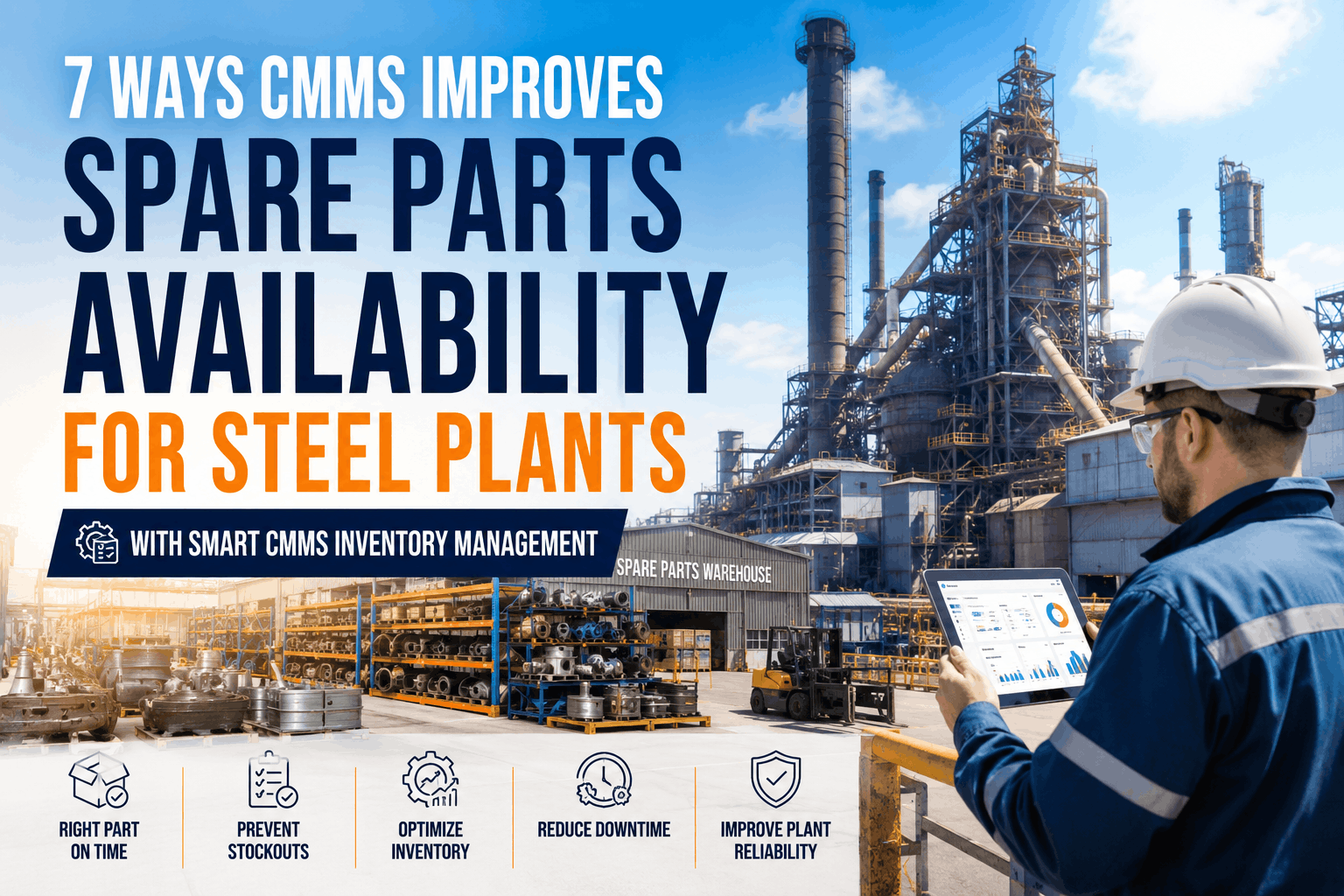
7 Ways CMMS Improves Spare Parts Availability for Steel Plants
How modern CMMS systems ensure critical spare parts are available when needed — from inventory optimization and reorder point management to stockout prevention and MRO inventory control.
The Spare Parts Challenge in Steel Plants
Steel plants face uniquely challenging inventory conditions: thousands of unique parts across hundreds of equipment types, long lead times for specialized components, high cost of stockouts causing production downtime, and the constant pressure to minimize inventory holding costs. The result is a tension between having too much inventory (wasting capital) and having too little (causing downtime). A structured CMMS-based inventory management system resolves this tension by using data to optimize stock levels. Start a free trial or book a demo to see how Oxmaint optimizes spare parts inventory.
1. Accurate Real-Time Inventory Tracking
Manual inventory tracking through spreadsheets or paper records is inherently inaccurate. Parts are issued, received, and moved without updates, creating a gap between what the system says is available and what actually exists. CMMS-based inventory tracking provides real-time visibility into stock levels, locations, and movements. Every part received, issued, or transferred is immediately reflected in the system. The result: accurate inventory data that technicians and planners can trust, eliminating the 20-30% discrepancy between system records and physical counts common with manual tracking.
2. Automated Reorder Point Management
Setting reorder points manually is a guessing game — how do you know when to reorder if you don't know usage rates and lead times? CMMS systems analyze historical usage data and supplier lead times to calculate optimal reorder points automatically. When stock falls below the reorder point, the system generates a purchase requisition automatically, eliminating the need for manual inventory checks. Steel plants using automated reorder points reduce stockouts by 65% and cut emergency purchases by 45-60%.
| Inventory Parameter | Manual Method | CMMS Method |
|---|---|---|
| Reorder Point | Guess based on memory or fixed targets | Calculated from historical usage + lead time + safety stock |
| Order Quantity | Same quantity every time regardless of usage | EOQ calculation based on usage, cost, and carrying cost |
| Lead Time | Fixed estimate, rarely updated | Actual lead time tracked per supplier and adjusted automatically |
| Safety Stock | Arbitrary buffer (same for all parts) | Calculated based on demand variability and supplier reliability |
3. Critical Parts Identification and Prioritization
Not all spare parts are equally important. A failed bearing on a non-critical pump can wait for standard delivery, while a failed gearbox bearing on a rolling mill requires immediate replacement. CMMS systems classify parts by criticality — linking each part to the equipment it supports and the consequence of failure. Critical parts (those supporting critical equipment with high downtime cost) are flagged for higher safety stock levels and proactive procurement. This prioritization ensures that inventory dollars are spent on the parts that matter most, not on parts that can be ordered as needed.
4. Parts-to-Equipment Linking for Better Planning
A spare part is only useful if you know which equipment it fits. CMMS systems link each part to the specific equipment, make, model, and serial number it supports. When a technician needs a replacement, they can quickly find the correct part number, verify stock availability, and reserve the part — all from the work order. This eliminates the 30-60 minutes technicians typically spend searching for the right part and reduces ordering errors. The part-to-equipment link also enables proactive parts planning — if you know a gearbox requires a specific bearing every 24 months, the CMMS can schedule that bearing for procurement 6 weeks before the planned maintenance.
5. Supplier Performance Tracking
CMMS systems track supplier performance — delivery times, quality, pricing, and responsiveness. This data enables procurement teams to make informed supplier selection decisions, negotiate better terms with high-performing suppliers, and identify suppliers with chronic delays or quality issues. Steel plants using CMMS supplier tracking reduce procurement costs by 10-20% and improve parts availability through better supplier relationships.
6. Inventory Optimization and Holding Cost Reduction
Carrying too much inventory ties up capital and warehouse space. Carrying too little causes stockouts and downtime. CMMS systems use usage data, lead times, and downtime costs to calculate optimal inventory levels for every part. The result: 20-30% reduction in inventory holding costs while maintaining or improving parts availability. Steel plants typically carry $5-15 million in spare parts inventory — a 25% reduction frees $1.25-3.75 million in working capital.
We had $12 million tied up in spare parts inventory and still experienced stockouts on critical items 2-3 times per year. Implementing CMMS-based inventory management changed everything. We reduced inventory by 28% ($3.4 million freed up) while improving parts availability from 86% to 97%. The system automatically reorders parts based on usage, not guesswork. We haven't had a critical stockout in 18 months. The CMMS paid for itself in the first year through inventory reduction alone.
7. Kitting and Maintenance Planning
CMMS systems enable kitting — grouping all parts needed for a specific maintenance job into a single kit. When a planned maintenance event is scheduled, the system ensures all required parts are available and sets them aside. This eliminates the "we have 8 of 10 parts" problem that delays maintenance work. Kitting is particularly valuable for planned outages, where maintenance work is scheduled months in advance and part availability must be assured.
| Benefit | Without CMMS | With CMMS | Improvement |
|---|---|---|---|
| Stockout Rate | 15-25% | <5% | -65% |
| Inventory Holding Cost | 100% | 70-80% | -20-30% |
| Emergency Procurement Cost | 100% | 40-55% | -45-60% |
| Parts Search Time | 30-60 min | <5 min | -90% |
| Critical Stockouts | 2-4/year | <1/year | -75% |
Frequently Asked Questions — Spare Parts Management in Steel Plants
Stop Stockouts and Optimize Your Parts Inventory — Start Your CMMS Today.
Oxmaint's inventory management module automates reorder points, tracks critical parts, and ensures parts are available when you need them — reducing stockouts, emergency costs, and inventory holding costs. Free to start.