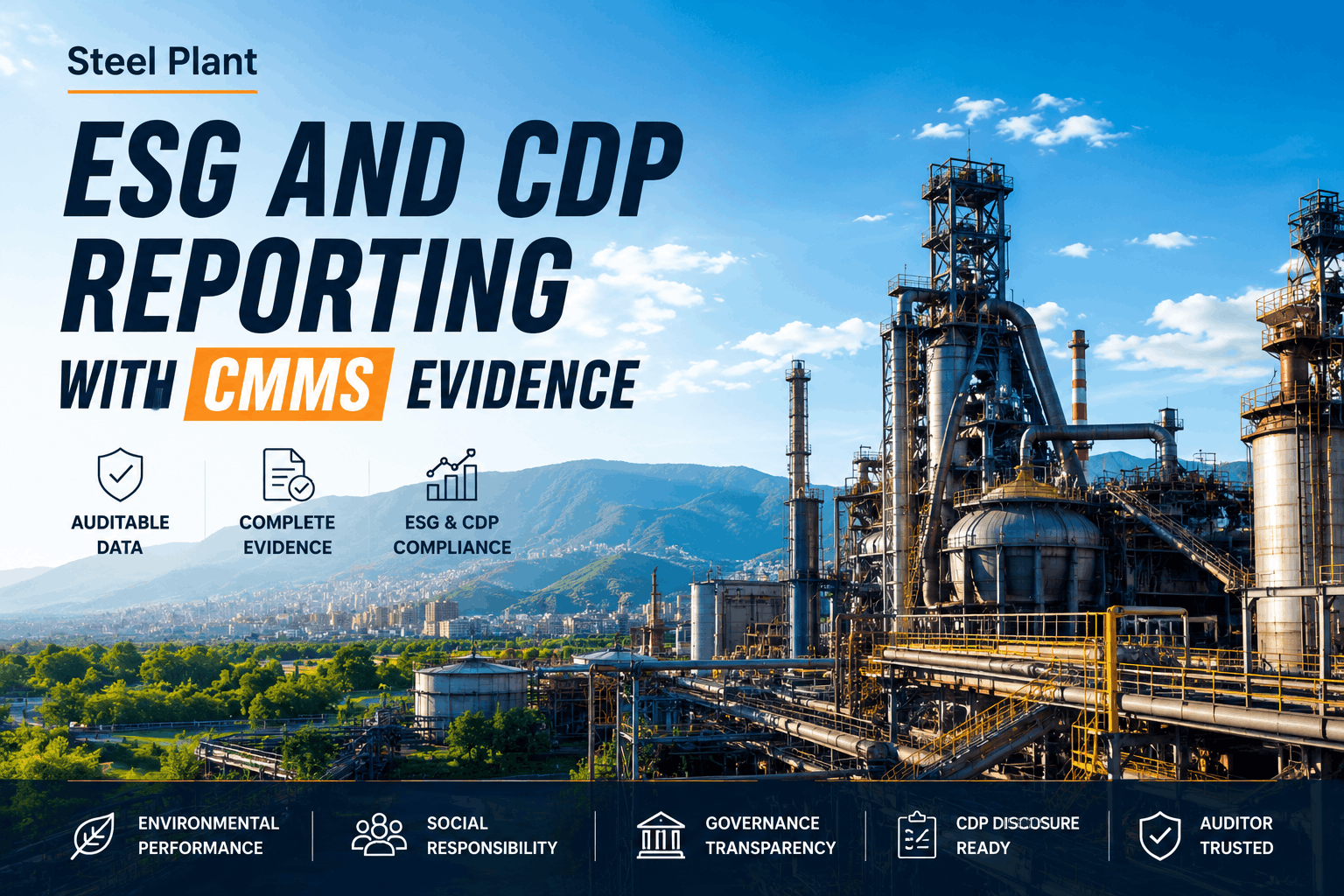
ESG (Environmental, Social, Governance) and CDP (Carbon Disclosure Project) reporting has evolved from a voluntary corporate sustainability exercise into a mandatory compliance obligation for any steel mill operating in or exporting to regulated markets. The EU's CSRD (Corporate Sustainability Reporting Directive) requires large mills to prepare comprehensive ESG disclosures aligned with ESRS (European Sustainability Reporting Standards). The United States' SECM climate rules (though currently stayed pending litigation) have signaled regulatory intent toward mandatory climate disclosure for public companies. For steel mills seeking access to capital markets, ESG-linked financing, or supply chain partnerships with global OEMs, third-party ESG assessment and CDP response have become table-stakes. The challenge is that ESG and CDP reporting demand data that lives scattered across your organization — maintenance records showing equipment reliability and safety performance, production data for energy and carbon metrics, labor records for safety incident reporting, environmental monitoring data, and supplier supply chain transparency. Assembling this data into governance-ready disclosures without a unified data infrastructure is slow, error-prone, and leaves you vulnerable to auditor challenges. A CMMS integrated with production systems, environmental monitoring, and financial data creates a single source of truth for ESG metrics — converting month-long reporting sprints into quarterly automated compilations ready for third-party assurance and investor disclosure.
The ESG Reporting Landscape for Steel Mills in 2026: Regulatory Framework & Data Demands
Steel mills operate within a complex ESG reporting landscape that varies by geography, ownership structure, and market access requirements. Understanding which frameworks apply to your mill determines what data collection and reporting infrastructure you need:
European Union (CSRD/ESRS): Large companies operating in the EU (250+ employees, €50M+ revenue, or €25M+ assets on two consecutive balance sheet dates) must comply with CSRD from 2024 onward. Reporting includes environmental (E1–E5 standards covering climate, energy, water, waste, and pollution), social (S1–S4 standards covering labor rights, supplier responsibility, health & safety, and community impact), and governance (G1 standards covering business conduct). CSRD reports must be externally assured (limited assurance first year, moving toward reasonable assurance). Companies must conduct double materiality assessments identifying which ESG topics have financial impact on the business and environmental/social impact from the business. Reporting deadline for FY2024 is April 2025 for large EU public-interest companies; FY2025 deadline is April 2026 for large EU undertakings meeting size thresholds.
United States (SEC Climate Rules & California SB 253/261): The SEC's climate disclosure rules (adopted March 2024) remain stayed pending litigation; full implementation timeline is uncertain. However, California's SB 253 (Scope 1 & 2 reporting) and SB 261 (Scope 3 reporting) apply to companies with revenue >€500M operating in California, with reporting required by 2026 (FY2025) and 2027 (FY2026). While federal SEC rules are in limbo, California state requirements are binding. Most North American steel mills meet California threshold revenue requirements if they export to or operate in California.
Voluntary Frameworks (ISSB, GRI, TCFD, CDP): Multiple voluntary frameworks coexist and are increasingly referenced by investors, customers, and capital markets: ISSB (International Sustainability Standards Board) standards IFRS S1/S2 are being adopted as national mandatory requirements in 30+ jurisdictions; GRI (Global Reporting Initiative) standards provide comprehensive ESG metrics; TCFD (Task Force on Climate-Related Financial Disclosures) guides climate risk reporting; CDP represents the largest corporate environmental data collection program globally (23,000+ companies reporting in 2024). Many mills report to multiple frameworks simultaneously to satisfy different stakeholder demands.
Supply Chain Pressure (OEM Requirements): Many mills face internal ESG data requests from customers — automotive OEMs, appliance manufacturers, renewable energy companies — asking for carbon footprint, safety incident rates, supplier diversity metrics, and labor practices. These customer questionnaires are often comprehensive and time-consuming to complete; a unified ESG data infrastructure allows you to respond quickly to customer requests without manual data gathering.
Core ESG Metrics for Steel Mills: Data Sources, Calculation Methods & CMMS Integration
A complete steel mill ESG report typically includes 30–50 specific metrics across environmental, social, and governance domains. Understanding where each metric originates and how to calculate it reliably is essential to avoiding audit findings. Here's how a CMMS-enabled data infrastructure supports ESG metric reporting:
GHG Emissions Intensity (tCO₂e per tonne crude steel)
Source: Energy consumption data (fuel burn, electricity purchased), production records (tonnes of crude steel), and emission factors (Scope 1 from fuel carbon content, Scope 2 from grid carbon intensity). OxMaint integrates DCS energy data, production mill records, and fuel supplier carbon certificates into a unified calculation. Calculation per GHG Protocol and CBAM methodology. Scope 3 (precursor and supply chain carbon) calculated from supplier emissions data and industry emission factors. Annual reporting required with third-party verification.
Energy Consumption Intensity (MWh per tonne crude steel)
Source: Utility meter data (electricity, natural gas, coal consumption) integrated from DCS/SCADA systems and supplier invoices, divided by production tonnage. Baseline calculation per IEMA (International Furnace Efficiency Association) standards for different production routes (BF-BOF typical: 12–14 MWh/t; DRI-EAF typical: 8–10 MWh/t). Year-over-year tracking shows energy efficiency improvements from process optimization or capital projects (e.g., blast furnace air temperature optimization, caster cooling water reduction). Auditors verify energy consumption data against utility invoices and spot-check meter readings.
Total Recordable Incident Rate (TRIR) & Lost Time Injury Rate (LTIR)
Source: Incident and accident reporting system (often in CMMS) tracking all work-related injuries resulting in time off work, restricted duty, or medical treatment. TRIR = (number of injuries × 200,000) / total hours worked; LTIR = (lost-time injuries × 200,000) / total hours worked. Industry benchmark for integrated steel mills: TRIR 1.5–3.5, LTIR 0.8–1.8 (lower is better). Calculation includes both employee and contractor incidents. Auditors review incident investigation reports, medical records, and worker compensation claims to verify data accuracy.
Near-Miss Reporting Rate (Reports per 200,000 hours worked)
Source: CMMS near-miss tracking system recording incidents that could have resulted in injury but did not. Industry best practice: near-miss rate should be 5–10× higher than TRIR (indicating robust safety culture and early hazard identification). OxMaint tracks near-misses alongside incident severity classification, enabling analysis of leading safety indicators that predict injury events. Near-miss data is regulatory-sensitive — OSHA and other safety agencies scrutinize near-miss documentation during audits.
Water Consumption & Recycling Rate (m³ per tonne crude steel)
Source: Water utility meter data (freshwater withdrawal) and recycled water system data (cooling water reuse loops). Industry benchmark for integrated mills: 40–80 m³/t freshwater; high-efficiency mills achieve <30 m³/t through closed-loop cooling. Calculation includes direct water consumption (cooling, process) and indirect water (steam generation). Water recycling percentage = (recycled water m³ / total water m³) × 100%. Industry leaders achieve 85–95% water recycling. ESG reports must also track wastewater discharge volume, treatment method, and compliance with local permits.
Workforce Diversity Metrics (% female, % minority, % management diversity)
Source: HR systems reporting workforce headcount by gender, ethnicity, and role level. ESG frameworks increasingly require diversity disclosure and progress toward targets. Steel industry diversity is lagging other sectors — typical female workforce percentage in mills is 8–15% (target: 20–25% by 2030 in many plans). Diversity targets drive hiring practices, apprenticeship programs, and leadership development initiatives tracked in HR systems and reported in ESG disclosure.
Health & Safety Training Hours (hours per employee annually)
Source: CMMS and HR systems tracking mandatory safety training completion (lock-out/tag-out, confined space entry, chemical handling, hazard communication, etc.). Industry standard: 40–60 hours per employee annually for high-hazard manufacturing. ESG reports require breakdown by training type, completion rate, and competency assessment results. Gap: many mills track training completion but not competency validation — ESG assurance increasingly requires proof of actual skill development, not just training attendance.
Supplier Audit & Compliance Tracking (% suppliers meeting ESG criteria)
Source: Supplier management system tracking supplier ESG audits, labor practice verification, environmental compliance certifications. Large mills audit 20–40% of suppliers annually against ESG criteria; target: 100% supplier coverage within 3 years. ESG reports show % suppliers meeting compliance standards, corrective action closure rates, and supplier engagement programs. Gap: most mills lack systematic supplier ESG data collection; customer ESG demands are accelerating this adoption in 2024–2026.
Double Materiality Assessment: Identifying Financial & Environmental Impact of ESG Topics
CSRD and ISSB frameworks require double materiality assessment — a process of identifying which ESG topics have (1) financial impact on the business (inside-out) and (2) environmental/social impact from the business (outside-out). For a steel mill, this assessment typically involves stakeholder engagement surveys, peer benchmarking, and data analysis to identify material topics and assign them relative importance. A double materiality matrix maps importance to business (x-axis: financial/risk impact) vs. importance to stakeholders (y-axis: ESG impact). Topics in the upper-right quadrant are highest priority for disclosure and management. For most integrated steel mills, material topics consistently include: Climate Change & GHG Emissions (Principle A: high business risk from CBAM and customer decarbonization demands; high environmental impact from steel production), Energy Management (directly linked to climate and profitability), Occupational Health & Safety (high operational risk, high social impact), and Responsible Supply Chain (increasingly material as customers demand supplier transparency). Topics in the lower-left quadrant (low business risk, low environmental impact) require minimal disclosure; CMMS data collection focuses on material topics to avoid data gathering overhead on low-impact areas.
Third-Party ESG Assurance & Audit Readiness: Document Management & Data Traceability
CSRD requires limited assurance of sustainability information in the first reporting year; reasonable assurance is expected by 2027–2028. Third-party assurance engagements are rigorous — assurers conduct on-site audits, review source documentation (energy invoices, incident reports, training records), and perform statistical sampling to verify data accuracy. Many mills discover during initial assurance that their data traceability is inadequate — energy data can't be linked to specific production batches, incident categorization is inconsistent, and supplier carbon data lacks verification documentation. A CMMS with built-in audit trail functionality (version control, change logs, digital signatures, linked supporting documents) creates assurance-ready data infrastructure. Every ESG metric can be traced back to source data; every calculation can be reviewed step-by-step; every supporting document is accessible and time-stamped.
Steel Mill ESG & CDP Reporting FAQs: Data, Scope, Timelines & Assurance
Does our steel mill need to report ESG data if we're not EU-based and don't export to EU customers?
Possibly not under CSRD, but increasingly yes under other pressures: California SB 253/261 if you operate in California, investor ESG requests if you're publicly traded or pursuing capital markets access, and OEM customer carbon questionnaires if you supply automotive/renewable energy manufacturers. Voluntary ESG frameworks (ISSB, GRI, CDP) are adopted by 60%+ of large industrial companies globally regardless of regulatory mandate.
What is the cost of preparing and assuring an ESG report for a 3 MTPA integrated steel mill?
Internal cost (labor): €100K–200K for data collection, calculation, and report compilation (first year higher due to infrastructure setup). External assurance cost: €25K–50K for limited assurance engagement (varies by assurance provider and scope). Total first-year cost: €125K–250K. Subsequent years: €80K–150K (internal) + €20K–40K (external) as data infrastructure matures and reporting processes optimize.
Who should own ESG reporting in the mill organization — HSE, Finance, Operations, or Sustainability?
Best practice: Sustainability role reports to CFO and coordinates across HSE (safety/labor data), Operations (energy/production data), and Environmental teams (environmental metrics). Reporting ownership in Finance ensures credibility with capital markets; coordination across functions ensures data accuracy and completeness. Some mills create dedicated sustainability or ESG controller roles — highly recommended as ESG reporting complexity grows.
Can our mill report ESG under multiple frameworks (CSRD, GRI, ISSB, CDP) simultaneously without duplicating effort?
Yes — frameworks are increasingly harmonized. CSRD/ESRS align closely with ISSB standards; CDP climate questionnaire aligns with CSRD E1 climate standard. A single unified data infrastructure capturing core metrics can generate reports for multiple frameworks with 80–90% overlap. Only unique framework-specific metrics require separate data collection. CMMS with framework-agnostic data capture enables efficient multi-framework reporting.
How do we handle confidentiality of trade-secret information (e.g., energy-intensive process details) when ESG reports are publicly disclosed?
ESG disclosure requirements allow aggregated data and benchmarked performance without revealing process-specific secrets. Energy intensity (MWh/t) can be disclosed without revealing specific equipment configurations. Carbon intensity can be reported without revealing fuel mix or technology details. Assurers can review detailed data under confidentiality agreements while public reports contain only aggregated metrics.
What are the most common ESG data gaps that cause audit findings in steel mills?
Top findings: (1) Energy/carbon calculation methodology not clearly documented — assurers request detailed calculation worksheets; (2) Scope 3 carbon lacking supplier verification — use of unverified default values triggers audit adjustments; (3) Safety incident classification inconsistency — different managers categorize similar incidents differently; (4) Training hour documentation lacking date-stamps or competency verification; (5) Water consumption allocation methodology not disclosed. All preventable through systematic CMMS data capture.
If our mill achieves ESG certification (e.g., ISO 14001, ISO 45001), does that reduce ESG reporting burden?
Partially. ISO certifications demonstrate management system maturity and may reduce assurance scope. However, CSRD/ISSB/CDP have broader scope than ISO standards — they require stakeholder engagement, double materiality assessment, and strategic disclosure beyond ISO compliance. ISO compliance is necessary but insufficient; ESG reporting requires additional strategic communication and stakeholder transparency not addressed by ISO standards.
How do we handle ESG reporting for mills in multiple countries when regulations differ by jurisdiction?
Consolidated ESG reporting typically occurs at parent company level, aggregating data from all sites. Regulatory requirements vary — EU subsidiaries must comply with CSRD; US operations may face SEC/California requirements; other jurisdictions have no regulatory mandate. Best practice: report under highest global standard (currently CSRD/ISSB) at parent level, cascading requirements to subsidiary level. CMMS enables centralized data collection across all locations with local compliance flagging.