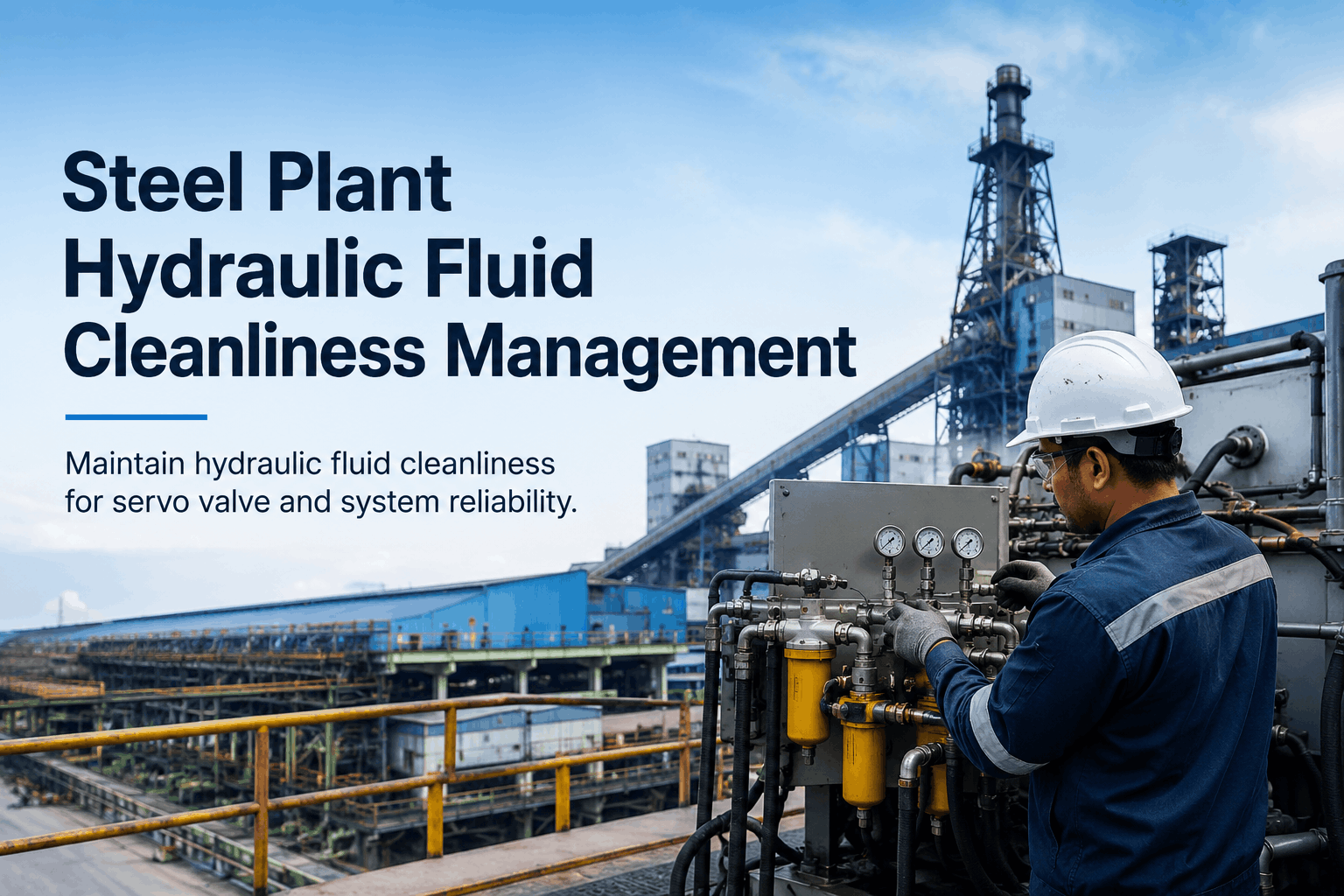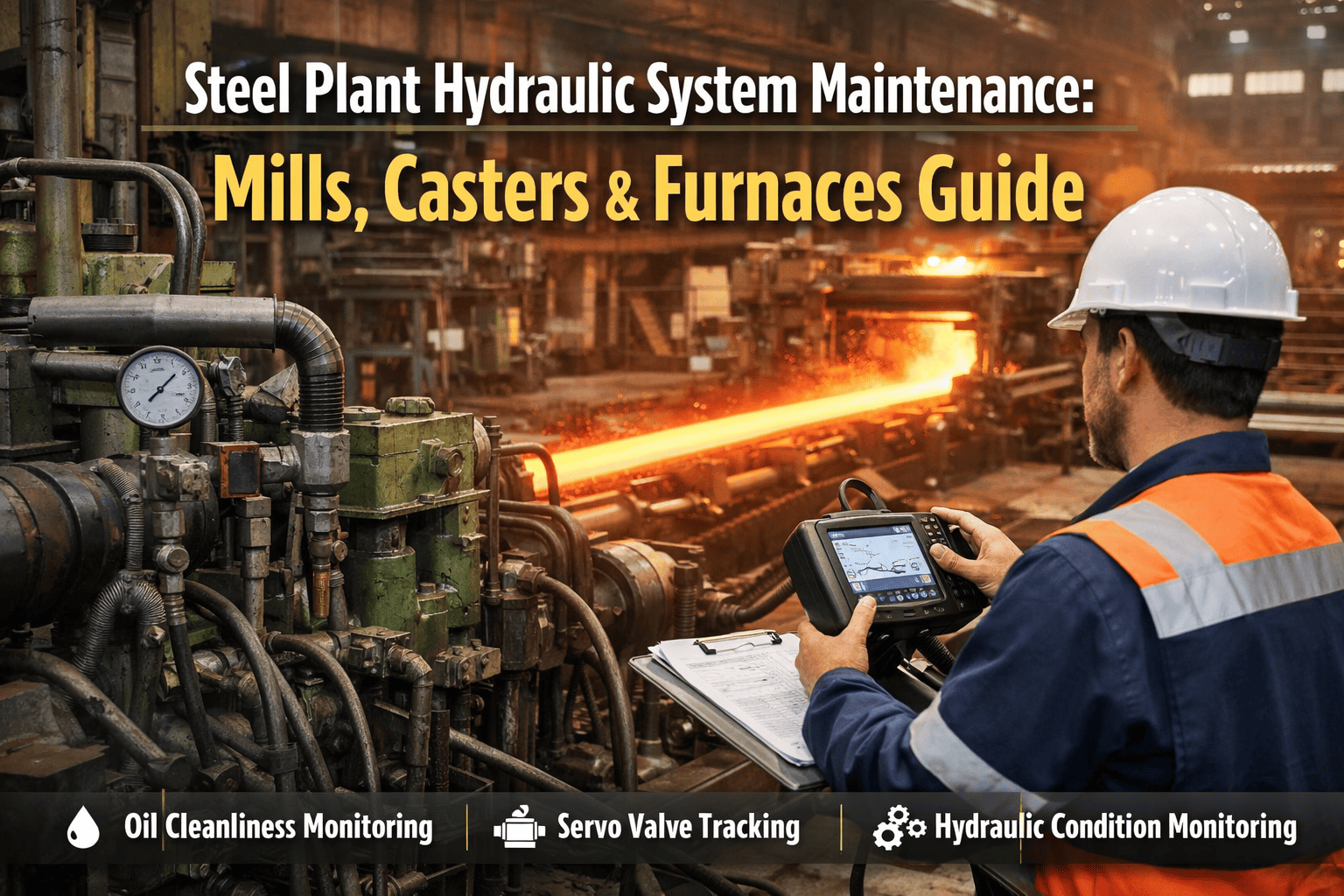
Steel plant hydraulic systems fail catastrophically more often than any other equipment category—and the root cause is almost always contamination, not equipment design. A single particle larger than 10 microns circulating in pressurized hydraulic fluid can block servo valve spools, scratch pump cylinders, jam pressure relief mechanisms, and destroy directional control valves. Water suspended in hydraulic fluid accelerates oxidation, promotes rust formation, and breaks down lubrication film strength—initiating bearing and pump wear that progresses from detection to catastrophic failure within weeks. Steel mills operating hydraulic systems without rigorous contamination control experience component failures averaging every 8-12 months costing $40,000-$120,000 per incident in emergency repairs and production downtime. Facilities implementing comprehensive hydraulic system cleaning protocols—including kidney loop filtration, desiccant breathers, sealed storage, and quarterly oil analysis—reduce hydraulic-related downtime by 70-85% and extend system component life from 5-7 years to 15-20+ years. The difference between a hydraulic system that runs reliably for two decades and one that fails catastrophically every year is not the equipment manufacturer—it is the cleanliness standards maintained during operation and the vigilance applied to preventing contamination at the source. OxMaint's hydraulic system contamination tracking platform monitors ISO cleanliness codes, schedules kidney loop operation, documents breather replacement, tracks water content analysis, and triggers fluid replacement when contamination thresholds are exceeded—ensuring hydraulic system reliability through cleanliness governance.
Steel Plant Hydraulic System Cleaning: Prevent Failures with Contamination Control
Hydraulic fluid contamination causes 90% of pump and servo valve failures. This comprehensive guide covers ISO cleanliness standards, kidney loop filtration systems, desiccant breather technology, water content monitoring, quarterly oil analysis protocols, and fluid replacement triggers—ensuring maximum hydraulic system reliability and extended component life.
Understanding Hydraulic Contamination: Why Steel Plants Lose Hydraulic Systems
Hydraulic systems operate at pressures of 2000-4000 PSI, forcing fluid through microscopic gaps in pump cylinders, control valves, and actuators. The clearances between moving parts are measured in thousandths of an inch—a particle 10-25 microns creates a blockage in those gaps, generating pressure spikes that damage seals and valves. Servo valves operating at high-response frequencies are the most vulnerable: their spools move with clearances of 2-5 microns, making them devastatingly sensitive to particle contamination. A single 10-micron particle jamming in a servo valve spool causes the valve to stick open or closed, leading to uncontrolled actuator movement or loss of pressure control. Water in hydraulic fluid—whether from condensation in the reservoir, ingress through degraded seals, or improper maintenance procedures—initiates rust formation on internal metal surfaces, accelerates oxidation of the base oil, and reduces lubrication film strength around pump pistons and cylinders. Water content above 500 ppm is irreversible: the fluid has absorbed moisture beyond saturation point and cannot release it short of complete fluid replacement. Steel mills operating hydraulic presses, injection molding systems, and precision control systems cannot tolerate even brief contamination—a single hour of operation with ISO 18/16/13 cleanliness instead of ISO 16/14/11 accelerates component wear by 10-fold. The maintenance difference is straightforward: sealed reservoirs with desiccant breathers prevent dust and moisture ingress; kidney loop filtration continuously removes particles and water from the reservoir during idle periods; quarterly oil analysis establishes contamination trending; sealed storage of replacement hydraulic fluid prevents contamination during transport and handling. Steel mills implementing these protocols achieve ISO 15/13/10 or better cleanliness consistently—an achievement that extends pump life from 5-7 years to 20+ years and nearly eliminates catastrophic failure incidents.
ISO Cleanliness Codes: Understanding the Standard That Determines Hydraulic System Life
ISO 4406 cleanliness codes describe fluid purity using the notation ISO X/Y/Z, where X represents particles >4 microns per milliliter, Y represents particles >6 microns per milliliter, and Z represents particles >14 microns per milliliter. The numbers themselves are logarithmic: ISO 16/14/11 means fewer than 16 particles >4 microns, fewer than 14 particles >6 microns, and fewer than 11 particles >14 microns per milliliter of fluid. Industrial hydraulic systems manufactured with standard tolerances (clearances of 10-25 microns) can tolerate ISO 18/16/13 cleanliness indefinitely without component damage. Systems with tighter tolerances—servo valves with 2-5 micron clearances, proportional directional control valves with 8-12 micron clearances—require ISO 16/14/11 or better to avoid accelerated wear. Achieving ISO 15/13/10 or better prevents nearly all contamination-related failures and extends component life to manufacturer design life (20-30 years). New hydraulic fluid from manufacturers typically arrives at ISO 17/15/12 cleanliness—already containing some particles from manufacturing and handling. Transferring this fluid into a steel mill reservoir with poor contamination controls degrades it immediately to ISO 20/18/15 or worse through dust ingress during pouring and interaction with reservoir contamination. Conversely, a sealed transfer procedure using in-line filtration maintains fluid cleanliness throughout the filling process. The cost difference is minimal: a sealed fill pump with 3-5 micron filter costs $500-$1000; the cost of a single servo valve failure caused by contamination is $15,000-$40,000. Kidney loop filtration systems continuously recirculate reservoir fluid through high-efficiency filters (3-5 micron absolute) during idle periods, removing particles that settle in the reservoir and absorbing moisture that would otherwise remain dissolved in the oil. A kidney loop operating 2-3 hours per day improves fluid cleanliness by 2-3 ISO code points within 6 months of operation—taking contaminated fluid from ISO 19/17/14 to ISO 16/14/11 through continuous filtration and drying. Steel plants implementing kidney loop systems report cleanliness improvements of 3-4 ISO code points and extension of system component life by 200-300% compared to facilities without kidney loop operation.
Kidney Loop Filtration: Continuous Contamination Removal During Idle Operations
A kidney loop filtration system is a standalone pump and filter assembly that circulates hydraulic fluid from the reservoir through a high-efficiency filter and back into the reservoir during idle periods—removing particles and absorbing water that would otherwise remain suspended in the fluid. The system operates independent of the main hydraulic pump, allowing fluid cleaning to occur while production equipment is not running. Kidney loop systems are sized to process the entire reservoir volume 5-10 times daily: a hydraulic system with 500-gallon reservoir requiring 10-minute circulation time would use a kidney loop pump delivering 50 gallons per minute. The filter cartridge (typically 3-5 micron absolute) traps particles and is equipped with a differential pressure indicator showing saturation—when pressure drop exceeds 3-5 psi, the cartridge requires replacement (cost $150-$400 per cartridge, replacement time 15-30 minutes). Kidney loop systems also incorporate water removal capability through either silica gel desiccant cartridges or water-absorbing filter media—removing dissolved moisture before it can oxidize the base oil or promote rust formation. Operating a kidney loop 2-3 hours per shift during idle periods is recommended for steel mill applications: morning startup cleaning before production begins, midday circulation during slow periods, and overnight operation continuously improving fluid cleanliness. The investment in kidney loop equipment ($8000-$15,000 installed) combined with annual operating costs ($2000-$3000 for filter replacements and electricity) delivers ROI within 6-12 months through eliminated servo valve failures and extended pump service life. A steel mill preventing one servo valve failure ($25,000 cost) through kidney loop operation has recovered full system investment. Preventing 3-4 failures annually (typical for facilities without kidney loops) generates $75,000-$100,000 in annual economic benefit, making kidney loop investment one of the highest-ROI maintenance initiatives available.
Fluid Replacement Decision Matrix: When to Replace vs. Condition-Based Extension
Hydraulic fluid replacement decisions are typically made on fixed schedules (annual or every 2000 hours) regardless of fluid condition—an approach that wastes money on premature disposal of serviceable fluid or, conversely, allows degraded fluid to remain in service causing failures. Condition-based fluid replacement decisions use specific analytical parameters to determine replacement urgency: Total Acid Number (TAN) measures base oil oxidation and additive depletion (fresh fluid TAN <0.5 mg KOH/g; replacement threshold >2.5 mg KOH/g); viscosity index degradation indicates oxidative breakdown and reduced film strength; water content trending identifies moisture ingress; and particle count trends reveal contamination rate acceleration. A hydraulic system with excellent particle count (ISO 15/13/10), low water content (<150 ppm), stable TAN (<1.2 mg KOH/g), and normal viscosity can safely extend fluid life 50-100% beyond standard replacement intervals without risk. Conversely, a system showing TAN rising >0.5 mg KOH/g per quarter, particle count increasing >30% over 6 months, or water content approaching saturation (>400 ppm) requires immediate fluid replacement regardless of actual operating hours. Steel mills implementing condition-based fluid replacement achieve 20-40% extension of fluid service life while simultaneously reducing failure risk through early detection of degradation. The analysis cost ($200-$400 per test for comprehensive hydraulic oil analysis) is recovered within weeks through extended interval optimization. Most facilities benefit from quarterly analysis intervals (every 250-500 operating hours or 3 calendar months for continuous-duty systems) establishing clear trending and early warning of degradation acceleration.
Hydraulic System Contamination Program Implementation: Compliance and Operational Excellence
Hydraulic system contamination control program implementation begins with baseline system assessment: measure current fluid cleanliness through ISO code particle count analysis, document water content, establish TAN baseline, and visually assess reservoir sealing. This baseline becomes the reference point for all trending and improvement targets. Second phase involves infrastructure upgrades: install desiccant breather on all hydraulic reservoirs (if not already equipped), implement kidney loop filtration system, establish sealed fluid transfer procedures with in-line filtration. These capital improvements cost $20,000-$50,000 for a typical multi-system steel mill installation but deliver ROI within 6-12 months through eliminated servo valve failures. Third phase establishes operational procedures and training: create documented inspection checklists for breather saturation assessment, kidney loop operation scheduling, and sealed transfer protocols; train all maintenance personnel on proper procedures; establish clear responsibility assignments. Fourth phase implements data governance: schedule quarterly oil analysis, establish trending databases, set ISO code targets (typically ISO 15/13/10 or better for servo valve systems), and create decision rules for fluid replacement based on analysis parameters. OxMaint's hydraulic contamination tracking system maintains analysis records, tracks breather and filter replacement schedules, documents kidney loop operation hours, and alerts when ISO codes, water content, or TAN trends approach replacement thresholds—automating the administrative overhead while ensuring consistent application of contamination control protocols.
Frequently Asked Questions — Hydraulic System Contamination Control
Eliminate Hydraulic Failures Through Systematic Contamination Control
OxMaint's hydraulic contamination tracking platform monitors ISO cleanliness codes, schedules kidney loop operation, documents breather replacement, tracks water content analysis, and triggers fluid replacement when contamination thresholds are exceeded. Establish baseline ISO 4406 particle counts. Target ISO 15/13/10 cleanliness through kidney loop operation and sealed transfer procedures. Quarterly analysis trending detects water ingress, oxidation acceleration, and contamination sources before they cause failures. Prevent servo valve failures, extend pump service life to 20-30+ years, and reduce annual maintenance costs by $50K-$150K at typical steel facilities.