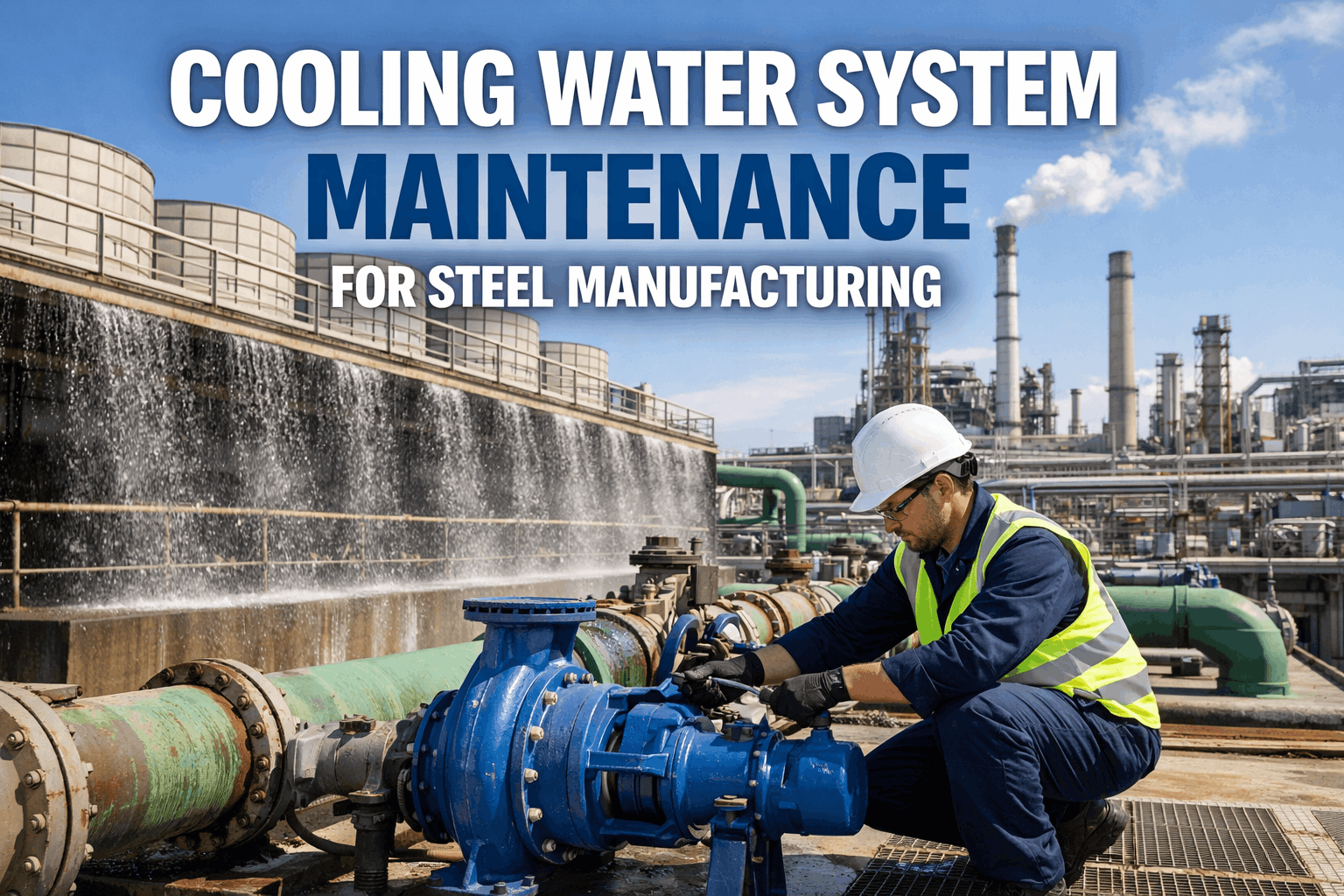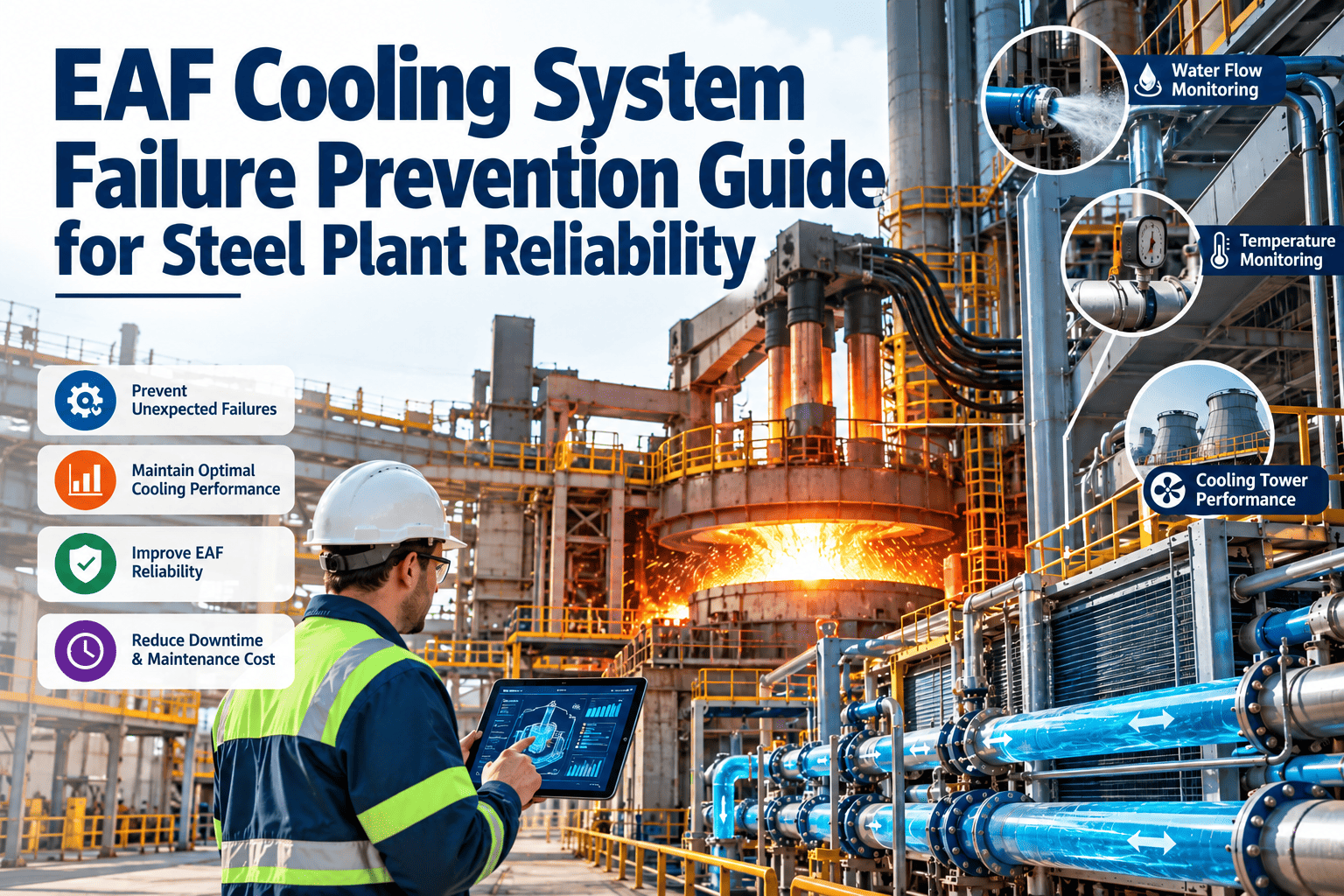
An electric arc furnace runs at temperatures where a small cooling fault becomes a serious event within minutes. Water-cooled panels, roof rings, cables, hoses, ducts and pumps all share one job: keep heat away from structure and people. When one circuit loses flow or leaks, the cost is not only a repair but lost heats, damaged refractory and real safety exposure. This guide explains how steel teams can prevent EAF cooling failures with disciplined monitoring, structured inspections and a maintenance management platform built for steel plants.
EAF and Steelmaking / Cooling Reliability
EAF Cooling System Failure Prevention: Catch the Drift Before the Leak
Track flow, temperature, pressure and makeup water on every cooling circuit, and turn every abnormal reading into an owned work order for steel plant maintenance and reliability teams.
Pumps and Strainers
then
Supply Header
then
Panels, Roof, Cables, Ducts
then
Return Header
then
Heat Exchanger or Tower
Monitoring points at every stage: flow, inlet and outlet temperature, pressure, conductivity, makeup volume
Why Cooling Failures Matter More Than Most EAF Faults
Most furnace faults cost time. A cooling fault can cost time, equipment and safety, which is why it deserves its own reliability programme.
- Water escaping into a hot furnace can cause violent steam generation, so leaks are treated as a safety event, not a nuisance.
- Overheated panels warp, crack and leak, which turns a flow problem into a mechanical failure.
- Blocked or scaled circuits often show only small changes in temperature difference before a hot spot forms.
- Cooling downtime blocks the entire melt shop, because tapping schedules depend on furnace availability.
The gap between sensing and acting
Many plants already have flow meters and thermocouples. The weakness is usually what happens after a reading drifts: an alarm sounds, someone acknowledges it, and no work order follows. A maintenance system closes that gap by tying each abnormal reading to an inspection, an owner and a due time.
Four Signals Every Circuit Should Report
Flow
Falling flow points to fouling, a partly closed valve, a failing pump or a collapsing hose.
Delta-T
A rising gap between inlet and outlet temperature shows heat is not being carried away.
Pressure
Sudden loss suggests a leak or burst. Rising differential suggests a blockage.
Makeup Water
Unexplained makeup demand in a closed loop is one of the earliest leak indicators.
No single reading is enough. A circuit with normal flow but a creeping outlet temperature is telling a different story from one with normal temperature and rising makeup water. Reading the signals together is what separates prevention from firefighting.
Cooling Circuit Map: Where Failures Start
Use this map to decide which assets need condition triggers and which need time-based preventive tasks.
| Component | Typical Failure | Early Signal | Preventive Action |
|---|---|---|---|
| Sidewall panels | Cracking, warping, internal scale | Rising outlet temperature | Scheduled visual and thermal check at each outage |
| Roof ring and delta | Erosion, leaks at welds | Local hot spots, wet refractory | Inspection against panel history |
| Water-cooled cables and bus tubes | Blocked bore, hose fatigue | Cable temperature rise | Flow verification and hose replacement by age |
| Hoses and couplings | Cracking, abrasion, heat damage | Weeping at fittings | Route inspection and life-based replacement |
| Off-gas duct sections | Scale, tube leaks | Falling flow, rising differential | Descaling plan and pressure test |
| Pumps and drives | Bearing wear, seal leaks, cavitation | Vibration, motor current change | Condition-based servicing and standby changeover test |
| Strainers and filters | Clogging | Pressure differential across strainer | Cleaning routine set by differential trend |
| Heat exchanger or tower | Fouling, fan or fill damage | Return temperature drift | Cleaning cycle and water treatment checks |
Root Causes Behind Repeat Cooling Failures
1
Scale and deposits
Poor water treatment leaves mineral deposits that insulate tube walls, so metal runs hotter than design even when flow looks acceptable.
2
Debris and blocked strainers
Corrosion products and repair debris travel to the narrowest passages, starving individual panels while the main header looks healthy.
3
Thermal fatigue
Repeated heating and cooling across heats cracks welds and fittings, especially near slag line and electrode zones.
4
Ageing hoses and connections
Flexible hoses near moving arms and cables see bending and heat. Without replacement by age or cycles, they fail without warning.
5
Pump and standby neglect
A standby pump that has never been tested under load is a hope, not a safeguard. Changeover must be proven regularly.
6
Lost repair history
When patched panels and replaced hoses are not recorded against the exact asset, the same weak point keeps failing unnoticed.
Turn Every Cooling Alarm Into an Owned Work Order
Register every circuit, panel, hose and pump in one asset hierarchy, then schedule inspections and corrective work with full history behind it.
Risk Matrix: Prioritising Cooling Assets
Rank each circuit by how likely it is to fail and how severe the outcome would be. Spend inspection effort where both are high.
Low Consequence
Medium Consequence
High Consequence
High Likelihood
Monitor and plan
Act this shutdown
Act immediately
Medium Likelihood
Routine PM
Monitor and plan
Act this shutdown
Low Likelihood
Routine PM
Routine PM
Monitor and plan
Roof panels and sidewall panels near the slag line usually sit in the top right. Auxiliary ducts and secondary loops often sit lower, but only if their history supports it.
Reactive Cooling Maintenance Versus a Planned Programme
Reactive
- Leaks found when steam appears or tapping is delayed
- Panels replaced without knowing the cause
- Alarms acknowledged but not logged as work
- Spare panels and hoses bought in a hurry
- Same weak circuit fails every few months
Planned
- Drift trends trigger inspection before a leak
- Every failure has a recorded cause and fix
- Abnormal readings create work orders automatically
- Critical spares stocked from failure history
- Repeat failures flagged and engineered out
The Prevention Workflow, From Reading to Closeout
Detect
Reading leaves its normal band on flow, delta-T, pressure or makeup
Log
Condition raises a work order against the exact circuit
Inspect
Technician checks strainers, valves, hoses and panel surface
Correct
Repair, descale or replace, with parts and time recorded
Verify
Flow and temperature confirmed before return to service
Learn
Cause coded so trends reveal repeat weak points
The value sits in the last step. When failure causes are coded consistently, reliability engineers can compare panels, hose types and water treatment results instead of arguing from memory.
Inspection Checklist for Every Planned Outage
Panels and structure
- Inspect panel faces for cracks, bulging and erosion
- Check weld seams and tube bends near hot zones
- Look for wet refractory or staining that suggests slow leaks
- Record every repair location against the panel ID
Hoses, cables and valves
- Check hose routing for abrasion and heat exposure
- Replace hoses that have reached their age or cycle limit
- Verify isolation valves move freely and seal fully
- Confirm flow through each cable and bus tube
Pumps and water quality
- Test standby pump changeover under load
- Review vibration and motor current trends
- Clean strainers and review pressure differential
- Check conductivity, pH and treatment dosing records
Moving From Time-Based to Condition-Based Cooling Maintenance
Fixed intervals are a good start, but cooling assets age at different rates depending on heat load, water quality and practice. Condition-based triggers refine the plan.
- Use rising strainer differential to schedule cleaning rather than a calendar date.
- Use delta-T drift per circuit to prioritise descaling and panel inspection.
- Use makeup water trend to trigger a leak hunt before a visible failure.
- Use vibration and current on pumps to plan bearing and seal work.
- Keep time-based tasks for hoses, valves and safety checks where age is the driver.
Oxmaint supports both approaches in one place: recurring preventive tasks, meter or condition-driven work orders, mobile checklists for technicians and dashboards that show which circuits are drifting.
Safety and Compliance Records
Cooling faults sit close to water-in-furnace safety procedures, so records matter as much as repairs. Your own site procedures, insurer requirements and local regulations define what evidence you need.
| Record | Why It Matters | How It Is Kept |
|---|---|---|
| Leak events and response | Shows how quickly the team isolated and confirmed safe restart | Work order with timestamps and sign-off |
| Panel and hose history | Proves replacement by condition or age | Asset record with repair log |
| Pump changeover tests | Shows standby protection is proven | Recurring inspection with pass or fail |
| Water treatment checks | Links scale risk to treatment control | Inspection readings over time |
| Restart authorisation | Confirms verification before return to service | Checklist approval on the work order |
KPIs for EAF Cooling Reliability
Cooling Leaks
Count per period, split by panels, hoses, cables and ducts.
Unplanned Downtime
Furnace hours lost to cooling faults, with cause codes attached.
Mean Time Between Failures
Tracked per panel, hose type and pump to show weak points.
PM Compliance
Share of scheduled cooling tasks completed on time.
Add a fifth measure your team controls directly: time from abnormal reading to inspection started. It shows whether alarms are turning into action.
What to Look for in Steel Plant Maintenance Software
- An asset hierarchy that models circuits, headers, panels, hoses and pumps, not only major equipment.
- Preventive schedules and condition-based triggers side by side.
- Mobile inspections so technicians record readings and photos at the furnace.
- Spare parts control for panels, hoses, seals and strainers linked to failure history.
- Reports that compare failure causes across circuits and shutdowns.
Water Quality: The Silent Driver of Panel Life
Most panel failures are blamed on heat, but water condition decides how much heat the tube wall can tolerate. Scale, corrosion and biological growth all reduce heat transfer and raise metal temperature.
| Water Condition | What It Does | Maintenance Response |
|---|---|---|
| Hardness and scale formation | Insulates tube walls and narrows passages | Review treatment dosing, schedule descaling on drifting circuits |
| Corrosion products | Produces debris that blocks strainers and small bores | Trend strainer differential, inspect for internal pitting |
| Biological growth in open circuits | Fouls heat exchangers and towers | Confirm biocide programme and clean on schedule |
| Conductivity and blowdown drift | Signals concentration or contamination | Log readings per round and act on trends |
Recording water quality readings on the same asset records as pumps and panels lets engineers see whether a run of leaks followed a treatment problem, instead of treating each leak as an isolated event.
Common Mistakes That Let Cooling Failures Repeat
Alarm fatigue
Frequent nuisance alarms teach crews to ignore the one that matters.
Patch and forget
Weld repairs made without recording location or cause.
Untested standby
Backup pumps that fail on the day they are needed.
One-size intervals
Same hose life for every position, regardless of heat exposure.
Siloed data
Sensor readings in one system and repairs in another.
No spares logic
Critical panels and hoses not stocked against failure history.
Each of these is a process gap rather than an equipment gap, which is good news: process gaps can be closed with clear ownership, checklists and consistent records.
Spares and Shutdown Planning for Cooling Assets
A cooling repair that waits for a part is a furnace outage that grows. Failure history should drive what sits on the shelf.
- Stock spare panels for positions with the shortest recorded life, and record where every spare is stored.
- Hold hoses, couplings, gaskets, pump seals and strainer elements at minimum levels tied to consumption.
- Plan panel replacement and descaling inside scheduled outages, using inspection findings collected beforehand.
- Link parts issued to the work order so cost per circuit becomes visible over time.
- Review the previous outage findings before writing the next shutdown scope, so known weak points are addressed first.
Handover between shifts
Cooling issues often begin on one shift and become critical on the next. Open work orders, recent abnormal readings and pending inspections should be visible to the incoming crew, so a slow leak is not rediscovered from scratch every twelve hours.
Trends Shaping EAF Cooling Reliability
Continuous monitoring
More plants monitor flow and temperature per panel circuit, which allows trends to be compared heat after heat instead of only during rounds.
Thermal inspection
Thermal cameras and infrared checks on cables, bus tubes and panel faces help find blocked or hot circuits without shutting down.
Data-driven planning
Failure codes and repair history support decisions on panel design, hose type and outage scope, rather than relying on individual memory.
Technology only pays back when readings lead to action. The maintenance system is the layer that assigns the task, records the fix and keeps the evidence for the next review.
Frequently Asked Questions
What is the earliest sign of an EAF cooling leak?
Unexplained makeup water demand and a shift in circuit flow or pressure often appear before visible steam.
How often should cooling hoses be replaced?
Set intervals from OEM guidance and your failure history, then track them in the maintenance system.
Can maintenance software use sensor readings?
Yes. Readings from your monitoring or SCADA systems can drive condition-based work orders for each circuit.
Why track cooling repairs by exact panel?
Repeat failures cluster on specific panels and positions, and only asset-level history reveals them.
Where do we start?
Begin with the highest-risk circuits, then book a demo to map your setup.
Protect the Furnace With a Cooling Programme That Learns
Bring inspections, condition triggers, work orders and failure history into one steel plant CMMS, and stop repeat cooling failures at the source.