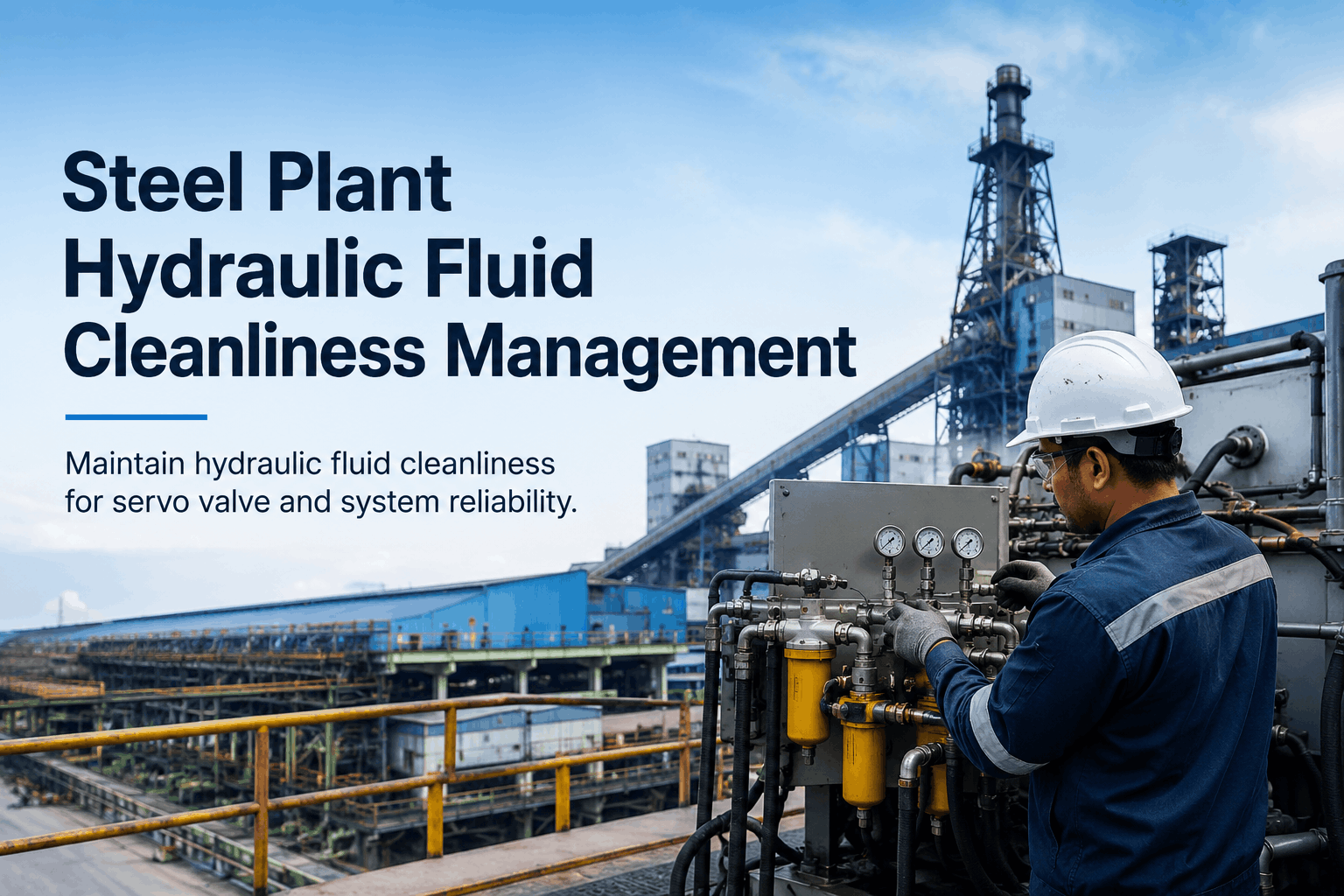
Steel plant hydraulic systems operate under extreme conditions — rolling mills, casters, and servo-controlled presses demand precision and reliability. Hydraulic fluid contamination is the single largest threat to servo valve functionality and system availability. Industry data shows that 89% of servo valve failures in steel plants trace to fluid contamination exceeding ISO 4406 cleanliness targets. A contaminated servo valve replacement costs $8,000-$22,000 plus 8-16 hours of production downtime. Conversely, maintaining target fluid cleanliness (typically ISO 18/16/13 or better for servo systems) prevents 76% of servo failures and extends component life by 4-6 years. OxMaint's fluid monitoring module tracks particle count per ISO 4406, water content, TAN (Total Acid Number), and varnish buildup — automatically triggering offline filtration work orders when cleanliness thresholds drift, intercepting failures before servo malfunction.
Steel Plant Hydraulic Fluid Cleanliness Management: ISO Codes, Servo Valve Protection, and Contamination Control
Master ISO 4406 cleanliness codes, prevent 76% of servo valve failures, reduce emergency maintenance by 34%, and extend hydraulic component life 4-6 years with structured fluid monitoring and contamination control protocols.
Section 1: ISO 4406 Cleanliness Codes — What Steel Plants Need to Understand
ISO 4406 is the international standard for hydraulic fluid cleanliness expressed as a three-part code: 18/16/13 means particles larger than 4 microns number 1,300-2,500 per milliliter, particles larger than 6 microns number 320-640 per ml, and particles larger than 14 microns number 20-40 per ml. Steel plant servo systems require cleanliness levels of ISO 17/15/12 or better. General hydraulic systems can tolerate ISO 21/19/16. The difference matters: a servo valve rated for ISO 18/16/13 fluid but operating in ISO 22/20/18 fluid accumulates abrasive particle damage at 3-4× the normal rate. Within 1,200 operating hours, the servo valve begins to stick, response time degrades 15-25%, and control accuracy drifts. By 1,800-2,000 hours, the valve fails completely. Steel plant maintenance teams must understand that fluid cleanliness is not a "nice to have" — it is a direct control system performance requirement. Most steel plants monitor cleanliness once per quarter or once per year. This is insufficient. Servo-critical systems (automated casters, press flow controls, mill stand synchronization) require monthly fluid sampling and analysis. High-duty systems running 300+ cycles per day should sample every 2-3 weeks. Automated fluid sampling schedules tied to cycle count prevent cleanliness drift by catching contamination spikes before they trigger failures.
Section 2: Contamination Sources in Steel Plants — Where Particles Actually Come From
Steel plant hydraulic systems accumulate contamination from five primary sources. First, water ingress through reservoir breathers exposed to humid steel plant air — moisture can reach 12-18% by weight in summertime. Water accelerates oxidation, promotes microbial growth in the fluid, and causes corrosion of component internals. Second, component wear debris — as pumps, cylinders, and motors age, internal wear generates iron oxide particles that circulate throughout the system. A failing pump can contribute 50,000-200,000 particles per ml per operating hour. Third, external particle ingress during maintenance — technicians opening hose connections, replacing filters, or topping-up fluid expose the system to atmospheric dust. A single careless connection can introduce 500,000+ particles into a 500-liter tank. Fourth, degraded filter bypass events — when filters load up and bypass indicators are ignored, contaminated fluid circulates unfiltered for hours or days, exponentially increasing particle concentration. Fifth, varnish formation from oxidized fluid — long-term thermal stress and oxygen exposure cause fluid molecules to polymerize into varnish deposits that coat valve internals, reducing response time and flow precision. Steel plants with high-temperature environments (rolling mills generating 200°F+ ambient heat) experience 2-3× faster varnish formation. The solution is multi-layered: (1) install desiccant breather filters on all reservoir vents, (2) establish offline kidney-loop filtration running 4-6 hours daily during production downtime, (3) implement zero-contamination procedures during maintenance, (4) monitor bypass indicators religiously and replace filters immediately when triggered, and (5) track fluid oxidation (TAN testing) quarterly and perform complete fluid flush when TAN exceeds 2.0 mg KOH/g.
| Contamination Source | Particle Generation Rate | Detection Method | Control Strategy |
|---|---|---|---|
| Water Ingress (Humid Air) | 12–18% water content by weight in humid seasons | Karl Fischer titration testing monthly | Desiccant breather filters on all reservoir vents |
| Pump/Cylinder Wear Debris | 50K–200K particles/ml/hr from failing pump | ISO particle count trending, component condition monitoring | Schedule pump rebuild/replace at 6,000–8,000 hrs or when wear debris exceeds thresholds |
| Maintenance Contamination | 500K+ particles from single unprotected connection opening | Correlation of particle spikes with maintenance activity dates | Zero-contamination procedures: caps on all connections, sealed fluid transfer carts, technician training |
| Filter Bypass Events | Unfiltered circulation for hours-days when bypass triggered | Bypass indicator monitoring, emergency work order response protocol | Replace filters immediately when bypass indicator shows yellow. Never run with red bypass indicator |
| Varnish / Oxidized Fluid | 2–3× faster formation in 200°F+ environments | ASTM D2272 RPVOT test (Rotating Pressure Vessel Oxidation Test), TAN trending | Complete fluid flush when TAN exceeds 2.0 mg KOH/g. Quarterly TAN testing in high-temp environments |
Section 3: Offline and Kidney-Loop Filtration — Active Fluid Reconditioning
Offline filtration is the most cost-effective contamination control strategy in steel plants. A kidney-loop cart — a portable unit with 3-6 micron filter, water removal cartridge, and circulation pump — can reduce particle concentration by 60-80% during a single 6-hour conditioning cycle. Steel plants should run offline filtration during shift changes or overnight downtime: park the kidney-loop cart next to the hydraulic reservoir, connect suction and return lines, and run the unit for 6-8 hours. Cost per cycle: $120-$200 in electricity and filter cartridge life. Benefit: prevents one $15,000 servo valve failure. Offline filtration is especially critical after maintenance activities or emergency repairs that may have introduced contamination. A best-practice protocol is: (1) after any hose disconnection or component replacement, immediately run 6-hour offline filtration cycle, (2) after any filter bypass event, run offline filtration before resuming servo operations, (3) during high-contamination seasons (humid summer), run offline filtration 2× per week as preventative measure, (4) track fluid cleanliness trends with particle count data — if cleanliness worsens 2+ ISO codes over 2 weeks, investigate contamination source and increase offline filtration frequency. CMMS platforms schedule offline filtration automatically based on fluid sample data, eliminating manual decision-making and ensuring kidney-loop carts are deployed exactly when contamination is rising, not after failures occur.
Section 4: Fluid Sampling and Analysis — The Early Warning System for Servo Valve Health
Fluid analysis is the only reliable early warning system for contamination before it damages components. Steel plant hydraulic systems should implement a structured sampling protocol: (1) Servo-critical circuits (caster controls, mill stand synchronization, precision press valves) — sample every 2-3 weeks or after every 500 operating hours, (2) General hydraulic systems (cylinder circuits, accumulator charging) — sample monthly, (3) All systems after maintenance — sample 24-48 hours after any component work to detect contamination spikes, (4) Baseline sampling — establish current cleanliness, water content, TAN, and viscosity targets as reference points in month 1. Each fluid sample should be analyzed for: ISO 4406 particle count (4, 6, and 14 micron thresholds), water content (Karl Fischer method), TAN (oxidation degree), and viscosity at 40°C and 100°C. Analysis cost: $120-$250 per sample. Turnaround: 2-3 business days from laboratory. Most steel plants send samples to contract laboratories (SGS, Wear Check, Mobil Pegasus, Shell Tellus), which maintain historical trending databases and alert when metrics exceed target ranges. The critical metric is trend, not absolute value. A fluid at ISO 20/18/15 is still acceptable if it was 19/17/14 two weeks prior. But if cleanliness degrades from ISO 18/16/13 to ISO 20/18/15 to ISO 22/20/17 over 6 weeks, a contamination source is active — kidney-loop filtration should be deployed immediately. CMMS integrates fluid analysis results and triggers alerts when particle count or water content crosses critical thresholds, enabling predictive offline filtration before servo valve failure risk emerges.
Section 5: Servo Valve Protection Strategy — Integration of Cleanliness, Monitoring, and Preventative Replacement
Servo valve protection is not a single action — it is a holistic strategy integrating cleanliness maintenance, real-time monitoring, and predictive replacement. The strategy unfolds in four phases: Phase 1 (Baseline, Month 1) — sample fluid, establish current cleanliness/water/TAN targets, inspect all servo valves for stiction or response drift, and document baseline servo response times. Phase 2 (Months 2-6) — execute monthly fluid sampling, run offline filtration every 2-3 weeks, install desiccant breathers on all reservoirs, and implement zero-contamination procedures during maintenance. Monitor for any degradation in servo response time (>10% slower indicates early stiction). Phase 3 (Months 7-18) — continue sampling and offline filtration per established frequency, track fluid cleanliness trend (should stabilize at target ISO code), and schedule servo valve rebuild or replacement at 8,000-10,000 operating hours even if valve still functions (preventative replacement is cheaper than emergency replacement). Phase 4 (Months 19+) — ongoing monitoring with adjusted sampling frequency based on demonstrated cleanliness stability. If cleanliness consistently maintains ISO 17/15/12 or better, reduce sampling to quarterly. If cleanliness drifts above target twice per year, increase offline filtration frequency and investigate environment-specific contamination sources. Steel plants implementing this complete strategy report 76% reduction in servo valve failures, 34% reduction in unscheduled maintenance, and average servo component lifespan extension from 4-5 years to 9-10 years. The investment in fluid monitoring and offline filtration equipment ($15,000-$28,000 capital for kidney-loop cart and lab relationship setup) is recovered within 6-12 months through avoided servo failures alone. Schedule a consultation to audit your current fluid cleanliness program and calculate servo valve failure prevention ROI specific to your steel plant's system configuration and operating conditions.
Frequently Asked Questions
We were losing 2–3 servo valves per year on our caster system. Each failure meant 8–12 hours of downtime and $15,000 in parts and labor. After implementing a structured fluid cleanliness program with monthly sampling and bi-weekly offline filtration, we went from 2.5 servo failures per year to zero in 18 months. The kidney-loop cart and lab analysis cost us $28,000 to set up, but we saved $45,000 in avoided failures in year one alone. This is our highest-ROI maintenance investment.
Protect Your Servo Valves with Structured Fluid Cleanliness Management
Integrate ISO cleanliness monitoring, offline filtration scheduling, and fluid analysis into your CMMS. Start your steel plant's servo valve protection strategy today.