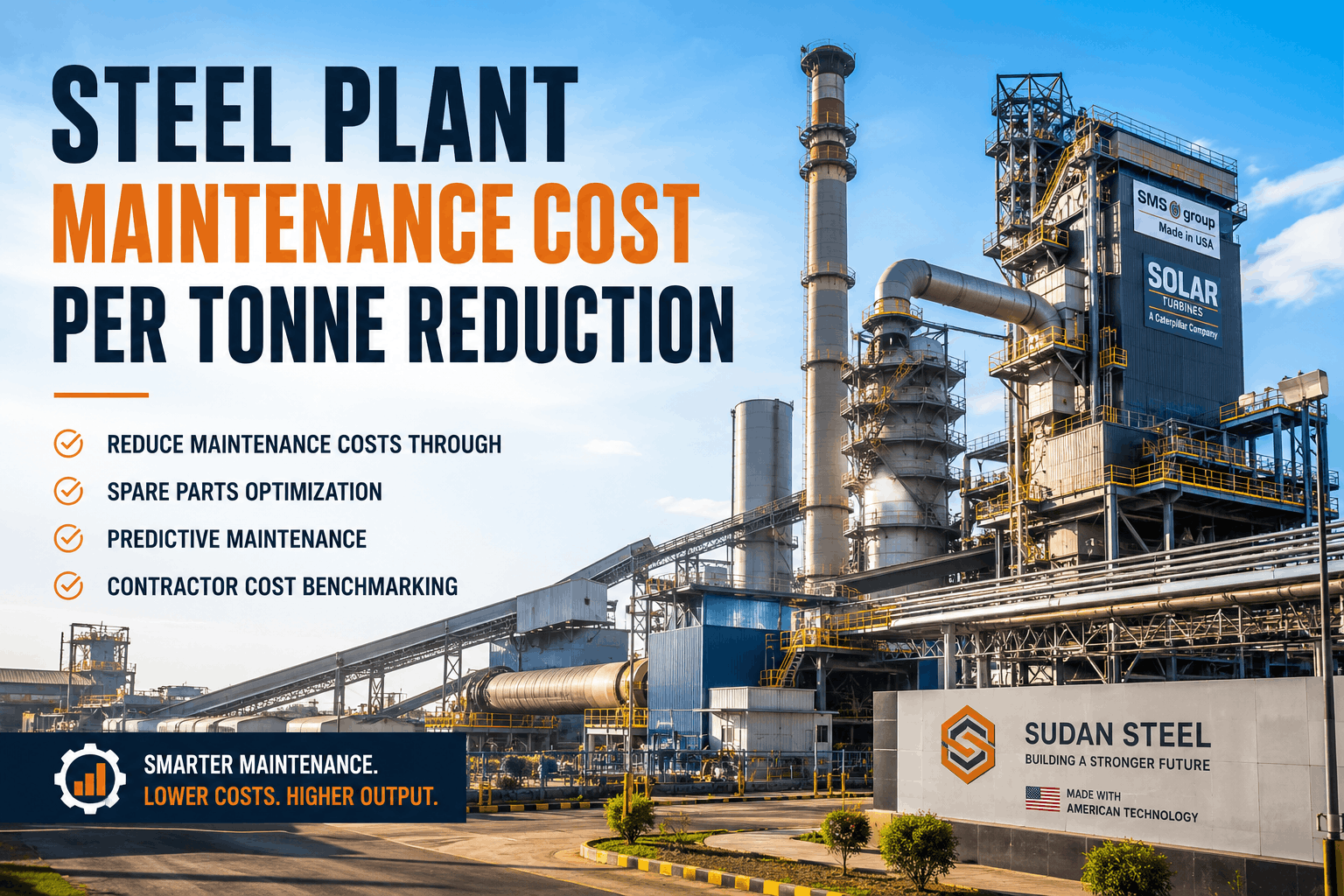
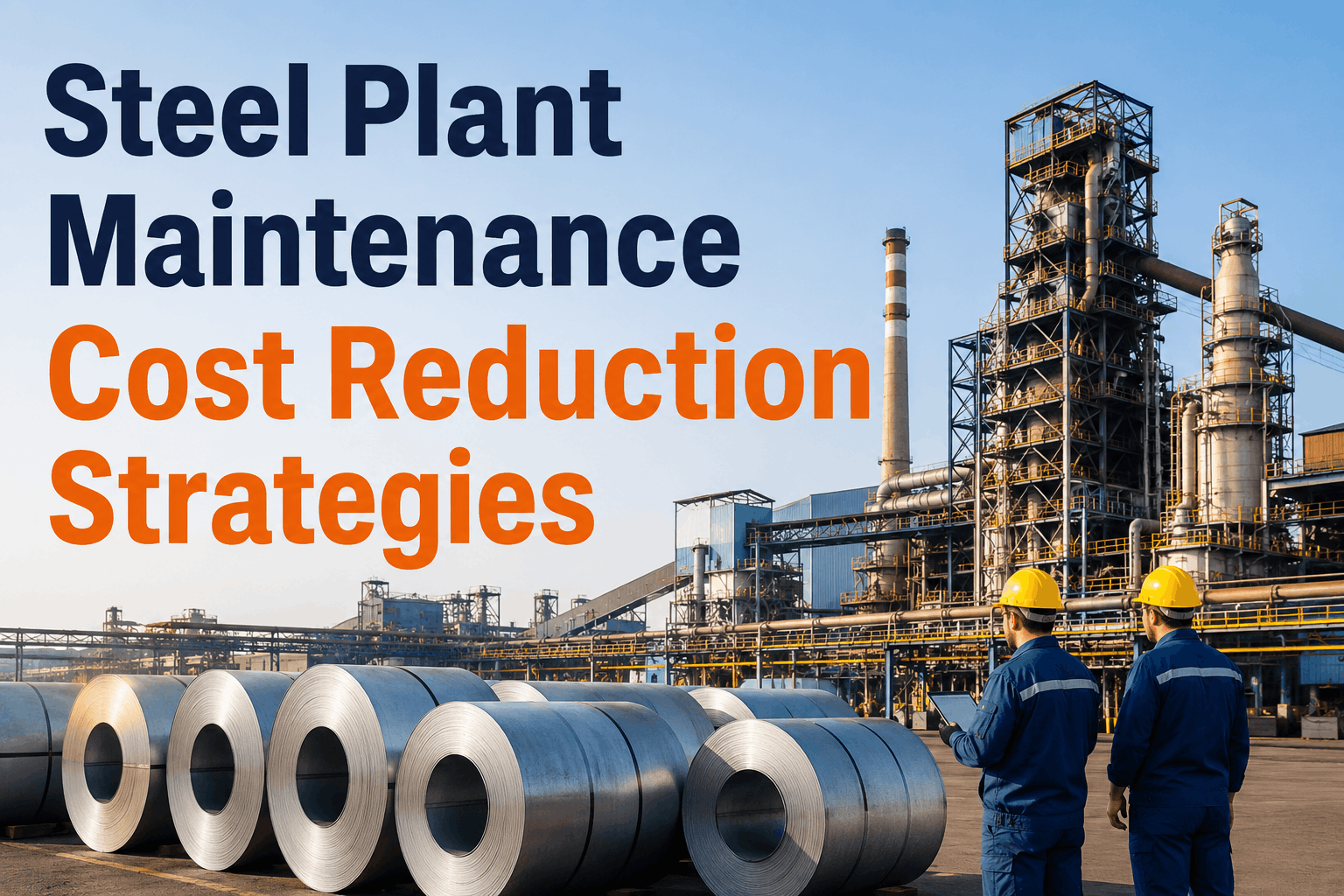
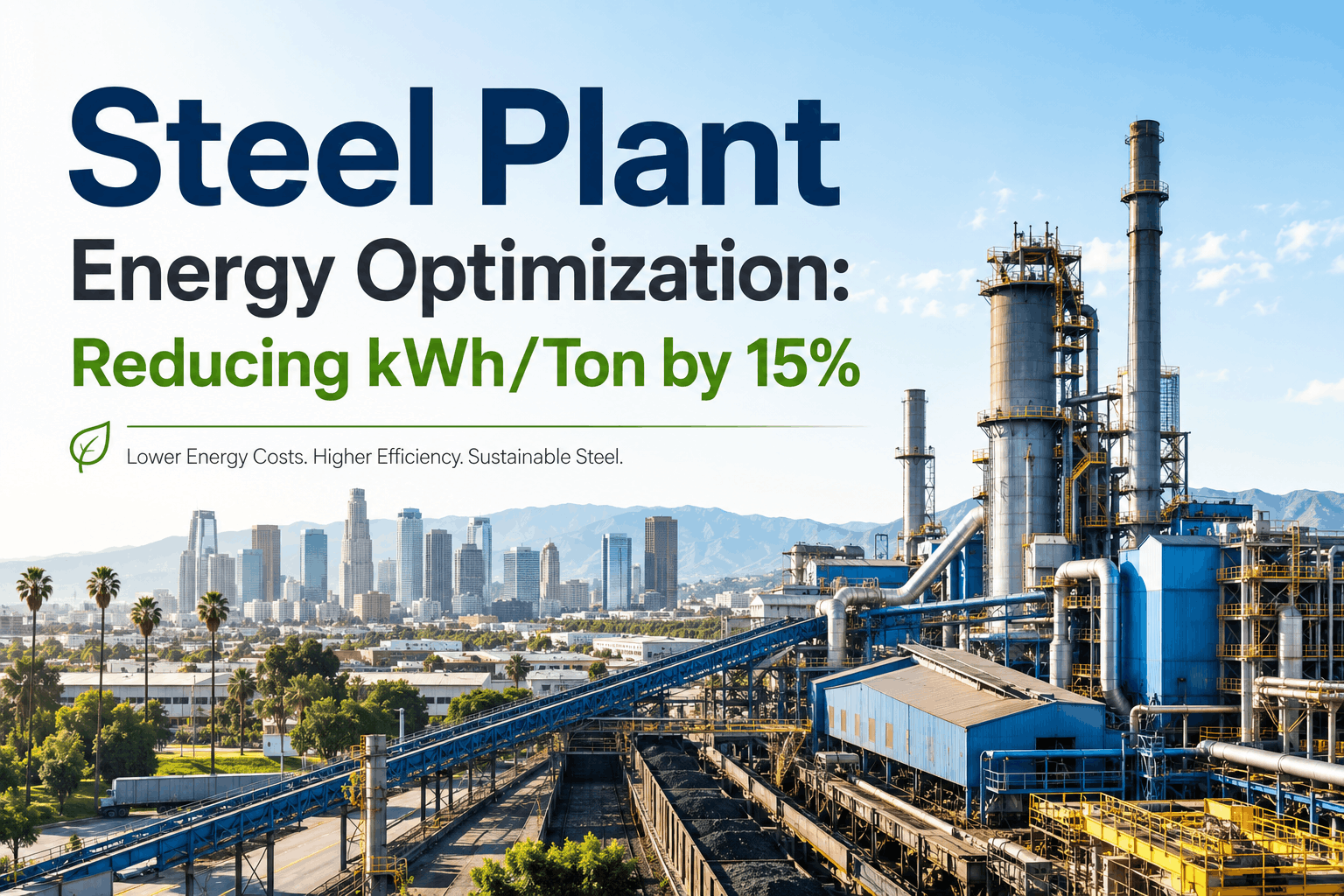
Indian steel producers face a maintenance cost equation that their international competitors do not — high energy tariffs, import-dependent spare parts with long lead times, skilled technician shortages outside major industrial clusters, and competitive pressure from Chinese and Korean steel on global markets that leaves limited margin for operational inefficiency. The steel plants that are widening their cost advantage in this environment are not the ones spending more on maintenance — they are the ones spending smarter: shifting reactive maintenance to planned maintenance, connecting condition monitoring data to work order systems, and using asset analytics to make maintenance interval decisions with production and cost data rather than OEM-prescribed fixed intervals that were written for different operating conditions. Book a demo to see how OxMaint's Analytics & Reporting drives maintenance cost reduction across Indian steel plant operations.
Steel Industry Optimization · India · Analytics & Reporting
Reducing Steel Plant Maintenance Costs in India
Reactive-to-planned shift · spare parts optimization · energy cost reduction · condition-based maintenance · local context strategies
Indian steel plants operating at 70–80% OEE spend an estimated 18–22% of total production cost on maintenance — versus 12–15% at world-class operations. Closing that gap without compromising equipment reliability requires analytics-driven maintenance decisions, not blanket budget cuts.
₹2.8–4.2Cr
Estimated per-hour production loss on a hot strip mill finishing stand — unplanned failure during peak monsoon demand
18–22%
Maintenance as % of total production cost — Indian steel plants vs 12–15% world-class benchmark
35–50%
Of Indian steel plant maintenance spend attributable to emergency repair and unplanned breakdown response
4–8 weeks
Typical import lead time for critical OEM spare parts — the single largest driver of extended unplanned downtime
The 5 Highest-Impact Cost Reduction Levers in Indian Steel Plant Maintenance
01
Reactive-to-Planned Maintenance Ratio
Indian steel plants with reactive maintenance ratios above 40% are spending 3–4× more per repair event than those running at 15–20% reactive. Emergency breakdown response at 2 AM costs: overtime labour, emergency logistics, expedited parts, and the production loss during unplanned downtime. Shifting that ratio requires structured PM scheduling, not just a CMMS — it requires the backlog management, parts availability confirmation, and work package preparation that makes planned maintenance actually executable.
Target: <20% reactive · Savings potential: 25–35% reduction in total maintenance spend
02
Spare Parts Inventory Optimisation
Two simultaneous failure modes exist in Indian steel plant spare parts systems: critical items with 4–8 week import lead times that are not stocked, causing extended downtime when failures occur; and slow-moving consumables and non-critical parts that are over-stocked at significant working capital cost. The solution requires criticality-based inventory stratification — identifying which parts must be stocked to defined minimum levels based on failure consequence, and which can be managed on local procurement timelines.
Working capital reduction: 20–30% · Extended downtime reduction: 40–60%
03
Condition-Based Maintenance for High-Cost Assets
Fixed-interval PM on rolling mill drives, blast furnace blowers, and continuous caster withdrawal systems replaces parts on schedule whether they need it or not — and still misses failures that develop between PM intervals. Vibration monitoring and motor current analysis on the 20–30 highest-cost assets in a steel plant typically identifies 60–70% of potential failures before they cause unplanned downtime, while simultaneously extending the maintenance intervals on assets that are running well, reducing total PM cost.
Unplanned downtime reduction: 40–65% · PM cost reduction: 15–25% on monitored assets
04
Energy Cost Reduction Through Maintenance
In Indian steel plants operating on expensive grid power (₹6–9/kWh in most industrial states) or captive power generation, equipment in poor maintenance condition is the largest controllable energy cost. Dirty condenser coils on compressors, worn motor bearings running at elevated load, scaled heat exchanger surfaces, and leaking compressed air systems each add measurable energy cost that is invisible without monitoring. Energy-correlated maintenance — triggering PM events on energy consumption deviation rather than fixed intervals — addresses this systematically.
Energy cost reduction: 8–15% · Equivalent to significant per-tonne production cost improvement
05
Contractor & Labour Cost Management
Indian steel plants typically rely heavily on contract maintenance labour — providing flexibility but poor work quality visibility and high per-task cost without performance benchmarking. Structured contractor management through a CMMS that tracks work order completion rates, first-time fix rates, and rework frequency per contractor creates the data foundation for rate negotiations and contractor rationalisation. Consolidating contractor spend with fewer, better-measured vendors typically reduces total contract maintenance cost by 15–25%.
Contractor cost reduction: 15–25% · Rework rate reduction: 30–40%
Know Which Lever Moves Your Cost Number the Most.
OxMaint's Analytics & Reporting benchmarks your reactive ratio, PM compliance, spare parts turn rate, and energy deviation against Indian steel plant industry data — showing where your highest-return cost reduction opportunity is before you invest in it.
India-Specific Maintenance Cost Factors — What Makes the Challenge Different
Generic maintenance cost reduction frameworks from Western industrial literature assume conditions that do not apply in Indian steel plant operations. A cost reduction programme designed for a German or Japanese steel plant will underperform if applied without adaptation to the Indian operating environment.
Import Spare Parts Lead Time
ChallengeCritical OEM parts (IGBT modules, hydraulic servo valves, specialized bearings) — 4–8 week import lead times from Germany, Japan, and USA
Cost impactExtended downtime waiting for parts costs 10–30× the part value in lost production at Indian mill production rates
OxMaint responseCriticality-based min/max inventory with automated reorder triggers; lead time-adjusted safety stock calculations per supplier country
Power Reliability & Cost
ChallengeGrid power unreliability in many steel belts (Chhattisgarh, Jharkhand, Odisha) drives captive power plant dependency — adding maintenance complexity
Cost impactCaptive power plant maintenance at 3–5% of total production cost; voltage variation accelerates motor insulation degradation
OxMaint responsePower quality monitoring triggers for motor insulation testing; CPP asset PM schedules integrated with steel plant CMMS
Skilled Technician Availability
ChallengeQualified maintenance engineers are concentrated in metro areas — plants in Raipur, Rourkela, Visakhapatnam clusters face retention challenges
Cost impactHigh turnover increases training cost; institutional knowledge loss accelerates with experienced technician departures
OxMaint responseDigital work packages capture procedural knowledge; mobile-first interface reduces skill threshold for routine PM execution and recording
Monsoon and Dust Environment
ChallengeJune–September monsoon increases corrosion rate, dust ingress, and electrical isolation failures — not addressed in OEM PM schedules designed for temperate climates
Cost impactSeasonal failure spikes in electrical and instrumentation equipment add 20–30% to Q2-Q3 maintenance spend
OxMaint responseSeasonal PM calendars with pre-monsoon and post-monsoon inspection work orders for all electrical assets in outdoor or semi-outdoor locations
OxMaint Analytics — Maintenance Cost KPIs for Indian Steel Plants
| KPI |
Indian Steel Plant Benchmark |
World-Class Target |
OxMaint Analytics Output |
| Reactive maintenance ratio |
35–50% of hours |
<15% of hours |
Weekly reactive vs planned ratio trending with root cause breakdown by asset class |
| PM compliance rate |
55–70% |
>90% |
PM completion rate per area, department, and contractor with overdue escalation |
| Wrench time (technician productivity) |
25–35% |
>55% |
Work order cycle analysis identifying waiting time categories — parts, permits, access, instructions |
| MTBF on critical assets |
Typically not measured |
Tracked per asset, trending upward |
MTBF trend per asset with correlation to PM compliance and parts quality |
| Maintenance cost per tonne |
₹450–750/tonne (integrated plants) |
₹280–380/tonne (world-class) |
Maintenance cost per tonne trending with category breakdown — labour, parts, contractor, energy |
| Emergency spares stock-out rate |
15–25% of breakdown events |
<3% |
Parts availability at time of work order creation; stock-out frequency by part category |
| Contractor first-time fix rate |
Typically unmeasured |
>85% |
Work order rework frequency per contractor with cost attribution for repeated visits |
"
The most consistently misdiagnosed maintenance cost problem in Indian steel plants is the spare parts problem. Plant managers see high maintenance spend and cut spare parts budgets — which reduces working capital cost on paper but increases unplanned downtime cost by a multiple, because the parts that are cut are often the long-lead-time imports that cause 9-day shutdowns when they fail. The correct response is not to cut the spare parts budget — it is to stratify it. Identify the 50 parts whose absence would cause the most production loss and ensure they are always stocked to a calculated minimum. Use OxMaint's criticality-weighted inventory model to determine which those are. Then reduce the 300 slow-moving parts that are consuming working capital without protecting availability. Cutting the wrong parts kills production. Cutting the right parts frees capital. The data exists to know the difference.
Gerhard Schöttler, Dipl.-Ing., TÜV-Certified
Process & Reliability Engineering, ThyssenKrupp · 26 Years Steel Plant Operations across European, Asian, and Indian integrated steel facilities · Specialist in maintenance cost optimisation programmes for emerging market steel producers
Frequently Asked Questions
What is a realistic maintenance cost reduction target for an Indian steel plant in year one of implementing OxMaint?
First-year reduction of 12–20% in total maintenance spend is achievable for plants starting from a high reactive ratio baseline (40%+), primarily through PM compliance improvement, emergency overtime reduction, and spare parts rationalisation. Plants already running structured PM programmes see smaller first-year gains but more durable year-two and year-three improvements as MTBF trends and condition-based monitoring mature. OxMaint benchmarks against Indian steel plant industry data so the target is calibrated to your baseline, not a generic global benchmark.
Book a demo to see a cost reduction projection for your plant profile.
How does OxMaint handle the India-specific challenge of long import lead times for critical spare parts?
OxMaint's inventory module supports lead-time-adjusted safety stock calculations — each critical part is configured with its sourcing country, typical lead time, and failure consequence class. The reorder alert fires at the point where current stock falls below the calculated safety stock for that lead time, not at a generic low-stock threshold. Parts with 8-week import lead times generate reorder alerts at a much higher stock level than locally sourced equivalents. This prevents the scenario where a part is ordered after it fails rather than before.
Start a free trial to configure your critical spare parts inventory model.
Is OxMaint available in Indian regional languages for shop-floor technician use?
OxMaint's mobile interface supports Hindi and is designed for shop-floor use by technicians — not just maintenance engineers and planners. Work packages, inspection checklists, and defect reporting workflows are built for mobile completion with photo attachment, making them practical for technicians in field conditions without requiring desktop access or English language proficiency for routine tasks. Multi-language support for regional languages is available on enterprise plans — contact the OxMaint team to discuss specific regional language requirements for your plant locations.
Analytics & Reporting · OxMaint · Indian Steel Plants
Your Maintenance Budget Is Already Allocated to Breakdowns You Haven't Had Yet. OxMaint Redirects It.
From reactive-to-planned ratio improvement to spare parts optimisation, energy cost correlation, and contractor performance benchmarking — OxMaint's Analytics & Reporting gives Indian steel plant maintenance teams the operational data to reduce cost per tonne without reducing equipment reliability.