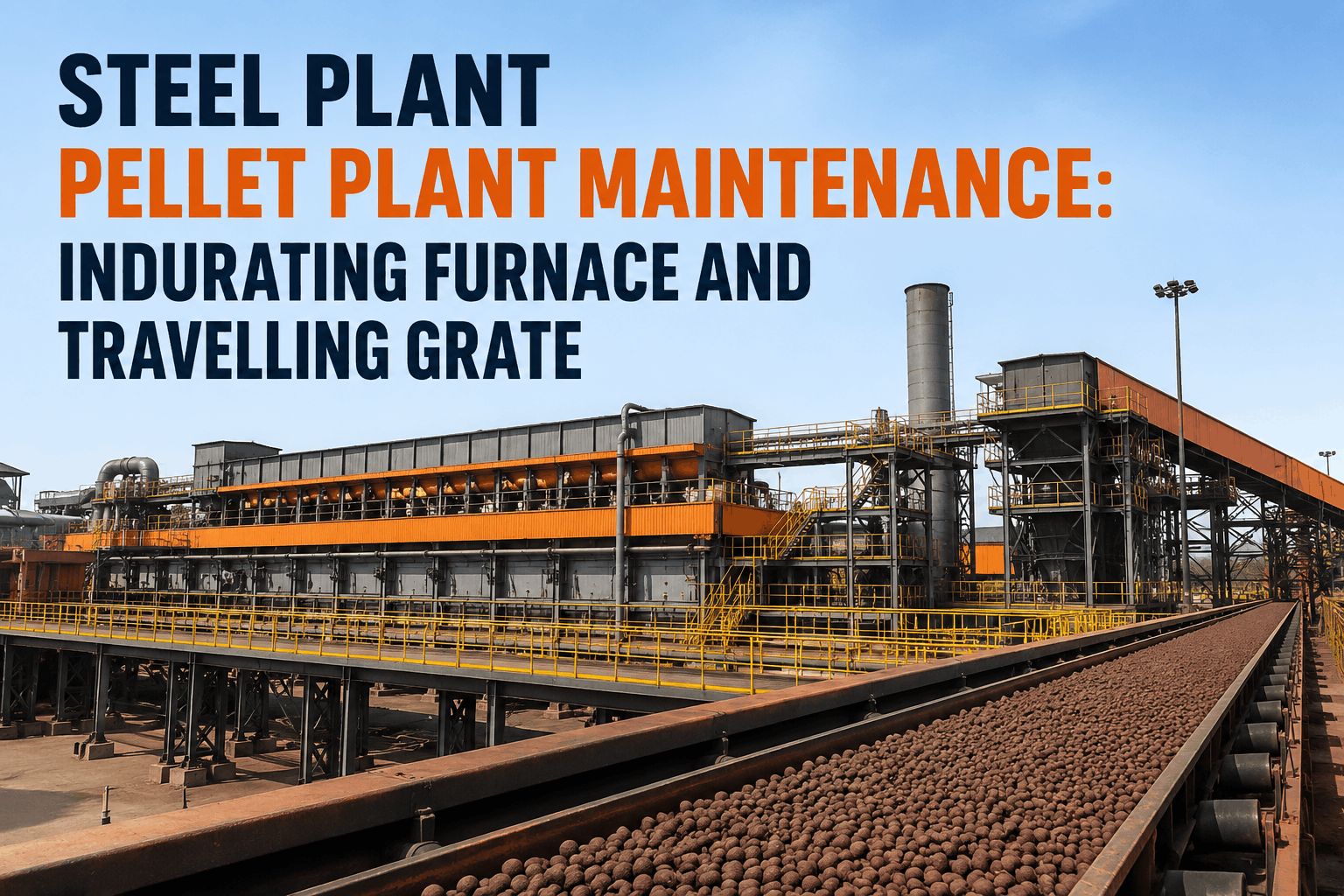
Steel Plant Pellet Plant Maintenance: Indurating Furnace and Travelling Grate
By Alex Jordan on June 18, 2026
Iron ore pellet plants are the critical link between mining and steelmaking — producing the high-quality furnace feed that blast furnaces and direct reduction plants require. The indurating furnace and travelling grate are the heart of the pelletizing process, operating at 1,200–1,350°C to harden green pellets into finished product. A single grate bar failure can cause a cascade of damage, leading to 24–72 hours of downtime and production losses of $500,000–2,000,000 per event. Yet most pellet plant maintenance is reactive — operators wait for grate bars to break, burner refractory to spall, or pallet cars to seize before acting. Start a free trial with Oxmaint to schedule and track pellet plant maintenance, or book a demo to see how steel plants use Oxmaint's pellet plant module to maintain indurating furnaces and travelling grates for maximum uptime.
Steel Plant Pellet Plant Maintenance: Indurating Furnace and Travelling Grate Reliability for Maximum Uptime
Grate bar inspection and replacement, pallet car maintenance, burner management, refractory repair, pellet cooler maintenance, and process optimization — the complete guide to maintaining indurating furnaces and travelling grates for maximum pellet plant availability.
$500K–2M
Production loss from a major indurating furnace outage
50%
Of grate bar failures preventable with regular inspection
30–50%
Longer refractory life with scheduled maintenance
5:1
ROI on pellet plant maintenance program in year one
Pellet Plant Maintenance
Every Hour of Indurating Furnace Downtime Is $20,000–80,000 in Lost Pellet Production
Oxmaint's pellet plant maintenance module tracks grate bar condition, pallet car health, burner performance, refractory condition, and pellet cooler reliability — generating work orders that keep indurating furnaces running and pellets flowing to the blast furnace.
Why Pellet Plant Reliability Matters — The Cost of Downtime
The pellet plant supplies iron ore pellets to the blast furnace or direct reduction plant. When pellet production stops, the blast furnace must either operate on a reduced burden (impacting productivity) or draw from pellet inventory (which is typically limited to 3–7 days of production). Start a free trial or book a demo to see how Oxmaint's pellet plant module prevents the failures that starve your blast furnaces.
The 5 Critical Pellet Plant Systems That Need Scheduled Maintenance
Travelling Grate
Grate bars, pallet cars, and drive systems. Grate bar breakage and pallet car wheel failure are the most common causes of unplanned downtime. Regular inspection prevents catastrophic damage.
Indurating Furnace
Burners, refractory, and combustion control. Refractory spalling and burner failure cause temperature imbalance, affecting pellet quality and risking furnace damage.
Pellet Cooler
Cooling system for finished pellets. Air flow, grate bars, and discharge mechanism require regular maintenance to prevent pellet degradation.
Green Pellet System
Mixer, balling drum or disc, and screening. Equipment wear and misalignment affect pellet quality and generation.
Process Gas System
Recirculating fans, gas cleaning, and heat recovery systems. Fan imbalance and gas leakage affect furnace efficiency and emissions.
8 Essential Pellet Plant Maintenance Tasks
The eight maintenance tasks below represent the highest-ROI interventions for pellet plant reliability. Each task prevents the failures that impact pellet production and blast furnace feed. Oxmaint's pellet plant module schedules and tracks all eight tasks automatically.
Maintenance Task
Frequency
System Affected
Downtime Prevention
1. Grate Bar Inspection
Daily/Weekly
Travelling Grate
Prevents broken grate bars from damaging pallet cars and reducing airflow
2. Pallet Car Wheel Inspection
Monthly
Travelling Grate
Prevents wheel seizure and pallet car derailment
3. Burner Inspection & Tuning
Monthly
Indurating Furnace
Maintains temperature profile and fuel efficiency
4. Refractory Inspection
Quarterly
Indurating Furnace
Prevents refractory failure and heat loss
5. Pellet Cooler Inspection
Weekly
Pellet Cooler
Prevents cooler grate failure and pellet degradation
6. Green Pellet Equipment
Weekly
Balling Drum/Disc
Maintains pellet size distribution and quality
7. Process Gas Fan Inspection
Monthly
Process Gas System
Prevents fan imbalance and efficiency loss
8. Temperature Profiling
Daily
Indurating Furnace
Identifies temperature imbalances before they affect quality
Without vs. With Pellet Plant Maintenance Program
The gap between a steel mill with a structured pellet plant maintenance program and one without is visible across every reliability metric — from grate bar life to pellet plant availability. The comparison below shows the reactive baseline versus the structured result. Oxmaint delivers the structured result with automated tracking of all eight maintenance tasks.
Without Maintenance Program
Pellet Plant Availability
Typical: 82–88%. Grate bar failures, refractory issues, and pallet car problems cause 5–10% downtime. Pellet production interrupted.
82–88% availability
With Maintenance Program
Pellet Plant Availability
Achievable: 94–97%. Scheduled grate bar inspection, pallet car maintenance, and refractory repair prevent unplanned outages. Pellet production reliable.
94–97% availability
Without Maintenance Program
Annual Unplanned Downtime
Average: 15–25 days/year. Grate bar cascade failures cause 5–10 days. Refractory repair causes 5–10 days. Pallet car issues cause 5–10 days.
Average: 6–12 months. Unplanned bar breakage common. Replacement labor intensive and costly.
6–12 months
With Maintenance Program
Grate Bar Life
Achievable: 18–30 months. Regular inspection and rotation extend life. Replacement planned during scheduled outages.
18–30 months
Pellet Plant Maintenance Maturity Scoring
Pellet plant maintenance maturity follows a clear spectrum — from reactive operations that accept frequent outages to fully optimized programs that maintain >95% availability. The scoring framework below lets steel plant managers assess their current capability — identifying the gaps that are costing millions in lost production.
5
Fully Optimized · Predictive Maintenance
All 8 maintenance tasks scheduled and tracked. Grate bar wear monitored. Refractory condition tracked. Pellet plant availability >95%.
$5–10M production protected. Reliable blast furnace feed.
4
Proactive · Scheduled Maintenance
Most maintenance tasks scheduled. Grate bars inspected monthly. Some tracking gaps. Pellet plant availability 88–94%.
Grate bars inspected when issues arise. Refractory repaired only after failure. Pallet cars serviced reactively. Pellet plant availability 82–88%.
Gap: Preventive program needed. Prioritize grate bar and refractory PM.
2
Minimal Maintenance
Pellet plant run until failure. Grate bars replaced only when broken. Refractory patched only when visible. Frequent outages.
Risk: Production interruptions. Immediate program required.
1
No Maintenance Program
No scheduled maintenance. Frequent grate bar failures. Refractory failures common. Pellet plant availability <80%.
Risk: Maximum production exposure. Immediate maintenance program required.
Pellet Plant Monitoring Technology — What You Need
Effective pellet plant maintenance requires the right technology stack. The components below work together to prevent failures and maintain pellet production. Oxmaint integrates with all major pellet plant monitoring systems — giving you a single platform for all pellet production reliability data.
Grate Bar Wear Monitoring
Track grate bar condition, wear patterns, and remaining life. Schedule replacement based on condition, not guesswork.
Pallet Car Condition
Track wheel bearing condition, frame integrity, and seal performance. Prevent derailment and cascade damage.
Furnace Temperature Profiling
Monitor temperature profile across the indurating furnace. Identify hot spots and cold spots affecting pellet quality.
Refractory Condition
Thermographic inspection of furnace lining. Detect spalling, cracks, and heat loss. Schedule repair before failure.
Fan & Blower Monitoring
Monitor vibration, temperature, and performance of recirculating fans and process gas blowers. Detect imbalance and wear.
Pellet Quality Monitoring
Track pellet strength, size distribution, and chemistry. Correlate maintenance activities with quality outcomes.
Maintenance Scheduling
Schedule all 8 maintenance tasks. Generate work orders automatically. Track completion and effectiveness.
CMMS Integration
All pellet plant reliability data flows into CMMS. Automated work orders for all maintenance. Centralized records for pellet production reliability.
"
Our pellet plant was the bottleneck in our steelmaking operation — grate bar failures, refractory spalling, and pallet car issues caused 18 days of unplanned downtime annually. We implemented Oxmaint's pellet plant maintenance program with daily grate bar inspections, monthly refractory thermography, and scheduled pallet car maintenance. Pellet plant availability improved from 85% to 95%. Unplanned downtime dropped from 18 days to 5 days per year. The maintenance program paid for itself in the first 8 months.
Pellet Plant Manager — Integrated Steel Mill, US Midwest
How often should grate bars be inspected on a travelling grate?+
Daily visual inspection for broken bars and wear patterns. Weekly detailed measurement of bar wear and gap spacing. Monthly replacement of bars that have reached 80% of expected life. Oxmaint tracks grate bar condition and recommends replacement based on actual wear, not fixed intervals. Book a demo to see grate bar tracking.
What is the most common cause of indurating furnace refractory failure?+
Thermal cycling and chemical attack from process gases are the most common causes. Furnace starts and stops cause rapid temperature changes that spall refractory. Sulfur and alkali compounds in the process gas react with refractory materials, causing chemical degradation. Quarterly refractory inspections and controlled furnace shutdowns extend life. Start a free trial to schedule refractory inspections.
How do you extend pallet car wheel life?+
Regular wheel bearing lubrication, alignment checks, and load monitoring extend wheel life. Wheel seizure is typically caused by bearing failure from contamination or lubrication loss. Monthly wheel inspection and quarterly bearing lubrication reduces wheel failure by 60–80%. Oxmaint tracks wheel condition and schedules preventive maintenance.
What is the cost of pellet plant downtime?+
A 24-hour indurating furnace outage typically costs $500,000–2,000,000 in lost pellet production. If the blast furnace must cut production due to pellet shortage, additional costs of $1–3M per day apply. Preventive maintenance programs prevent these losses at 5–10% of the cost of a single failure. Start free to calculate your pellet plant downtime cost.
How does a CMMS help with pellet plant maintenance?+
A CMMS like Oxmaint provides five pellet plant advantages: (1) Maintenance scheduling — all 8 tasks scheduled and tracked, (2) Condition monitoring — grate bar wear, refractory condition, pallet car health tracked, (3) Work order integration — maintenance actions generate work orders, (4) Parts management — critical spare parts tracked, (5) Reliability improvement — data-driven maintenance optimization. Start free to see how Oxmaint manages pellet plant maintenance.
Pellet Plant Intelligence from Oxmaint
Every Hour of Indurating Furnace Downtime Is $20,000–80,000 in Lost Pellet Production
Grate bar wear monitoring, pallet car health tracking, refractory condition management, and pellet quality optimization — unified in one CMMS that keeps pellet plants running and blast furnaces fed. Stop fixing grate bars reactively. Start preventing failures proactively.