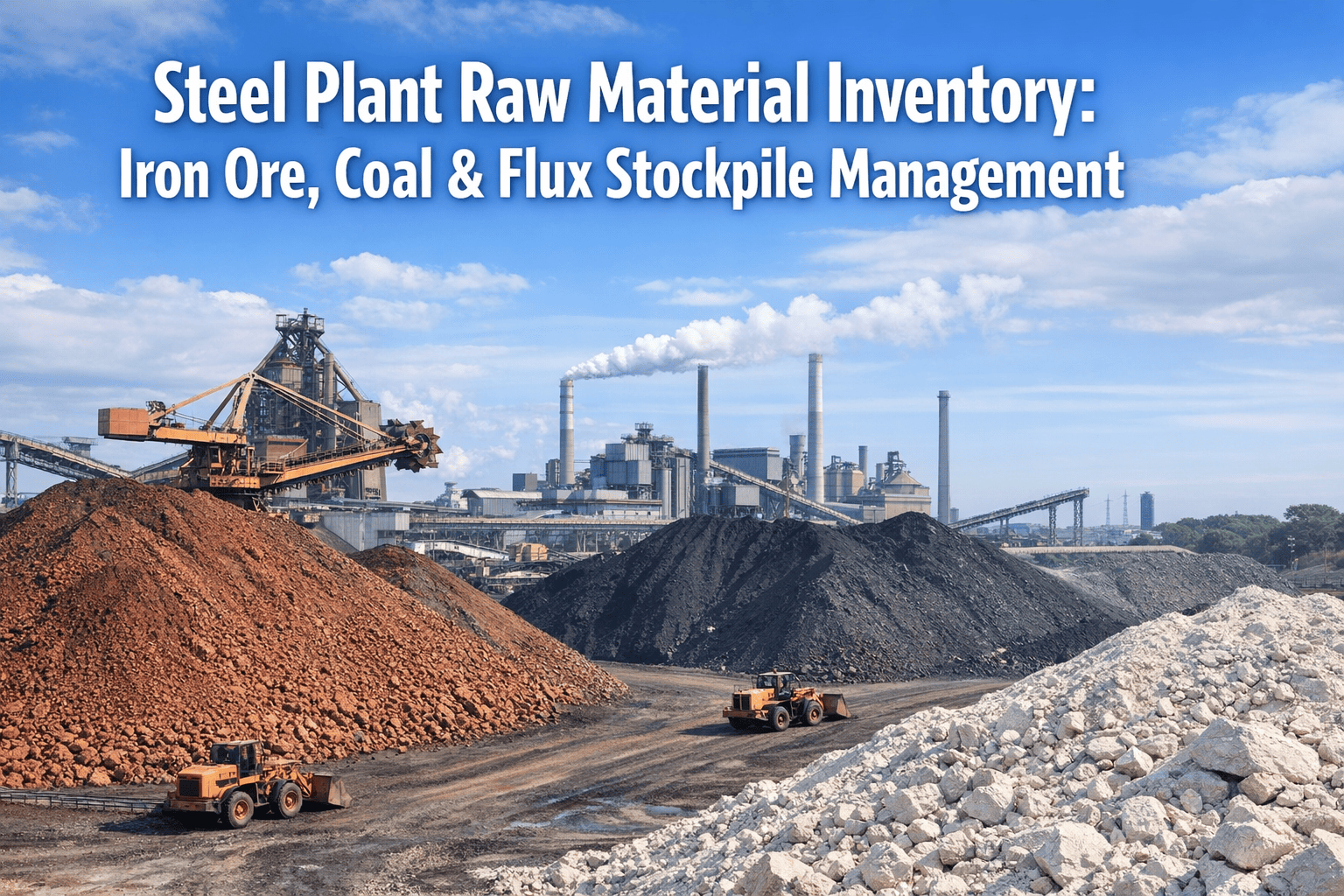
Steel Plant Raw Material Inventory: Iron Ore, Coal & Flux Stockpile Management

By James smith on April 10, 2026

steel-plant-raw-material-inventory-iron-ore-coal-flux

Every tonne of crude steel produced through the blast furnace route consumes approximately 1,370 kg of iron ore, 780 kg of metallurgical coal, and 270 kg of limestone — yet most steel plants still manage these massive material flows through spreadsheets, paper gate logs, and tribal knowledge. Oxmaint's inventory tracking module brings AI-powered forecasting and real-time stockpile visibility to raw material management — connecting yard stock levels, blend requirements, consumption rates, and supplier schedules into a single operational view. This guide covers how leading steel plants manage iron ore, coal, and flux from the ship unloader to the blast furnace mouth.

Raw Material Inventory Management — Integrated Steelmaking

Iron Ore, Coal & Flux Stockpile Management in Steel Plants

From vessel arrival to blast furnace burden — how modern plants use AI forecasting, real-time stockpile tracking, and blend optimization to maintain uninterrupted production while minimizing inventory carrying cost.

1,370 kg
Iron ore per tonne of BF/BOF crude steel (World Steel Association)
7–20 days
Typical raw material days-of-supply at steel mills globally
15–30%
Inventory carrying cost reduction with AI-driven forecasting
60+
Supplier origins managed by large integrated steel producers
3 Critical Stockpiles

What You're Managing — and Why Each One Is Different

Iron ore, coal, and flux each have distinct quality variability, storage requirements, and consumption patterns. Managing them with the same approach is the root cause of most blend failures and unplanned furnace adjustments.

01
Iron Ore
Lump, Sinter Feed, Pellets
Consumption
1,370 kg per tonne crude steel (BF route)
Critical Parameters
Fe%, SiO₂, Al₂O₃, moisture, size fraction
Storage Risk
Segregation during stacking, moisture gain in wet season, spontaneous combustion in fine ore
Days of Supply Target
15–25 days (coastal mills) / 20–35 days (inland, longer transport cycle)
Major import sources: Brazil (47%), Canada (30%), Sweden (13%) — supply disruptions require 2–4 weeks' buffer in most markets
02
Metallurgical Coal
Coking Coal, PCI, Thermal
Consumption
780 kg per tonne crude steel (BF route)
Critical Parameters
VM%, ash%, CSN, crucible swell number, moisture
Storage Risk
Spontaneous combustion (high VM coals), compaction reducing pore space, weathering degrades coking properties
Days of Supply Target
10–20 days — limited by spontaneous combustion risk in stockpile above 3m height
~1 billion tonnes of met coal consumed in global steelmaking annually — cyclone season in Australia directly impacts supply reliability for Asian mills
03
Flux Materials
Limestone, Dolomite, Quartzite
Consumption
270 kg limestone per tonne crude steel (BF route)
Critical Parameters
CaO%, MgO%, SiO₂ max, size fraction, fines percentage
Storage Risk
Moisture absorption in limestone, dust loss from fine dolomite, degradation during stockpile retrieval
Days of Supply Target
20–45 days — typically domestic supply with lower transport risk than ore or coal
Flux quality consistency directly controls blast furnace slag basicity — a 2% CaO variation in limestone requires real-time burden recalculation to maintain target B2 ratio
Inventory Tracking + AI Forecasting

Track Every Stockpile, Every Blend, Every Days-of-Supply in Real Time

Oxmaint's inventory module gives your raw material team live visibility across all stockpile types — with AI-powered consumption forecasting that accounts for campaign variability, seasonal supply disruptions, and grade blending requirements.

The Real Problems

What Breaks Down in Manual Stockpile Management

01
Yard Capacity Conflicts
Vessels arrive without accurate yard space visibility, creating demurrage costs while ships wait offshore. Nippon Steel imports 100M+ tonnes annually — even a 1-day demurrage per vessel adds millions in avoidable cost.
02
Blend Quality Misses
Manual blending calculations based on lab assay sheets cannot account for stockpile segregation in real time. A 2% variance in iron ore Fe% across a sinter blend causes significant productivity loss at the blast furnace.
03
Days-of-Supply Blind Spots
Spreadsheet-based tracking cannot factor in grade-specific consumption rates. A plant may show 18 days of coal inventory but only 9 days of the specific CSN-grade required for the current production campaign.
04
Seasonal Supply Gaps
Cyclone season, monsoon disruptions, and port strikes create supply windows that static procurement schedules miss. AI forecasting models that integrate weather patterns and shipping lead times provide 2–4 weeks' advance warning to purchasing teams.
Days-of-Supply Reference

Raw Material Inventory Benchmarks — Steel Mills by Region & Route

Region / Route Iron Ore DoS Met Coal DoS Flux DoS Key Supply Risk Recommended Buffer
Coastal Asia (BF/BOF) 15–20 days 10–15 days 20–30 days Cyclone season (Q1), port congestion +5 days premium grade
Inland Asia (BF/BOF) 20–35 days 12–20 days 30–45 days Domestic rail capacity, weather closures +7 days for coking coal
Europe (BF/BOF) 18–25 days 15–22 days 25–40 days Import dependency, geopolitical risk +8 days all grades
North America (BF/BOF) 20–30 days 10–18 days 30–45 days Great Lakes shipping season (ice closure) +10 days winter buffer
India (BF/BOF — coastal) 12–18 days 14–20 days 20–35 days Monsoon season, port draft limits +6 days monsoon buffer
EAF Route (any region) 7–14 days (DRI/HBI) 5–10 days (PCI only) 15–25 days Scrap price volatility, DRI supply +3 days DRI/HBI
Oxmaint Capabilities

How AI-Powered Inventory Tracking Changes Raw Material Management

1
Real-Time Stockpile Tracking by Grade & Location
Track each stockpile as a separate inventory record with grade-specific parameters — Fe%, CSN, CaO% — not just total tonnage. Days-of-supply calculated per grade against actual campaign consumption rates, not average consumption.
2
AI Consumption Forecasting
Machine learning models trained on your plant's historical blast furnace data predict consumption by production schedule, campaign type, and seasonal variation — generating purchase order triggers 14–21 days before stockpile falls below safety level.
3
Blend Optimization Alerts
When incoming vessel grade deviates from purchase specification, Oxmaint automatically calculates the blend adjustment required across existing stockpile grades to maintain target sinter or burden chemistry — pushing the adjusted ratio to the blast furnace control team.
4
Supplier & Vessel Schedule Integration
Vessel ETAs, grade manifests, and supplier contract quantities linked directly to inventory forecasts — giving purchasing teams a live view of inbound supply against projected stockpile trajectory, with automated alerts when supply gaps open up beyond acceptable risk windows.
"

The single most undervalued capability in raw material inventory management is grade-specific days-of-supply tracking. Every plant I audit can tell me total iron ore inventory in tonnes. Almost none can tell me how many days of high-Fe lump ore they have for the current campaign mix. That gap is where procurement decisions go wrong — purchasing teams reorder on total tonnage while the blast furnace team is already blending around a grade shortage they can't quantify. A platform like Oxmaint that tracks inventory by grade, location, and quality parameter — and projects consumption against actual campaign schedules — closes that gap and eliminates the guesswork that causes both over-stocking and emergency procurement premiums simultaneously.

Dr. Priya Sharma
Raw Materials & Supply Chain Lead — Tata Steel Europe / Independent Steel Operations Consultant, 19 Years in Integrated Steelmaking
Common Questions

Raw Material Inventory — Frequently Asked Questions

What is the right days-of-supply target for iron ore and coal in a steel plant?
Target days-of-supply depends on your supply route and production volume. Coastal Asian mills typically carry 15–20 days of iron ore inventory, while inland mills with longer transport cycles maintain 20–35 days. Metallurgical coal is constrained by spontaneous combustion risk above certain stockpile heights, limiting most plants to 10–20 days. The more important metric is grade-specific DoS — total inventory in tonnes can mask critical shortfalls in specific quality grades required for the current blast furnace campaign. Oxmaint tracks grade-specific DoS in real time against your campaign consumption schedule.
How does AI forecasting improve raw material procurement decisions?
AI forecasting models trained on historical blast furnace data predict grade-specific consumption 14–21 days ahead — accounting for planned production campaigns, seasonal variations, and quality blending requirements that static procurement formulas miss entirely. This lead time allows purchasing teams to arrange optimal vessel scheduling without emergency freight premiums, adjust blend ratios before a grade shortage develops at the burden, and avoid costly demurrage from vessels arriving before yard space is available. Book a demo to see AI-powered forecasting applied to your plant's material mix.
How does Oxmaint handle quality monitoring across multiple iron ore and coal grades?
Each stockpile in Oxmaint is configured with its critical quality parameters — Fe%, SiO₂, Al₂O₃ for iron ore; VM%, ash%, CSN for coking coal; CaO%, MgO% for limestone. As lab assay results are entered (or imported from your LIMS), the system updates grade quality profiles in real time and flags any incoming material that deviates from purchase specification. Blend alerts are automatically generated when the deviation requires a recalculation of the burden or sinter blend to maintain target chemistry. Start a free trial to configure your grade quality parameters today.
What is the biggest inventory management risk during seasonal supply disruptions?
The highest-risk scenario is a grade-specific shortage that develops during a seasonal supply gap — cyclone season in Australia for coking coal, monsoon season affecting Indian port operations, or Great Lakes ice closure for North American integrated mills. These events are predictable by calendar but their severity is variable. Plants that carry only total-tonnage-based safety stock often discover a grade shortage 4–5 days before it hits production, leaving insufficient time for premium-grade emergency procurement. AI forecasting that models seasonal supply curves against campaign demand provides 2–4 weeks' advance warning. Book a demo to see supply risk alerting for your plant's specific supply routes.
From Stockyard to Blast Furnace

Give Your Raw Material Team the Visibility They've Been Working Without

Oxmaint's inventory tracking and AI forecasting module connects grade-specific stockpile levels, blend requirements, vessel schedules, and consumption forecasts into one operational view — so your procurement team never orders too late and your blast furnace team never blends blind.


Share This Story, Choose Your Platform!