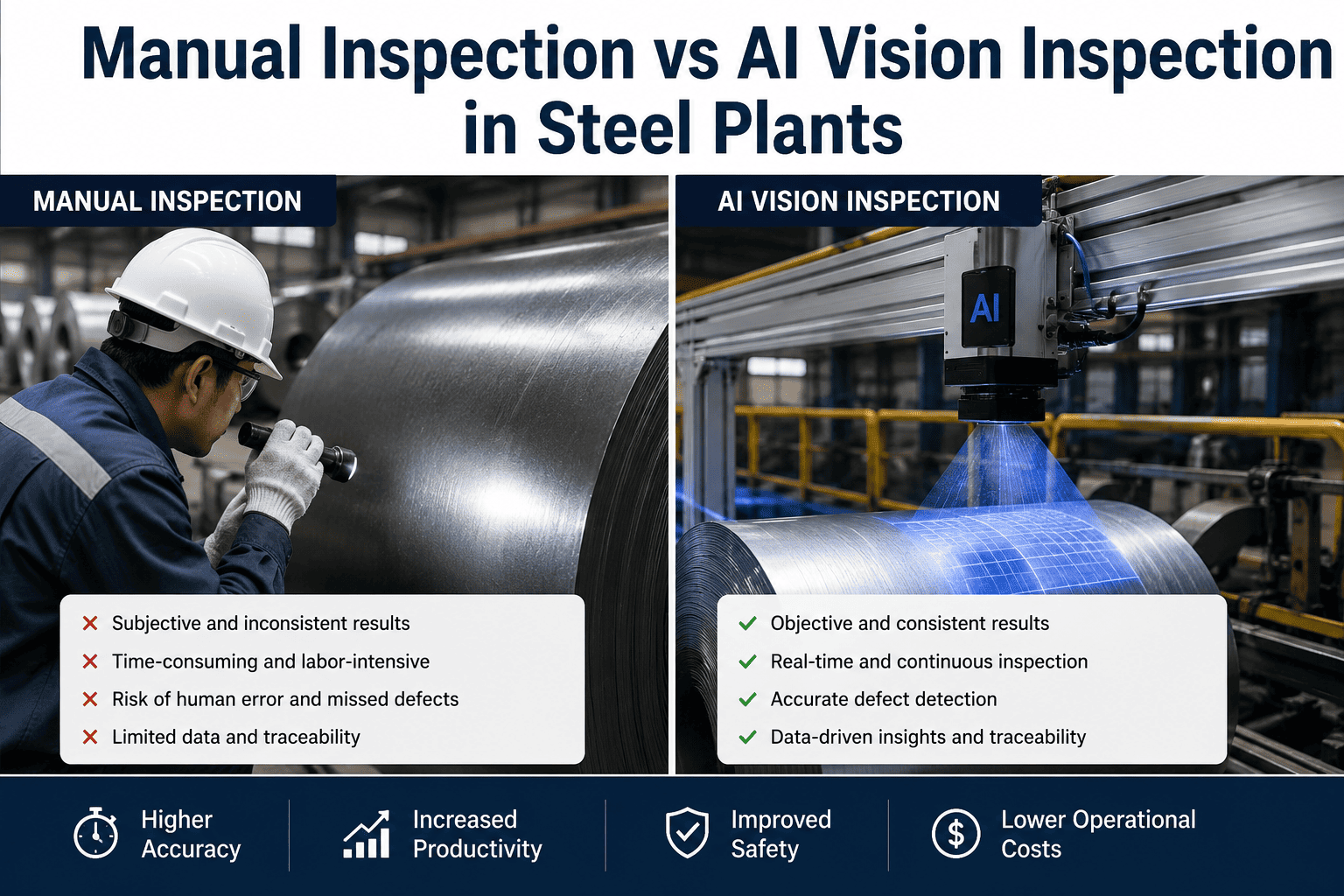
Manual visual inspection of steel surfaces has a hard physical ceiling: the human eye resolves about 0.1mm at comfortable viewing distance, fatigues after 20–40 minutes of sustained concentration, and operates at a fraction of rolling line speed. These are not performance failures — they are biological constraints. AI vision systems don't replace the expertise of experienced quality engineers; they remove the constraints that make human inspection inadequate at modern production speeds. OxMaint AI Vision Inspection runs continuously at 1,200+ m/min with 97% accuracy, classifying defects, linking to process data, and creating maintenance work orders — tasks that previously took hours now happen in under 10 seconds from detection to dispatch.
Article · AI Vision Inspection · Steel Quality Control
Manual Inspection vs AI Vision Inspection in Steel Plants
A structured comparison across detection accuracy, speed, consistency, traceability, and maintenance integration — with data from steel plant deployments and a framework for deciding where each approach still makes sense in 2025.
58%
Avg defect detection rate — manual inspection at full rolling speed
97%
Avg defect detection rate — OxMaint AI Vision at full rolling speed
100×
Speed advantage of AI vision vs sustained manual inspection
8× faster
Defect-to-maintenance-action time with CMMS-integrated AI vision
Head-to-Head Comparison: 8 Critical Dimensions
| Dimension |
Manual Inspection |
AI Vision (OxMaint) |
Winner |
| Detection Rate |
55–65% at full speed |
95–98% at full speed |
AI Vision |
| Inspection Speed |
12 m/min max (effective) |
1,200+ m/min continuous |
AI Vision |
| Surface Coverage |
2–5% sample-based |
100% full-width strip |
AI Vision |
| Classification Consistency |
Variable by inspector, shift, fatigue |
Deterministic — same criteria every time |
AI Vision |
| Response Time |
3–4 hours (shift handover) |
Under 10 seconds |
AI Vision |
| Maintenance Integration |
Manual escalation, paper-based |
Auto work order in CMMS |
AI Vision |
| Traceability |
Paper logs, incomplete records |
Full digital audit trail per coil |
AI Vision |
| Novel / Complex Defects |
Experienced inspector can reason |
Requires training data or human review |
Manual |
Where Each Approach Still Makes Sense
Manual Inspection — Still Valid Here
Novel defect types not yet in the AI training library — human pattern recognition flags anomalies the model has never seen
Customer witness inspections and grade release decisions requiring human sign-off for certification purposes
Sampling for metallurgical root cause — physical specimen extraction and lab analysis require human judgment on sample location selection
Small-batch specialty product runs with custom acceptance criteria not reflected in standard AI classification models
AI Vision — Outperforms Manual Here
High-speed continuous inspection at rolling speed — physically impossible for manual inspection to cover at 900+ m/min
Roll mark pitch analysis — AI identifies responsible stand within 2 repetitions; manual inspection cannot determine stand without process data correlation
Shift-change continuity — AI inspection has zero performance degradation across shifts, weather conditions, or fatigue levels
Defect trend analysis across campaigns — AI accumulates machine-readable quality data that drives process optimisation decisions unavailable from paper records
OxMaint AI Vision gives your quality team 100% surface coverage at full rolling speed — with automatic maintenance dispatch that closes the loop between detection and root cause elimination.
The Maintenance Integration Gap — Why Detection Alone Is Not Enough
The most overlooked difference between manual and AI inspection is not detection rate — it is what happens after a defect is detected. Manual inspection ends with a quality report. AI vision with CMMS integration ends with a closed work order, a confirmed root cause repair, and prevention of the next occurrence.
Manual Inspection Outcome Chain
Defect detected at downcoiler
→
Paper quality sheet written
→
Supervisor notified next shift
→
Maintenance told at handover
→
Root cause investigated manually
→
Repair scheduled next campaign
Average time: 3–6 hours · Average additional coils affected: 6–12
AI Vision + OxMaint CMMS Outcome Chain
Defect detected at full speed
→
AI classifies type + source
→
Work order auto-created
→
Technician dispatched (mobile)
→
Root cause repaired
→
Quality record auto-filed
Average time: <10 seconds · Average additional coils affected: 0.8
Performance Comparison: Six Metrics
Surface Coverage per Coil
"I've been in steel quality for 21 years and I've seen this comparison made incorrectly many times. The question is not 'can AI detect defects as well as a good inspector?' — at rolling speed, AI wins unconditionally. The question is 'what do you do with the detection?' Manual inspection creates a paper record. AI vision creates a maintenance work order. That's the difference that drives the ROI — not the camera, not the model accuracy, but the closed loop that takes a surface defect detection and converts it directly into a roll change or a descaler nozzle inspection before the next coil runs. Plants that deploy AI vision without connecting it to their CMMS are paying for fast detection of problems they'll still be finding on every coil next month. The plants that get the compound improvement are the ones that let the quality event drive the maintenance action automatically."
Dr. Sunita Verma, PhD Metallurgy, CQE, Six Sigma Master Black Belt
Metallurgical Quality Director · Certified Quality Engineer (ASQ) · Six Sigma Master Black Belt · 21 years integrated steel plant quality systems · Specialist in AI-assisted quality control implementation and rolling mill maintenance-quality integration
Frequently Asked Questions
Can AI vision inspection fully replace human quality inspectors in a steel plant?
AI vision replaces the continuous, high-speed surface scanning function of manual inspection — the task where human biology creates an insurmountable performance gap at rolling speeds. It does not replace the expert judgment functions that experienced quality engineers provide: interpreting novel defect types, conducting customer witness inspections, making grade release decisions for specialty products, and directing process improvement investigations. The optimal model is AI handling 100% of continuous line inspection while quality engineers focus on the high-judgment activities that create more value than standing at a coiler watching strip move past at 1,200 m/min.
Start a free trial to see the division of responsibilities in practice.
How does AI vision handle defect types it has not been trained on?
OxMaint AI Vision includes an anomaly detection layer that flags surface regions with high texture variation that don't match any known defect classification — essentially detecting "something unusual" even without a trained category. These anomalies are routed to quality engineer review with image capture for human assessment. If the anomaly is confirmed as a new defect type, the images are used to expand the training library and improve the model. This hybrid approach ensures no novel defect category passes undetected, while building the AI's classification range over time through continuous learning from each plant's specific production environment.
What is the ROI model for switching from manual to AI vision inspection?
The ROI model for AI vision inspection has three primary drivers: reduction in coil rejections (typically 60–80% reduction, valued at scrap-to-prime price differential per tonne), reduction in customer complaint processing costs (typically 70–85% reduction), and reduction in crop loss from defect propagation (typically 65–75% reduction). Secondary benefits include labour reallocation from inspection to higher-value quality engineering tasks. At a 2+ MTPA hot strip mill, full ROI is typically achieved within 4–8 months of deployment.
Book a demo to model the ROI for your specific production volume.
How does OxMaint AI Vision connect quality detection to maintenance work orders?
OxMaint operates as both the AI vision inspection platform and the CMMS — quality events and maintenance actions live in the same system. When the AI classifies a defect above the configured severity threshold, it simultaneously creates a maintenance work order pre-populated with defect type, suspected responsible asset, required repair action, and relevant SOP. The work order is dispatched to the responsible technician's mobile device within seconds of detection. The technician's repair completion is linked back to the quality record, creating end-to-end traceability from defect detection through maintenance action to quality clearance — in a single platform with no manual data transfer.
Your Quality Team Shouldn't Be Watching Strip at 1,200 m/min — AI Should.
OxMaint AI Vision handles 100% surface coverage at full rolling speed, classifies every defect, and dispatches the maintenance work order automatically. Your quality engineers focus on what they're actually good at.