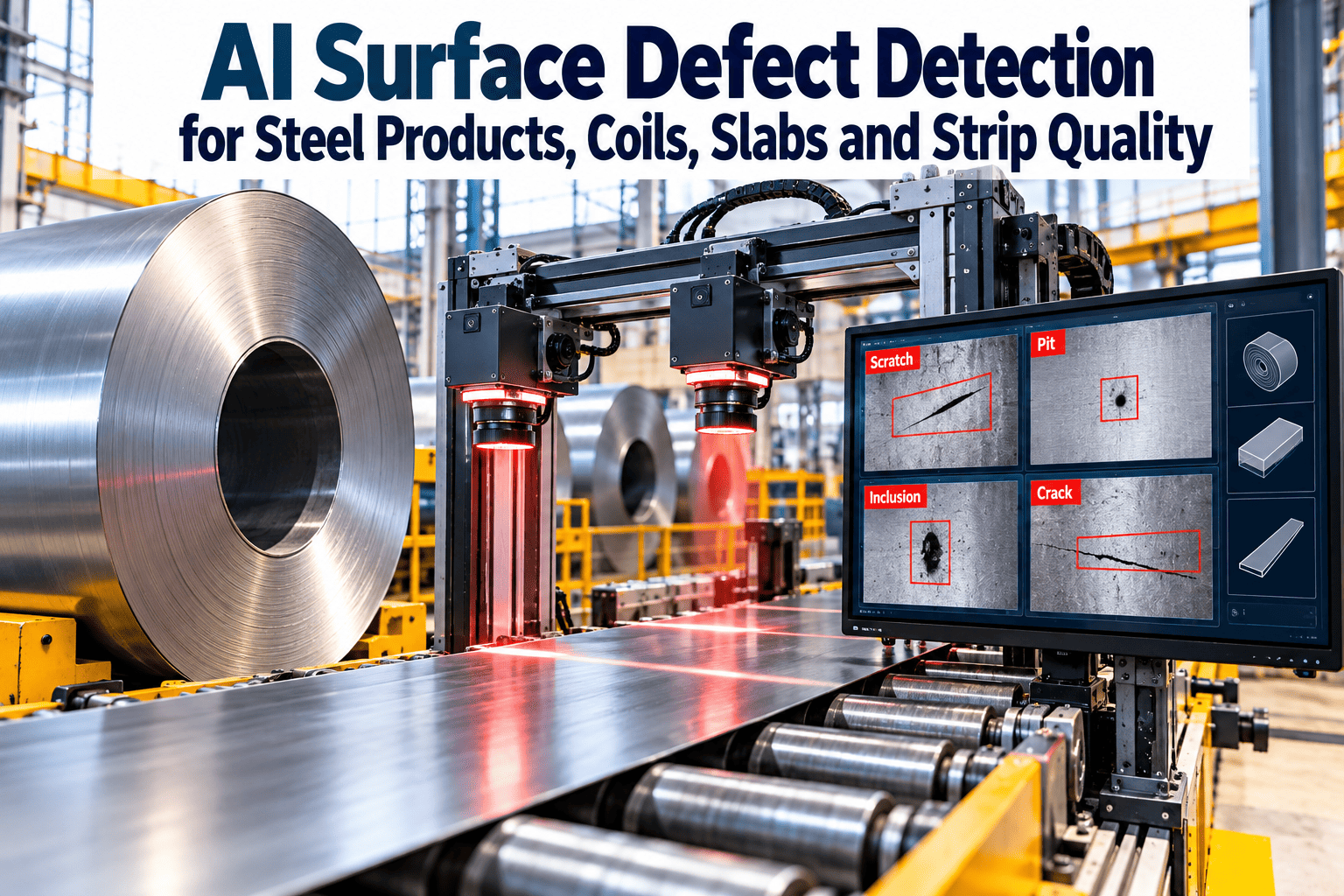
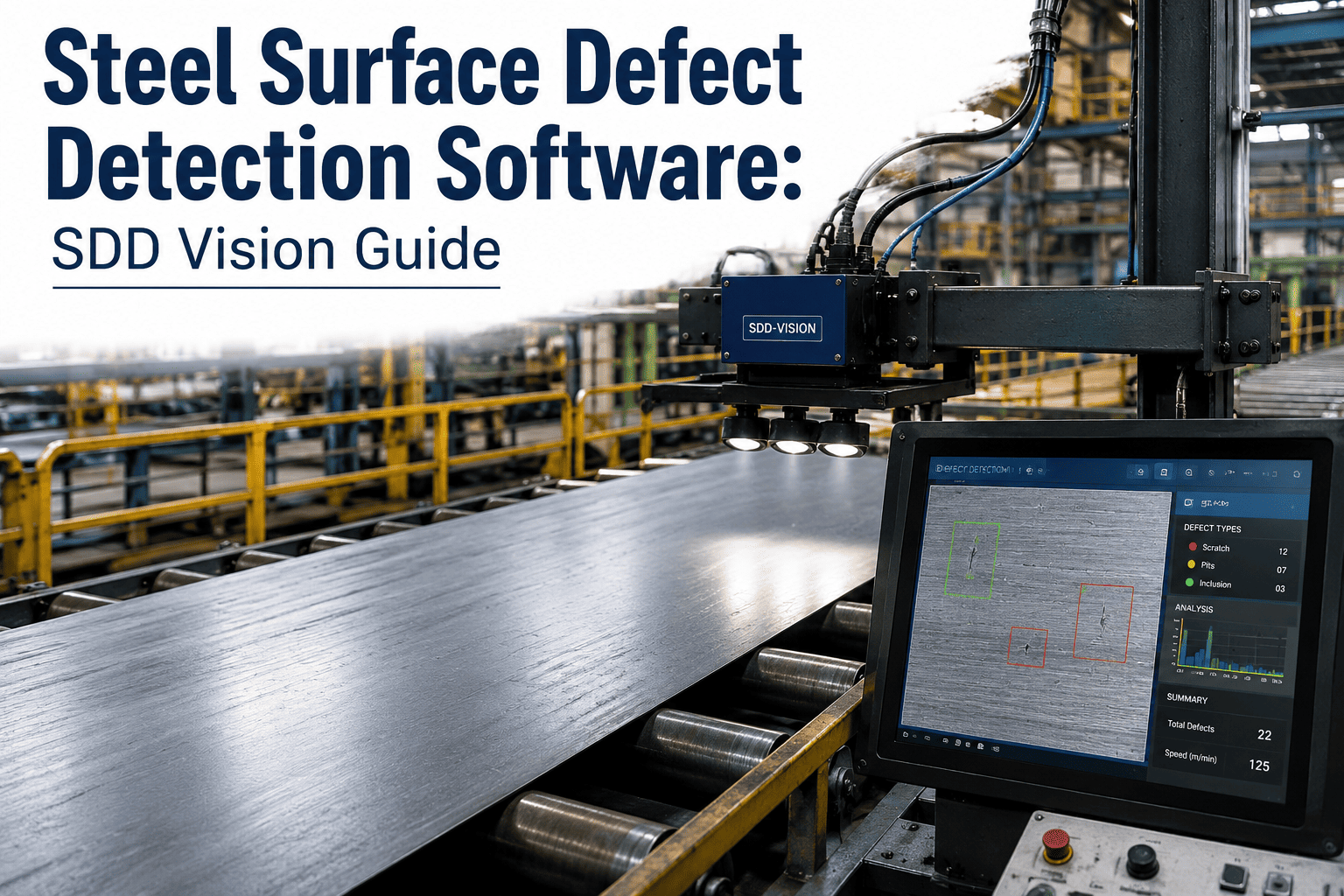
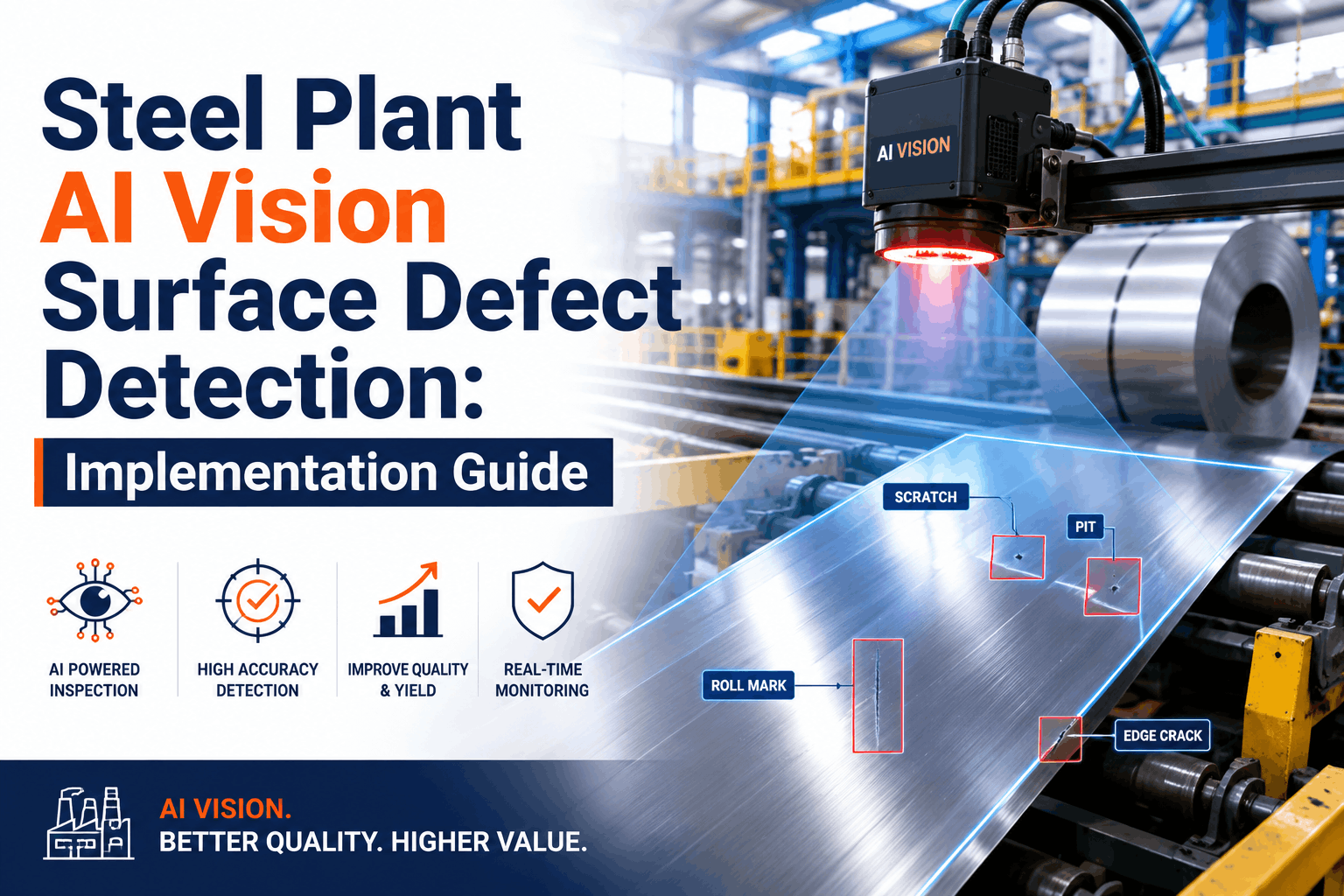
A 3mm longitudinal crack on a hot-rolled steel slab costs almost nothing to catch at the mill — and tens of thousands of dollars to discover after the coil has been shipped, processed, and returned as a customer complaint. Steel surface defects are not random events. Every scale entrapment, every lap, every seam has a traceable cause: a roll pass misalignment, a descaler pressure drop, a cooling rate deviation. The problem isn't that defects occur — it's that most plants still detect them hours or days after the cause has propagated through the entire production run. OxMaint's AI Vision Inspection platform connects real-time defect detection to the maintenance actions that eliminate the root cause — turning quality events into preventive work orders before the next coil runs.
Each defect type has a distinct morphology, a traceable process cause, and a specific inspection method. Understanding the connection between defect appearance and maintenance root cause is the first step toward eliminating recurrence — not just detecting occurrence.
01
Longitudinal Cracks
Critical
Linear cracks running parallel to the rolling direction. Originate from oscillation marks in the continuous caster, subsurface inclusions, or thermal stress from uneven secondary cooling. Can propagate through rolling if not detected at slab stage.
Root CauseMould oscillation misalignment, cooling water distribution failure, transverse temperature gradient
DetectionMagnetic flux leakage, eddy current, AI visual at roughing mill exit
Maintenance LinkMould oscillation PM, secondary cooling nozzle inspection
02
Scale Entrapment
High Impact
Oxidised iron pressed into the surface during rolling passes. Appears as rough, pitted, or discoloured patches. Primary cause: insufficient descaling pressure or blocked descaler nozzles allowing scale to remain on slab surface before roll contact.
Root CauseDescaler nozzle blockage, pressure below 180 bar, wrong nozzle angle
DetectionAI vision camera post-rougher, surface profilometry, manual visual
Maintenance LinkDescaler nozzle PM, water filter inspection, pressure monitoring
03
Laps & Folds
High Impact
Folded-over metal folds that appear as linear surface irregularities. Caused by overfill in roll passes, mismatched roll profiles, or incorrect guide positioning. The fold is mechanically bonded but creates a stress concentration site in service.
Root CauseRoll pass overfill, guide misalignment, worn groove geometry
DetectionAI vision at finishing stands, liquid penetrant in lab sampling
Maintenance LinkRoll pass schedule adherence, guide setting verification PM
04
Slivers
High Impact
Thin metallic splinters partially attached to the surface. Originate from subsurface inclusions, rolled-in scrap fragments, or casting defects that break free during rolling. Slivers cause downstream processing problems and customer rejections in automotive and appliance grades.
Root CauseNon-metallic inclusions in steel chemistry, scrap contamination, casting porosity
DetectionHigh-resolution AI camera, eddy current at cold mill entry
Maintenance LinkLadle refining review, tundish PM, scrap yard quality protocol
05
Seams
Medium
Narrow, elongated surface breaks running lengthwise, often appearing as a series of fine lines. Seams arise from existing subcutaneous cracks in the billet or bloom that open up during elongation. Cannot be removed by grinding — require source elimination.
Root CauseBillet subcutaneous cracks, insufficient reduction ratio, blooming pass issues
DetectionMagnetic particle inspection, AI vision linear crack classifier
Maintenance LinkBillet inspection protocol, blooming mill PM, reduction ratio audit
06
Pitting & Cratering
Medium
Small depressions or craters distributed across the surface. Caused by inclusion detachment leaving voids, roll surface pitting transferring to strip, or mechanical impact damage. Pitting on roll surfaces telegraphs directly onto every coil produced until the roll is changed.
Root CauseRoll surface pitting, non-metallic inclusion pull-out, impact damage
DetectionAI camera texture analysis, roll surface inspection at change
Maintenance LinkRoll change frequency PM, roll shop grinding schedule, inclusion rating
07
Roll Marks
Medium
Periodic surface marks repeating at exact intervals equal to the roll circumference. The most mechanically traceable defect category — the repetition period identifies exactly which roll in which stand is damaged. Catching roll marks early prevents thousands of metres of affected strip.
Root CauseRoll surface damage (spalling, pickup, grinding error), foreign object impact
DetectionAI vision with pitch analysis algorithm, manual period measurement
Maintenance LinkImmediate roll change work order triggered by pitch match to stand
08
Edge Defects
Medium
Cracking, lamination, or tearing at the strip edge. Caused by temperature edge effects in the finishing train, worn edge guides, insufficient edge heater capacity, or tension distribution issues during coiling. Edge defects require cropping trim loss or cause edge-cracking in subsequent cold rolling.
Root CauseEdge temperature drop, guide wear, insufficient edge heater capacity
DetectionAI edge camera, pyrometer edge temperature monitoring
Maintenance LinkEdge heater PM, guide inspection, coiler tension calibration
"The plants that have genuinely eliminated defect recurrence — not just detected it faster — are the ones that built a closed loop between the quality system and the CMMS. When your AI camera flags a roll mark pattern, the system needs to immediately identify which stand, create a work order for that roll change, and confirm the roll was changed before the next production run starts. Without that closed loop, you're detecting the same defect on every coil until someone manually escalates it through three layers of reporting. AI vision without maintenance integration is just a faster way to find problems you'll see again tomorrow. AI vision with OxMaint integration means the defect triggers the maintenance action that prevents it recurring — automatically, with full traceability from defect to repair to quality clearance."
Rajesh Iyer, MTech Metallurgy, Six Sigma Black Belt
Metallurgical Process Engineer · Six Sigma Black Belt · 18 years hot rolling and quality control, integrated steel plants · Former Chief Quality Officer, 4 MTPA flat products mill · ISS and AIST technical committee contributor