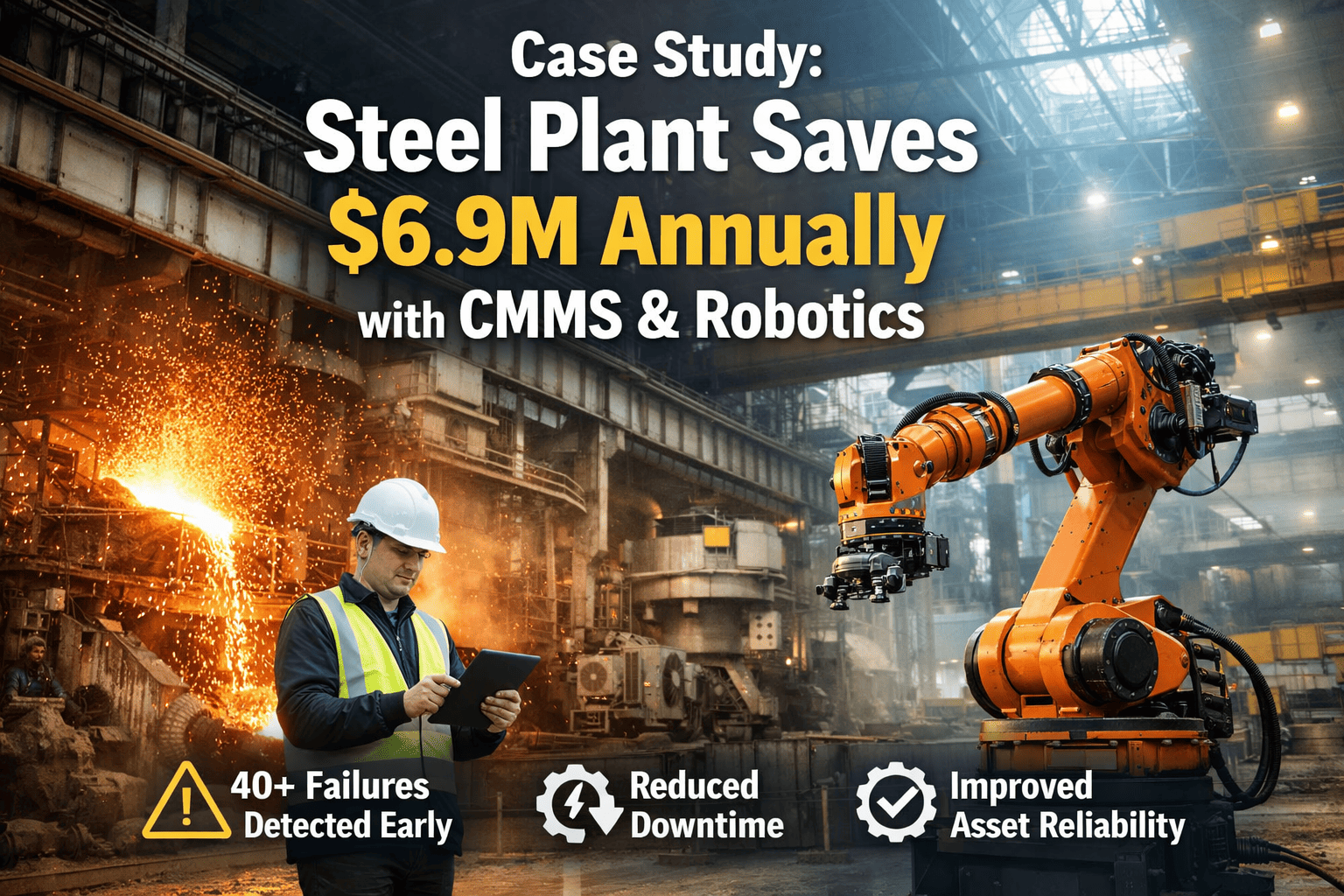
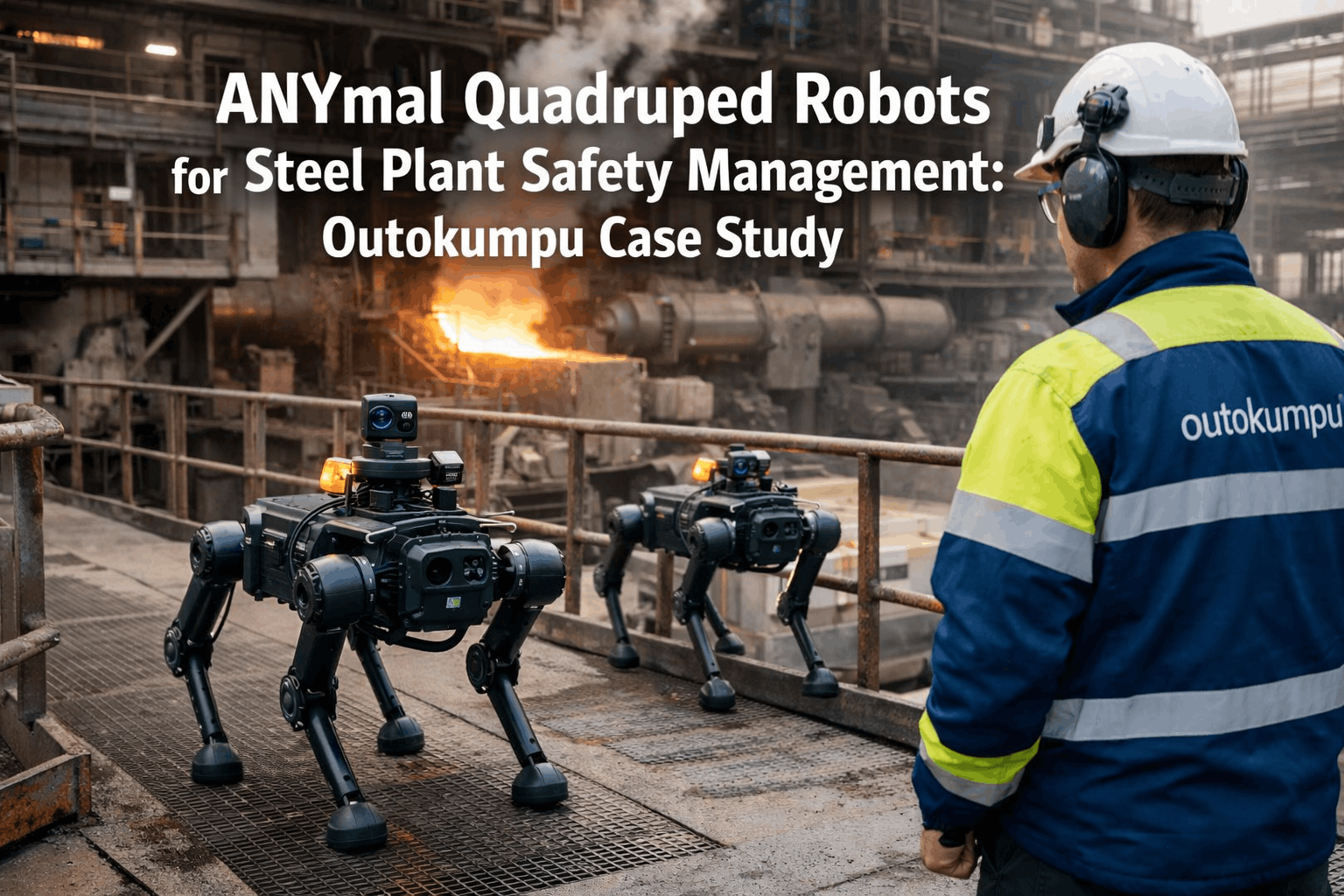
When an integrated steel plant deployed a fleet of 7 quadruped robots across its blast furnace perimeter, coke battery corridors, rolling mills, and electrical rooms — and connected every robot finding directly to OxMaint's CMMS platform — the results in the first 90 days reshaped how the plant's leadership thought about inspection entirely. 43 developing failures were identified. All 43 were resolved through planned maintenance. Total intervention cost: $127,000. Estimated emergency cost avoided: $6.09 million. This is that case study. Book a demo to model the same results at your facility.
43
Developing Failures Detected in 90 Days
$127K
Total Planned Intervention Cost
$6.09M
Emergency Cost Avoided
48x
Return on Intervention Investment
The Problem: Manual Inspection Was Structurally Broken
Before robotic deployment, this plant ran manual inspection rounds across 14 process zones. Inspectors worked in 10–15 minute exposure windows near blast furnace perimeters where ambient temperatures exceeded 60°C. Coke battery corridors required full SCBA equipment, limiting movement and reducing observation quality. Rolling mill floors combined noise above 100 decibels with overhead crane activity — leaving little cognitive bandwidth for systematic defect detection.
The data told the real story: an internal audit conducted prior to robot deployment revealed that 38% of manual inspection findings were never converted into work orders. They were noted on clipboards and lost between the plant floor and the CMMS. Equipment was degrading. Nobody knew.
38%
Findings Lost Pre-Deployment
Manual inspection findings noted on clipboards but never converted to work orders or maintenance action in the CMMS.
15 min
Max Exposure Window
Blast furnace perimeter inspectors limited to 10–15 minute windows due to ambient temperatures above 60°C — not enough time for thorough inspection.
4x
Emergency vs Planned Repair Cost
Emergency repairs were running 3–5x the cost of planned interventions across the facility's critical asset categories.
0
Trend Data Available
No historical sensor trend data existed for root cause analysis — each failure appeared as a surprise with no predictive warning trail.
The Deployment: 7 Quadruped Robots Across 6 Critical Zones
The plant deployed 7 quadruped robots — platforms equivalent to ANYmal and Boston Dynamics Spot — across six process zones in a phased 30-day rollout. Each robot was loaded with thermal imaging (0.1°C resolution), ultrasonic acoustic sensors, 3D LiDAR for autonomous navigation, pan-tilt visual cameras, and gas detection modules. Every robot patrol route was mapped into OxMaint's Fleet Console. Every finding was routed automatically to the correct asset record and work order queue.
Zone
Robots Deployed
Checkpoints / Shift
Primary Sensors
Failures Detected
Blast Furnace Perimeter
2
180
Thermal, Gas, Acoustic
14
Coke Battery Corridor
1
90
Gas, Visual, Thermal
9
Rolling Mill Floor
2
160
Acoustic, Vibration, Thermal
11
Electrical Rooms
1
70
Thermal, Acoustic
6
Cooling Tower Area
1
50
Visual, Thermal, Gas
3
Ladle & Crane Bay
As needed
40
Thermal, Visual, LiDAR
0
Want to Model This For Your Plant?
OxMaint's robot fleet integration connects quadruped patrol data directly to CMMS work orders — zero manual entry, zero lost findings. See it live in a 30-minute walkthrough.
How OxMaint Turned Robot Data Into Work Orders — Automatically
The critical bottleneck in most robotic inspection programs is not the robot. It is what happens to the data after the robot collects it. At this plant, every finding flowed from robot sensor to closed work order through four automated steps — with no manual data entry and no human review required before work order creation.
01
Robot Detects Anomaly
Thermal camera flags a hot spot on a cooling stave. AI classifies finding as "elevated temperature, severity: medium" with thermal image, GPS coordinates, and timestamp automatically attached.
↓
02
OxMaint API Creates Work Order
Robot integration bridge posts the finding to OxMaint. A prioritized work order is created automatically with all sensor data, images, and location coordinates attached — no manual entry required.
↓
03
Planner Reviews & Schedules
Maintenance planner receives a complete work order — with severity, asset history, and recommended intervention — and schedules repair within the next planned outage window.
↓
04
Repair Logged, Model Learns
Technician completes and closes the work order. OxMaint logs the outcome against the asset record. The AI model updates its baseline — improving detection accuracy for future patrols.
The 43 Failures: What the Robots Found That Manual Inspection Missed
Of the 43 developing failures detected across 90 days, the breakdown by failure type reveals a consistent pattern: thermal anomalies were the largest category, followed by mechanical degradation signatures detected through acoustic analysis — failure modes that are essentially invisible to human inspectors working under time pressure in hostile environments.
Thermal Anomalies
16 findings
Hot spots on cooling staves, heat exchanger surfaces, electrical connections, and refractory lining detected weeks before visible failure.
Avg. cost avoided per finding: $180K
Acoustic / Vibration Signatures
12 findings
Bearing wear, impeller degradation, and coupling misalignment identified through ultrasonic pattern deviation from established healthy baselines.
Avg. cost avoided per finding: $145K
Gas & Leak Detection
8 findings
Hydrogen sulfide and carbon monoxide concentration deviations in coke battery zones flagged before reaching dangerous exposure levels for workers.
Avg. cost avoided per finding: $95K
Visual / Structural Defects
7 findings
Corrosion progression, refractory cracking, and structural fatigue captured in high-resolution 4K patrol imagery at angles inaccessible to human inspectors.
Avg. cost avoided per finding: $60K
The ROI Calculation: $127K In vs. $6.09M Avoided
Every intervention was logged in OxMaint with full before-and-after documentation. The cost avoidance figures are not projections — they are based on documented emergency repair costs for the same failure modes at comparable steel plants, drawn from the plant's own maintenance cost history and steel industry benchmarks.
Cost Category
Planned (Actual)
Emergency (Avoided)
Blast furnace cooling stave repairs (14)
$48,000
$2,520,000
Rolling mill bearing / drive repairs (12)
$31,000
$1,740,000
Gas leak remediation (8)
$22,000
$760,000
Structural / electrical repairs (9)
$26,000
$1,070,000
Total — 90-Day Programme
$127,000
$6,090,000
The 48x return on intervention cost in 90 days does not include the value of zero safety incidents, 80% reduction in hazardous-area worker exposure, or the accumulated sensor trend baseline that now powers the plant's predictive maintenance programme into year two.
Manual vs. Robotic Inspection: What Changed at This Plant
38% of findings lost before reaching the CMMS
15-minute human exposure windows near blast furnace
270 checkpoints per zone per week maximum
No acoustic or gas sensing capability during rounds
Zero historical trending data for predictive analysis
Emergency repairs running 4x planned maintenance cost
0% finding loss — all robot findings auto-convert to work orders
Robots patrol hazardous zones 24/7 without exposure limits
1,890 checkpoints covered daily across all six zones
Thermal, acoustic, gas, and visual data at every checkpoint
Full sensor trend baseline built within 30 days of deployment
All 43 failures resolved at planned cost — zero emergency events
Ready to Replicate These Results?
OxMaint connects your robot fleet to automated work orders, trending dashboards, and ROI-documented savings tracking from day one. Most plants eliminate finding loss completely within the first week of integration.
What Happens After 90 Days: The Compounding Effect
The 90-day results were exceptional. The 12-month trajectory was transformational. Every patrol patrol added sensor data to the asset baseline. Every closed work order trained the AI model further. By month four, the system was generating predictive alerts — flagging assets likely to develop anomalies before any sensor threshold was crossed, based on trend rate analysis alone.
Days 1–30
Deployment & Route Calibration
All 7 robots online. Patrol routes mapped into OxMaint Fleet Console. OxMaint API integration tested. First 340 findings processed. Anomaly thresholds calibrated per asset and zone. First 11 work orders generated and completed.
Days 31–60
Pattern Library Builds
Sensor baselines established for 94% of critical assets. AI model begins comparing live readings against healthy patterns. 19 additional developing failures detected. Maintenance team processes work orders at planned rates — no emergency callouts.
Days 61–90
Predictive Alerts Begin
Final 13 developing failures detected. ROI documentation completed: $127K in vs. $6.09M avoided. Management approval received for fleet expansion to adjacent process areas. Board-level presentation prepared using OxMaint's analytics export.
Month 4 Onward
Predictive Maintenance at Scale
System generates trend-based predictive alerts before sensor thresholds are crossed. Emergency maintenance frequency down 60% year-on-year. Fleet expanding to 12 robots. Plant benchmarking against ArcelorMittal and Outokumpu digital programmes.
Frequently Asked Questions
How does OxMaint connect robot inspection data to CMMS work orders?
OxMaint receives robot findings via REST API integration. When a quadruped robot detects a thermal anomaly, acoustic deviation, or gas concentration spike, the finding is automatically posted to OxMaint with thermal images, GPS coordinates, severity classification, and timestamp. A work order is created instantly — assigned to the correct asset record, with recommended corrective action — without any manual data entry.
Start a free trial to connect your first robot to OxMaint's fleet console.
What types of failures do quadruped robots detect most effectively in steel plants?
Quadruped robots with thermal imaging excel at detecting cooling stave hotspots, refractory lining degradation, electrical connection anomalies, and heat exchanger surface deterioration — typically 4 to 8 weeks before failure. Acoustic and ultrasonic sensors identify bearing wear, impeller degradation, and coupling misalignment through deviation from healthy acoustic signatures. Gas detection modules catch hydrogen sulfide and carbon monoxide concentration changes in coke battery zones before they reach dangerous levels for workers.
How quickly can a steel plant see results after deploying a robotic inspection fleet with OxMaint?
The plants in this case study began generating work orders from robot findings within 72 hours of OxMaint integration going live. The first confirmed developing failures were detected within 8 days of patrol commencement. Most plants establish full asset sensor baselines within 30 days, with AI anomaly detection fully calibrated by day 45.
Book a demo to see a deployment timeline tailored to your fleet size and asset mix.
Does OxMaint support mixed fleets — drones, crawlers, and quadrupeds simultaneously?
Yes. OxMaint's Fleet Console manages patrol schedules, charging windows, zone exclusions, and finding workflows for mixed fleets across multiple plant zones simultaneously. Drone findings, crawler thickness readings, and quadruped patrol data all flow through the same API integration layer into a unified maintenance record. Schedule conflicts and active production zone exclusions are handled automatically.
Sign up free to configure your first fleet in OxMaint.
What is the typical payback period for a quadruped robot fleet in a steel plant?
Industry data from steel plant deployments shows payback periods of 8 to 18 months depending on asset criticality and current inspection frequency. A single prevented blast furnace emergency saves $2M to $5M — in many cases exceeding the entire annual programme cost in one event. The plant in this case study achieved a 48x return on planned intervention cost within 90 days alone, before accounting for the value of the accumulated predictive maintenance baseline built over the same period.
Start Today — Free
Your Plant's Next Major Failure Is Already Giving Off Signals
Quadruped robots are already detecting it. The question is whether those signals are flowing into a CMMS that creates work orders — or disappearing into a dashboard no one reviews. OxMaint closes that loop. Connect your robot fleet, eliminate finding loss, and build the predictive baseline that turns 90 days of patrol data into years of avoided emergencies.
48x
ROI documented in 90 days
0%
Finding loss with OxMaint integration
Free
No credit card to start