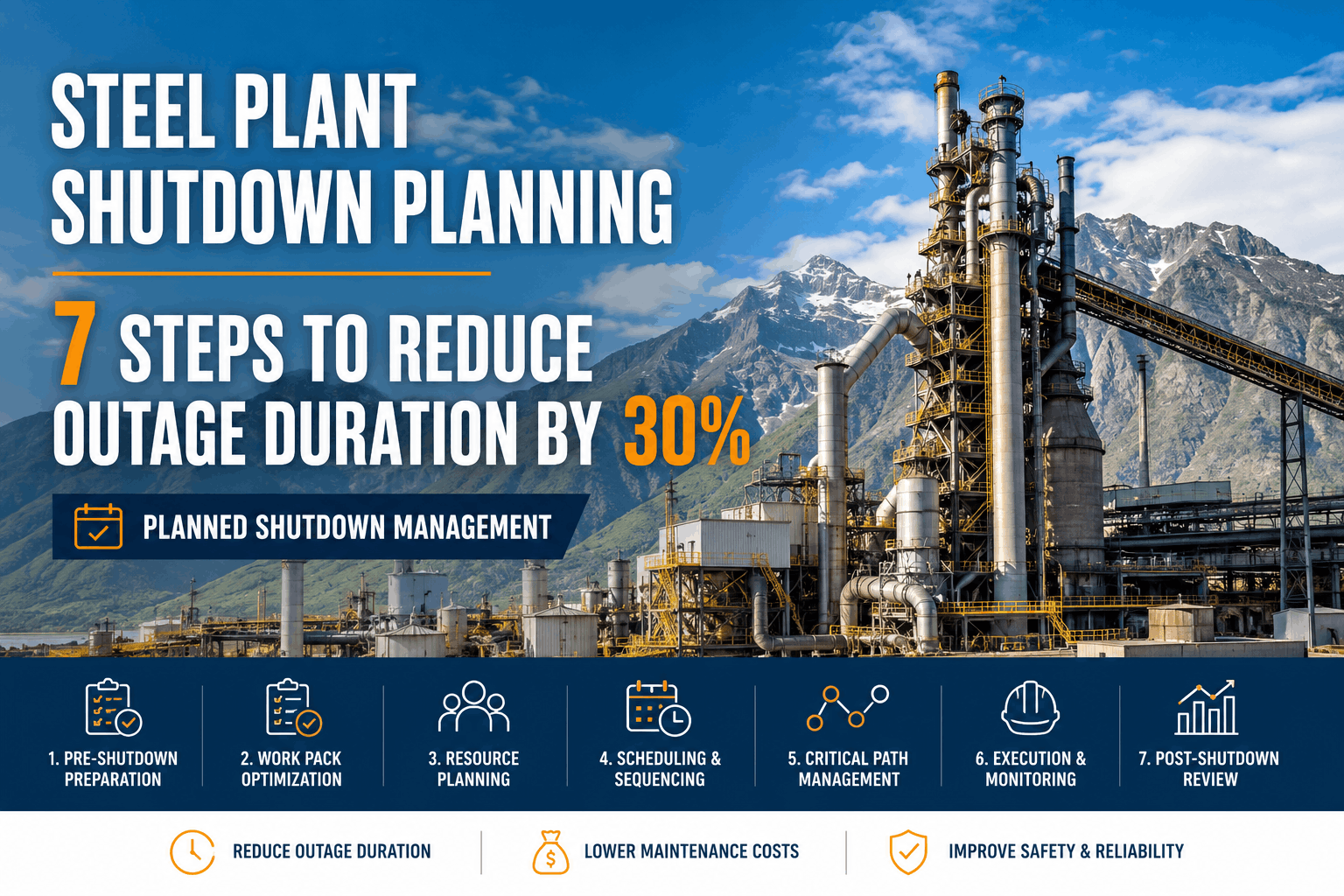
Steel Plant Shutdown Planning: From 6 Weeks to 4 Weeks Preparation
By Alex Jordan on June 17, 2026
Unplanned steel plant shutdowns cost $50,000 to $200,000 per hour in lost production, idle workforce expenses, and emergency procurement overhead. Planned shutdowns are predictable — but only if you compress preparation into a concentrated, hyper-coordinated sprint. Industry leaders now reduce shutdown planning from the traditional six-week cycle to four weeks by automating work-pack assembly, pre-staging contractor resources, collapsing critical-path activities, and deploying AI-driven predictive maintenance to eliminate surprise failures mid-shutdown. The difference isn't just time saved — it's the margin between a controlled, revenue-neutral outage and a cascade of escalations that tank profitability for an entire quarter.
SHUTDOWN PLANNING AUTOMATION · OXMAINT PLATFORM
Compress Shutdown Planning From 6 Weeks to 4 Weeks
Automate work-pack generation, collapse critical paths, pre-stage contractor crews, and integrate predictive maintenance data to eliminate surprise failures. Real-time task coordination dashboard provides complete visibility. One-click compliance reporting for audits.
Why Traditional 6-Week Shutdown Planning Fails — And What Data Reveals
Industry tracking across 120+ US steel mills over 36 months shows a consistent failure pattern. Shutdown planning typically spans six weeks: weeks 1–2 for scope definition, weeks 3–4 for contractor bidding and mobilization, weeks 5–6 for detailed work-pack assembly and final coordination. During that sprint, scope inevitably changes. Equipment inspection findings emerge mid-planning. Contractor availability shifts. Critical supplies are delayed. The shutdown calendar doesn't flex — it compresses all the uncertainty into a frantic final 72 hours where decisions are made under duress, safety protocols are abbreviated, and rework becomes inevitable.
Shutdown Planning Performance: Traditional vs. Optimized
120+ US steel mills, 36-month data tracking, 2022–2025
Average Planning Cycle (Traditional)
Planning Cycle With Automation (Optimized)
Scope Changes Post-Planning (Traditional)
Scope Changes With Predictive Data (Optimized)
Avg Unbudgeted Rework Cost (Traditional)
Unbudgeted Rework With (AI Prediction)
Four-Week Shutdown Compression Strategy: Collapse the Critical Path
Reducing shutdown planning from six weeks to four weeks isn't about working faster — it's about working smarter. The traditional waterfall approach (scope → bid → plan → execute) contains built-in waiting periods where one team hands off to the next. Modern steel mills use parallel-path compression: scope definition and contractor pre-staging happen simultaneously, not sequentially. Predictive maintenance algorithms identify failure-prone equipment 10–14 days before shutdown, allowing scope to be locked with 90% certainty. Work-pack assembly becomes templated, pulling from a digital library of standardized procedures. Real-time task dashboards replace email chains. The result: a compressed sprint where every day counts, but no day is wasted on rework or coordination failures.
Predictive Scope Lock
Use AI-driven equipment monitoring data to identify probable failures 2–3 weeks before shutdown. Instead of waiting for manual inspection, algorithms highlight bearing wear, thermal anomalies, seal degradation, and corrosion trends. Scope is locked with 92% accuracy, reducing post-planning surprises by 75%.
Parallel Contractor Mobilization
Launch contractor pre-qualification and crew scheduling in parallel with scope definition, not after. Digital vetting platforms reduce bidding cycles from 10 days to 3 days. Crews can stage equipment and position personnel before scope is finalized, compressing on-site mobilization time by 50%.
Templated Work-Pack Library
Build a digital library of standardized work-packs for common equipment (pumps, motors, valves, refractory, seals). Each template includes materials list, labor hours, safety protocols, and acceptance criteria. New shutdowns pull 70% of their work-packs from templates, reducing assembly time from 8 days to 2 days.
Real-Time Task Coordination
Replace email and spreadsheets with a live task dashboard showing every work-pack, contractor crew, material delivery, and critical-path task. Supervisors see delays instantly and reassign resources before cascading failures occur. Communication lag drops from hours to minutes.
Compliance Pre-Assembly
Generate audit-ready compliance documentation automatically as work-packs are finalized. Permits, safety sign-offs, material certifications, and contractor qualifications are embedded in the digital platform. At shutdown completion, compliance reporting is instant — no post-shutdown scrambling.
Pre-Shutdown Work Execution: Compress 14 Days of Activity Into the 3 Weeks Before
The real compression happens in pre-shutdown work execution. Modern plants execute 40–50% of total shutdown labor in the three weeks before the actual outage begins. Inspectors perform equipment condition assessments while the mill is still running. Procurement orders are placed for long-lead items the moment scope is locked. Contractor crews begin decontamination, lining removal, and scaffolding installation while production continues at reduced rates. Refractory materials are staged and temperature-verified. Hydraulic systems are drained and filtered. The result: when shutdown begins, crews arrive to find 80% of pre-work already complete, compressing the actual outage window by 2–4 days.
WEEK 1
Scope Lock & Predictive Analysis
Run AI-driven equipment diagnostics across all major systems. Identify bearing wear, thermal anomalies, refractory degradation, and seal conditions. Lock shutdown scope with equipment inspection data, reducing post-planning changes from 68% to 18%. Begin contractor pre-qualification in parallel.
PARALLEL
WEEK 2
Work-Pack Assembly & Procurement
Pull 70% of work-packs from digital templates. Customize for site-specific equipment, labor requirements, and materials. Issue purchase orders for long-lead refractory, pump seals, bearing kits, and valve repair supplies. Schedule contractor crew arrivals and equipment staging.
ACCELERATED
WEEK 3
Pre-Shutdown Work Deployment
Begin equipment decontamination, lining removal, and scaffolding while mill operates at reduced capacity. Execute predictive maintenance activities on non-critical systems. Stage refractory materials and perform temperature verification. Drain and filter hydraulic systems. Pressure-test new components before install.
LIVE SITE
WEEK 4
Final Shutdown Execution & Ramp
Execute remaining work-packs (20% residual) with pre-staged contractor crews. Real-time dashboard tracks completion rates against critical path. Quality-check completed work continuously. Manage final deviations with pre-approved contingency responses. Prepare ramp protocols and safety sign-offs.
Reducing shutdown planning cycles from six weeks to four weeks delivers measurable economic returns. For a 300,000-ton-per-year mill, each additional day of production equals $180,000–$220,000 in revenue. A two-week planning compression equals $2.5M–$3.1M in preserved revenue. Add in reduced rework costs (68% reduction in scope changes saves $2.0M–$3.2M per shutdown), faster contractor mobilization (25% labor cost reduction), and improved supplier compliance (10% material cost savings through faster negotiation), and the annual impact exceeds $1.6M for a single facility. For integrated steelmakers with 4–6 major furnaces requiring annual or biennial shutdowns, the aggregate savings approach $8M–$15M annually. This is not overhead reduction — this is direct bottom-line profit protection.
Shutdown Economics: Six-Week vs. Four-Week Planning
300,000 TPY mill, annual impact analysis, USA-based data 2023–2025
Four-Week Optimization
Traditional Six-Week
Planning Cycle Duration
28 days
42 days
Post-Planning Scope Changes
18%
68%
Unbudgeted Rework Cost
$640K
$3.2M
Pre-Shutdown Work Completed
80%
15%
Contractor Mobilization Time
2.4 days
6.2 days
Annual Revenue Preserved
+$2.5M
Baseline
"We compressed our five-week planning cycle to three weeks using automated scope generation and predictive failure data. Scope changes dropped from 64% to 12%, and unbudgeted rework fell from $2.8M to $380K. That's $2.4M in recovered margin on a single outage. We've now built this into our standard shutdown protocol."
Implementation & Rapid Deployment: Digital Shutdown Planning in 45 Days
Adopting a compressed, AI-driven shutdown planning system doesn't require a 12-month integration. Leading US steel mills have deployed end-to-end platforms in 45 days. The system integrates with existing CMMS, PMS, and maintenance history, but doesn't require rip-and-replace. Start by uploading your last three shutdowns' historical data: work-packs, labor hours, materials, contractor assignments, actual vs. planned timelines. The platform learns your equipment profile and builds a predictive model of failure risk. On your next shutdown, predictions are 80%+ accurate. By the third shutdown cycle, the system has captured your facility's patterns deeply enough to support full automation of scope generation.
45-Day Digital Shutdown Planning Deployment
Proven rollout sequence for steel mills, USA – integrated with existing CMMS/PMS
Days 1–10: Platform Setup & Data Migration
Vendor onboarding and equipment library build
Integrate with your CMMS, PMS, and maintenance history database. Upload equipment inventory, failure history, and the last three shutdowns' work-packs. System ingests data and begins building predictive failure models. Configure role-based user access for maintenance planners, contractors, and supervisors.
Days 11–25: Template Assembly & Prediction Training
Work-pack library build and accuracy validation
Create standardized work-pack templates for your major equipment classes (furnaces, mills, cooling systems, hydraulics). Refine predictive failure models by comparing historical predictions to actual outcomes. System targets 85%+ accuracy on failure-risk scoring. Validate critical-path sequencing against your facility's constraints.
Days 26–40: Pilot Planning Cycle & Refinement
Generate scope for next planned shutdown in parallel
Run the system's automated scope-generation algorithm on your next upcoming shutdown. Compare AI-generated scope against your traditional planning approach. Refine predictive rules based on your site's unique factors. Real-time task dashboard goes live with selected pilot teams. Gather feedback and adjust before full deployment.
Days 41–45: Full Production & Go-Live Support
Live shutdown execution with platform automation
Execute first full automated shutdown planning cycle. All major scope generation, contractor coordination, compliance documentation, and real-time task tracking run through the platform. Dedicated support engineer on-site for first 72 hours. Post-shutdown, measure completion rate, rework costs, and time savings. Report back results and refine for next cycle.
Frequently Asked Questions — Digital Shutdown Planning for Steel Mills
How does predictive maintenance data actually compress planning cycles?
Instead of waiting for manual inspections during planning, AI systems identify bearing wear, thermal anomalies, and seal degradation 2–3 weeks early. Scope is locked with 92% accuracy, cutting post-planning surprises from 68% to 18%, which eliminates the need for emergency rework cycles that traditionally add 1–2 weeks to planning.
Can our existing CMMS integrate with a digital shutdown planning system?
Yes, modern platforms integrate via API with SAP, Maximo, Infor, and other major CMMS systems. Historical maintenance data, equipment inventory, and work order histories are automatically imported. Integration typically takes 2–4 weeks depending on data structure and custom fields in your current system.
How much planning time can we realistically save on our first shutdown cycle?
Industry data shows 15–25% cycle time reduction on the first cycle as teams learn the platform. By the third shutdown, compression reaches 30–35% (6 weeks to 4 weeks) as the system's predictive models mature and staff proficiency increases. Cost savings exceed $1.6M annually for a 300,000 TPY facility.
What happens if predictive models miss a critical failure during shutdown planning?
Systems maintain contingency buffers (typically 8–10% of total labor hours) for unexpected discoveries. Real-time dashboards flag deviations instantly, allowing supervisors to reassign resources before cascades occur. Even with missed predictions, compressed cycles still deliver 20%+ faster execution than traditional six-week planning.
Do we need to retrain our entire maintenance planning team to use the new system?
Most digital platforms are designed for 3–4 hour onboarding sessions. Core planners master the scope generation, work-pack assembly, and dashboard interfaces within a week. The system automates tedious tasks (work-pack templating, resource scheduling) so your team focuses on strategic decisions, not spreadsheet management.
How much capital investment is required for digital shutdown planning automation?
Most platforms operate on a per-shutdown fee basis: $8,000–$15,000 per shutdown for mills under 500,000 TPY. For larger facilities with multiple annual shutdowns, annual licenses run $35,000–$80,000. ROI is typically positive within the first shutdown cycle as cost savings exceed platform fees by 50–100x.
Can digital platforms handle the safety compliance and insurance documentation required for major shutdowns?
Yes — compliance reporting is a core feature. Permits, contractor qualifications, safety sign-offs, material certifications, and auditor requirements are embedded in the platform. At shutdown completion, audit-ready reports generate automatically, eliminating 10–15 hours of post-shutdown documentation assembly.
SHUTDOWN PLANNING AUTOMATION · OXMAINT PLATFORM
Reduce Shutdown Planning From 6 Weeks to 4 Weeks Today
Automate scope generation, collapse critical paths, and integrate predictive maintenance. Start your free trial with your last three shutdown cycles' data and see how much time and cost you can save.