Steel plants carry millions in spare parts inventory yet still face critical stockouts that extend shutdowns by hours or days. The problem is not the size of the inventory — it is the absence of a systematic framework that distinguishes what must always be available, calculates when to reorder before stock runs out, and connects procurement decisions to actual maintenance work orders. Sign in to OxMaint to implement ABC/VED classification, automated reorder management, and work order parts reservation for your steel plant's spare parts catalogue. Book a demo to see OxMaint's Spare Parts and Inventory Module working on a steel plant catalogue of any scale.
Industry Reality
Four Numbers That Define the Steel Plant Spare Parts Challenge
$15M
Average spare parts inventory at an integrated steel plant — 60-70% typically without criticality classification
$300K
Cost per hour of unplanned production downtime caused by a critical spare parts stockout
25-30%
Annual inventory carrying cost as a percentage of inventory value including capital, storage, and obsolescence
20-40%
Share of spare parts classified as slow-moving or obsolete in plants without structured ABC/VED analysis
Inventory Classification
ABC & VED Analysis — The Foundation of Spare Parts Optimisation
ABC Analysis — By Annual Spend Value
A
Top 20% of SKUs drive 80% of total spend
Monthly review · Tight stock control · Named vendor frame contracts
B
Next 30% of SKUs drive 15% of total spend
Quarterly review · Standard reorder points from consumption data
C
Remaining 50% of SKUs drive only 5% of spend
Lean or zero stock · Periodic bulk order · On-demand procurement
VED Analysis — By Production Criticality
VVital
Production halts immediately without this part. No substitute exists. Safety stock must be maintained at all times regardless of value or consumption frequency. Examples: blast furnace tuyeres, BOF converter nose, hot strip mill work rolls.
EEssential
Significant production impact if unavailable. Short-term substitution may be possible. Examples: large bearings, gear couplings, hydraulic cylinders, electrical drives, switchgear components, ESP rapping motors.
DDesirable
No immediate production impact. Can be procured on demand. Examples: standard fasteners, consumable tooling, common filters, general purpose hardware, lighting components.
Combine ABC + VED to get a 9-cell stocking matrix. AV items require maximum protection. CD items warrant zero or lean stock.
OxMaint automates this classification and keeps it current as consumption patterns change.
Classify Every Spare. Automate Every Reorder. Stop Every Preventable Stockout.
OxMaint applies ABC and VED logic to your existing parts catalogue, sets reorder points from actual consumption data, and alerts procurement before a stockout becomes a production shutdown.
Root Causes
Six Inventory Failures That Cost Steel Plants Millions Every Year
01
No Criticality Classification
All spare parts treated equally. Critical bearings share the same stocking policy as standard fasteners. A stockout on any item triggers the same response regardless of its production impact.
02
Manual Reorder Decisions
Store staff reorder on experience or when a shelf looks empty. No calculation from actual consumption data. Result: overstocked C-class items, chronic shortfall on critical A/V-class spares.
03
Lead Times Not Tracked
Critical steel plant spares can have 8-26 week lead times. When vendor lead times are not recorded per part, reorder is placed too late — emergency airfreight costs 3-5x the standard procurement price.
04
Obsolete Stock Accumulates
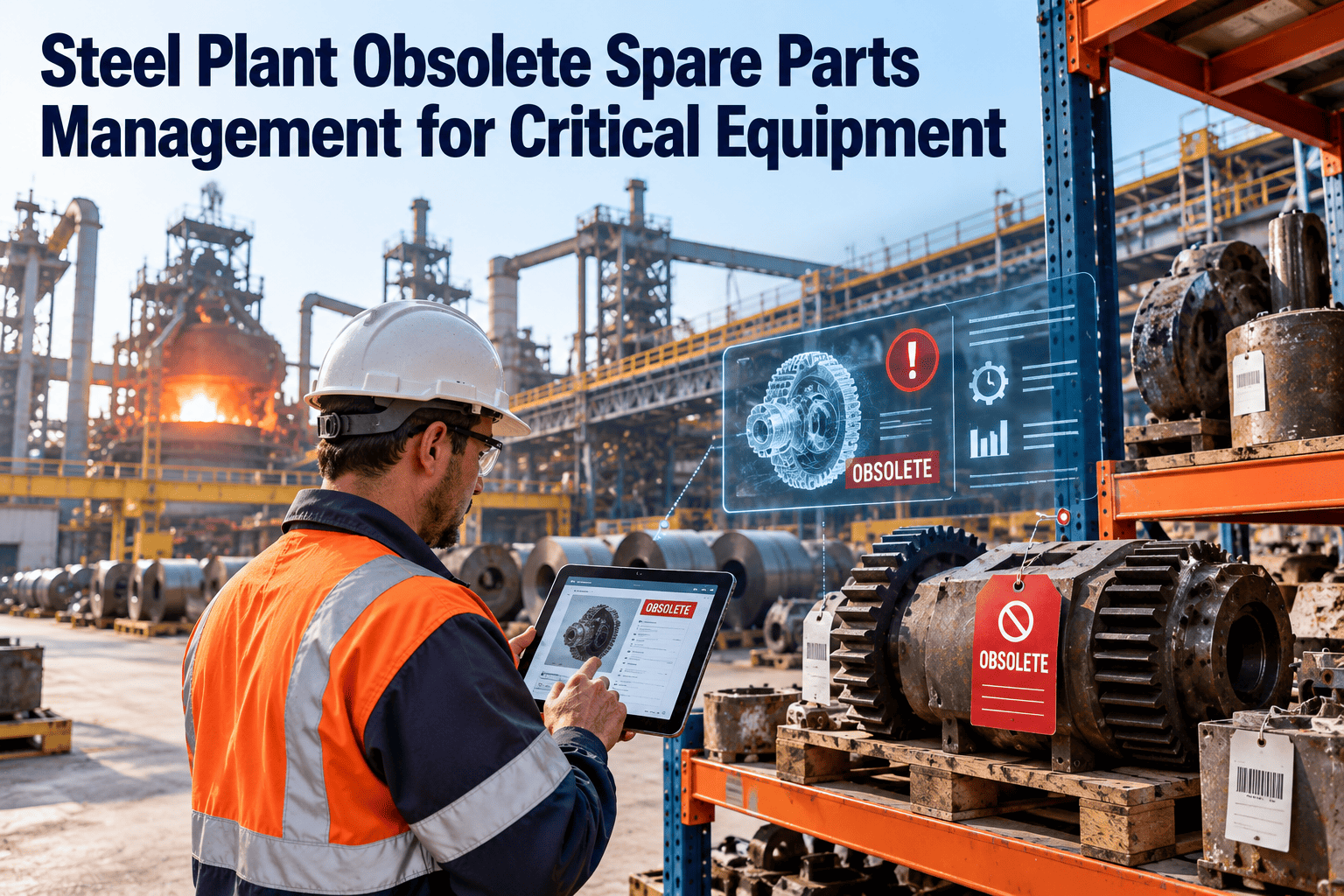
Parts for retired equipment remain on the books for years, tying up working capital. 20-40% of most steel plant inventories have not moved in over two years — invisible without structured consumption tracking.
05
Vendor Performance Unmeasured
On-time delivery and quality reject rates are not tracked per vendor. The procurement team cannot identify which vendors are reliable for critical spares and which require additional buffer stock.
06
Maintenance and Stores Disconnected
Planned work orders do not reserve parts in stores at the planning stage. The required part gets consumed by an unplanned repair — converting planned outage into unplanned downtime on the day.
How OxMaint Works
From Parts Catalogue to Optimised Inventory — Four Steps
1
Catalogue Classification
Import your existing parts catalogue. OxMaint applies ABC value analysis automatically and guides VED criticality assignment per part linked to its parent asset. Classification updates continuously as consumption history builds — no annual manual reclassification required.
Sign in to import your parts catalogue.
2
Automated Reorder Point Calculation
ROP = (Daily Usage x Lead Time) + Safety Stock
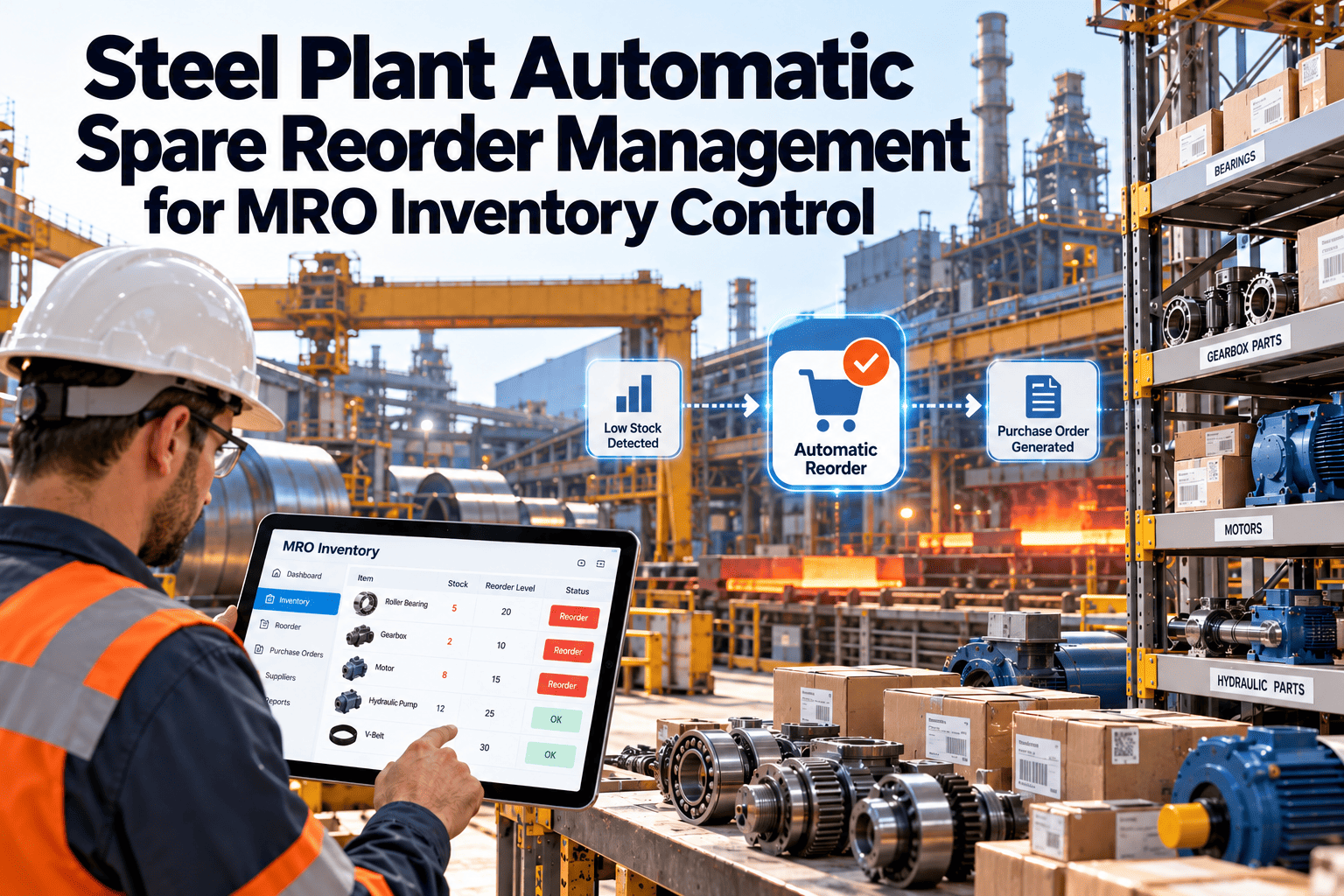
Reorder points calculated per SKU from actual consumption rate, vendor-specific lead time, and configured safety stock. Procurement alerts generated automatically when stock hits the reorder level.
Book a demo to see reorder automation.
3
Planned Maintenance Parts Reservation
Parts required for planned work orders are reserved in stores when the job is scheduled — not when the technician arrives. If parts are short, the procurement alert is raised against the work order with the job date providing urgency context for the purchasing team.
4
Vendor Performance Tracking
Every purchase order tracked against promised lead time, actual delivery, and quality acceptance. Vendor scorecards generated automatically. Reorder lead time inputs update from actual vendor performance — making safety stock calculations progressively more accurate.
Sign in to activate vendor performance tracking.
Reference Data
Critical Spare Parts in Steel Plants — Stocking Parameters by Category
| Part Category |
VED Class |
Lead Time |
Safety Stock |
Reorder Policy |
OxMaint Trigger |
| BF Tuyeres / Tuyere Stock |
Vital |
12-20 weeks |
1-2 full campaign sets |
Immediate reorder on any issue |
Auto-alert on any stock issue |
| Hot Strip Mill Work Rolls |
Vital |
8-16 weeks |
1 full stand set + 1 spare pair |
Consumption-linked to production schedule |
Roll count + campaign schedule |
| Large Bearings (ID > 200mm) |
Vital / Essential |
10-24 weeks |
1-2 units per critical application |
Min-max with vendor frame contract |
Min level breach alert |
| Hydraulic Cylinders (Custom) |
Essential |
12-18 weeks |
1 unit per assembly type |
One-for-one on issue from stores |
Zero-stock alert on issue |
| Standard Bearings (Catalogued) |
Essential |
1-4 weeks |
2-5 units per consumption rate |
ROP from 6-month consumption history |
Automated procurement request |
| Drive Belts / Chains |
Desirable |
1-2 weeks |
3 months consumption |
Periodic review / blanket order |
Quarterly review alert |
| General Fasteners / Consumables |
Desirable |
1 week |
Lean — visual reorder |
Kanban / bin-level trigger |
Bin scan or periodic count |
Benchmarks are indicative. Parameters must be calibrated to your equipment, operating cycles, and vendor base. Book a demo to configure these parameters for your plant in OxMaint.
Expert Review
What Industry Practitioners Say
"
The single biggest lever in steel plant maintenance cost reduction is not a new technology — it is disciplined spare parts classification. Plants that implement rigorous ABC/VED analysis and link their stores to their maintenance planning system typically recover 15-20% of their annual parts spend within 18 months. The same parts, the same vendors, the same team — but a structured system that stops you buying what you already have and ensures you have what you actually need when you need it. OxMaint's approach of connecting the stores module directly to work orders is precisely the integration that most plants are missing.
Platform Capabilities
What OxMaint Delivers for Steel Plant Spare Parts Management
Classification
ABC / VED Analysis Engine
Automated ABC classification from purchase history. VED criticality assignment linked to asset records. 9-cell matrix drives a distinct stocking policy per part — updated as consumption changes, no annual manual reclassification required.
Reorder
Dynamic Reorder Point Automation
Reorder points per SKU from actual consumption rate, vendor lead time, and safety stock parameters. Procurement alerts generated at the reorder level. Structured purchase requests raised automatically.
Sign in to activate reorder automation.
Maintenance Link
Work Order Parts Reservation
Parts required for planned work orders reserved in stores at job planning stage. Availability confirmed before scheduling. Parts shortfall raises a procurement alert linked to the work order with job date providing urgency context.
Vendors
Vendor Lead Time and Scorecard Tracking
Every PO tracked against promised and actual delivery. On-time rate, lead time accuracy, and quality rejection rate per vendor calculated automatically. Reorder lead time inputs update from actuals.
Book a demo to see vendor scorecards.
Obsolescence
Slow-Moving and Obsolete Stock Identification
Parts with zero or below-threshold consumption over a configured period flagged automatically. Equipment decommissioning links obsolete part identification to asset retirement. Working capital tied up in inactive stock quantified for disposal decision.
Analytics
Inventory Cost and Availability Dashboard
Inventory value by ABC class, stockout frequency by VED category, procurement spend by vendor, and carrying cost trend — all in one dashboard. The data that makes the case for right-sizing inventory investment at management level.
Sign in to see inventory analytics.
Every Critical Stockout Was Predictable — With the Right Classification and Reorder Data
OxMaint's Spare Parts and Inventory Module gives your steel plant the ABC/VED framework, reorder automation, and maintenance-stores integration that converts parts management from reactive firefighting into precision reliability support.
Common Questions
Steel Plant Stores and Procurement Teams Ask These Every Week
How does OxMaint calculate reorder points for parts with irregular or infrequent consumption?
For parts with irregular or infrequent consumption, OxMaint uses a rolling average over a configurable lookback period — typically 6 to 12 months — weighted toward recent periods to account for changing maintenance patterns. For critical insurance spares with no predictable consumption, a minimum stock rule is applied ensuring the part is never at zero regardless of usage history. The reorder point formula used is ROP = (Average daily consumption x Vendor lead time in days) + Safety stock, with all inputs visible and adjustable in the OxMaint interface.
Sign in to configure reorder parameters for your parts catalogue.
Can OxMaint manage a parts catalogue with 50,000 or more SKUs across multiple warehouses?
Yes. OxMaint manages multi-warehouse spare parts catalogues at scale — supporting distributed storage across central stores, bay stores, and satellite locations at different production units. Stock is tracked per location with inter-warehouse transfer capability and full traceability. Most integrated steel plants with 30,000 to 80,000 active SKUs complete the deployment within 8 to 12 weeks, typically starting with A/V-class critical items and expanding from there.
Book a demo to see multi-warehouse management for a large steel plant catalogue.
What is the typical inventory cost reduction after implementing OxMaint's spare parts module?
Based on implementations at integrated steel plants, the typical range is 12 to 22% reduction in total spare parts inventory value within 18 months. Reduction comes from three sources: disposal or redeployment of identified obsolete stock — typically 15 to 25% of inventory value; reduced emergency procurement premium costs as stockouts decrease; and reduced over-ordering of C-class items once reorder points replace manual decisions. Critically, availability of A/V-class critical spares typically improves simultaneously — cost reduction and reliability improvement occur together, not as a trade-off.
Sign in to start realising inventory cost reduction for your plant.
Can OxMaint integrate with our existing ERP for purchase orders and goods receipt?
Yes. OxMaint integrates with SAP MM, Oracle Fusion, Microsoft Dynamics, and other ERP platforms via standard API or structured data exchange. Purchase requests from OxMaint reorder alerts are transmitted directly to the ERP procurement module. Goods receipt confirmation from the ERP automatically updates stock levels in OxMaint — eliminating dual data entry and ensuring inventory records remain accurate without manual reconciliation between systems.
Book a demo to discuss your specific ERP integration requirements.
How does OxMaint handle spare parts for equipment still under OEM warranty?
OxMaint's asset records include warranty tracking — flagging parts for warranted equipment as OEM-sourced items with specific vendor and sourcing conditions. When a work order is raised on a warranted asset, OxMaint alerts the maintenance planner that warranty conditions may apply to parts selection. OEM-specific approved vendor lists are configurable per asset class, maintaining warranty compliance without requiring the maintenance team to hold separate reference documentation.
Sign in to configure OEM warranty tracking for your critical assets.
The Parts That Will Cause Your Next Unplanned Shutdown Are Already in Your Inventory Data — If You Know Where to Look
Steel plants that implement structured spare parts management report fewer critical stockouts, lower emergency procurement costs, and better planned maintenance completion rates — from the same catalogue, managed with better information. Free trial. No implementation fees. Critical spares classified and reorder points active within weeks.