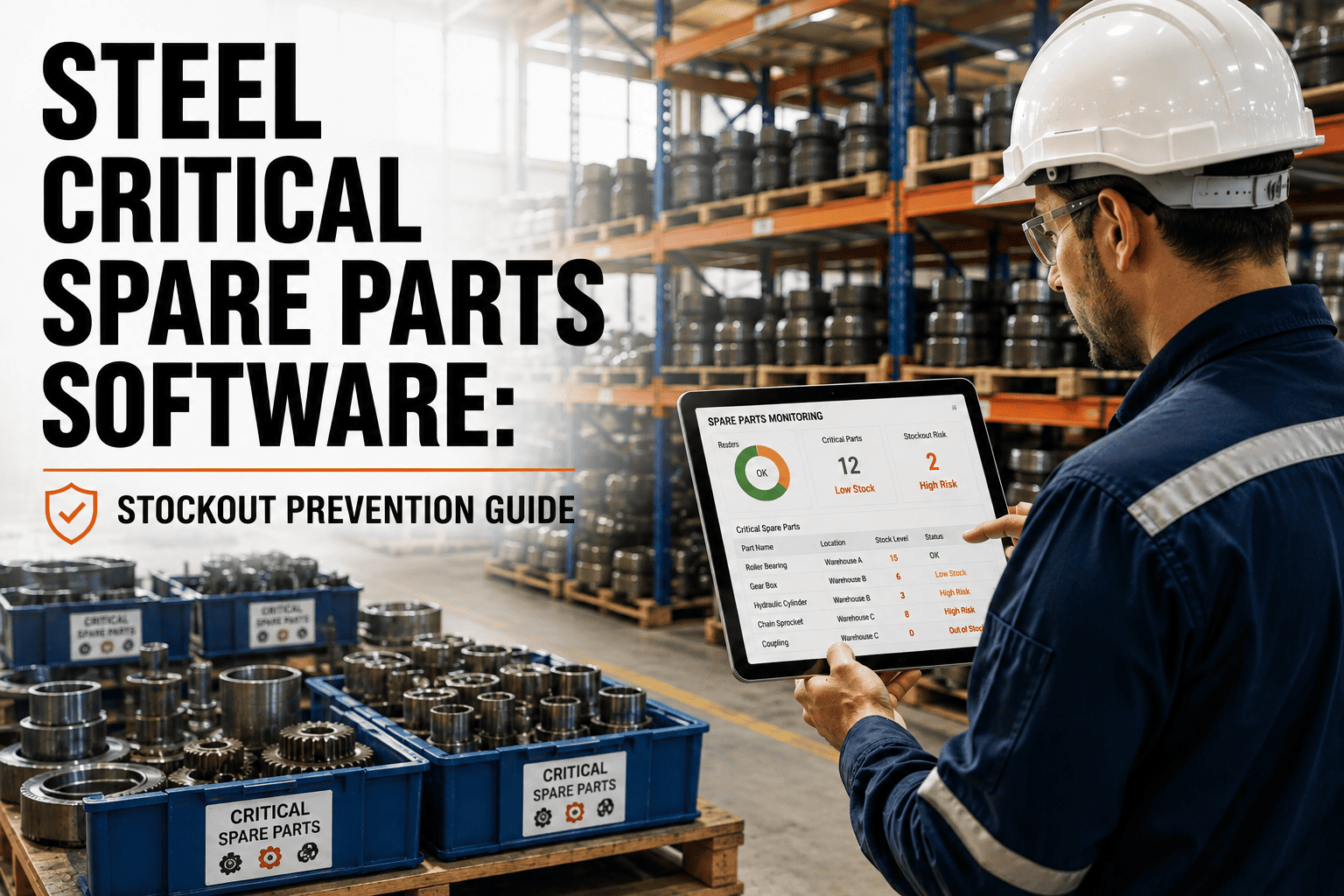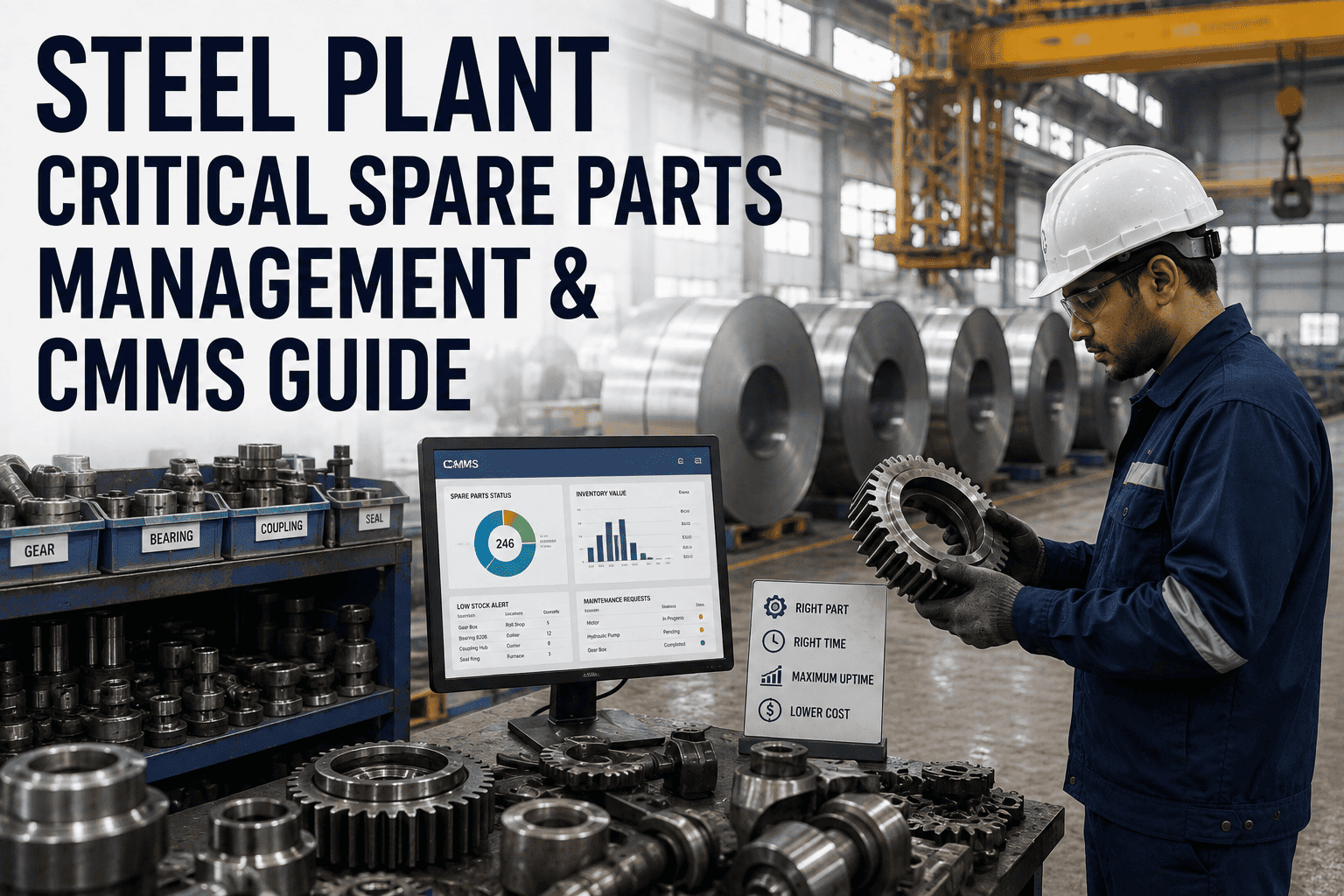
A steel plant can hold thousands of spare parts and still stop because one bearing, seal or hydraulic valve is missing. It can also tie up large amounts of cash in parts that have not moved in years. Spare parts optimization balances those two risks by deciding what to stock, how much to hold and when to reorder, using failure history rather than guesswork. This guide covers critical spares across the plant and shows how a maintenance inventory system links parts to assets and work orders.
Steel Plant Spare Parts Optimization for Critical MRO Inventory and Maintenance
Stock the right parts for bearings, seals, rolls, refractory, hydraulics, electrical and conveyors, without burying cash on the shelf.
High impact, high risk
Hold on site
High impact, easy supply
Hold small buffer
Low impact, long lead
Plan by trend
Low impact, easy supply
Buy on demand
The two failures of steel plant inventory
Too little stock
- Breakdowns last longer while parts are sourced
- Expedited freight and premium prices become routine
- Technicians cannibalize other equipment
- Planned outages slip because kits are incomplete
Too much stock
- Cash is locked in slow-moving items
- Storerooms fill with duplicates and obsolete parts
- Shelf-life items such as seals and hoses age out
- Counts drift and nobody trusts the system
Optimization is about fit, not volume
The goal is not the smallest or the largest inventory. It is the right parts, at the right place, with enough warning to replenish them.
Step 1: decide what is truly critical
Criticality should reflect what a part does to production, safety and the environment when it is unavailable. Item price alone is a poor guide.
| Question | If yes, the spare is likely critical |
|---|---|
| Does failure stop the whole line or a bottleneck? | No workaround exists, so downtime runs until the part arrives |
| Is there a safety or environmental consequence? | Cranes, gas handling, dust control and cooling systems rank high |
| Is the lead time long? | Special bearings, large gears and custom parts cannot be bought in days |
| Is the supplier single-source or overseas? | Delivery risk increases the case for holding stock |
| Is the part unique to one machine? | No substitute can be borrowed from elsewhere |
| Does the part have a history of failure? | Repeat demand supports a standing stock level |
Link spares to the equipment they protect
Tying each part to an asset bill of materials shows which machines depend on it. That makes it easier to justify holding a spare, or to retire one.
Step 2: classify by usage, value and consequence
ABC by annual spend
Separates the small number of items that account for most of the cost, so they receive the closest control.
XYZ by demand pattern
Separates steady consumption from erratic or rare demand, which needs a different stocking approach.
VED by essentiality
Rates parts as vital, essential or desirable, based on what happens to operations without them.
Insurance spares
Rarely used, high-consequence items held because failure would be severe, even though demand is almost zero.
Use more than one lens
A low-cost part that stops the line is more important than an expensive one with a quick substitute. Combining classifications avoids that mistake.
Know what you hold, where it is and why
Connect parts, assets, work orders and reorder rules in one maintenance platform.
Critical spares by plant area
| Area | Typical critical spares | Main risk to consider |
|---|---|---|
| Rolling mills | Roll neck and chock bearings, pinion and gearbox components, couplings, spindles, rolls | Long lead time and outage dependence |
| Hydraulics | Servo and proportional valves, cylinders, pumps, accumulators, seal kits, hoses | Contamination damage and ageing of elastomers |
| Melt shop and furnaces | Electrode system parts, cooling panels, water-cooled hoods, refractory shapes, tap-hole components | Wear is predictable but delivery can be slow |
| Electrical and drives | Drive modules, contactors, encoders, transformers, PLC cards, cables | Obsolescence and compatibility |
| Cranes | Wire ropes, brake parts, limit switches, sheaves, hooks | Safety consequence |
| Conveyors and handling | Belts, idlers, pulleys, gearboxes, motors, skirt rubber | High volume, mixed criticality |
| Pumps, fans and water systems | Impellers, mechanical seals, bearings, motors, valves | Standby availability and wear |
Different areas need different rules
Refractory is consumed on a campaign cycle, while insurance spares may sit untouched for years. Each deserves its own stocking logic.
Step 3: use failure history to set stock levels
Collect usage and failure data
Pull parts consumed per work order, grouped by asset and failure mode.
Estimate demand
Use consumption history and planned maintenance schedules, not only past orders.
Add the lead time
Use realistic supplier delivery times, including customs and inspection.
Set safety stock
Raise it for critical items and uncertain supply, lower it for easy items.
Review after each event
A failure or stockout is a prompt to revisit the numbers.
A simple reorder logic
A common starting point is reorder point equals expected demand during lead time plus safety stock. Critical parts add a minimum on-hand quantity regardless of usage.
Predictable versus unpredictable demand
Predictable demand
- Consumables replaced on a schedule
- Preventive maintenance kits
- Wear parts with known life
- Planned using the maintenance calendar
Unpredictable demand
- Random electrical and hydraulic failures
- Insurance spares for rare events
- Parts for aging equipment
- Planned using criticality and risk
Match the method to the demand
Planned work can pull parts to the job in advance, while rare events need a buffer decision. Treating both the same is a common source of excess stock.
Alternatives to owning every spare
- Consignment stock, where the supplier holds parts at your site until used
- Vendor managed inventory for high-volume consumables
- Repair and exchange programs for gearboxes, motors and valves
- Shared spares between similar lines or neighbouring plants
- Framework agreements with guaranteed delivery times
- Refurbishing removed assemblies to create a rotating pool
Each option moves cost and risk
Consignment reduces capital, but contract terms matter. Repair loops save money but require tracking so the rebuilt part returns to stock.
Storage, shelf life and condition
Items that age
- Seals, O-rings and hoses
- Greases and oils
- Batteries and electronic boards
- Rubber belts and skirting
Good storage practice
- Date-stamp receipts and use first-in, first-out
- Rotate shafts and large bearings as advised
- Keep bearings clean, dry and in original packing
- Protect electronics from dust and moisture
A spare that fails on the shelf is wasted
Shelf-life tracking and periodic condition checks prevent installing a part that has already degraded in storage.
Kitting for planned maintenance
Kitting exposes gaps early
Preparing a kit days ahead shows missing parts while there is still time to order them calmly.
Keeping data accurate
- Use unique part numbers and clear descriptions to avoid duplicates
- Record manufacturer, alternate and supplier part numbers
- Run cycle counts, starting with critical and high-value items
- Control who can issue parts and require a work order reference
- Review inactive items and mark them obsolete or surplus
- Record bin locations so technicians find parts quickly
Trust drives usage
If the system is wrong, technicians stockpile their own spares. Accurate counts are what let the optimization work, and they depend on disciplined issuing, receiving and regular cycle counts.
How Oxmaint supports inventory and maintenance together
| Inventory need | Oxmaint capability |
|---|---|
| Catalogue parts and link them to machines | Inventory management with asset association |
| Issue parts to a job and track cost | Work orders with parts usage |
| Trigger reorders at set levels | Minimum levels and reorder alerts |
| Plan parts for scheduled work | Preventive maintenance scheduling |
| Capture usage and receipts on the floor | Mobile workflows |
| Spot slow-moving and high-use items | Reports and dashboards |
Failure history becomes inventory intelligence
When parts are consumed through work orders, the system builds the history needed to improve stock levels over time.
Measures that show the inventory is working
A simple lead time and safety stock illustration
The numbers below are invented to show the arithmetic only. Use your own consumption and supplier data when setting real levels.
| Input | Illustrative value | How it is used |
|---|---|---|
| Average monthly use | 4 units | Shows normal consumption |
| Supplier lead time | 3 months | Time the stock must cover while waiting |
| Demand during lead time | 12 units | Monthly use multiplied by lead time |
| Safety stock | 4 units | Buffer for late delivery or higher use |
| Reorder point | 16 units | Order when stock falls to this level |
What changes the answer
- A longer or less reliable lead time raises the buffer
- A part with no substitute justifies a higher minimum
- Planned replacements can reduce the buffer, because demand is known
- A shared part used on several machines pools the risk
Handling obsolete, surplus and slow-moving stock
Identify
List parts with no usage for a defined period and check whether their equipment still runs.
Classify
Separate true insurance spares from parts that no longer have a purpose.
Decide
Keep, return to the supplier, transfer to another site, sell or dispose of the item.
Update records
Mark the status, free the bin and remove the part from reorder rules.
Insurance spares need a written reason
A part that has not moved in years may still be correct to hold. Recording the risk it covers stops it being cleared out by mistake.
Managing equipment obsolescence
Early warning signs
- Supplier announces end of production or support
- Repair quotes rise or lead times lengthen
- Only used or refurbished units are offered
- Firmware or software support is withdrawn
Possible responses
- Make a last-time buy for critical items
- Qualify an alternative part or supplier
- Plan an upgrade during a major outage
- Keep a tested spare and the repair path documented
Drives and control cards deserve attention
Older electrical and automation hardware often becomes hard to source before it fails. Flagging these assets early gives time to choose between stocking and replacing.
Planning parts for outages and campaign work
- Build the parts list from the outage scope, not from memory
- Check every line against stock several weeks before the stop
- Order long-lead items first and track their delivery dates
- Stage kits by area and label them to the work order
- Assign one person to receive, inspect and issue outage parts
- Record what was actually used so the next list improves
Contingency for discovery work
Opening a gearbox or mill often reveals damage that was not predicted. Holding a defined contingency list for likely findings shortens the extension when surprises appear.
Reducing emergency purchases
Who owns inventory decisions
- Reliability engineer: sets criticality and recommends stock levels from failure history
- Maintenance planner: reserves parts and builds kits for scheduled work
- Storekeeper: receives, locates, counts and issues parts accurately
- Purchasing: manages suppliers, lead times and agreements
- Finance and operations: agree the balance between stock cost and downtime risk
A regular review keeps levels honest
A short monthly review of stockouts, emergency buys and inactive items keeps the numbers close to reality and gives each role a clear part to play.
Optimization checklist
- Rank equipment by criticality first
- Link every part to the assets that use it
- Record real supplier lead times
- Classify parts by value, demand and consequence
- Set minimum levels for critical items
- Review dead stock and duplicate part numbers
- Use consignment or repair loops where suitable
- Run cycle counts on a fixed schedule
- Review levels after every stockout or major failure
Frequently asked questions
What is critical spare parts optimization?
It is setting stock levels for parts by their effect on production and risk, using history and lead time.
How do we avoid overstocking?
Review inactive items, classify by demand and use supplier arrangements for rarely needed parts.
Where should we start?
Start with the most critical lines and their long-lead parts. You can sign up and build the catalogue.
Can inventory link to work orders?
Yes, parts can be reserved and issued on jobs. Book a demo to see it.
How often should levels be reviewed?
Review critical items at least periodically and after any failure, outage or supplier change.
Stop stockouts without overstocking
Bring spares, assets, schedules and work orders into one maintenance system.