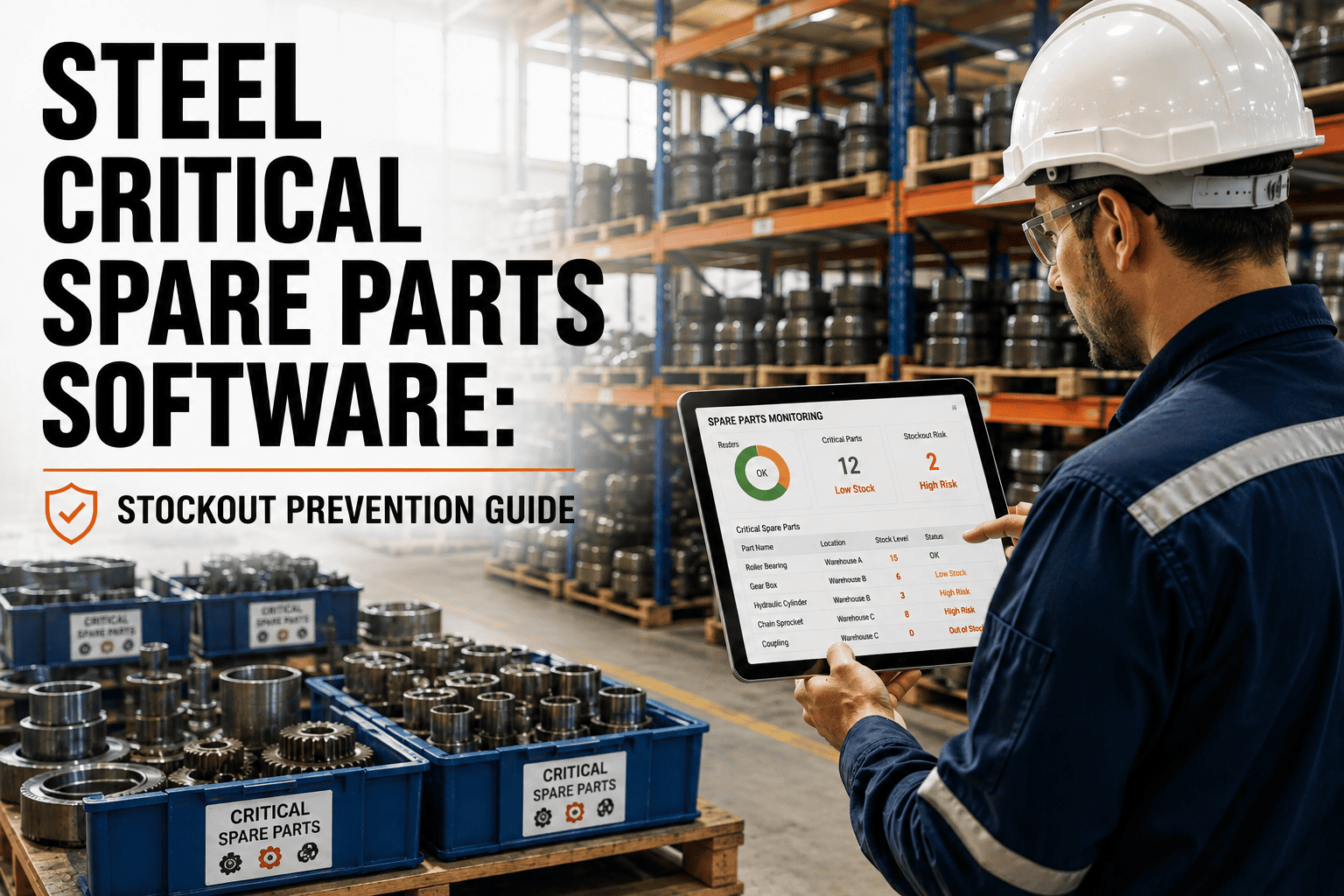
A single missing bearing, gearbox pinion or hydraulic valve can idle a caster, a rolling mill stand or a ladle crane for far longer than the repair itself takes. In steel plants, stockouts rarely come from holding too little stock overall. They come from stocking the wrong parts, trusting weak usage data and keeping purchasing disconnected from maintenance plans. Preventing them means classifying critical spares, setting defensible stock levels and linking every reservation to a work order, which is the workflow that Oxmaint maintenance management software is designed to support.
Steel Plant Spare Parts Stockout Prevention for Critical Equipment
Casters, rolling mills, furnaces, cranes and drives: keep the right part on the shelf before the breakdown, not after it
Why One Missing Part Costs a Steel Plant So Much
Steel production is continuous and tightly coupled. When a critical item is unavailable, the delay spreads across several departments before anyone orders a replacement.
- Part not on shelfThe storeroom record shows zero or a wrong location.
- Repair waitsTechnicians stand by while buyers request urgent quotes.
- Equipment stays downUpstream units hold material and downstream units run dry.
- Premium spendExpedited freight and rush orders replace planned purchasing.
The repeated pattern is a reactive cycle. Emergency buys inflate cost, and the same unplanned failure returns because nobody had time to fix the underlying cause.
Root Causes of Stockouts in Steel Plant MRO
Most stockouts trace back to a short list of causes. Identify which ones apply to your storerooms before changing any stock levels.
| Root cause | What it looks like | Corrective action |
|---|---|---|
| No criticality ranking | Line-stopping parts treated like general consumables | Rank each part by the asset it protects |
| Inaccurate bills of materials | Technicians discover missing parts at the machine | Link parts to assets and job plans |
| Weak usage history | Reorder points set by guesswork | Record issues against work orders every time |
| Ignored lead times | Supplier delay exceeds the planned buffer | Review supplier lead time each quarter |
| Cannibalized stock | Parts borrowed from spare equipment and never replaced | Log every transfer and trigger a replacement order |
| Repairable items not tracked | Motors, gearboxes and rolls lost in the repair loop | Track repairables through send-out and return |
Before and After: Moving From Reactive Buying to Controlled Availability
Before
- Parts requested by phone or paper slip
- Storeroom counts checked only at year end
- Reorder triggered after the last unit is issued
- Critical spares unknown until a failure
- Technicians search several storerooms
After
- Parts reserved against the work order
- Cycle counts focused on critical items
- Reorder alerts based on lead time and usage
- Critical spares listed per asset
- Kits staged before the job window opens
Classify Critical Spares by Equipment Consequence
Criticality should reflect what happens if the part is unavailable, not how often it is bought. A seal used twice a year may protect a caster, while a fast-moving filter may protect nothing important.
- Class A, line stopperFailure halts production or creates a safety exposure. Examples include caster segment bearings, main drive couplings, ladle crane brakes and hoist gearbox components.
- Class B, capacity limiterFailure slows output or forces a workaround. Examples include pump seals, cooling fan motors, proximity sensors and valve positioners.
- Class C, routine consumableEasily replaced with no process effect. Examples include fasteners, filters and general lubricants.
Review Class A parts first. These items justify safety stock even when annual consumption is close to zero.
A Practical Method for Setting Stock Levels
Use a simple reorder structure for consumable items and a risk-based approach for rarely used critical parts.
See Critical Spares Linked to Assets and Work Orders
Look at how parts, reservations and reorder alerts connect inside one maintenance workflow.
From Work Order to Kitted Job: The Availability Workflow
Availability improves when parts follow the maintenance plan instead of reacting to it.
- PlanThe job plan lists required parts, quantities and tools.
- CheckThe planner confirms stock against the planned date.
- ReserveStock is allocated so another job cannot consume it.
- KitStoreroom staff assemble parts before the outage window.
- Issue and returnUsed and unused parts are recorded against the asset.
- ReplenishConsumption triggers a purchase request when stock reaches the reorder level.
The same record then supports failure analysis. Parts consumed per asset show which equipment drains the storeroom most often.
Special Cases: Repairables, Shared Spares and Slow Movers
Repairable assemblies
Gearboxes, motors, hydraulic cylinders and rolls cycle through repair. Track serial number, repair status and expected return date so the pool is never overstated.Shared spares across lines
Identical motors or pumps on several lines may be covered by a common spare, provided the swap procedure and fit are verified.Slow-moving critical parts
Do not delete these because they show low turnover. Document why they are held and who approved the decision.Obsolete components
Flag discontinued drives and controls early so a last-time buy or retrofit can be planned.
KPIs That Show Whether Stockouts Are Falling
Track a small set of measures and review them monthly with maintenance, stores and purchasing together.
Weekly Stockout Prevention Checklist
- Review work orders scheduled for the next two weeks and confirm parts availability.
- Check Class A items that fell below their minimum level.
- Confirm open purchase orders against promised delivery dates.
- Count a sample of critical bins and correct any discrepancies.
- Review parts borrowed from other assets and raise replacement orders.
- Check repairables out for repair and their expected return dates.
- Record parts failures that need supplier or specification follow-up.
How Oxmaint Supports Spare Parts Control
Oxmaint connects inventory to the maintenance records that create demand. Capabilities relevant to stockout prevention include:
- Inventory management with stock levels, locations and reorder alerts.
- Asset management to link spares to the equipment they protect.
- Work orders that record parts used and labor hours.
- Preventive maintenance scheduling that shows future parts demand.
- Mobile access so technicians can check and request parts from the floor.
- Reporting and dashboards for usage trends and recurring failures.
Confirm exact fields and workflows in a demo against your own storeroom process.
Common Mistakes to Avoid
- Setting stock levels from purchase history instead of recorded consumption against work orders.
- Removing slow-moving critical spares during a stock reduction without checking the equipment consequence.
- Treating a supplier quoted lead time as fixed when recent deliveries show otherwise.
- Letting technicians take parts without a work order, which hides real demand.
- Reviewing stock levels once and never again after equipment upgrades or process changes.
- Keeping stores, maintenance and purchasing data in separate systems that nobody reconciles.
A 90-Day Rollout Path
Critical Spares by Steel Plant Area
Each production area has its own failure modes and its own consequence of delay. Use this table as a starting point for your own criticality review, then adjust it to your equipment makes, models and operating conditions.
| Area | Typical critical spare groups | Why availability matters |
|---|---|---|
| Blast furnace and raw materials | Conveyor drive components, stove valves, cooling water pumps, bell or charging system parts | Cooling and charging faults can force a controlled reduction in operation |
| Steelmaking and ladle handling | Tilt drive gearbox parts, lance handling components, ladle crane brakes and hoist ropes | Handling molten metal leaves little room for waiting on parts |
| Continuous casting | Segment bearings, rolls, mould and oscillation components, hydraulic valves, spray nozzles | A stopped caster halts the casting sequence and disrupts upstream and downstream flow |
| Rolling mills | Work roll bearings, spindles, gearbox components, drive modules, hydraulic gauge control parts | Drive and bearing failures stop rolling and may damage product |
| Utilities and water systems | Pump seals, motors, variable frequency drives, fan components, valves | Cooling and compressed air faults affect several units at once |
| Electrical and automation | Controller cards, sensors, power supplies, protection relays, networking hardware | Obsolete electronics may have long and uncertain supply lead times |
Working With Purchasing and Suppliers
Stockout prevention is a shared responsibility. Maintenance defines the need, stores protects the item and purchasing secures supply.
Agree realistic lead times
Ask suppliers for current lead times in writing, and compare them with what actually happened on the last three orders.Use blanket orders and call-offs
For regular items, a planned supply agreement can reduce urgent buying and still keep cash tied up to a minimum.Qualify alternates in advance
Approve equivalent parts or second suppliers before an emergency, so engineering is not approving substitutes under pressure.Share the forecast
Send suppliers the upcoming shutdown parts list so they can plan production and delivery against it.
When purchasing can see approved requests and planned job dates, it can prioritize orders by the work they support rather than by who called most recently.
Storeroom Practices That Protect Availability
Even a well-designed stock policy fails if the item cannot be found or its count is wrong.
- Unique part identifiersRemove duplicate records for the same part under different descriptions.
- Fixed bin locationsEvery item has one recorded home, and moves are logged.
- Controlled issueParts leave the store only against a work order or authorized request.
- Returns processUnused items go back into stock and the count is corrected.
- Targeted cycle countsCount critical and high-value items more often than low-risk consumables.
- Condition and shelf life checksSeals, belts, lubricants and electronics can deteriorate in storage, so record dates and storage needs.
Stock that exists on paper but not on the shelf is the most dangerous kind, because nobody orders a replacement.
Linking Condition Monitoring to Spare Parts Decisions
Condition-based maintenance changes when parts are needed, not whether they are needed. Vibration, temperature, oil analysis and inspection findings can show that a bearing or gearbox is deteriorating weeks before functional failure.
- A rising vibration trend on a mill drive can trigger a work order and a parts reservation while the replacement is still planned.
- Inspection findings on a crane hoist can confirm that brake or rope components must be on site before the next outage.
- Repeated failures of the same component show where stock levels or part quality need review.
- Repair history can help decide whether to hold a new spare, a refurbished unit or both.
The benefit is a longer warning period. A longer warning period lets purchasing order normally instead of expediting.
Balancing Availability Against Working Capital
The answer to stockouts is not to buy everything. Excess inventory ties up cash, occupies space and creates obsolescence risk.
Signs of too little stock
- Repeated emergency purchases
- Jobs delayed waiting for parts
- Cannibalization of standby equipment
- Critical assets with no listed spare
Signs of too much stock
- Items with no issues for several years and no risk reason
- Duplicate parts under different part numbers
- Spares for equipment that was retired
- Large quantities of fast-aging consumables
Review both lists together each quarter. Reduce stock where there is no consequence and add cover where the consequence is high.
Frequently Asked Questions
What causes most spare parts stockouts in steel plants?
Poor criticality ranking, inaccurate bills of materials and untracked usage are common causes. Parts are often bought after failure instead of planned.
Should every critical part be stocked?
No. Stock where consequence is high and lead time is long, and rely on supplier agreements elsewhere.
How does a CMMS reduce stockouts?
It links parts to assets and work orders, so demand is visible early. Try Oxmaint to test that workflow.
How often should reorder levels be reviewed?
Review critical items quarterly, and after any equipment change or repeated supplier delay.
Can inventory data support predictive maintenance?
Yes. Parts consumption trends highlight assets that fail often. Book a demo to see the reporting.
Keep Critical Steel Equipment Running With the Right Part on the Shelf
Build a spare parts process tied to your assets, work orders and maintenance schedule.