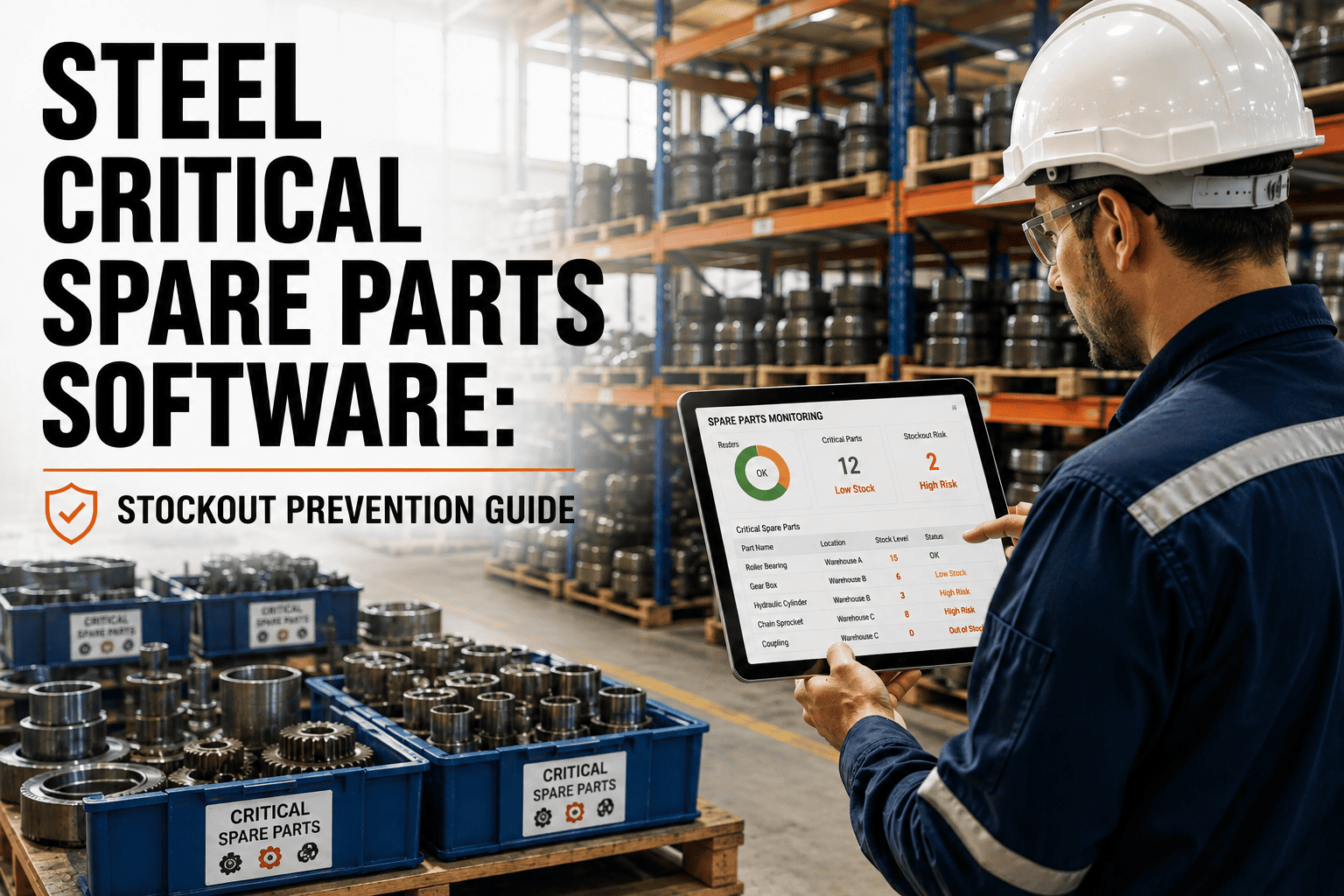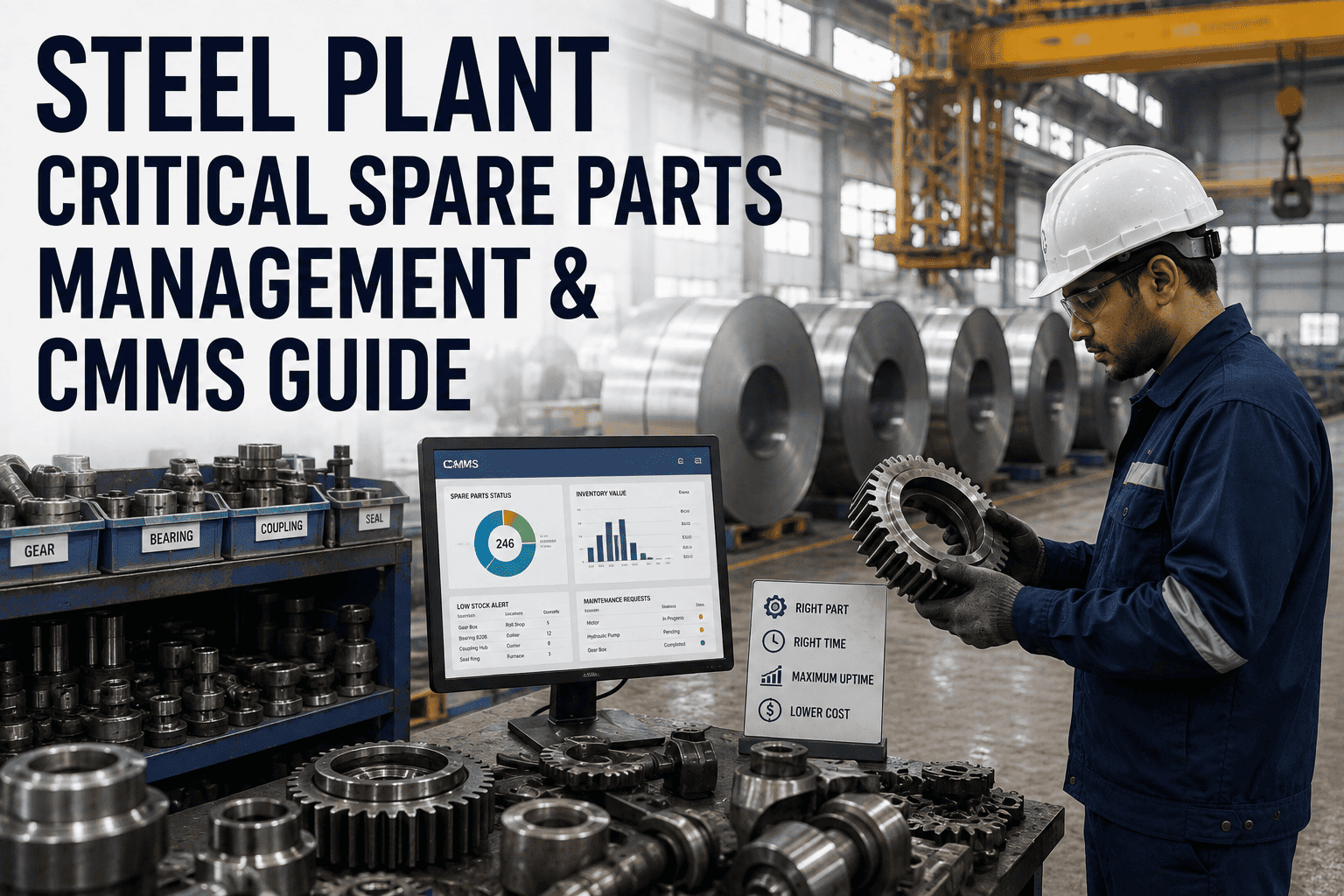
A steel plant rarely loses a shift because a part was expensive. It loses the shift because the part was not on the shelf when a failing asset finally reached the repair window. Stockouts turn a planned fix into an emergency, stretch downtime across connected process zones, and push crews into waiting instead of working. Preventing them means connecting predictive alerts, work order reservations, reorder logic, lead times, and supplier behavior in one view. Many teams start by exploring steel plant CMMS software for spare parts control to see how those pieces fit.
Steel Plant Stockout Prevention for Reliability
Link every predictive work order to a reserved part, a live reorder point, and a supplier you can measure, so the repair window never opens on an empty bin.
Why a Missing Part Costs More in Steel Than Almost Anywhere
Steel production is a connected chain. When a single component is unavailable, the delay rarely stays inside one department.
Where the delay spreads
- Maintenance extends the outage because the repair cannot finish.
- Operations holds upstream units at reduced rate while waiting for release.
- Purchasing pays premium freight and spot prices for urgent orders.
- Planners rebuild the schedule and bump other prepared jobs.
What the plant actually sees
- Technicians standing at a locked machine with no part.
- Substitute parts fitted under pressure and failing early.
- Cannibalized equipment that creates the next stockout.
- A storeroom that looks full but lacks the one critical item.
A stockout is a chain, not a single event
Most stockouts are not surprises. They are the visible end of a sequence of small gaps that were each fixable earlier.
- Day 0Early warning appears. A condition monitoring trend or inspection note flags a worsening component.
- Day 1Work order created without parts. The job exists, but nobody checks stock against it.
- Week 1Stock level unverified. The system shows a quantity that includes items already promised elsewhere.
- Week 2Order placed late. Lead time is longer than the time left before the planned window.
- OutageRepair stalls. The crew is ready, the window is open, and the part is not on site.
Root Causes Behind Steel Plant Maintenance Parts Stockouts
Fixing a stockout once is easy. Preventing the next one means finding the cause underneath it.
| Root cause | How it shows up | Prevention in a CMMS |
|---|---|---|
| No link between work orders and parts | Jobs start without a confirmed kit | Parts list attached to every planned and predictive job |
| Reservations not tracked | On-hand count includes stock promised to other jobs | Available quantity equals on-hand minus reserved |
| Static reorder points | Levels set once and never revisited | Review points against actual consumption and lead time |
| Lead times assumed, not measured | Orders arrive after the planned window | Record promised versus actual receipt dates by supplier |
| Wrong parts treated as equal | A low-cost item with no substitute stocks out | Classify by criticality and replenishment difficulty |
| Duplicate or unclear part records | The same item exists under several descriptions | Clean part master tied to the asset bill of materials |
| Predictive findings disconnected from stock | Alert triggers a job but not a parts check | Predictive work orders reserve or request parts on creation |
Connecting Predictive Work Orders to Reservations
Predictive maintenance gives you advance notice. Reservations turn that notice into guaranteed parts.
- Alert raised, parts not checked
- Stock counted as available twice
- Shortfall found on repair day
- Emergency order at premium cost
- Alert creates a job with a parts list
- Reservation removes stock from the free pool
- Shortfall triggers a request early
- Delivery lands before the window
What a reservation should do
- Commit a specific quantity to a specific work order without issuing it yet.
- Reduce the available quantity shown to other planners immediately.
- Release automatically if the job is cancelled or rescheduled.
- Flag a shortage the moment reserved demand exceeds on-hand plus incoming stock.
Why timing matters
A predictive alert has value only if the lead time of the needed part is shorter than the warning time. If it is not, the alert is information without action. Comparing the two at the moment of alert is the single most useful check a stockout prevention process can run.
Reorder Points, Lead Times, and Safety Stock
Reorder logic should reflect how fast a part is consumed and how long it takes to replace.
Usage rate
Draw from issue history on work orders, not from purchase history, so the number reflects real consumption.
Lead time
Use the observed time from order to usable receipt, including inspection and put-away.
Safety stock
Size it to the variability of both usage and supplier delivery, and the consequence of running out.
When formulas are not enough
- Rarely used critical spares have too little history for statistics, so use engineering judgment tied to failure consequence.
- Parts with long, uncertain lead times need larger buffers or a standing arrangement with the supplier.
- Seasonal or campaign-driven demand, such as relining cycles, needs reorder levels that change with the plan.
- Min-max values should be reviewed on a fixed schedule, not only after a stockout.
See Reservations and Reorder Alerts Working Together
Walk through a predictive work order that reserves stock, raises a request on shortage, and tracks the delivery against your repair window.
Prioritizing Critical Spare Parts by Risk
Not every part deserves the same protection. A simple two-axis view separates what must be on site from what can be ordered on demand.
High consequence, short lead
Keep a controlled minimum and monitor closely.
High consequence, long lead
Hold on site. Review stock and supplier status continuously.
Low consequence, short lead
Order on demand or use simple min-max levels.
Low consequence, long lead
Plan ahead with the maintenance schedule rather than stock.
Typical critical spare families by zone
| Process zone | Parts families that often need protection |
|---|---|
| Blast furnace | Tuyere assemblies, cooling components, hot blast valve seals, fan and blower bearings |
| Steelmaking | Oxygen lance components, tap hole parts, trunnion and drive bearings, hydraulic valves |
| Continuous caster | Mold components, segment rolls and bearings, tundish nozzles, servo valves, spray nozzles |
| Rolling mill | Roll chocks and bearings, spindles and couplings, gearbox components, drive modules |
| Utilities and handling | Pump seals, motors, variable speed drives, belts, idlers, compressor elements |
Measuring Supplier Performance Against Your Repair Windows
A supplier that is late by a few days may be acceptable for routine items and disastrous for a critical spare.
Using the scorecard
- Feed observed lead times back into reorder points automatically or on a set review.
- Qualify an alternate source for critical items where a single supplier creates risk.
- Use delivery history in supplier discussions about standing stock or consignment.
Stockout Prevention Workflow in a Steel Plant CMMS
The workflow below keeps the maintenance team, storeroom, and purchasing looking at the same numbers.
- 01
Build a clean part-to-asset link
Tie each spare to the assets it serves, so a failing asset shows the exact parts it needs.
- 02
Attach parts to predictive and planned jobs
Use job plan templates so the parts list exists before the job is scheduled.
- 03
Reserve and check availability
Compare reserved demand to on-hand and incoming stock to expose shortages early.
- 04
Trigger replenishment
Raise reorder alerts and purchase requests based on levels and lead time.
- 05
Receive, issue, and learn
Record actual consumption and delivery dates so the next cycle uses better data.
Where Oxmaint fits
- Inventory records with minimum and maximum levels and reorder alerts.
- Work orders that carry parts lists, so planned and corrective jobs consume stock accurately.
- Asset records and preventive maintenance schedules that show future parts demand.
- Mobile access so technicians can confirm and record parts used at the equipment.
- Reports on consumption, stock position, and work orders delayed by parts.
KPIs That Show Whether Stockouts Are Really Falling
Track a small set of measures consistently, and review them with maintenance, stores, and purchasing together.
Stockout frequency
Number of times a needed part was unavailable when requested.
Service level
Share of part requests filled from stock on first request.
Jobs delayed by parts
Work orders waiting on materials as a share of open work.
Emergency purchases
Rush orders relative to all purchase lines.
Inventory turns
How quickly stock moves, balanced against service level.
Supplier on-time rate
Deliveries received by the promised date.
Balance availability and carrying cost
Stockout prevention does not mean stocking everything. The aim is the right parts in the right quantity, with obsolete and duplicate stock reviewed regularly to free money for items that matter.
How to read the numbers together
- Falling stockouts with rising inventory value suggests levels are padded instead of targeted.
- Rising emergency purchases with stable service level points to late ordering, not low stock.
- Many jobs delayed by parts on a few assets usually means those part records need review first.
- Poor supplier on-time rates on critical items justify an alternate source or standing stock agreement.
A Practical Rollout Sequence
Start where a stockout hurts most and expand once the data is trustworthy.
Foundation
- Identify the most critical assets and their key spares.
- Clean duplicate part records and confirm locations.
- Record current on-hand and set interim min-max levels.
Connection
- Attach parts to job plans and predictive work orders.
- Turn on reservations and available-quantity visibility.
- Begin capturing supplier promised and actual dates.
Optimization
- Refine reorder points using observed lead time and usage.
- Review critical spare list with operations each quarter.
- Retire obsolete stock and tighten supplier agreements.
Common mistakes to avoid
- Setting levels once and never revisiting them as consumption changes.
- Treating all parts equally, which starves critical items and overfeeds trivial ones.
- Ignoring reservations, so the same stock is promised to several jobs.
- Trusting quoted lead times without comparing them to actual receipts.
Who Owns Parts Availability? Clear Roles Prevent Gaps
Stockouts often survive because every team assumes another team is watching the shelf. Naming an owner for each decision closes that gap.
| Role | Decision they own | Signal they need from the CMMS |
|---|---|---|
| Maintenance planner | Which parts a job needs and when they must be ready | Parts availability shown at the moment the job is planned |
| Reliability engineer | Which spares are critical and how many to hold | Failure history, consumption, and asset criticality |
| Storeroom lead | Accuracy of counts, locations, and reservations | Reserved, on-hand, and incoming quantities per part |
| Purchasing | Supplier choice, order timing, and expediting | Reorder alerts with required-by dates from open jobs |
| Operations | Release of the equipment window | Confirmation that parts and crew are ready before the stop |
Weekly parts readiness review
- List jobs scheduled in the next two to four weeks that still have an open parts shortage.
- Confirm the expected delivery date for each shortage against the planned window.
- Decide early whether to expedite, substitute with an approved alternative, or move the job.
- Record the outcome so recurring shortages feed into the next reorder level review.
Storeroom discipline that supports every other control
Reservations and reorder points are only as reliable as the counts behind them. Cycle counts focused on critical spares, returns of unused parts to the correct bin, and issue transactions recorded at the time of use keep the system quantity close to the shelf quantity.
Handling substitutions safely
- Record approved alternatives on the part record so planners can see them during a shortage.
- Require engineering sign-off for any substitute on a high-consequence asset.
- Track substitute use, because repeated substitution signals a reorder level or supplier problem.
- Avoid cannibalizing standby equipment unless a replacement order is raised at the same time.
Steel Plant Stockout Prevention FAQs
What causes most maintenance parts stockouts in steel plants?
Usually disconnected data: parts not linked to work orders, untracked reservations, and reorder levels that ignore real lead time. Try Oxmaint to link them.
How do reservations help prevent stockouts?
They commit stock to a job so other planners see only what is truly available, exposing shortages before the repair window.
How should reorder points be set for critical spares?
Combine usage, observed lead time, and safety stock, then adjust using failure consequence when history is thin.
Can predictive maintenance reduce emergency purchases?
Yes, when alerts create work orders with parts lists, early notice lets purchasing order at normal cost and lead time.
What should we do first?
Start with critical assets and their spares, then book a demo to review your workflow.
Make Sure the Part Is There When the Window Opens
Connect predictive alerts, reservations, reorder points, and supplier performance in one maintenance system built for continuous process plants.