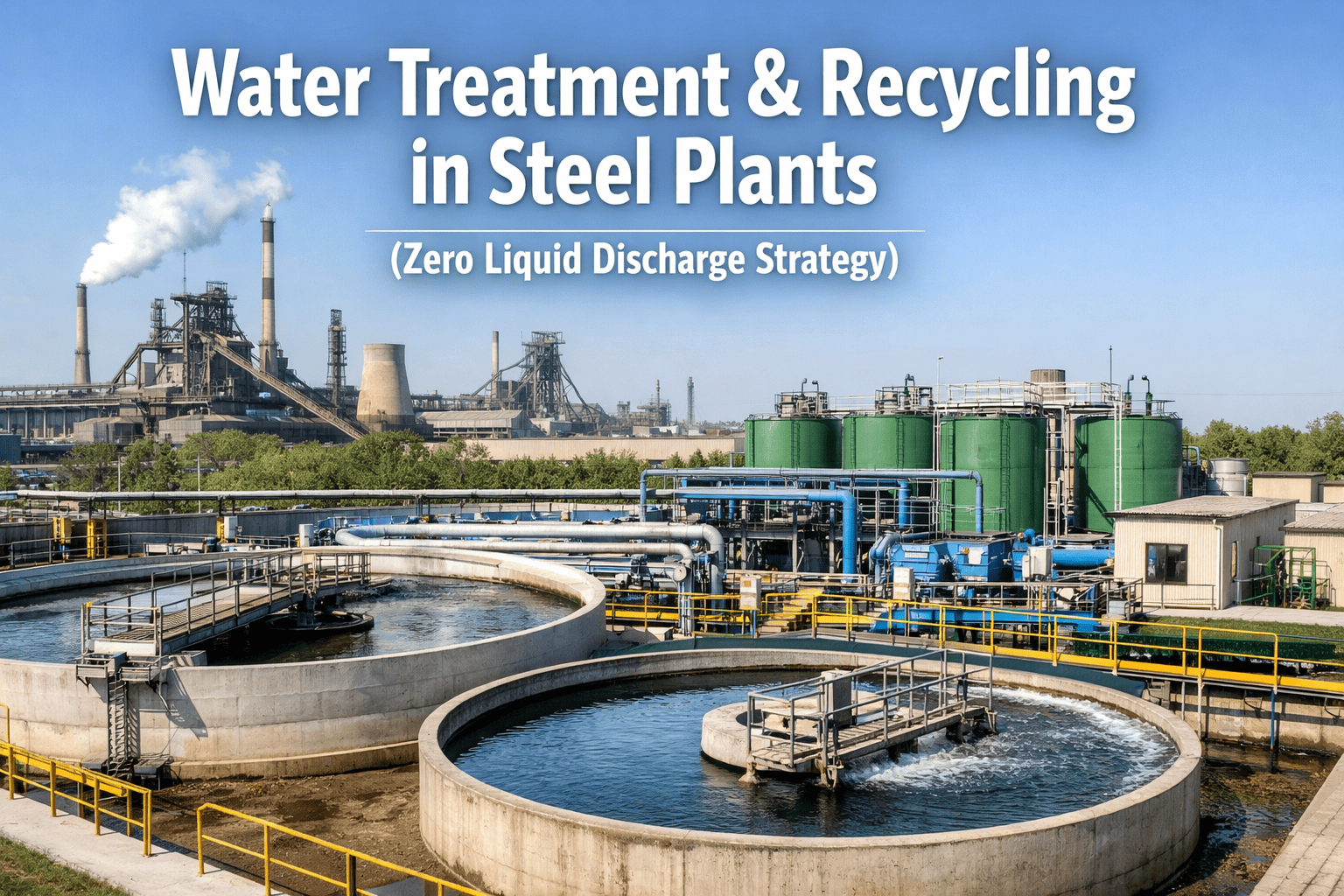
Steel plants consume 20-50 cubic meters of water per ton of finished steel produced—among the most water-intensive industrial operations globally. A typical 500,000-ton integrated mill consumes 10-25 million cubic meters annually, generating 8-20 million cubic meters of wastewater requiring treatment, recycling, or discharge to municipal systems. Water costs (treatment, disposal, municipal fees) average $0.50-2.00 per cubic meter, totaling $4-50 million annually on large mills. Regulatory constraints are tightening globally: EU Water Framework Directive mandates 90% recycling rates, U.S. Clean Water Act NPDES permitting requires specific discharge limits and monitoring, and many states impose water stress surcharges during drought periods, doubling treatment costs. Without systematic water management, mills face cascading risks: discharge permit violations triggering regulatory penalties ($50-500k per violation), municipal discharge fee increases (20-50% escalations), operational disruption from supply scarcity, and reputational damage from environmental incidents. Zero Liquid Discharge (ZLD) implementation—recycling all process water and eliminating external discharge—enables mills to reduce water purchasing costs by 60-80%, achieve regulatory compliance with unlimited margin for process variation, avoid drought-related operational constraints, and command premium selling prices for "water-neutral" steel. Oxmaint's water management system automates water consumption tracking by process zone, monitors treatment system performance (clarifiers, filters, RO units, evaporators), tracks recycling rates and closure of water loops, identifies high-consumption processes requiring optimization, schedules preventive maintenance on water treatment equipment, flags discharge parameter exceedances requiring corrective action, and maintains audit-ready regulatory compliance documentation for EPA and state water agency inspections.
Water Management Challenge in Steel Mills: Why Zero Liquid Discharge Matters More Than Ever
Steel manufacturing requires massive water volumes for cooling (largest consumption), descaling operations, dust suppression, and product quenching. Cooling tower systems alone consume 50-70% of total mill water, recirculating the same water through heat exchangers dozens of times daily and losing water only to evaporation and blowdown (typically 5-8% of circulation rate). Without closed-loop recycling, mills discharge dissolved solids accumulated from evaporation—calcium, magnesium, silica, suspended solids—creating environmental liabilities and regulatory exposure. Traditional wastewater treatment plants remove suspended solids and some dissolved solids, but cannot prevent dissolved mineral discharge. Zero Liquid Discharge requires advanced treatment technologies (membrane filtration, reverse osmosis, evaporators, crystallizers) to recover and recycle all water, eliminating external discharge entirely. ZLD implementation requires capital investment ($20-80 million on large mills) but delivers cost ROI through water cost elimination, regulatory compliance assurance, and operational flexibility. Mills operating under water stress (California, Texas, Southwest U.S., Europe, India) face acute supply and cost pressures—ZLD is not optional sustainability initiative but operational survival necessity. Water management without ZLD strategy leaves mills vulnerable to: supply disruption during drought (production shutdown risk), permit revocation (regulatory action forcing shutdown), discharge fee escalation (5-10% annual increases in some regions), and customer defection to "water-neutral" competitors. Systematic water management beginning with consumption baseline, progressing through treatment system optimization, and culminating in closed-loop recycling delivers competitive resilience and eliminates water-related operational and financial risk.
Five Critical Water Management Zones and Zone-Specific Treatment Requirements
Systematic water management requires identifying major water-consuming processes, understanding contamination streams entering each process, establishing treatment requirements to enable recycling, and implementing monitoring systems to ensure treatment effectiveness. Steel mills operate five distinct water management zones with different recycling challenges and treatment approaches. Without zone-level visibility into water consumption and treatment status, mills cannot optimize recycling or achieve ZLD targets. Oxmaint integrates water monitoring across all five zones, tracks treatment system performance, and flags treatment failures requiring immediate corrective action.
Largest water consumer (50-70% of total mill water). Recirculated water accumulates dissolved solids (calcium, magnesium, silica, iron). Treatment: side-stream clarification (removes suspended solids), softening via lime-soda ash (reduces hardness), scale inhibitor chemistry (prevents mineral precipitation on equipment). Recycling rate: 90-95% through makeup water reduction and evaporation-only loss. Challenge: mineral scale formation reduces heat transfer efficiency by 10-20% if untreated.
Uses high-temperature water jets to remove mill scale from hot steel surfaces (400-800 tons/hour throughput on large mills). Waste stream: 50-100 tons/hour water laden with suspended iron oxide scale. Treatment: settling tank (gravity separation), hydrocyclone (centrifugal separation), filter press (dewatering scale solids for landfill or iron recovery). Recycling rate: 70-85% of descaling water returned to process after treatment. Remaining loss: evaporation and absorbed moisture in scale solids. Challenge: iron oxide solids accumulation if treatment system undersized.
Rolling mills use water-oil emulsions for metal surface lubrication and cooling. Emulsion water stream (200-500 gallons/hour typical) becomes contaminated with oil, metallic particles, and process byproducts. Treatment: coalescing separator (oil-water separation), centrifuge or filter (removal of metallic particles), membrane ultrafiltration (removal of soluble contaminants). Recycling rate: 90-95% when properly maintained. Challenge: emulsion stability deteriorates over time, requiring periodic replacement of 10-15% of circulation volume.
Fugitive dust suppression systems spray water on material stockpiles, raw material handling areas, and calcined product. Baghouse wet scrubber blowdown contains fine particulate (dust, plant debris, atmospheric contamination). Treatment: settling tank (gravity separation of suspended solids), clarification with polymer coagulation (removal of fine particles), sand filter (additional polishing). Recycling rate: 80-90% returned to dust suppression system. Waste stream: settled sludge (5-15% solids by weight) requiring dewatering and disposal. Challenge: seasonal variation in dust suppression demand affects treatment system loading.
Product quenching (cooling hot rolled products from 1000°F to <200°F using water), wire drawing coolant, and miscellaneous process uses (valve cooling, torch cutting, general rinsing). Combined streams: 100-200 gallons/minute with mixed contamination (iron fines, oils, dissolved salts). Treatment: primary clarification (large solids removal), secondary clarification (small solids removal), deep sand filtration, reverse osmosis for dissolved contaminant removal (if aiming for high purity recycling), evaporation/crystallization for zero discharge. Recycling rate: 75-90% depending on treatment intensity. Challenge: treatment cost scales with required water purity; balancing recycling benefit vs. treatment expense.
Water Quality Parameters, Discharge Limits, and Treatment System Performance Monitoring
Successful water management requires continuous monitoring of water quality parameters across all zones, tracking treatment system performance, and ensuring discharge compliance before any water leaves the facility. EPA NPDES permits specify discharge limits for total suspended solids (TSS, typically 30 mg/L), total nitrogen (variable by region, 5-20 mg/L), total phosphorus (0.5-3.0 mg/L), pH (6.5-8.5), temperature (within 5°F of ambient), and specific chemicals used in steel processes (iron, manganese, chromium depending on alloy production). Treatment system underperformance—clarifier overflow, filter media breakthrough, RO membrane degradation—results in discharge parameter exceedances, permit violations, and regulatory penalties. Oxmaint automates quality parameter tracking, treatment system performance monitoring, and alert generation when parameters approach discharge limits, enabling proactive corrective action before violation occurs.
| Water Zone | EPA Discharge Limits | Primary Treatment Method | Monitoring Frequency | Recycling Rate Target |
|---|---|---|---|---|
| Cooling Tower Blowdown | TSS <30 mg/L, pH 6.5-8.5, Temp <+5°F ambient | Clarification, softening, cooling | Daily TSS, pH; 3x weekly lab analysis | 90-95% |
| Descaling Water | TSS <30 mg/L, iron <2.0 mg/L (varies), pH 6.5-8.5 | Settling, hydrocyclone, filter press | Daily visual/TSS; 2x weekly lab; monthly iron analysis | 70-85% |
| Rolling Mill Emulsion | Oil <15 mg/L, TSS <30 mg/L | Coalescer, centrifuge, ultrafiltration | Daily oil content; 2x weekly lab analysis | 90-95% |
| Dust Suppression Blowdown | TSS <30 mg/L, pH 6.5-8.5 | Settling, clarification, sand filtration | Daily visual; 2x weekly lab TSS | 80-90% |
| Miscellaneous Quenching/Process | TSS <30 mg/L, oil <15 mg/L, pH 6.5-8.5 | Multi-stage clarification, RO if high reuse | 3x weekly lab analysis (comprehensive) | 75-90% |
| Blended Discharge (if any) | EPA NPDES permit specific limits | Integrated treatment or ZLD evaporation | Daily online monitoring, weekly lab confirmation | 95-100% (ZLD target) |
Zero Liquid Discharge Pathway: From Conventional Treatment to Closed-Loop Recycling
Zero Liquid Discharge is achieved through progressive implementation of recycling technologies, starting with conventional treatment (clarification, filtration) of each process water zone, advancing to closed-loop recycling of individual zones, and ultimately integrating all zones into a unified water recovery system where treated water is recycled within process zones and the only discharge is evaporation (100% water recovery, 0% liquid discharge). ZLD requires capital investment in advanced treatment equipment (reverse osmosis units, evaporators, crystallizers) and steady-state operational discipline to maintain treatment system performance. ROI justification varies by mill location: mills in water-stressed regions (high cost, supply risk) achieve 3-5 year capital payback through water cost elimination; mills in water-abundant regions with low disposal costs may require 10-15 years, justifying ZLD through regulatory compliance and environmental reputation rather than immediate financial return. Phased implementation (stage 1: zone-specific recycling; stage 2: inter-zone recycling; stage 3: complete ZLD with final evaporation/crystallization) enables capital distribution over 5-10 years while progressively reducing water costs and discharge liability.
- Install water meters on all major process zones (cooling tower inlet/outlet, descaling process, rolling mill, dust suppression, quenching water). Measure baseline consumption (cubic meters per ton of steel) over 4-week period capturing normal and peak operations.
- Sample wastewater from each zone: measure TSS, oil content, pH, temperature, specific contaminants (iron, chromium, nitrogen). Identify major contamination sources limiting recycling feasibility.
- Estimate current treatment system capacity vs. required capacity for ZLD goal. Identify undersized or ineffective treatment equipment. Document equipment maintenance history (clarifier cycles, filter change frequency).
- Calculate baseline water cost: municipal supply cost + wastewater disposal cost + treatment chemicals. Establish financial baseline for ROI projection (payback period = ZLD capital cost / annual water cost savings).
- For each zone, design treatment system capable of recycling 80-95% of water: cooling tower (clarification, softening, polishing filter), descaling (settling, hydrocyclone, filter press), emulsion (coalescer, centrifuge, cartridge filters), dust suppression (clarification, sand filter), quenching (multi-stage clarification, RO if high-purity return required).
- Size treatment equipment for zone flow rates: cooling tower 20-50 m³/hr, descaling 1-3 m³/hr, rolling mill emulsion 0.5-2 m³/hr, dust suppression 5-15 m³/hr, quenching 2-5 m³/hr. Equipment sizing error results in treatment failure and discharge violations.
- Specify final polishing step: sand filtration (removes fine solids to 5-10 µm), cartridge filtration (1-10 µm if required), or polishing clarifier (removes colloidal particles). Determine if RO is required for highest-quality water recycling (near-zero mineral content).
- Design inter-zone recycling paths: can cooling tower blowdown treated water supply dust suppression? Can descaling water supply cooling tower makeup? Inter-zone optimization reduces overall treatment demand and capital cost.
- Maintenance optimization: inspect all treatment equipment (clarifiers, filters, RO units, sumps). Replace or rehabilitate undersized or non-functional equipment. Increase clarifier sludge removal frequency if settling is poor. Replace filter media if breakthrough occurring.
- Implement zone-specific recycling: establish closed-loop circulation on cooling tower (recover 90-95% through makeup reduction and evaporation-only loss), descaling (settle solids, recirculate treated water to descaling nozzles, 70-80% recycling rate), rolling mill emulsion (recover emulsion via coalescer, 90-95% recycling).
- Oxmaint integration: install water meters and quality sensors on treated water return lines (upstream of recycling pump). Track daily recycling rates by zone. Schedule clarifier cleaning, filter cartridge replacement, RO membrane cleaning on preventive maintenance calendar.
- Establish treatment performance targets: cooling tower TSS <20 mg/L (improved from typical 30-40 mg/L baseline), descaling water iron <2 mg/L, rolling mill emulsion oil <10 mg/L. Measure performance weekly; alert if targets not achieved indicating equipment failure.
- Install reverse osmosis (RO) systems on highest-value water streams (rolling mill emulsion, quenching water) to remove dissolved salts and enable 95%+ recycling to process. RO system capital: $5-20M depending on flow rate. Operating cost: $0.50-1.50 per cubic meter treated.
- Install evaporation or crystallization system to handle RO reject brine and remaining concentrated wastewater (typically 2-5% of flow after recycling). Evaporator produces near-zero liquid discharge, with solid salt byproduct for landfill or (in some cases) resale or industrial use.
- Closed-loop inter-zone recycling: route treated cooling tower water to dust suppression, descaling water to cooling tower makeup, quenching water through RO for return to rolling mill. Optimize paths to maximize reuse and minimize treatment demand.
- Establish final discharge monitoring: measure discharge water (if any) for all EPA-regulated parameters (TSS, oil, pH, temperature, specific contaminants). Target zero discharge; if discharge required as temporary step, ensure compliance with NPDES permit with safety margin (discharge parameters 20-30% below permit limits).
- Daily water balance closure: measure total water intake (municipal + rainfall), total water consumed in products (embedded in steel, typically 1-2%), total evaporative loss (cooling towers, dust suppression, process evaporation, estimated 3-8%), verify residual = zero (or <0.5% safety margin accounting for meter accuracy).
- Oxmaint monitoring: track daily recycling rates by zone (target 90-100%), treatment system performance (TSS <10 mg/L in recycled water), RO system status (membrane condition, reject rate, operating pressure). Monthly report showing water balance closure and zero-discharge achievement.
- Waste stream optimization: solid byproducts from treatment (sludge, salt crystals) should be minimal and potentially valuable. Explore resale of treatment byproducts (iron oxide from descaling, salt crystals from evaporation) to offset ZLD operational costs.
- Regulatory advantage: document zero discharge achievement for EPA, state environmental agency, and municipal water system. Prepare for unannounced environmental inspections with complete water balance data, treatment logs, discharge monitoring records. Potential for water pollution liability insurance reduction (5-15% annual premium reduction).
Water Cost Savings, Regulatory Compliance, and Environmental Reputation Benefits
Zero Liquid Discharge delivers three distinct economic and competitive benefits. First: direct water cost reduction of 60-80% through elimination of municipal supply costs ($0.50-2.00 per cubic meter) and wastewater disposal fees ($0.30-1.50 per cubic meter). A 500,000-ton mill consuming 15 million cubic meters annually at $1.50 total cost (supply + disposal) saves $13.5 million annually through ZLD, yielding 3-5 year capital payback on $20-40 million ZLD system investment. Second: regulatory compliance assurance through zero external discharge eliminates NPDES permit violation risk, EPA penalty exposure, and state water agency enforcement action. Third: market differentiation through "water-neutral" or "zero-discharge" certification enables premium pricing (2-5% price increase for low-impact steel), captures sustainability-focused supply contracts (automotive, renewable energy, construction sectors increasingly requiring low-impact supply chains), and improves ESG scores supporting access to green financing and institutional investor capital. Mills implementing ZLD gain operational flexibility: water stress no longer constrains production (no supply cutoff risk during drought), production can scale without proportional water cost increase (fixed treatment cost vs. variable municipal cost), and regulatory approvals for expansion become faster (environmental agency pre-approval for zero-impact expansion).
Measure recycled water volume divided by total zone water input. Track monthly by zone to identify underperforming treatment systems. Zones below 70% recycling indicate treatment failure requiring maintenance or equipment replacement.
Daily TSS measurement of treated water from clarifiers, filters, and final polishing. Exceedances above targets indicate filter cartridge breakthrough, clarifier overflow, or media degradation requiring immediate maintenance.
Calculate savings: (baseline cubic meters × baseline cost per cubic meter) - (recycled cubic meters × treatment chemical cost per cubic meter). ZLD operational cost: $0.20-0.50 per cubic meter treated (chemicals, maintenance, labor, utilities). Savings accrue immediately upon ZLD activation.
Monthly water balance report: total inlet water - evaporative loss - product water content = residual (should be zero ±0.5% accounting for meter accuracy). Residual >0.5% indicates leakage, accounting error, or continued discharge requiring investigation.
Preventive maintenance on clarifiers, filters, RO units, and evaporators is essential to maintain treatment performance. Delays in filter cartridge replacement, RO membrane cleaning, or clarifier sludge removal directly degrade recycling rates and trigger discharge violations.
ZLD eliminates discharge entirely, making NPDES violations impossible (zero external discharge = zero parameter exceedance risk). Track: discharge monitoring reports filed on time (if any temporary discharge during startup), zero notices of violation received, no EPA enforcement action or penalties.