Water is the most pervasive utility in a steel plant and the least systematically maintained. Cooling water circuits serve blast furnaces, continuous casters, rolling mills, and electrical equipment simultaneously — yet most plants manage these systems through periodic chemistry checks logged on paper, pump vibration complaints handled reactively, and cooling tower inspections scheduled by season rather than by condition. The consequence is scale buildup that reduces heat exchanger effectiveness by 15 to 30%, corrosion failures that require unplanned equipment isolation, and pump bearing failures that halt cooling circuits serving critical production equipment. Oxmaint's water chemistry tracking and cooling system monitoring gives utilities maintenance teams the structured PM framework to manage these systems proactively before chemistry and mechanical failures create production impacts.
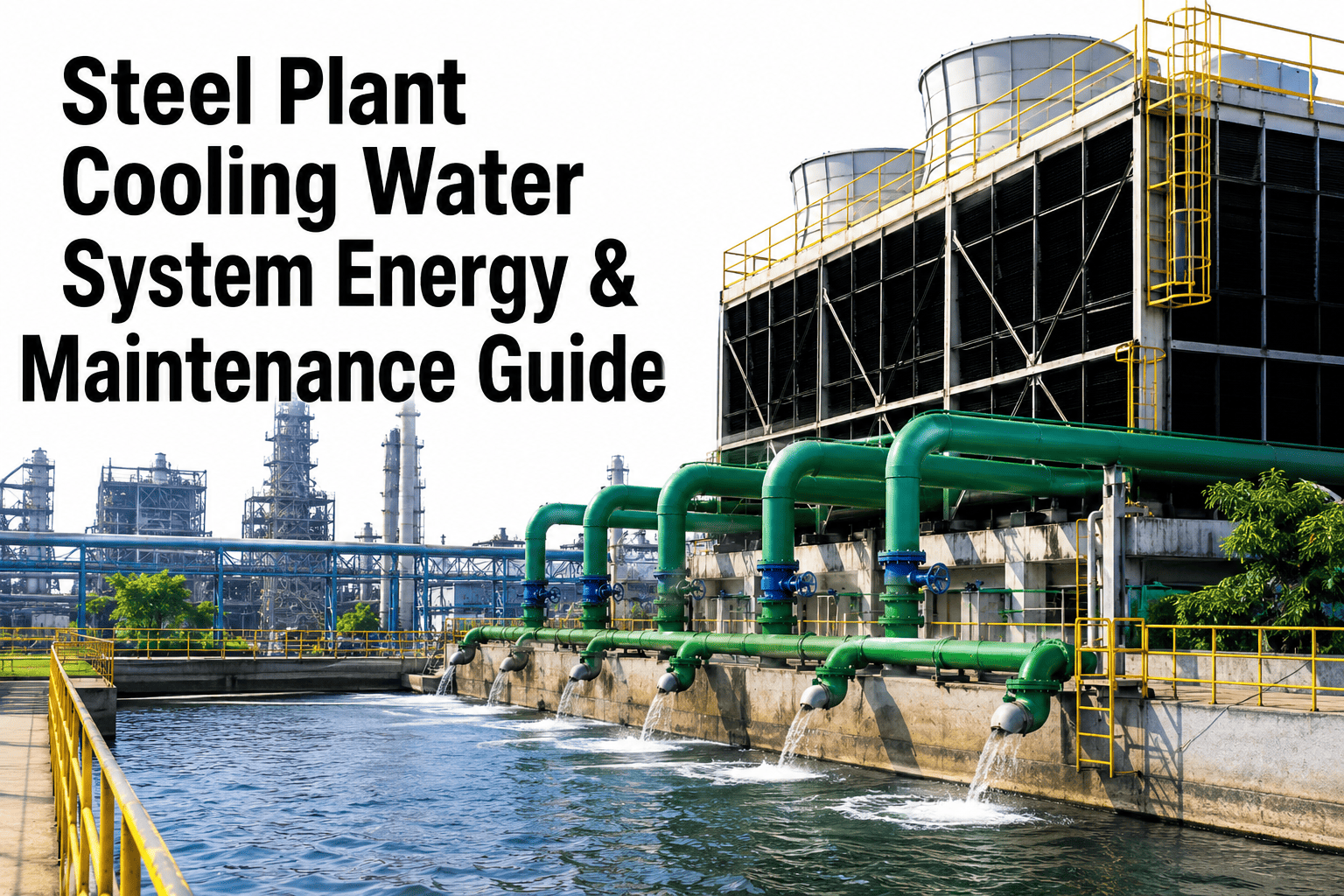
Steel Plant Water Treatment & Cooling System Maintenance Guide
How structured CMMS programmes track water chemistry, manage pump PM schedules, monitor cooling tower performance, and maintain spray cooling systems across the full range of steel plant cooling water circuits — from blast furnace jackets to continuous caster secondary cooling.
Why Water and Cooling System Maintenance Is the Most Under-Managed Utility in Steel Plants
Steel plant cooling water systems are architecturally complex — multiple closed and open circuits, each with different water quality requirements, operating temperatures, and contamination risks, all serving equipment that cannot be isolated without halting production. The scale of the system means that maintenance teams typically manage it at a macro level: periodic chemistry rounds, reactive response to pump failures, and cooling tower cleaning when algae becomes visible. This is the maintenance posture that produces $284,000 equipment failures from undetected water treatment gaps.
The water chemistry connection to equipment failure is direct but slow-developing: a feedwater pH drifting below 7.0 for six weeks does not trigger an alarm, but it initiates corrosion in pipe walls and heat exchanger tube sheets that materialises as a tube failure months later. Scale buildup in closed circuit heat exchangers accumulates imperceptibly across campaigns, reducing cooling capacity until the equipment it serves begins to overheat. Pump bearing degradation from process water contamination follows a trajectory that vibration monitoring would catch weeks before the bearing seizes. All three failure pathways are preventable through the structured CMMS-driven monitoring that most utility maintenance programmes do not currently apply. Sign up for Oxmaint to begin structured water system tracking across your steel plant utilities.
Water Chemistry Monitoring and Treatment Programme Management
Water chemistry monitoring is the foundation of any effective cooling system maintenance programme — it is the only mechanism that detects the electrochemical processes destroying equipment before physical symptoms appear. The challenge in most steel plants is not the absence of water testing; it is the absence of a systematic record that surfaces trends before they become failures. Chemistry readings logged on paper shift reports or unconnected spreadsheets cannot show the gradual pH drift, conductivity increase, or inhibitor depletion that precedes a corrosion or scaling event.
pH, Conductivity, Hardness, and Inhibitor Concentration Trending
Each cooling water circuit — blast furnace jacket cooling, caster primary and secondary, rolling mill roll cooling, and electrical equipment cooling — operates with different chemistry specifications reflecting its contamination risk and heat load. CMMS tracking maintains a separate chemistry history for each circuit, with alert thresholds configured to the circuit's specific operating requirements. pH readings trending below the minimum specification for three consecutive measurements generate a corrective action work order automatically before corrosion initiation occurs.
Conductivity monitoring provides the most sensitive early indicator of treatment programme effectiveness. Conductivity increasing above the target blowdown limit indicates scaling potential building in the circuit. Inhibitor concentration falling below the minimum effective level — detectable from titration results logged against each circuit's dosing record — identifies chemical feed system failures or consumption rate changes requiring dosing adjustment before the protective film on heat exchanger surfaces breaks down.
The hardness-to-scaling relationship is particularly consequential for furnace and caster cooling circuits that operate at higher temperatures. Langelier Saturation Index calculations from CMMS-maintained chemistry data identify when the circuit is operating in the scaling zone weeks before visible scale deposits form on heat exchanger surfaces. Book a demo to see how Oxmaint's water chemistry trending is configured per circuit.
Cooling Water Pump Condition Monitoring and Preventive Maintenance
Cooling water pump failures are among the most consequential maintenance events in a steel plant because the equipment they serve — furnace cooling jackets, continuous caster segments, electrical switchgear cooling — cannot tolerate even brief cooling loss without process interruption or equipment damage. Yet in most plants, pump maintenance is triggered by audible changes in operation or increasing leakage rather than systematic condition monitoring. The 1 to 6 week advance warning available from vibration trending and bearing temperature monitoring is routinely wasted.
Bearing Condition, Seal Integrity, and Flow Rate Trending
Process water pump bearing failures display characteristic warning signatures that vibration and thermal monitoring capture 2 to 6 weeks before mechanical failure: vibration amplitude increasing 15 to 20% above baseline at the bearing frequencies associated with the specific bearing type, motor bearing temperatures trending above their established range, and discharge pressure fluctuations indicating developing impeller wear or suction cavitation. CMMS condition history for each pump — updated at each maintenance round and connected to permanently installed sensors where criticality justifies the investment — provides the trend record needed to schedule bearing replacement during a planned isolation window.
Mechanical seal condition is the second most critical pump parameter after bearing health. Seal leakage increasing from the acceptable weeping rate to visible drips indicates seal face degradation or spring compression loss. Scheduled seal inspection intervals in the CMMS, triggered by operating hours rather than calendar dates, ensure that high-duty cooling pumps have seal condition assessed at intervals matched to their actual service conditions rather than generic annual PM schedules that over-service low-duty pumps while under-servicing high-duty ones.
Flow rate monitoring against circuit design specification identifies impeller wear, increased circuit resistance from scale buildup in downstream equipment, and valve position drift — all of which reduce cooling system capacity before temperature alarms at the served equipment trigger investigation. Sign up for Oxmaint to configure pump PM schedules with operating hours triggers for your cooling circuit pumps.
The Cost of a Single Undetected Water Treatment Failure
A mid-sized processing plant lost $284,000 worth of production when equipment failed following water treatment logs showing gaps of up to three weeks without recorded testing. Investigation revealed the failure had been preventable — scaling indicators were visible in chemistry data during the 30 to 60 days before failure, but without systematic monitoring through a CMMS, the warning signs went unrecorded until catastrophic failure occurred.
Structured water chemistry tracking in Oxmaint closes this gap by maintaining continuous trend records per circuit with automatic alert generation when readings move outside acceptable ranges. Most facilities implementing CMMS-driven water treatment programmes reduce emergency failures by 81% within the first year. Start your free account to begin building structured water chemistry tracking immediately.
Cooling Tower Performance Tracking and Biological Control
Steel plant cooling towers handle the highest heat rejection loads in the cooling water system, and their performance directly determines how much cooling capacity is available for production equipment during peak summer operating periods. Cooling tower fill degradation, drift eliminator condition, fan performance, and biological contamination management are all maintenance variables that affect cooling system capacity — and all follow predictable deterioration patterns that CMMS condition tracking can monitor against.
Fill Condition, Fan Performance, and Biological Control Management
Cooling tower approach temperature — the difference between the cold water basin temperature and the ambient wet bulb temperature — is the most direct operational measure of cooling tower effectiveness. CMMS logging of approach temperature against ambient wet bulb conditions, recorded weekly and compared against the tower's design approach specification, identifies fill degradation and internal fouling before production equipment begins to overheat during peak summer loads. An approach temperature increasing by 3°C above historical baseline at equivalent wet bulb conditions indicates fill or distribution system degradation requiring inspection.
Fan condition monitoring on cooling tower cells follows the same vibration trending approach applied to process pumps. Gearbox oil condition, fan blade pitch setting, and belt tension where applicable are all tracked as individual PM tasks per cell in the CMMS, with separate maintenance histories for each cell enabling like-for-like condition comparison across cells serving the same circuit.
Biological control — Legionella prevention in particular — requires the most rigorous chemistry documentation in the cooling water programme. CMMS-maintained records of biocide dosing frequency, residual disinfectant measurements, and periodic Legionella colony count test results create the audit trail required by health and safety regulations and provide the chain of evidence needed when a biological control incident is investigated. Book a demo to see Oxmaint's compliance documentation for cooling tower biological control.
Secondary Cooling Spray System Maintenance and Nozzle Performance Tracking
Continuous caster secondary cooling spray systems are the closest water system analogue to plate mill descalers in terms of the maintenance challenge they present: hundreds of nozzles across multiple cooling zones, each producing a specific heat extraction profile that determines strand solidification, surface quality, and caster capacity. Blocked or worn nozzles create local spray coverage gaps that produce shell reheating events — visible in strand surface temperature surveys as hotspots — leading to surface cracking, internal porosity, and in severe cases, breakout risk from localised shell thinning.
Nozzle Flow Performance, Zone Pressure Monitoring, and Scale Deposition Tracking
Spray nozzle blockage in continuous caster secondary cooling operates through a different mechanism from descaler nozzle blockage — scale deposition rather than scale particle impact. The precipitation of calcium and magnesium carbonate at the elevated temperatures near the strand surface gradually reduces nozzle orifice diameter, decreasing flow and producing spray pattern distortion. The CMMS-based approach to managing this degradation is identical in structure to descaler tracking: nozzle position maps with per-nozzle flow verification during caster maintenance windows, tracked against design flow rates and logged with CMMS work orders for replacement when flow falls below the minimum effective threshold.
Zone pressure monitoring provides a secondary indicator of spray system health. Pressure drop across any secondary cooling zone that exceeds design specification by more than 10% indicates blocked nozzles, control valve drift, or pipe scale accumulation restricting flow to that segment. Monitoring zone pressures against baseline during normal casting operation provides continuous condition feedback without requiring caster shutdown. Sign up for Oxmaint to configure secondary cooling spray tracking with per-nozzle position records for your caster maintenance programme.
Manage All Four Water System Categories in One Platform
Water chemistry trending, pump PM scheduling, cooling tower monitoring, and spray system tracking — all configurable in Oxmaint for your steel plant's cooling water circuits.
Failure Modes, Risk Levels, and PM Trigger Intervals for Cooling System Assets
Use this reference when configuring water system asset PM schedules and condition monitoring thresholds in Oxmaint.
| Component / System | Primary Failure Mode | CMMS Detection Method | Risk Level | Recommended PM Trigger |
|---|---|---|---|---|
| Cooling Circuit Water Chemistry | Corrosion or scaling from pH/inhibitor drift | Chemistry trending per circuit: pH, conductivity, inhibitor | Critical | Daily readings with trend alert at 3 consecutive deviations |
| Process Cooling Pump Bearings | Fatigue failure from vibration or contamination | Vibration amplitude trend + bearing thermal history | Critical | Weekly vibration check; continuous sensor on critical circuits |
| Pump Mechanical Seals | Face degradation increasing leakage to failure | Leakage rate inspection log + operating hours counter | High | Hours-based inspection interval per pump duty class |
| Cooling Tower Fill | Fouling reducing heat transfer effectiveness | Approach temperature vs. wet bulb trending | High | Weekly approach temperature log with seasonal baseline |
| Cooling Tower Fans | Gearbox wear, blade pitch drift, belt failure | Vibration + gearbox oil condition log | High | Monthly vibration and oil check per cell |
| Cooling Tower Biology | Legionella and algae from biocide programme gaps | Biocide residual log + periodic colony count records | Critical | Weekly residual check; quarterly Legionella count test |
| Caster Secondary Cooling Nozzles | Scale blockage reducing spray coverage | Per-nozzle flow verification + zone pressure trending | High | Per caster maintenance window; zone pressure continuous |
| Heat Exchanger Tube Bundles | Scale and corrosion reducing thermal performance | Inlet/outlet temperature differential trending | High | Monthly thermal performance log; annual internal inspection |
| Trigger intervals based on steel plant cooling system operating conditions. Adjust in Oxmaint for your specific circuit criticality, water quality, and operating temperature profile. | ||||
How Oxmaint Addresses Each Water System Maintenance Need
Water Chemistry Tracking and Trend Alerting
Each cooling water circuit is registered in Oxmaint with its own chemistry specification — pH range, conductivity limit, inhibitor minimum, hardness target. Daily chemistry readings are logged per circuit, and trend alerts are generated automatically when readings deviate from specification across consecutive measurements. The chemistry history for each circuit is visible in a trend dashboard that surfaces gradual pH drift and inhibitor depletion weeks before they produce equipment damage.
Pump PM Scheduling with Hours-Based Triggers
Cooling water pumps are registered as individual assets with their vibration baseline, bearing thermal history, seal inspection log, and operating hours counter. PM work orders for seal inspection and bearing assessment are triggered by operating hours rather than fixed calendar dates, reflecting actual duty in high-cycle and low-cycle applications. Vibration amplitude trending is updated at each maintenance round with automatic alerts when amplitude exceeds the configured threshold above baseline. Sign up free to configure pump PM schedules.
Cooling Tower Performance and Compliance Monitoring
Cooling tower cells are registered per circuit with approach temperature history, fan condition logs, and biological control records. Approach temperature trending against wet bulb baseline surfaces fill degradation before it impacts production cooling capacity. Legionella control documentation — biocide dosing records, residual measurements, and colony count test results — is maintained per tower in Oxmaint's audit-ready compliance records. Book a demo to see compliance records configured.
Spray System Nozzle Tracking and Zone Pressure Monitoring
Caster secondary cooling nozzle positions are mapped in Oxmaint with a numbered ID for each nozzle per zone. Flow verification results are recorded per nozzle during caster maintenance windows, with replacement work orders generated for positions falling below the minimum effective flow threshold. Zone pressure readings during casting are logged against the design baseline, with alerts when pressure differential indicates restricted flow from scale accumulation or nozzle blockage.
"Most water treatment failures in industrial facilities show detectable warning signs in chemistry data, operating pressure patterns, or visual inspection findings during the 30 to 60 days before failure occurs. Systematic monitoring through CMMS platforms captures these early indicators before they escalate into costly breakdowns."
Frequently Asked Questions
Build a Structured Maintenance Programme for Your Steel Plant Water Systems
Water chemistry tracking, pump PM scheduling, cooling tower performance monitoring, and spray system nozzle management — configured in Oxmaint for the full range of steel plant cooling water circuits from blast furnace service to continuous caster secondary cooling.