Water Treatment and Recycling System Maintenance in Steel Plants
By John Mark on March 13, 2026
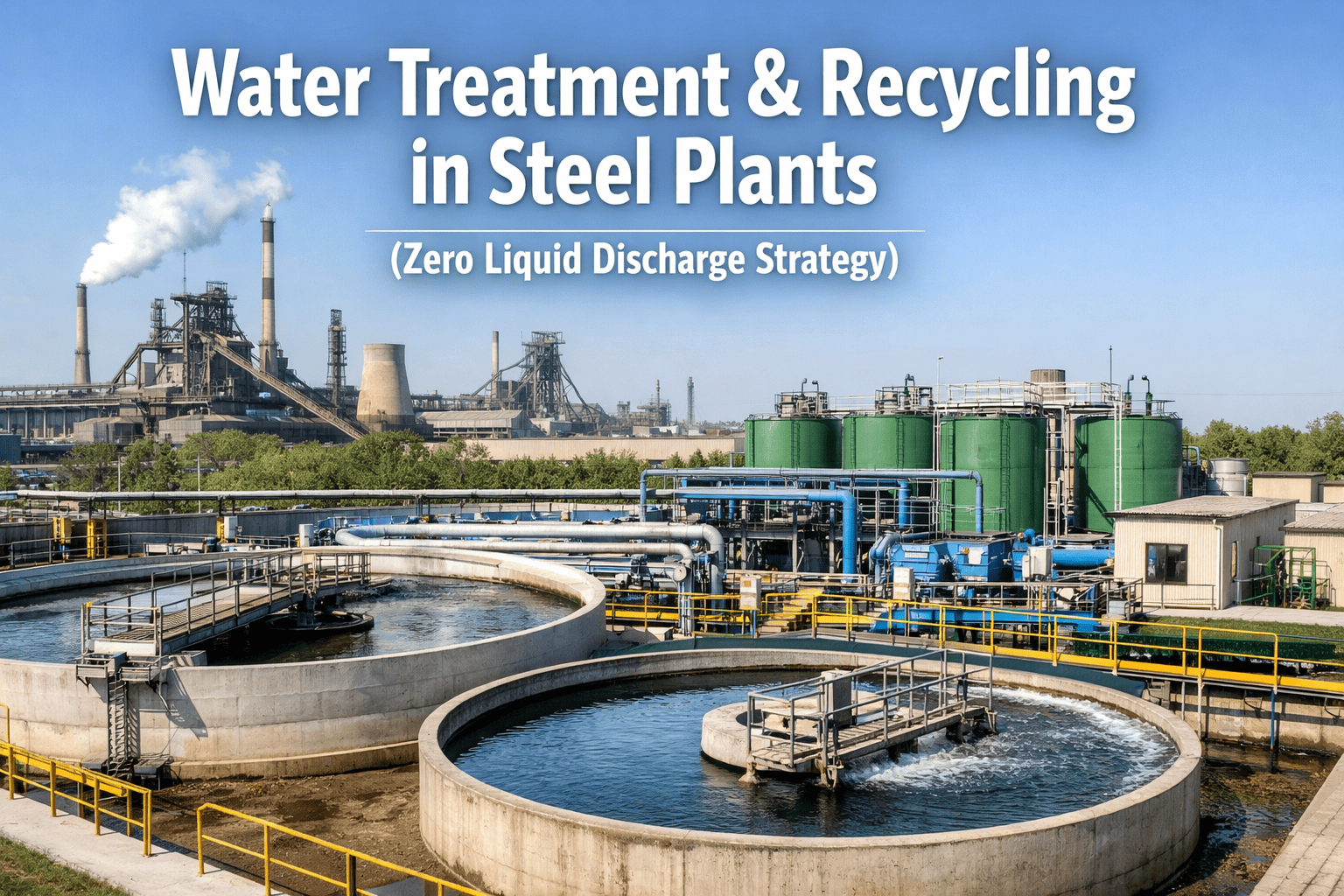
Steel plants are among the most water-intensive industrial operations on earth—a single integrated facility can consume and recycle tens of millions of litres every day across cooling circuits, scrubbing systems, quench processes, and wastewater treatment operations. Water is not a peripheral utility in a steel plant; it is a production-critical resource that flows through every major process from blast furnace gas cleaning to continuous caster spray cooling. When a cooling tower fails, a clarifier chokes, or a scrubber circuit loses flow, the production consequences are immediate and severe. Yet water treatment infrastructure is systematically undermaintained in most steel facilities—treated as a background utility rather than the critical process asset it is. Schedule a free water system maintenance assessment with our team and find out where your facility's water infrastructure is operating outside its design parameters—and what that is costing you in production risk and regulatory exposure.
The Scale and Complexity of Water Systems in Steel Plants
Understanding the maintenance challenge begins with understanding the sheer scale and interdependency of water systems in a steel facility. These are not simple pipe networks—they are integrated treatment and recycling circuits operating under highly variable load, contaminated feed streams, and extreme thermal demands that degrade equipment faster than almost any other industrial water application.
35M
L/day
Typical water throughput in a medium-scale integrated steel plant with full recycling circuits
98%
target
Water recycling rate achievable with properly maintained closed-loop circuits in modern steel plants
$420K
avg cost
Average regulatory fine for exceeding wastewater discharge limits in steel plant effluent events
63%
of faults
Of water system failures in steel plants are preceded by detectable warning signs that proper monitoring would have caught
The Six Major Water Circuit Types in Steel Plants and Their Maintenance Requirements
Each water circuit in a steel plant carries its own contamination profile, operating temperature, flow regime, and equipment set. A maintenance program that applies the same inspection intervals and chemical treatment approach across all circuits will systematically under-protect the high-risk ones and over-maintain the stable ones. These six circuit types must be managed independently.
Blast Furnace Gas Cleaning Circuits
High-contamination closed-loop scrubbing water
Critical
Scrubber water from blast furnace gas cleaning carries suspended coke dust, zinc compounds, alkaline particulates, cyanide traces, and dissolved ammonia at elevated temperatures. Scale forms rapidly in heat exchangers, sedimentation tanks accumulate hazardous sludge, and pumps handling abrasive slurry wear at high rates. Environmental consequence of uncontrolled discharge is severe—cyanide and zinc-bearing water is a regulatory priority contaminant in most jurisdictions.
Direct contact and indirect spray cooling circuits
Critical
Spray cooling water contacts hot steel strands directly in the secondary cooling zone, picking up mill scale, iron oxide fines, and lubricant residues. Nozzle blockage is the dominant failure mode—blocked spray nozzles cause uneven strand cooling, leading to surface cracks, internal segregation, and in severe cases, breakout. Water quality control, nozzle maintenance programs, and strainer management are the three pillars of caster water circuit maintenance.
Nozzle flow rate verification each campaignStrainer backwash dailyHeat exchanger tube inspection quarterlyPump seal condition weekly check
Rolling Mill Scale Pit and Descaling Systems
High-pressure descaling and scale pit water recovery
High
High-pressure descaling circuits deliver water at pressures exceeding 200 bar to remove surface scale from hot-rolled steel before and during rolling passes. Scale pit systems settle and recover the iron oxide fines generated, which have commercial value as iron-rich sludge. Nozzle wear at high pressure is rapid—worn nozzles deliver incorrect spray patterns that leave scale on the steel surface, causing surface defects and roll damage. Scale pit pumps handling abrasive slurry are among the highest-wear items in rolling mill water systems.
Descaling nozzle replacement on tonnage triggerScale pit level and pump condition dailyHeader pressure drop monitoringSump pump impeller inspection monthly
Cooling Tower and Recirculating Cooling Circuits
Open and closed recirculating cooling for process equipment
High
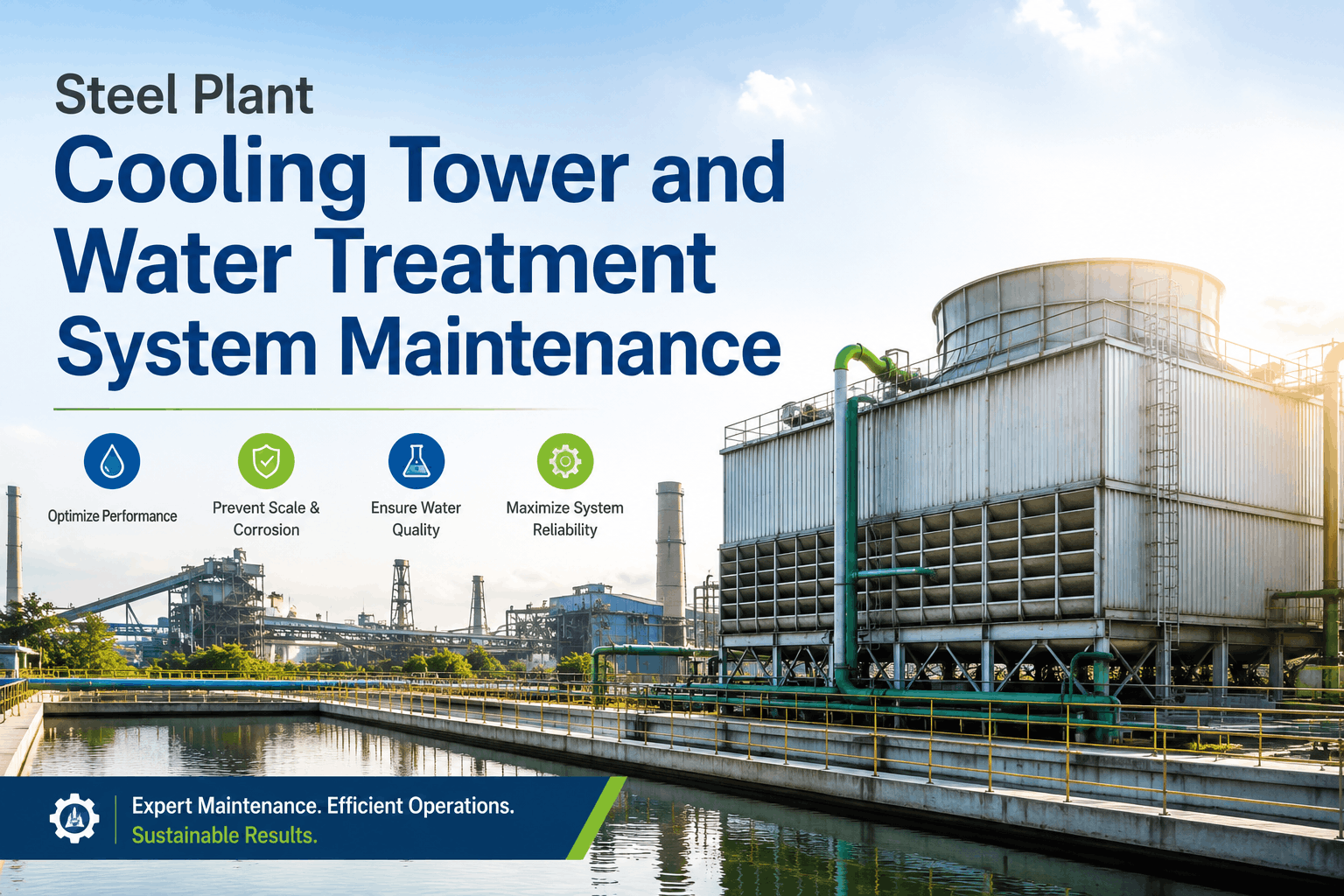
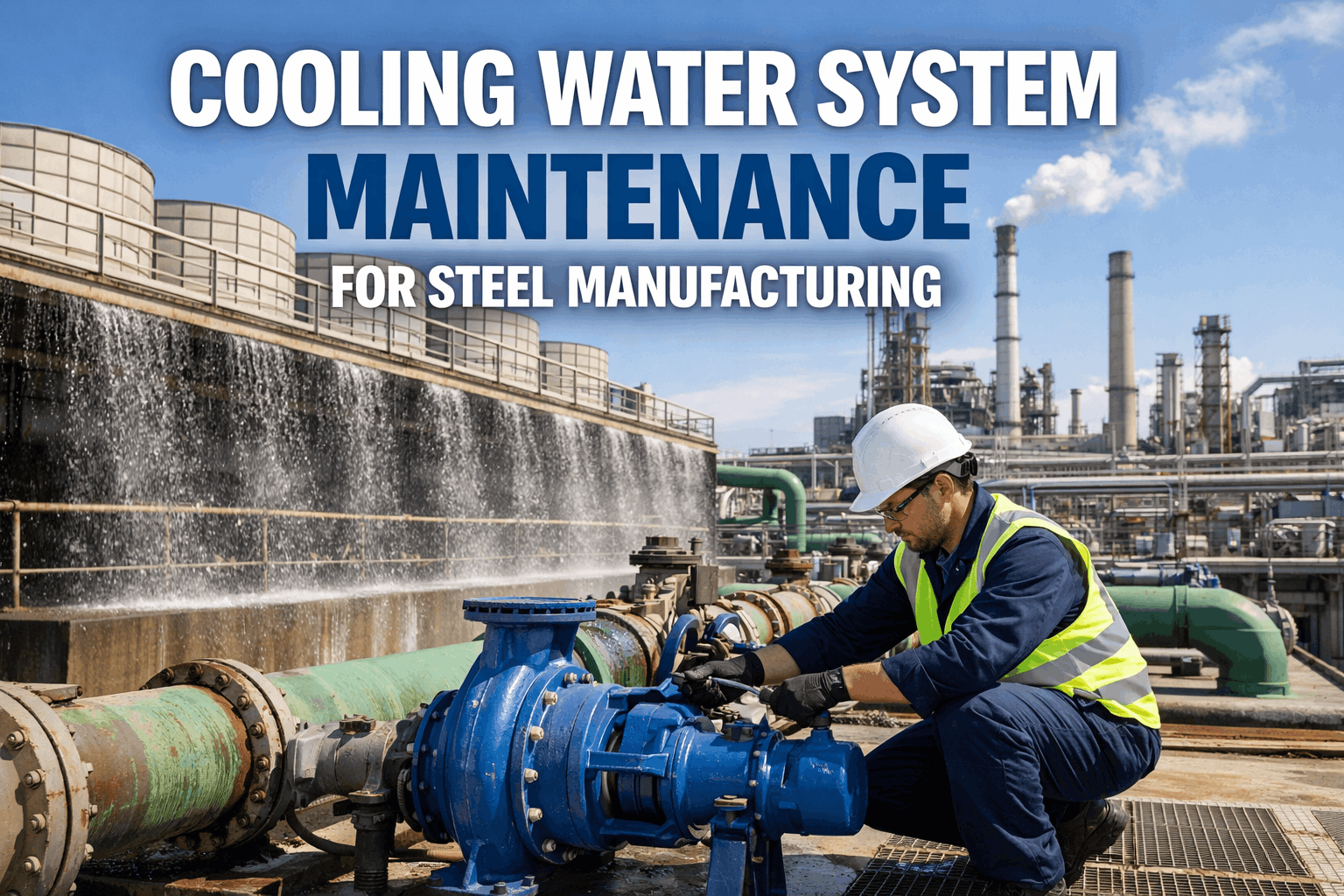
Recirculating cooling towers serve furnace equipment, gas compressors, hydraulic power units, and electrical equipment throughout the plant. The combination of warm temperatures, high mineral concentration from evaporation, and exposure to airborne biological matter creates ideal conditions for scale, corrosion, biological fouling, and Legionella growth simultaneously. Cooling tower chemistry management, basin cleaning, and heat exchanger condition monitoring are interlinked preventive programs that must be executed with strict discipline and documented water quality records.
Key Equipment
Cooling tower fills and drift eliminatorsCooling water pumpsPlate heat exchangersChemical dosing systems
Critical Maintenance Tasks
Daily chemistry monitoring — pH, TDS, biocide levelsBasin inspection and cleaning quarterlyFill pack inspection annuallyLegionella risk assessment every 6 months
Coke Oven and By-Product Plant Water Systems
Flushing liquor, ammonia still, and tar decanter circuits
Critical
Coke oven water systems carry some of the most hazardous process water in any steel plant—flushing liquor contains phenols, cyanide, ammonia, and polyaromatic hydrocarbons. Treatment before discharge requires ammonia stripping, biological oxidation, and tertiary polishing to meet environmental permits. Equipment in contact with this water stream corrodes and scales aggressively, and biological treatment systems are vulnerable to shock loading from process upsets that kill the active biomass essential for treatment performance.
Daily effluent quality analysisBiological system biomass monitoringStill column tray inspection during outagesDecanter interface level control weekly
Final Effluent Treatment and Discharge Systems
End-of-pipe treatment, monitoring, and discharge compliance
High
The final effluent treatment plant combines flows from multiple circuits—including oily water, storm runoff, and process blowdown—and must consistently meet environmental discharge consent conditions across all regulated parameters. Failure of any treatment component upstream of the discharge point creates potential consent exceedance. Continuous effluent quality monitoring, chemical dosing system reliability, and rapid response to upstream process changes are the critical maintenance elements for this final barrier system.
Key Equipment
API oil-water separatorsChemical dosing skidsFinal polishing filtersOnline quality analyzers
Critical Maintenance Tasks
Continuous online analyzer calibrationDosing pump output verification weeklyAPI separator cleaning quarterlyFilter media replacement on performance trigger
Unified Water System Management
Connect every water circuit PM schedule, chemistry log, and compliance record in a single platform.
Oxmaint links water treatment equipment to work orders, tracks chemical dosing compliance, and auto-generates inspection tasks based on operating parameters—so your water systems stay within specification and your environmental permits stay intact.
The Four Highest-Risk Equipment Failures in Steel Plant Water Systems
Not all water system failures carry equal consequence. These four failure modes have the highest combination of incident frequency, production impact, and regulatory exposure in steel plant water infrastructure—and each is preventable with a properly structured maintenance program.
01
Cooling Tower Legionella Outbreak
Cooling towers that are not maintained to Legionella risk assessment standards become aerosolization sources that expose both plant workers and the surrounding community. Regulatory consequence is tower shutdown, full site investigation, and potential prosecution. Water temperature control, biocide programme management, and documented risk assessments are all maintenance-owned functions.
Regulatory + Safety
02
Caster Spray Nozzle Blockage Leading to Breakout
Blocked spray nozzles in the continuous caster secondary cooling zone reduce local heat extraction, causing a hot spot in the solidifying strand shell. If the shell is insufficiently thick at any containment point, the liquid steel core breaks through—a breakout event that causes catastrophic equipment damage, production loss measured in days, and a high risk of serious worker injury from molten steel contact.
Safety + Production
03
EAF or Furnace Water Panel Leak
Water-cooled panels and lances in electric arc furnaces and oxygen converters are under constant thermal and mechanical stress. A leak that allows water to contact molten steel or slag generates explosive steam—one of the most violent failure modes in steelmaking. Water flow and temperature differential monitoring across all panels is a safety-critical maintenance function that must never be degraded by instrument failures or deferred calibration.
Safety Critical
04
Effluent Consent Exceedance from Treatment Failure
When any upstream treatment stage fails—clarifier overflow, dosing pump failure, biological system crash—the consequence arrives at the final discharge point with very little warning and even less reaction time. Facilities that lack automated effluent monitoring and emergency diversion capability have no option but to discharge non-compliant water, triggering regulatory enforcement actions, permit reviews, and potential production restrictions that can last months.
Regulatory + Financial
Predictive Maintenance Approach for Water Treatment Equipment
Water treatment assets in steel plants are ideal candidates for condition-based and predictive maintenance because they generate abundant process data—flow rates, pressures, temperatures, chemical dosing rates, and quality parameters—that collectively reveal asset health long before failure occurs. The challenge is building the monitoring infrastructure and CMMS integration to turn that data into timely maintenance actions.
Pump Condition Monitoring
Vibration analysis, bearing temperature trending, and motor current signature analysis detect impeller wear, cavitation onset, bearing degradation, and seal deterioration in water system pumps. Given the abrasive and corrosive nature of many steel plant water streams, pump wear rates are high and early detection enables planned replacement rather than reactive breakdown.
Monitor
Vibration RMS, bearing temp, motor amps
Heat Exchanger Fouling Detection
Continuous monitoring of temperature differential and pressure drop across heat exchangers detects fouling earlier than any inspection-based approach. Rising differential pressure at constant flow indicates scale or biological fouling building on heat transfer surfaces—the signal for a planned cleaning intervention before performance degrades to the point of production impact.
Monitor
ΔT inlet/outlet, ΔP across bundle
Water Chemistry Trend Analysis
Trending of pH, conductivity, turbidity, suspended solids, and specific contaminant concentrations across each circuit reveals scale index trajectory, corrosion potential, and biological growth risk before these conditions cause equipment damage. Automated dosing systems with feedback control maintain chemistry within specification and generate the compliance records required for environmental audits.
Monitor
pH, conductivity, turbidity, SS, LSI
Clarifier and Thickener Performance
Thickener underflow density trending and rake torque monitoring detect sludge compaction problems and mechanical bearing degradation before the more severe failure mode—rake arm collapse—occurs. Clarifier overflow turbidity trending alerts to floc formation problems that indicate flocculant dosing issues or upstream chemistry changes before they appear in discharge quality records.
Biological oxygen demand removal efficiency and mixed liquor suspended solids concentration in activated sludge systems indicate biomass health and treatment capacity. Declining performance provides weeks of advance warning before a biological system crash—provided the monitoring frequency is sufficient to detect the trend. Continuous monitoring of dissolved oxygen, sludge volume index, and nutrient ratios enables proactive biomass management.
Monitor
DO, MLSS, SVI, BOD removal rate
Effluent Quality Continuous Monitoring
Online analyzers at final discharge points monitoring pH, suspended solids, oil content, and key contaminants in real time provide the final safety net before a consent exceedance reaches the receiving watercourse. Analyzer calibration compliance and response time verification are maintenance-critical functions—an out-of-calibration analyzer at the discharge point provides false confidence and eliminates the early warning system entirely.
Monitor
pH, SS, oil, COD, specific contaminants
Digital Water System Maintenance
Stop managing water chemistry logs and PM records on separate spreadsheets. Connect them all in Oxmaint.
From cooling tower Legionella records to caster nozzle replacement tracking—one platform, complete visibility across all circuits.
Automatic PM triggers from chemistry threshold breaches
Legionella risk assessment records and action tracking
Caster nozzle replacement tracking by position and tonnage
Heat exchanger fouling trend reports and cleaning history
Environmental discharge compliance records and audit exports
Pump vibration and wear history linked to asset records
Water Treatment KPIs Every Steel Plant Environmental and Maintenance Manager Should Track
Measuring water system performance quantitatively allows maintenance and environmental managers to identify deteriorating circuits before they trigger production disruptions or regulatory incidents. These indicators provide the leading signals that paper-based monitoring systems routinely miss until it is too late.
KPI Metric
What It Measures
Target Benchmark
Warning Signal
Effluent Consent Compliance Rate
% of discharge samples meeting all permit parameter limits
100%
Any exceedance triggers immediate treatment plant investigation
Water Recycling Rate
% of total water consumed that is recirculated rather than discharged or extracted
Above 95%
Declining rate indicates increased blowdown or circuit leakage
Heat Exchanger Fouling Factor
Calculated fouling resistance based on ΔT and flow rate vs. clean baseline
Average operating hours between unplanned water circuit pump failures
Trending upward
Declining MTBF signals accelerating wear or chemistry-related damage
Caster Nozzle Availability Rate
% of installed caster spray nozzles meeting design flow rate at each check
Above 98%
Below 95% triggers urgent nozzle replacement to avoid breakout risk
Cooling Tower Chemistry Compliance
% of daily water chemistry readings within specification for all parameters
Above 98%
Persistent excursions indicate dosing system or make-up water quality issues
Common Water System Maintenance Failures in Steel Plants
These failures recur across steel facilities of all sizes and ages. Each is a systemic weakness in program design or execution—not bad luck—and each is preventable with the structured maintenance approach and digital management tools available today.
01
Critical
No Legionella Risk Management Programme for Cooling Towers
Operating cooling towers without a documented, regularly reviewed Legionella risk assessment and control scheme is both a regulatory breach and a serious public health risk. In multiple jurisdictions, operating a cooling tower without a registered water treatment scheme and documented monitoring records is a criminal offence. This failure mode is not a knowledge gap—it is a management and maintenance priority gap that digital permit-to-operate systems close effectively.
The most common justification for delaying nozzle replacement programs is production pressure—the caster is running, and a nozzle replacement requires a short outage. The consequence of deferral is progressive cooling non-uniformity that degrades product quality before it reaches breakout risk—meaning the first visible production impact may come after the safety window has already been exceeded. Nozzle replacement must be scheduled on a tonnage-based trigger, not deferred until a quality complaint forces the issue.
03
High
Chemical Dosing System Failures Undetected for Extended Periods
When a chemical dosing pump fails or a chemical supply runs out, the water chemistry that depends on it drifts out of specification silently—often for days—before a chemistry sampling event detects the change. By then, scale has begun forming, corrosion inhibitor protection has degraded, or biological fouling has established in warm circuits. Dosing pump output verification must be part of daily checks, not monthly maintenance visits.
04
High
Effluent Monitoring Instruments Left Out of Calibration
Online effluent quality analyzers at final discharge points are only useful if they are calibrated and functioning correctly. An out-of-calibration pH meter or turbidity sensor that reads within specification while the actual effluent is in exceedance provides false assurance and eliminates the plant's only real-time warning system. Analyzer calibration must be on a strict, documented schedule with results verified against grab sample analysis at each calibration event.
05
High
No Emergency Diversion Capability for Treatment Upsets
A water treatment plant with no emergency holding or diversion capacity has only one option when treatment performance drops below discharge standards—continue discharging non-compliant water or stop the process that generates the water. Neither is acceptable. Emergency retention capacity, diversion valves to holding ponds, and clear emergency response procedures for treatment plant upsets must be designed into the facility and regularly tested as part of the maintenance program.
06
Medium
Water System Assets Excluded from CMMS Asset Register
Water treatment assets—pumps, dosing systems, analyzers, clarifiers—are frequently maintained informally or managed by a water treatment contractor with no integration into the main CMMS. This creates complete invisibility of water system maintenance history, spare parts consumption, and failure patterns for operations and maintenance management. These assets must be in the CMMS, with linked work orders, PM schedules, and failure records like any other production-critical equipment.
Frequently Asked Questions
FAQ
What are the most important water treatment regulations that steel plants must comply with?
Steel plants are subject to multiple overlapping water-related regulatory frameworks. Industrial wastewater discharge limits are set by national environmental agencies and local permitting authorities under frameworks including the EU Industrial Emissions Directive, US Clean Water Act NPDES permit requirements, and equivalent national legislation in other jurisdictions. These permits specify maximum allowable concentrations for suspended solids, pH, heavy metals (zinc, lead, cadmium), oil and grease, phenols, cyanide, and ammonia-nitrogen in final discharge. In addition, cooling towers fall under Legionella control legislation in most developed markets, requiring documented risk assessments, registered water treatment schemes, and regular monitoring records. Non-compliance consequences include significant financial penalties, facility improvement notices, and in cases of severe or repeated breaches, prosecution of responsible individuals and enforced production restrictions.
FAQ
How often should cooling tower water chemistry be tested in a steel plant environment?
Steel plant cooling towers should be monitored daily for the core chemistry parameters—pH, conductivity, total dissolved solids, and biocide residual—due to the high evaporation rates, variable process heat loads, and risk of contamination from process upsets. Weekly analysis should include hardness, alkalinity, corrosion inhibitor concentration, and microbiological dip slide testing. Monthly comprehensive analysis covering all Legionella risk indicators, corrosion coupon assessment, and deposit analysis should be conducted by a specialist water treatment chemist. Legionella culture sampling frequency depends on the risk assessment outcome but should be at minimum quarterly, with more frequent testing during summer months, after system shutdowns and restarts, or following any process changes that affect water temperature or chemistry. All results must be documented with dated records and deviation actions recorded in the maintenance management system.
FAQ
How does a CMMS improve water treatment maintenance management in steel plants?
A CMMS transforms water treatment maintenance from a calendar-driven paper exercise into a data-driven, integrated program in three specific ways. First, it gives water treatment assets equal status to production equipment—with dedicated asset records, full maintenance history, linked work orders, and spare parts tracking—eliminating the common situation where water assets are invisible to operations management. Second, it enables condition-based maintenance triggers—connecting online monitoring data for chemistry, flow, pressure, and temperature to automatic work order generation when parameters breach predefined thresholds, ensuring that treatment responses happen within hours of a chemistry deviation rather than days. Third, it provides the compliance documentation infrastructure that regulators and auditors require—timestamped chemistry records, maintenance action logs, certification expiry tracking for instruments, and permit condition compliance reports that can be generated in minutes rather than assembled manually over days.
FAQ
What spare parts should be held in stock for water treatment systems?
Critical spare parts for steel plant water treatment systems should be held based on three criteria: replacement frequency, lead time, and consequence of stockout. For pumps—which are the most frequently failing component class in water circuits—impeller and seal kits for every pump model in each circuit should be held on-site, with a complete spare pump assembly for the most critical circuit duties such as caster cooling pumps and final effluent transfer pumps. For chemical dosing systems, diaphragm and valve ball kits for all dosing pump models are essential given that dosing pump failure causes chemistry drift with no visible warning. For online analyzers, electrode assemblies and calibration standards for all critical instruments at final discharge points should be held to ensure rapid recommissioning after sensor failure. Cooling tower components—fill pack sections, drift eliminator panels, and fan gear oil—should be held at sufficient volume to address the highest-frequency maintenance items without waiting for procurement.
Start Managing Water Systems Properly
Every Water Circuit in Your Steel Plant Is a Production Asset. Maintain It Like One.
Oxmaint gives your maintenance and environmental teams a unified platform to track every pump, every chemistry record, every compliance log, and every PM across all your water treatment circuits—with the digital infrastructure to prevent the incidents that paper-based programs miss entirely.