A 3mm bolt hits your conveyor at 2:47 PM. By 3:12 PM, it's lodged in a $280,000 rolling mill bearing. The mill stops. Emergency repairs: 14 hours, $47,000. Lost production: $185,000. Total damage from one tiny metal fragment: $232,000. This happens in steel plants worldwide—but it's entirely preventable. Foreign object detection systems catch contaminants before they reach critical equipment, stopping quarter-million-dollar disasters before they start.
Where Foreign Objects Strike in Steel Production
Critical damage zones across your production line
Rolling Mills
Critical Risk
$185K-$350K per incident
Metal fragments damage precision rollers, halting production for 8-16 hours
Furnaces
High Risk
$95K-$220K per incident
Foreign objects cause refractory damage and contaminate molten steel
Conveyors
High Risk
$45K-$125K per incident
Belt tears, pulley damage, and downstream equipment contamination
Cutting Systems
Medium Risk
$30K-$85K per incident
Blade damage, alignment issues, and precision loss from debris
Quality Systems
Medium Risk
$15K-$60K per incident
Product contamination leading to batch rejections and recalls
Storage Areas
Lower Risk
$5K-$25K per incident
Surface contamination and handling equipment damage
$125K
Average cost per hour of unplanned downtime in steel plants
14hrs
Average emergency repair time for equipment damage from foreign objects
82%
Of steel plants experienced unplanned downtime from debris in past 3 years
The Economics of Foreign Object Damage
Fortune Global 500 companies lose $1.4 trillion annually to unplanned downtime—11% of total revenues. For steel producers, foreign object damage is a top-three cause. A single metal fragment doesn't just damage one component—it triggers cascading costs. Emergency repairs cost 3-5x more than planned maintenance, expedited parts carry premium shipping charges, and customer relationships strain under delayed deliveries. The average steel plant experiencing 2-3 major incidents yearly spends $400,000-$900,000 on preventable damage. Plants ready to stop this bleeding can schedule a 30-minute assessment to identify their highest-risk zones and calculate potential savings.
The True Cost of a Foreign Object Incident
How a single metal fragment multiplies into massive losses
1
Immediate Impact
$3,500 - $8,000
Equipment damage to rollers or bearings
Emergency shutdown procedures
Initial diagnostic assessment
→
2
Production Loss
$125K - $260K
8-16 hours of downtime at $125K/hour average
Idle workforce costs continue
Lost production capacity
→
3
Repair Costs
$35K - $75K
Emergency parts at 200-300% markup
Expedited shipping charges
Overtime labor for technicians
→
4
Downstream Impact
$40K - $90K
Delayed delivery penalties
Expedited shipping to customers
Customer relationship damage
Total Single-Incident Cost
$200,000 - $430,000
From one undetected foreign object • Prevention cost: $15K-$50K annually for detection systems
Advanced detection systems cost $15,000-$50,000 annually—a fraction of one major incident. Steel plants ready to implement detection strategies can start a free trial to see how automated monitoring prevents catastrophic failures.
Detection Technologies: Catching Objects Before Damage
Modern detection combines multiple technologies for comprehensive coverage. Metal detectors catch ferrous and non-ferrous metals, X-ray systems detect dense materials, computer vision AI spots visual anomalies, and electromagnetic sensors monitor high-temperature zones. The most effective plants deploy integrated systems—not just one technology, but the right combination for their processes.
Foreign Object Detection Technologies
Capabilities, limitations, and optimal applications
Technology
What It Detects
Min. Size
Line Speed
Cost Range
Best For
Metal Detectors
Ferrous, non-ferrous, stainless steel
0.3-2mm
High
$5K-$20K
Raw material inspection, conveyor monitoring
X-Ray Systems
Metal, glass, stone, dense plastics
0.8-1mm
Medium
$35K-$100K
Final product inspection, packaged goods
Computer Vision AI
Surface defects, visible debris, anomalies
2-5mm
Very High
$25K-$75K
Surface quality, real-time monitoring
Electromagnetic Sensors
Conductive materials only
1-3mm
High
$8K-$30K
High-temperature zones, harsh environments
Laser Scanning
Dimensional variations, protrusions
0.5-1mm
Medium
$40K-$90K
Precision cutting areas, dimensional QC
Swipe to compare all detection technologies
Computer Vision AI: Real-Time Detection
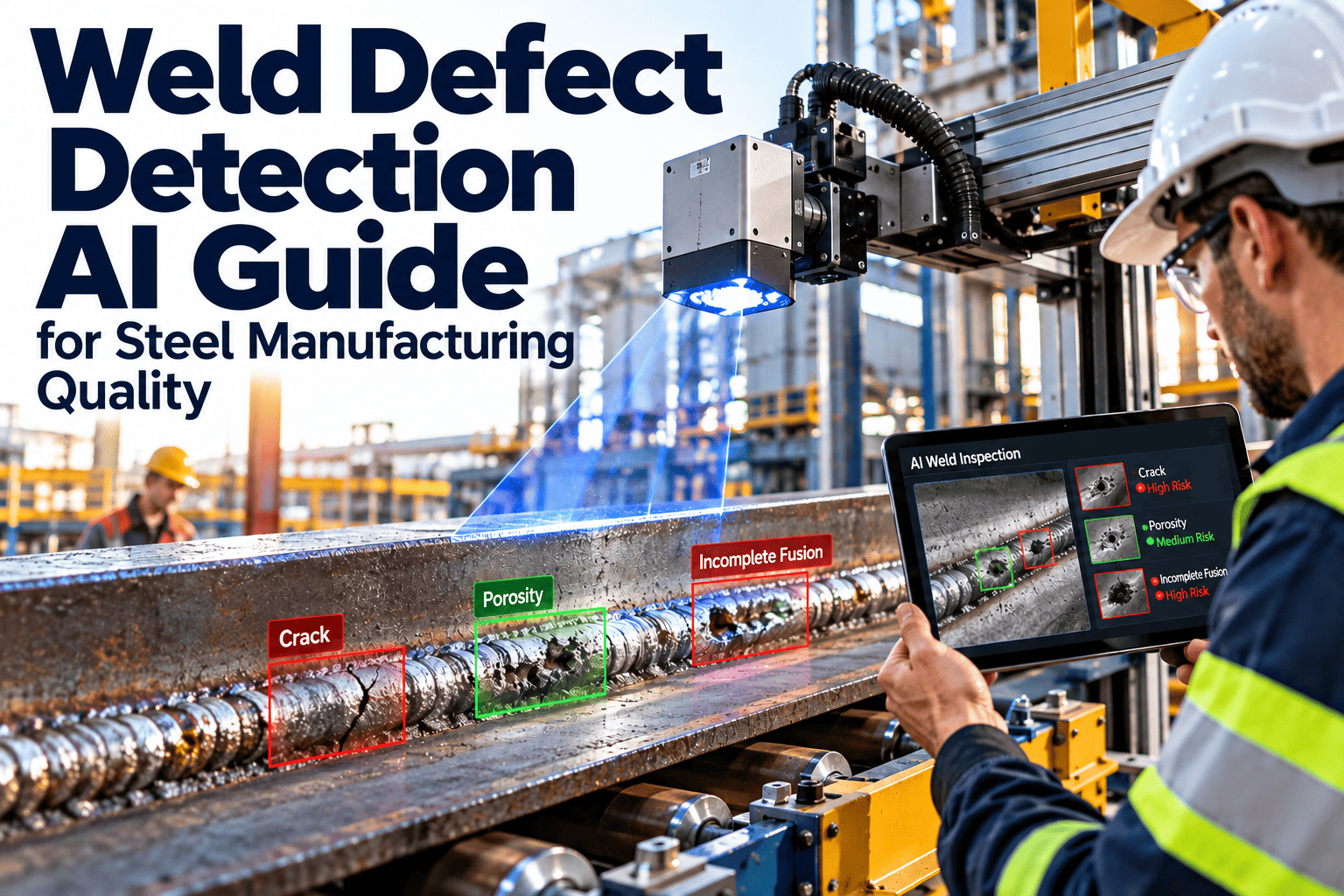
Computer vision systems analyze video streams in real-time, detecting foreign objects, safety violations, and equipment anomalies traditional sensors miss. Unlike metal detectors limited to specific materials, AI recognizes any visual anomaly—misplaced tools, debris, damage, or workers in restricted zones. These systems process thousands of frames per second across multiple cameras continuously, becoming more accurate over time. Plants implementing computer vision report 30-50% reduction in safety incidents and equipment damage. See how AI-powered detection works in actual steel plant environments—start your free trial today with instant access to live monitoring dashboards.
How Computer Vision AI Works in Steel Plants
High-Speed Cameras
Capture 60-120 FPS across critical zones
→
AI Analysis
Neural networks identify anomalies
→
Alert Triggered
Real-time notification to operators
→
Automated Response
CMMS work order generated
Detects in Real-Time:
✓ Metal fragments on conveyors
✓ Tools left in work zones
✓ Debris accumulation
✓ Equipment structural damage
✓ Unsafe worker positioning
✓ Product surface defects
Performance Metrics:
Detection Accuracy:96-99%
Response Time:<2 seconds
False Positive Rate:<3%
Coverage:24/7 continuous
See Foreign Object Detection in Action
Watch how AI-powered detection systems integrate with your CMMS to prevent equipment damage automatically. Our 30-minute demo shows real steel plant deployments and ROI calculations.
Detection systems deliver maximum value when integrated with your CMMS. When a sensor detects debris, it automatically generates a work order, assigns the technician, includes photos and location data, triggers shutdown protocols if needed, and logs incidents for trend analysis. This transforms reactive scrambling into proactive prevention. Facilities using integrated detection and CMMS platforms report 65% faster response times and 40% fewer repeat incidents.
Sensor-to-Action Workflow
Complete automation from detection through resolution
1
Object Detected
0:00
Sensor identifies foreign material
2
System Alert
0:02
Multi-channel notification sent
3
Risk Assessment
0:05
AI evaluates severity level
4
Equipment Response
0:10
Automated shutdown if critical
5
Work Order Created
0:15
CMMS generates task with details
6
Tech Assigned
0:20
Mobile notification with location
7
Issue Resolved
3-8min
Object removed, production resumes
8
System Learning
Ongoing
Data logged for trend analysis
ROI Analysis: What Steel Plants Save
A comprehensive detection system costing $75,000-$100,000 to install with $25,000 annual operating costs pays for itself after preventing just one major incident. Steel plants experiencing 2-3 incidents annually see 400-600% first-year ROI. Additional benefits include 15-20% insurance premium reductions, 30-40% decrease in emergency maintenance costs, and 8-12% improvement in equipment effectiveness.
Foreign Object Detection ROI Calculator
Based on industry averages for mid-size steel production facilities
Annual Costs Without Detection
Emergency Repairs (2.5 incidents/year avg)
$175,000
Production Downtime (35 hours/year avg)
$312,500
Expedited Parts & Shipping
$85,000
Customer Penalties & Relationship Costs
$95,000
Total Annual Impact:
$667,500
Detection System Investment
System Installation (one-time)
$75,000
Annual Operating Costs
$25,000
CMMS Integration & Training
$12,000
Year 1 Total Investment:
$112,000
Annual Savings & Benefits
Prevented Emergency Repairs (85% reduction)
+$148,750
Eliminated Downtime (30 hours saved)
+$267,500
Reduced Expedited Shipping
+$72,000
Avoided Customer Penalties
+$80,000
Insurance Premium Reduction
+$18,000
Total Annual Savings:
$586,250
Net Year 1 Benefit
$474,250
ROI Percentage
423%
Payback Period
2.3 months
Plants achieving highest returns deploy detection at critical choke points first, integrate alerts into mobile devices for minute-level response, use detection data to identify root causes, and measure success in overall equipment effectiveness improvements. Want to see your specific numbers? Sign up for a free account to access our ROI calculator with your facility's actual incident data, or schedule a consultation for a detailed financial analysis.
Implementation Strategy: Getting Started
Successful deployment follows a phased approach. Map your production flow to identify single-point-of-failure equipment where foreign objects cause maximum damage—typically rolling mills, cutting systems, and furnace feeds. Install detection at these critical points first, validate performance over 30-60 days, then expand to secondary zones. Modern systems can be operational within 2-4 weeks.
90-Day Implementation Roadmap
Weeks 1-2
Assessment & Planning
✓ Production flow analysis
✓ Critical zone identification
✓ Technology selection
✓ Team training schedule
Weeks 3-5
Pilot Installation
✓ Install 2-3 detection points
✓ CMMS integration setup
✓ Alert configuration
✓ Initial team training
Weeks 6-9
Validation & Tuning
✓ False positive optimization
✓ Response protocol refinement
✓ Performance data collection
✓ ROI measurement baseline
Weeks 10-12
Expansion & Scaling
✓ Additional zone coverage
✓ Advanced AI features enabled
✓ Trend analysis dashboards
✓ Continuous improvement loop
The technology deployment is straightforward—most challenges arise from process integration. Teams need clear alert response protocols, maintenance staff require workflow training, and management needs dashboards translating detection data into actionable insights. Successful plants treat implementation as a process change supported by technology, not just hardware installation. For guidance on deploying systems that integrate with existing operations, explore platform capabilities designed for heavy industrial environments.
Protect Your Equipment Before the Next Foreign Object Strikes
Join steel plants using OXmaint to prevent equipment damage through integrated detection and automated maintenance workflows. See real deployment examples and calculate your specific ROI.
How small a foreign object can detection systems identify in steel production?
Detection capabilities vary by technology. Metal detectors identify ferrous fragments as small as 0.3mm and stainless steel around 2mm. X-ray systems detect dense materials down to 0.8-1mm regardless of composition. Computer vision AI catches visible objects 2-5mm or larger. Practical limits depend on line speed, product interference, and environmental factors. Most steel plants deploy multiple complementary technologies for comprehensive coverage across contaminant types and sizes.
What's the typical ROI timeline for foreign object detection systems?
Most steel plants achieve positive ROI within 2-6 months, often from preventing a single major incident. A $75,000-$100,000 system prevents equipment damage averaging $200,000-$430,000 per incident including downtime and repairs. Plants with 2-3 annual incidents typically see 400-600% first-year ROI. Long-term benefits include 15-20% lower insurance premiums, 30-40% reduced emergency maintenance costs, and 8-12% improved equipment effectiveness.
Can detection systems operate in high-temperature steel production zones?
Yes, with proper technology selection. Standard systems struggle above 150°F, but specialized electromagnetic sensors rated for 400-600°F monitor furnace feeds and hot rolling areas. Computer vision systems with thermal-resistant housings operate near heat sources using infrared imaging. Many plants use zoned approaches: high-temperature sensors near furnaces, standard detectors in cooler areas, creating layered protection across production flow.
How do detection systems integrate with existing CMMS platforms?
Modern systems connect through standard protocols (MQTT, OPC UA, REST APIs, Modbus TCP/IP). When foreign objects are detected, systems automatically create CMMS work orders with alert details, images, location data, and response actions. Bi-directional integration allows CMMS to acknowledge alerts and update status. Advanced implementations include automated equipment shutdown through SCADA, mobile notifications to technicians, and trend analysis identifying recurring contamination sources.
What maintenance do detection systems require?
Systems need minimal maintenance. Metal detectors require monthly sensitivity testing, quarterly cleaning, and annual third-party validation. X-ray systems need tube replacement every 5,000-10,000 hours (2-4 years) and periodic calibration. Vision cameras need lens cleaning every 2-4 weeks, with AI models automatically improving. Most systems include self-diagnostics alerting to degraded performance before detection capability is compromised, allowing scheduled maintenance during planned downtime.