Quality failures in steel manufacturing don't just create scrap — they create liability. A single batch of off-spec steel reaching a customer can trigger product recalls costing $500K-$5M, contract penalties of 2-10% of order value, and reputation damage that takes years to rebuild. For steel plants serving automotive, construction, energy, or defense markets, quality isn't a department — it's a survival requirement. ISO 9001 certification is the minimum baseline, and customers increasingly demand IATF 16949 (automotive), API (oil & gas), or EN 10204 (European structural) compliance on top of it.
Yet most steel plants still manage quality with a patchwork of paper inspection forms, disconnected lab systems, Excel-based tracking, and tribal knowledge. Non-conformances get logged in one system, corrective actions in another, and audit findings in a filing cabinet. The result: quality escapes, repeated defects, failed audits, and the constant anxiety of not knowing what you don't know. Oxmaint's quality management system integrates quality directly into maintenance and operations — because 60-70% of steel quality defects originate from equipment condition, not operator error. When your CMMS and QMS speak the same language, defect root causes become visible, corrective actions stick, and ISO compliance becomes a byproduct of how you work, not an extra burden.
The ISO 9001 Compliance Gap in Steel Plants
ISO 9001:2015 requires documented processes, measurable quality objectives, root cause analysis, corrective action tracking, and continuous improvement evidence. Here's where most steel plants fall short — and how integrated quality-maintenance management closes each gap:
Steel-Specific Quality Defects: Where Equipment Meets Quality
The connection between maintenance and quality in steel is direct and measurable. Here are the most common quality defects in steel production, their equipment root causes, and how Oxmaint's integrated approach prevents them:
Surface Defects
Dimensional Deviations
Mechanical Property Failures
Internal Defects
Stop Treating Quality and Maintenance as Separate Functions
60-70% of steel quality defects originate from equipment condition. Oxmaint connects quality events to equipment data, making root causes visible and corrective actions permanent.
The Integrated Quality-Maintenance Workflow
Here's how Oxmaint creates a closed-loop system where every quality event drives a maintenance investigation, and every maintenance action feeds back into quality improvement:
Detect
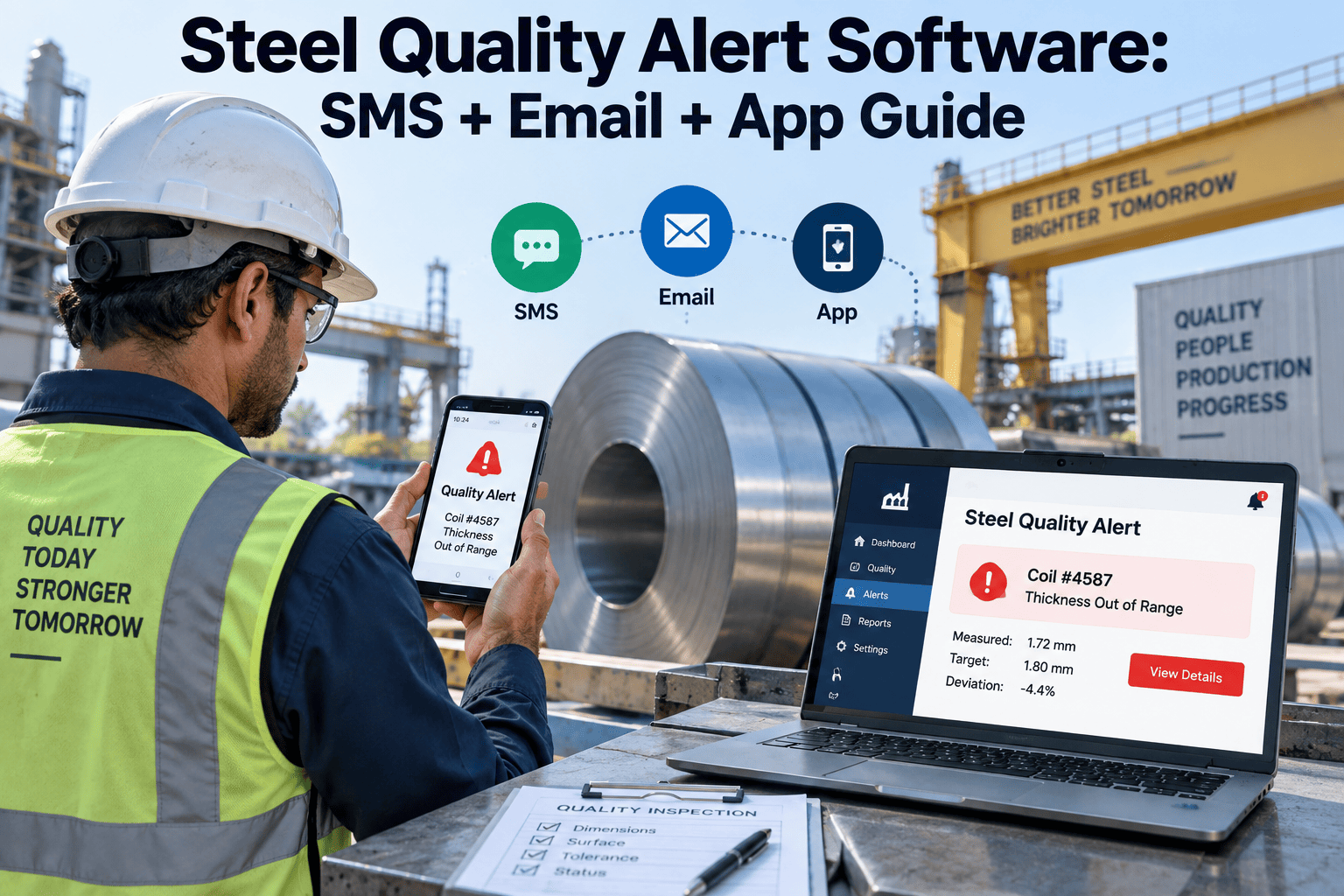
Quality event captured: inspection failure, lab result out-of-spec, customer complaint, or SPC alarm. The event is logged with product details, defect type, severity, and quantity affected.
Contain
Immediate containment actions: quarantine affected material, notify downstream processes, halt production if critical. Containment is documented with timestamps and responsible parties.
Investigate
Oxmaint automatically pulls equipment condition data at the time of the defect: recent maintenance history, condition monitoring readings, calibration status, and process parameter logs. Root cause analysis connects the defect to specific equipment conditions.
Correct
Corrective actions generated as maintenance work orders: repair the equipment, adjust PM schedules, update calibration intervals, or modify operating procedures. Each action has an owner, deadline, and completion criteria.
Verify
Effectiveness verification: monitor the specific quality metric for 30-90 days post-correction. If the defect recurs, the CAPA is automatically reopened with escalation. If it doesn't, the corrective action is validated and the PM change is made permanent.
Quality KPIs That Oxmaint Tracks for Steel Plants
These metrics provide real-time visibility into quality performance and ISO 9001 compliance status. All are available on Oxmaint's quality dashboards with drill-down to individual events:
Internal Reject Rate
Tonnes rejected / total tonnes produced. Tracked by product type, production line, defect category, and shift. Trigger: investigate any month above 2%.
Customer Complaint Rate
Claims received per 1,000 tonnes shipped. Each claim is tracked from receipt to resolution with root cause, corrective action, and 8D report generation.
CAPA On-Time Closure
Percentage of corrective actions closed by their due date. Below 85% signals systemic follow-through problems that auditors will flag as a major finding.
Calibration Compliance
Percentage of quality-critical instruments calibrated on schedule. A single overdue calibration on a gauge or pyrometer can invalidate an entire production batch.
Audit Finding Closure
Open findings from internal and external audits with aging. Zero overdue findings at time of surveillance audit is the standard for maintaining certification.
First Pass Yield
Percentage of production meeting all quality requirements without rework or downgrading. The single most important metric for operational quality. Best-in-class steel plants achieve 96-99%.
Implementation: Achieve ISO-Ready in 90 Days
Oxmaint's quality management implementation follows a 90-day fast-track program designed for steel plants preparing for ISO 9001 certification or strengthening an existing QMS:
Foundation: Digital Quality Infrastructure
Integration: Connect Quality to Maintenance
Compliance: Audit-Ready Verification
Quality Is a Maintenance Problem. Treat It Like One.
Oxmaint is the only CMMS that integrates quality management directly into maintenance operations — because that's where steel quality defects actually originate. Achieve ISO 9001 compliance while cutting defects by 40-65%.
Frequently Asked Questions
Can Oxmaint replace our existing standalone QMS?
Yes, for quality functions that interface with maintenance and operations. Oxmaint handles NCR management, CAPA tracking, calibration management, inspection checklists, audit management, and quality KPI reporting. For steel plants, this covers 80-90% of QMS requirements because the majority of quality events are equipment-related. Oxmaint also integrates with existing lab information management systems (LIMS) for chemical and mechanical test results, so you don't lose specialized lab functionality.
How does Oxmaint help during external ISO audits?
Oxmaint generates all the documentation auditors look for: complete NCR histories with root cause analysis, CAPA records with effectiveness verification, calibration compliance reports, internal audit histories with finding closure evidence, management review data packages, and trend analysis showing continuous improvement. Auditors can be given read-only access to verify records directly in the system rather than reviewing paper files. Steel plants using Oxmaint report 50-70% less time preparing for audits and zero major findings related to documentation gaps.
Does this support IATF 16949 for automotive steel?
Oxmaint supports the key IATF 16949 requirements that go beyond ISO 9001: FMEA integration (linking equipment failure modes to quality risk), SPC monitoring with control chart triggers for maintenance action, control plan management tied to equipment-specific inspection points, and 8D problem solving workflow for customer complaints. For steel suppliers to automotive OEMs, this IATF layer is essential for maintaining approved supplier status.
How quickly does quality improve after implementation?
Most steel plants see measurable quality improvement within 60-90 days of full implementation. The first gains come from calibration compliance (eliminating measurement-related defects) and linking known quality issues to equipment PM schedules. Within 6-12 months, the maintenance-quality correlation database is mature enough to enable predictive quality: flagging equipment conditions that are likely to cause defects before they actually do. Typical results: 40-65% reduction in internal reject rate, 50-75% reduction in customer complaints, and 30-50% reduction in cost of quality.
Can we generate EN 10204 inspection certificates from Oxmaint?
Yes. Oxmaint generates EN 10204 Type 3.1 and 3.2 inspection certificates by pulling chemical analysis, mechanical test results, and dimensional inspection data from integrated lab and measurement systems. Certificates are linked to specific heat numbers, production orders, and equipment records, creating complete traceability from raw material to shipped product. Digital certificates can be emailed directly to customers or accessed via a customer portal, eliminating manual certificate preparation that typically takes 30-60 minutes per order.