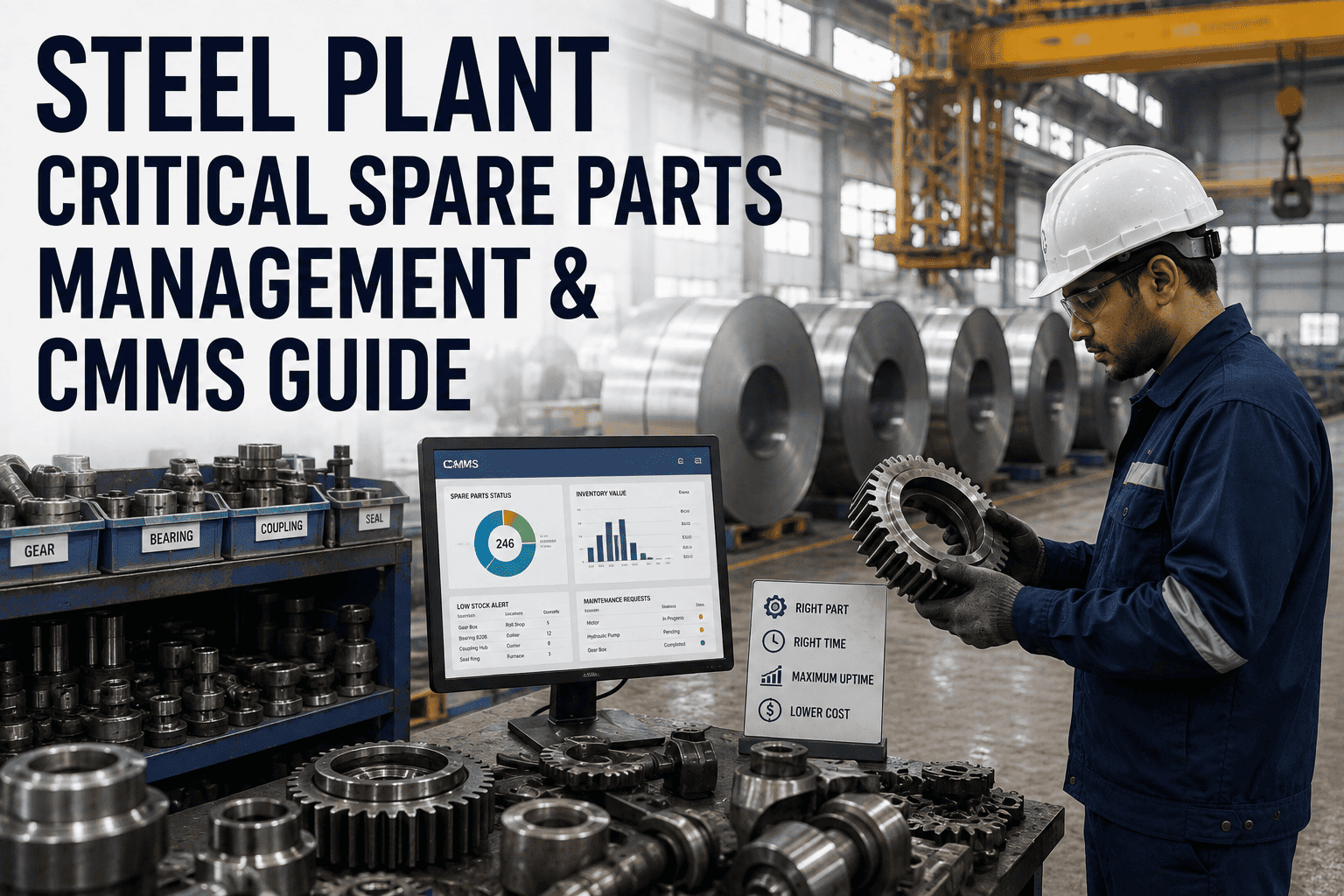
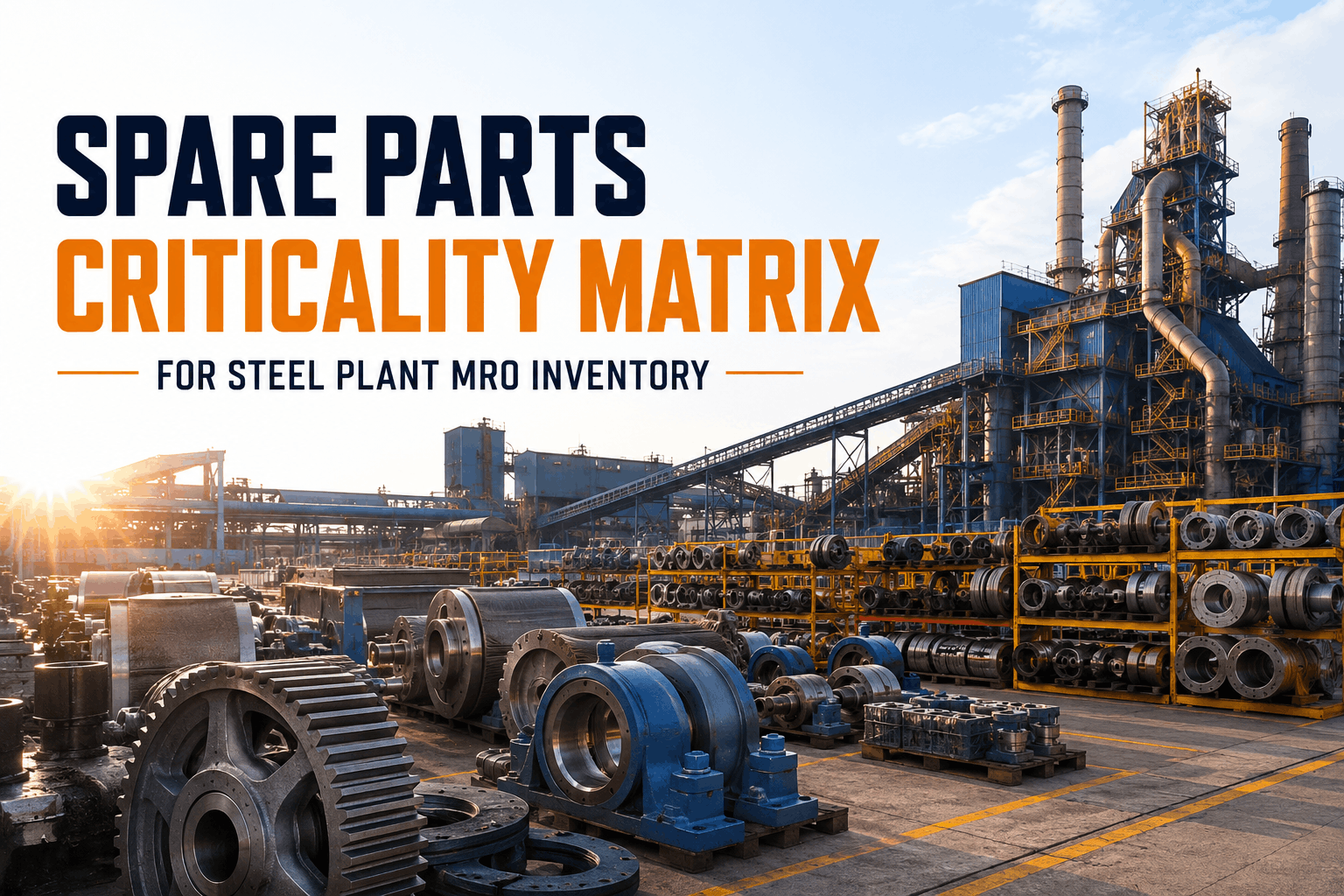
When a critical spare part isn't available, a steel plant doesn't slow down — it stops. A $400 hydraulic valve that's out of stock shuts down a BOF converter worth $150,000 per hour in lost production. A $2,500 gearbox bearing with a 16-week lead time idles a continuous caster for 3 days while the maintenance team scrambles to find one — costing $3.6M in lost output while the part itself would have cost $2,500 if it had been on the shelf. A $12,000 VFD for a rolling mill drive motor that used to arrive in 4 weeks now takes 14 weeks because the semiconductor components inside it are backordered globally — and the mill can't roll a single ton until it's replaced. These aren't hypothetical scenarios. They are happening right now at steel plants worldwide, and they've been accelerating since 2020. Global supply chain disruptions — semiconductor shortages, raw material constraints, shipping delays, geopolitical trade restrictions, supplier consolidation, and pandemic aftershocks — have fundamentally changed the risk profile of steel plant maintenance. Lead times that were 4–6 weeks are now 12–24 weeks. Parts that were commodity items available from multiple distributors are now allocation-controlled with uncertain delivery dates. Suppliers that guaranteed next-day delivery on critical spares now quote "best effort" timelines. The maintenance strategies that worked when parts were readily available — keeping minimal inventory, ordering when needed, relying on supplier relationships for emergency expedites — are now strategies that produce extended unplanned outages, emergency air freight bills, and production losses measured in millions. The plants that are weathering this disruption successfully are the ones that saw it coming and built resilience into their maintenance supply chain: strategic inventory buffers sized by criticality analysis, multi-source procurement for single-point-of-failure parts, CMMS-driven demand forecasting that orders parts months before they're needed, and equipment standardization that reduces the number of unique spare parts the plant depends on.
SUPPLY CHAIN REALITY CHECK
The Part Is on Backorder. The Plant Is Down. The Clock Is Running.
Hour 1–4: Emergency sourcing begins
Day 1–3: Production rescheduled around outage
Week 1–4: Customer orders delayed, penalty clauses trigger
Month 1–3: Contract renegotiations, lost market share
$150K–$500K
Per hour of unplanned downtime at a typical integrated mill
2–4× longer
Average lead times vs. pre-2020 for critical steel plant components
35–60%
Of unplanned outage hours now attributable to parts unavailability
The Disruption Map: What's Broken and Why It's Not Getting Fixed Soon
Supply chain disruption in steel plant maintenance isn't one problem — it's a convergence of multiple disruptions hitting simultaneously across different part categories. Understanding which categories are affected and why is the first step toward building a resilient maintenance supply chain.
VFDs, PLCs, HMIs, servo drives, power supplies, communication modules, I/O cards
Lead time shift: 4–8 weeks → 16–52+ weeks
Root cause: Global semiconductor shortage, automotive sector demand priority, chip fab capacity concentrated in few regions, geopolitical tensions affecting Taiwan/China supply
Steel plant impact: A single failed PLC I/O card can shut down an entire process area. VFD failures idle rolling mill drives, caster withdrawal rolls, and crane hoists. Obsolete control systems with no-longer-manufactured components create "ticking time bomb" vulnerabilities — when it fails, there is no replacement available at any price.
Large bore bearings (>200mm), specialty roller bearings, precision spindle bearings, custom seal assemblies
Lead time shift: 6–12 weeks → 20–40 weeks
Root cause: Specialty steel supply constraints for bearing races, supplier consolidation reducing manufacturing capacity, demand surge from mining/energy sectors competing for same components
Steel plant impact: Rolling mill main drive bearings, caster segment roll bearings, crane hoist drum bearings — all unique specifications with few substitution options. A single bearing failure can idle a rolling mill for weeks waiting for the replacement to arrive.
Servo valves, proportional valves, hydraulic cylinders, pump assemblies, accumulators, specialty seals
Lead time shift: 4–8 weeks → 12–28 weeks
Root cause: Precision machining capacity constraints, electronic control component shortages (smart valves), specialty alloy availability for high-pressure components
Steel plant impact: Hydraulic AGC systems on rolling mills, BOF tilting drives, caster mold oscillation, ladle turret positioning — all depend on specific hydraulic components. Servo valve failures on AGC systems produce immediate strip quality defects. Proportional valve failures on BOF tilting create safety-critical situations.
High-voltage motors (>500HP), specialty DC motors, furnace transformers, large power transformers, custom-wound motors
Lead time shift: 12–20 weeks → 30–60+ weeks
Root cause: Copper price volatility affecting transformer and motor winding costs, electrical steel supply constraints for laminations, skilled labor shortage for large motor/transformer manufacturing
Steel plant impact: Main rolling mill drive motors, EAF furnace transformers, and large blower motors are essentially custom manufactured. Lead times exceeding 12 months mean a failure today requires a replacement that should have been ordered last year. Plants without spare motors for critical drives face catastrophic production exposure.
MgO-C bricks, alumina-graphite components, SENs, slide gate plates, specialty castables, high-purity raw materials
Lead time shift: 4–8 weeks → 8–16 weeks
Root cause: China produces 60–70% of global magnesia and graphite — trade policy changes, environmental shutdowns, and logistics disruptions directly affect global refractory supply. Energy cost increases affecting European refractory producers.
Steel plant impact: Refractory stockouts delay vessel relines, forcing extended campaigns beyond safe limits. Unavailable specialty items (SENs, slide gate plates) can halt casting operations entirely. Plants dependent on a single refractory source face concentrated supply risk.
You Can't Control Global Supply Chains. You Can Control Your Readiness.
OxMaint integrates spare parts criticality analysis, demand forecasting, inventory optimization, and multi-source procurement tracking — building supply chain resilience directly into your maintenance management system.
Criticality-Based Inventory Strategy: What to Stock, How Much, and Why
Not every spare part deserves the same inventory strategy. A $5 gasket and a $50,000 spare motor both need management, but radically different management. The CMMS-driven criticality framework classifies every spare part by the intersection of failure consequence and supply chain vulnerability — creating a four-quadrant matrix that drives inventory decisions with precision instead of intuition. OxMaint automates this criticality analysis across your entire spare parts inventory.
High Failure Impact
Production stops, safety risk
MONITOR
Moderate safety stock. Reorder triggered by consumption. Multiple approved suppliers maintained. Focus: ensure at least one source can deliver within acceptable downtime window.
Example: Standard hydraulic hoses, common contactors, standard filter elements
CRITICAL BUFFER
Maximum safety stock. Strategic inventory sized to cover lead time + uncertainty buffer. Vendor-managed inventory or consignment where possible. Continuous supply market monitoring.
Example: Main drive VFDs, caster segment bearings, PLC processors, AGC servo valves, furnace transformer components
Low Failure Impact
Workaround available, deferred repair OK
ROUTINE
Minimal stock. Order on demand. Standard procurement process. Accept occasional stockout — cost of carrying inventory exceeds cost of short delay.
Example: Non-critical lighting, cosmetic hardware, redundant system backup components, general maintenance consumables
WATCH LIST
Low stock but actively monitored. Supply disruption could elevate to critical if failure impact changes. Substitution and cross-reference research prioritized. Long-lead items ordered ahead even if failure impact is currently low.
Example: Obsolescent control modules with workarounds, specialty instrumentation with redundant backup, non-critical custom fabrications
Five CMMS Strategies That Build Supply Chain Resilience
The problem: Traditional inventory management orders parts when stock hits a reorder point — which worked when suppliers delivered in 4 weeks but fails when lead times are 16–40 weeks. By the time the reorder point triggers, the delivery date is months past when you'll need the part.
CMMS solution: The system analyzes equipment condition data, PM schedules, historical consumption patterns, and component age to forecast parts demand 3–12 months forward. A bearing with vibration trending toward replacement threshold in 4 months triggers a parts order today — not when the bearing fails and the 20-week lead time starts. Forward demand visibility transforms procurement from reactive ordering to planned acquisition aligned with actual maintenance needs.
The problem: A typical integrated steel plant carries 40,000–100,000 unique spare part numbers. Many are functionally identical items from different manufacturers (three brands of the same-specification bearing, four suppliers of equivalent hydraulic seals) but aren't cross-referenced — so the plant stocks all four when one would suffice. Worse, when one brand is unavailable, nobody knows the equivalent alternatives exist in the warehouse.
CMMS solution: Cross-reference mapping links equivalent parts across manufacturers, creating a "one part, many sources" database. When the preferred brand is unavailable, the system automatically identifies approved alternatives from inventory or from alternative suppliers. Equipment standardization initiatives — selecting common motor frames, valve types, and bearing specifications for new installations — reduce the total unique part count by 15–30% over 3–5 years, concentrating inventory dollars on fewer items with higher availability.
The problem: Calendar-based PM triggers parts ordering at fixed intervals regardless of actual component condition. Some parts are replaced with 50% remaining life (wasting the part and the labor). Others are used past their safe service life because the calendar interval was set too conservatively for that specific application. Neither approach aligns parts procurement with actual need.
CMMS solution: Condition monitoring data (vibration, temperature, current, oil analysis) feeds remaining-useful-life estimates for each component. The system calculates when a replacement part will actually be needed — not when the calendar says it's due — and triggers procurement with enough lead time for current supply chain conditions. If a bearing has 6 months of remaining life and the current lead time for that bearing is 20 weeks, the system orders at month 1 for delivery at month 5 — providing a 4-week buffer before the predicted need date.
The problem: Many steel plants source critical components from a single supplier — the one with the best price or the longest relationship. When that supplier experiences disruption (raw material shortage, factory fire, logistics breakdown, financial distress), the plant has zero alternatives and lead time becomes "unknown."
CMMS solution: Every critical part is linked to multiple approved suppliers with current lead times, pricing, and reliability ratings tracked per supplier. The system alerts when any critical part has fewer than two qualified sources. Supplier performance tracking (on-time delivery rate, quality rejection rate, lead time accuracy) provides data for continuous supplier qualification. When a primary supplier's lead time extends beyond acceptable thresholds, the system automatically routes the order to the next-qualified alternative.
The problem: Steel plants routinely operate equipment from the 1970s–2000s with control systems, drives, and instrumentation that are no longer manufactured. When a 1990s-era PLC module fails, the replacement isn't on backorder — it doesn't exist. The only options are: find one on the secondary market (uncertain quality, uncertain availability, premium pricing), or upgrade the entire control system (6–18 month project, $500K–$5M cost, requires engineering design and production outage).
CMMS solution: Every installed component is tracked with manufacturer lifecycle status: active production, end-of-life announced, discontinued, and obsolete (no support). The system generates an obsolescence risk report ranking all installed components by criticality × lifecycle status — identifying the specific components that will become unavailable and when. This enables planned migration: budgeting and scheduling control system upgrades 2–3 years before the hardware becomes unsupportable, rather than discovering the obsolescence when a failure occurs and no replacement exists.
The Cost of Carrying Inventory vs. The Cost of Not Having It
The traditional argument against strategic inventory buffers is carrying cost — the 15–25% annual cost of holding inventory (capital, storage, insurance, obsolescence risk). But this calculation ignores the asymmetric risk: the cost of having a $50,000 spare motor on the shelf for 5 years is $37,500–$62,500 in carrying cost. The cost of not having it when the installed motor fails is $500,000–$2,000,000 in lost production during a 16–40 week lead time for a replacement. Book a demo to see how OxMaint calculates optimal inventory buffers by criticality.
Part cost (spare motor)
$50,000
5-year carrying cost (20%/yr)
$50,000
Installation labor (planned)
$8,000
Downtime: 8–16 hours planned outage
$40,000
Total cost over 5 years
$148,000
VS
Part cost (emergency order)
$65,000
Expediting / air freight premium
$15,000
Installation labor (emergency)
$18,000
Downtime: 3–14 days @ $200K/day
$600K–$2.8M
Total cost per event
$698K–$2.9M
ROI: Supply Chain Resilience in Steel Plant Maintenance
$6.8M
Reduced Parts-Related Production Losses
60–80% reduction in downtime hours caused by parts unavailability through strategic buffers, predictive ordering, and multi-source procurement
$2.4M
Eliminated Emergency Procurement Premiums
Air freight, expediting fees, and emergency sourcing premiums eliminated through forward demand planning — typical premium is 30–200% above standard pricing
$1.8M
Inventory Optimization — Right Stock, Less Total Value
15–25% inventory value reduction through elimination of non-critical overstocking, cross-reference consolidation, and obsolete stock disposal — while increasing critical part availability
$1.2M
Planned Obsolescence Migration
Scheduled technology upgrades during planned outages instead of emergency migrations during failures — each emergency migration costs 3–5× the planned equivalent
Expert Perspective: Building a Disruption-Proof Maintenance Supply Chain
"
I've managed maintenance procurement at two integrated steel plants for 19 years. The supply chain we relied on from 2000 to 2019 no longer exists. The mindset of 'just call the distributor and they'll have it tomorrow' is dead, and any plant still operating that way is one critical failure away from a multi-million dollar outage. The turning point at our plant came in 2021 when a caster withdrawal roll drive VFD failed — a $28,000 unit that used to be 4-week delivery. We called our supplier: 36-week lead time, no expedite options, semiconductor allocation constraints. The caster ran on bypass at reduced speed for 11 weeks until we located a refurbished unit from a plant in Europe — total cost including air freight, emergency refurbishment, and lost production from reduced casting speed: $1.7 million. For a $28,000 part. That incident funded our entire supply chain resilience program. We implemented a CMMS-driven approach: classified every spare part by criticality and supply vulnerability, identified 340 components in the "critical buffer" quadrant (high failure impact + high supply risk), established strategic inventory for all 340 items sized to cover current lead times plus a 30% uncertainty buffer, built cross-reference databases linking every critical part to at least two approved alternative suppliers, and connected condition monitoring to procurement — when vibration trending indicates a bearing will need replacement in 6 months, the purchase order generates automatically at month 1. Three years in: parts-related downtime is down 74%. Emergency procurement spend (expediting, air freight, premium pricing) is down 82%. Total inventory value actually decreased 12% because we stopped overstocking non-critical items and redirected that capital to the critical items that actually matter. The total program cost was $350,000 in the first year. It prevented an estimated $8.2 million in production losses in the same period. The lesson: supply chain resilience isn't about having more inventory — it's about having the right inventory, for the right parts, at the right time. And that requires a system, not a spreadsheet.
Classify every part by failure impact × supply risk — the 2×2 matrix drives radically different inventory strategies for different parts
Connect condition monitoring to procurement — when the data says a part will be needed in 6 months, order it today
Require two qualified sources for every critical part — single-source dependency is a risk you can't afford in today's supply environment
Track lead times actively — yesterday's 4-week part is today's 20-week part, and your reorder points must reflect current reality
Supply chain disruption is not a temporary condition — it's the new operating environment. The plants that thrive in it are the ones that build resilience into their maintenance systems: criticality-driven inventory, predictive procurement, multi-source strategies, and proactive obsolescence management. The plants that keep managing maintenance inventory the way they did in 2019 will keep experiencing the multi-million dollar outages that result when a $2,500 bearing or a $28,000 VFD isn't available when they need it. If you're ready to build supply chain resilience into your maintenance operation, book a free demo to see how CMMS-driven inventory optimization works on OxMaint.
Right Parts. Right Quantity. Right Time. Regardless of What the Supply Chain Does.
OxMaint delivers supply chain resilience for steel plant maintenance — criticality-based inventory buffers, predictive demand forecasting, condition-based parts ordering, multi-source procurement tracking, cross-reference mapping, obsolescence management, and real-time lead time monitoring. One platform to protect your production from supply chain disruption.
Frequently Asked Questions
How does the CMMS determine which parts should be in the "critical buffer" category?
The critical buffer classification uses a systematic scoring methodology that evaluates each spare part across two dimensions. Failure impact scoring considers: equipment criticality (is this part installed in production-critical equipment where failure stops production?), redundancy (is there a backup system that can carry the load while this component is replaced?), safety implications (does failure create a personnel safety or environmental risk?), and production loss rate (how much production is lost per hour of downtime when this component fails — measured in tons/hour × margin/ton). Supply risk scoring considers: number of qualified suppliers (single source = highest risk), current lead time (and trend — is it getting longer?), lead time reliability (how much does actual delivery vary from quoted delivery?), geographic concentration of supply (components dependent on a single country or region score higher), and obsolescence trajectory (approaching end-of-life products score higher). Parts that score high on both dimensions — high failure impact AND high supply risk — are classified as critical buffer items. A typical integrated steel plant identifies 200–500 parts in this category out of a total inventory catalog of 40,000–100,000 part numbers. These 200–500 parts typically represent less than 5% of part numbers but drive more than 60% of the production loss risk from parts unavailability. The CMMS maintains the scoring dynamically — as lead times change, as suppliers are added or lost, and as equipment configurations evolve, the classification updates automatically and alerts when parts shift between categories.
How should steel plants handle spare parts for obsolete control systems?
Obsolete control system components are the highest-risk spare parts category in most steel plants because they combine three dangerous factors: critical production impact (a failed PLC module stops an entire process area), zero manufacturer support (no new parts being made), and uncertain secondary market supply (parts available only from decommissioned systems, refurbishers, and broker networks with no guarantee of availability or quality). The CMMS-driven approach involves four parallel strategies. First, strategic last-buy: when a manufacturer announces end-of-life for a control platform, calculate the remaining installed base life expectancy (how many more years will this system be in service before upgrade?) and purchase sufficient spare modules to cover that period plus a safety margin. This requires knowing exactly which modules are installed where — a CMMS asset registry function. Second, qualified refurbishment sources: establish relationships with reputable control system refurbishers who test, repair, and warranty used modules. The CMMS tracks refurbished part quality (failure rate after installation, warranty claim history) to maintain confidence in these sources. Third, planned migration roadmap: for every obsolete control platform, develop a migration plan to a current-production replacement with a defined timeline and budget. The CMMS tracks migration progress and generates escalation alerts when the spare parts inventory for an obsolete system drops below the quantity needed to sustain operations until the migration is complete. Fourth, inter-plant sharing network: for companies with multiple steel plants, establish a shared spare parts pool for obsolete components — a module sitting unused at Plant A may be the emergency spare that prevents a $2M outage at Plant B.
What is the optimal safety stock level for critical spare parts in the current supply chain environment?
Safety stock calculations must account for both demand variability and supply variability — and in the current environment, supply variability dominates. The formula adapts the traditional safety stock model with a supply chain disruption factor. For critical buffer items, the recommended safety stock formula is: Safety Stock = (Maximum Lead Time × Average Demand Rate) − (Average Lead Time × Average Demand Rate) + Disruption Buffer. The disruption buffer adds protection for the scenario where the supplier's quoted lead time proves optimistic — which is common in the current environment. For steel plant critical spares, a disruption buffer of 30–50% above the standard safety stock calculation is appropriate for items with high supply chain volatility. In practice, for a critical spare part with: average demand of 2 units per year, average lead time of 20 weeks, maximum observed lead time of 32 weeks, and a disruption buffer of 40%, the safety stock would be approximately 2 units — meaning you should have the next replacement on the shelf before you install the current one. For very high-impact items (main drive motors, large transformers, unique VFDs) where lead times exceed 40 weeks and failure would cost millions in production loss, many plants maintain a full installed spare regardless of the statistical calculation — the carrying cost of a $50,000–$200,000 spare is insignificant compared to the $5M–$20M production exposure from not having one. The CMMS recalculates safety stock levels quarterly based on updated lead time data, consumption history, and supply market conditions — ensuring the buffer reflects current reality rather than historical assumptions.
How can steel plants reduce their total number of unique spare parts without increasing risk?
Equipment standardization and spare parts rationalization can reduce unique part count by 15–30% over 3–5 years while actually decreasing risk by consolidating inventory dollars on fewer, more available items. The approach works in layers. First, cross-reference consolidation (immediate, no capital required): many plants carry identical parts under different part numbers — the same bearing listed under the plant's internal part number, the OEM's part number, the bearing manufacturer's number, and the distributor's number. Cross-referencing consolidates these into a single part record with multiple reference numbers, immediately reducing apparent inventory complexity and preventing duplicate stocking. Second, functional equivalence standardization (1–2 years): when replacing failed components, select from a reduced list of approved standard specifications rather than matching the exact original. If the plant uses 12 different 50HP motor frame sizes across various installations, engineering review may determine that 3 standard frame sizes can serve all applications — reducing motor inventory from 12 types to 3 with no performance compromise. The CMMS maintains the approved substitution list and flags replacement opportunities at each work order. Third, new equipment specification standards (ongoing, 3–5 year impact): all new equipment purchases and capital projects specify components from the approved standard list. Over time, as equipment is replaced and upgraded, the installed base naturally converges toward fewer unique specifications. The CMMS tracks standardization progress — measuring what percentage of installed components conform to the standard list and identifying the remaining non-standard items as future conversion opportunities.
How does the CMMS integrate with procurement and ERP systems for automated ordering?
The CMMS-to-procurement integration operates through a defined workflow that connects maintenance demand signals to purchase execution. When the CMMS identifies a parts need — whether from a reorder point trigger, a predictive maintenance work order, a PM schedule generating planned consumption, or a condition monitoring alert flagging an approaching replacement — it generates a purchase requisition containing the part specification, quantity needed, required delivery date (based on the maintenance schedule that triggered the need), approved supplier list with current pricing and lead times, and budget coding linked to the originating work order or maintenance program. This requisition flows to the procurement system (typically the plant's ERP — SAP, Oracle, or equivalent) via API integration. The procurement team or automated purchasing rules convert the requisition to a purchase order, selecting the supplier based on the CMMS-provided ranking (availability, price, lead time, quality history). Once the PO is issued, delivery tracking updates flow back to the CMMS — so the maintenance planner can see in real time that the part needed for the scheduled motor replacement in Week 12 is confirmed for delivery in Week 10, or alternatively that delivery has slipped to Week 14 and the maintenance schedule needs adjustment. When the part arrives and is received into the warehouse, the CMMS inventory updates automatically, and the work order that triggered the procurement is notified that its required parts are now available — enabling the maintenance scheduler to confirm the job date. This closed-loop integration eliminates the manual handoffs, phone calls, and email chains that cause delays and information gaps in traditional maintenance procurement.