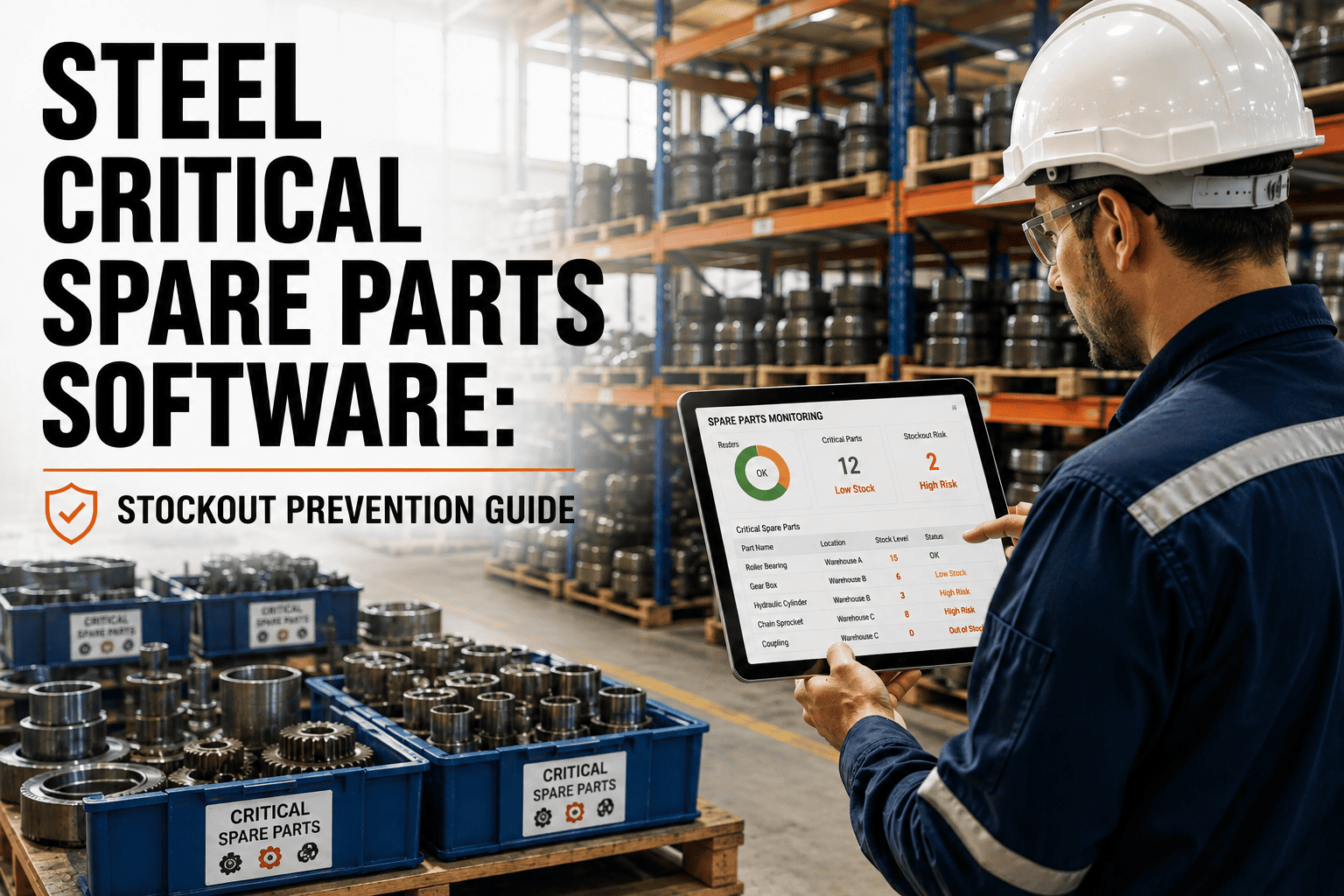
`Steel mills carry millions of dollars in MRO (Maintenance, Repair, and Operations) spare parts inventory — yet 80% of stockouts occur on critical parts that were misclassified as non-critical. The spare parts criticality matrix combines ABC analysis (usage value) with VED analysis (criticality) to create a data-driven inventory optimization framework that prevents stockouts while reducing carrying costs by 25–35%. Plant operators with comprehensive CMMS spare parts documentation pay 12–18% lower insurance premiums than mills without structured inventory records. Underwriters view documented criticality scoring, reorder point tracking, and stockout prevention evidence as proof of a well-managed, lower-risk facility — and they price accordingly. Beyond premiums, the speed of breakdown recovery is directly tied to inventory visibility: mills that can identify critical spare location and availability within minutes resolve outages faster with lower production loss. OxMaint automates spare parts criticality scoring and reorder management — so your most critical spares are always in stock when you need them.
Spare Parts Criticality Matrix for Steel Plant MRO Inventory
Optimize spare parts inventory using ABC analysis and criticality scoring to avoid stockouts — complete guide for steel mill inventory managers and reliability engineers.
The Criticality Matrix — ABC + VED Combined Framework
The spare parts criticality matrix combines two proven classification methods: ABC analysis (based on annual usage value — cost × consumption) and VED analysis (based on criticality — Vital, Essential, Desirable). The resulting 3×3 matrix creates nine inventory categories with distinct management strategies. A-class spares (high value, high consumption) deserve tight control and frequent review. V-class spares (vital to production) must never stock out regardless of cost. The intersection — AV (A-class value, Vital criticality) — requires the most rigorous management: safety stock, dual sourcing, and CMMS automated reorder triggers. OxMaint automatically classifies every spare part using this matrix — eliminating guesswork and manual spreadsheets.
ABC-VED Criticality Matrix — Nine Inventory Categories
The 3×3 ABC-VED matrix creates nine distinct spare parts categories, each requiring a different inventory management strategy. Category AV (A-class value, Vital criticality) spares demand the highest control: safety stock, CMMS automated reorder at min level, dual sourcing, and periodic review. Category CD (C-class, Desirable) spares can use simple two-bin or Kanban systems with infrequent review. The matrix transforms inventory from a cost center into a strategic asset. OxMaint automatically assigns each spare part to its matrix category — with recommended reorder policies and review frequencies.
| Category | Value (ABC) | Criticality (VED) | Management Strategy | Review Frequency |
|---|---|---|---|---|
| AV | A (High Value) | Vital | Safety stock + auto reorder + dual source | Monthly |
| AE | A (High Value) | Essential | Min-max with CMMS triggers | Quarterly |
| AD | A (High Value) | Desirable | EOQ review; consider just-in-time | Quarterly |
| BV | B (Medium Value) | Vital | Safety stock + periodic review | Quarterly |
| BE | B (Medium Value) | Essential | Standard min-max | Quarterly |
| BD | B (Medium Value) | Desirable | Two-bin system | Semi-annual |
| CV | C (Low Value) | Vital | Safety stock + periodic review — critical despite low cost | Monthly |
| CE | C (Low Value) | Essential | Kanban or two-bin | Semi-annual |
| CD | C (Low Value) | Desirable | Minimal stock or just-in-time; low risk | Annual |
Criticality Scoring Methodology — From Intuition to Data-Driven
Beyond ABC-VED, leading steel mills use a multi-factor criticality score (0–100) that weights: downtime cost per hour ($50K–$500K+ for steel assets), lead time (days to months), supplier reliability (single source penalty), obsolescence risk, and alternative availability. The score auto-assigns spares to A/B/C criticality tiers. A spare with downtime cost >$100K/hr, lead time >90 days, and single source scores 95+ — requiring safety stock, dual sourcing, and CMMS automated reorder alerts at min level. OxMaint calculates criticality scores automatically — eliminating guesswork from inventory planning.
MRO Inventory Optimization — From Criticality to Action
Criticality classification drives specific inventory actions: reorder point (ROP) = (daily usage × lead time) + safety stock. Safety stock multiples vary by criticality: Vital spares: 2–3× lead time demand; Essential: 1–1.5×; Desirable: 0.5× or zero. CMMS automatically triggers reorder when stock hits ROP, generates purchase requisitions for A/B spares, and alerts planners for C spares. Periodic review frequencies match criticality: AV spares reviewed monthly; CD spares reviewed annually. OxMaint automates ROP calculation and reorder triggering — eliminating manual spreadsheets and stockout risk.
ROI by Inventory Strategy — What Criticality Matrix Delivers
Return on investment from criticality-based inventory optimization scales with spare parts inventory value and stockout risk. The comparison below shows actual measured outcomes across three steel mill inventory profiles — small mill ($2M inventory), mid mill ($8M inventory), and large integrated mill ($20M+ inventory). OxMaint's inventory calculator generates a mill-specific projection based on your part count, inventory value, and average downtime cost.
We implemented OxMaint's criticality matrix across 18,000 spare parts. The system automatically classified AV spares — we discovered 340 parts were misclassified as low-criticality but actually had >$150K/hr downtime impact. After adjusting safety stock and reorder points, we reduced stockouts by 71% and cut inventory by $2.8M in 10 months. Our insurer reduced our property premium by 16% after reviewing our documented inventory control program.
Frequently Asked Questions
Know What Spares Are Critical. Never Stock Out Again.
ABC + VED + CMMS automation in one platform. Free to start.