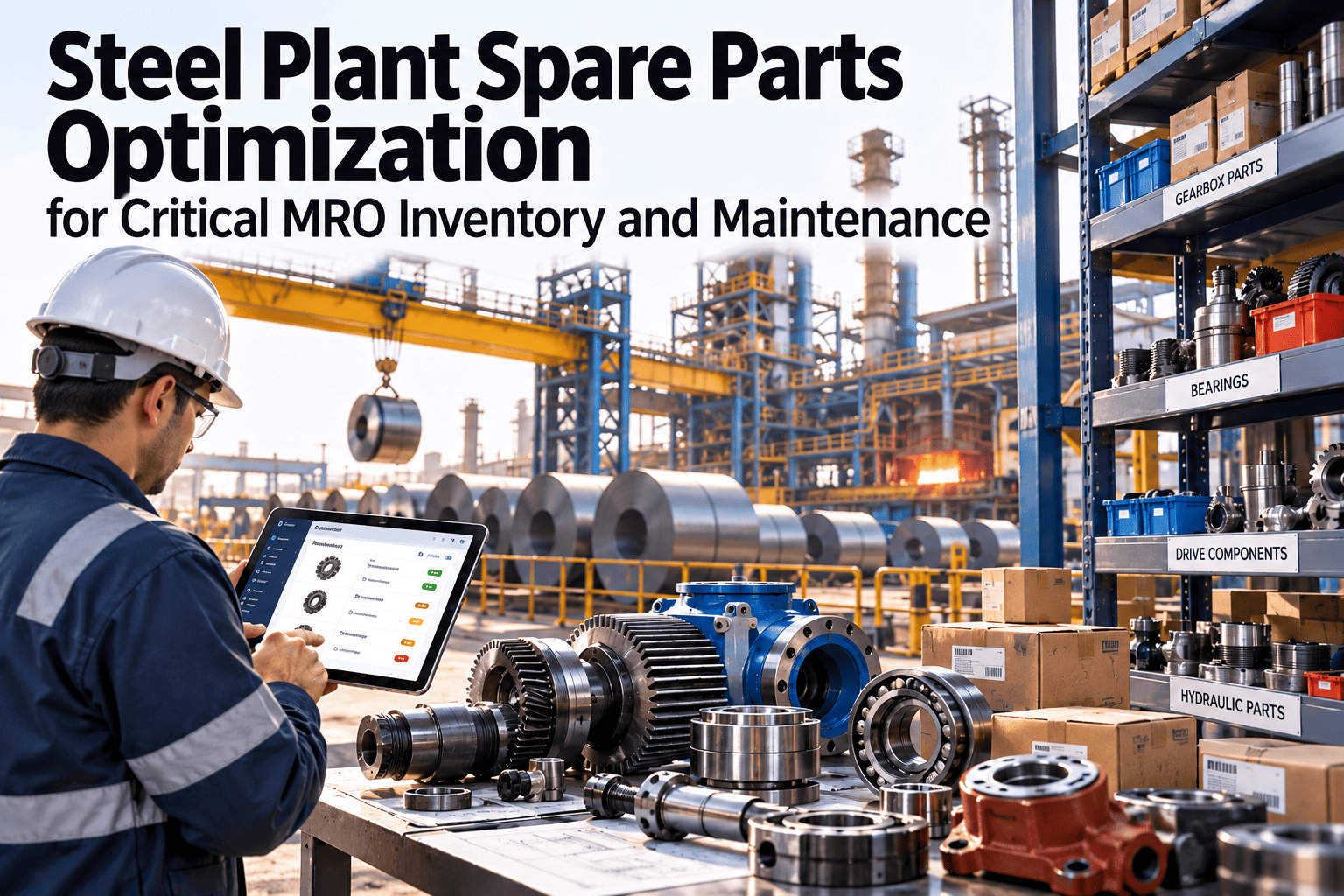
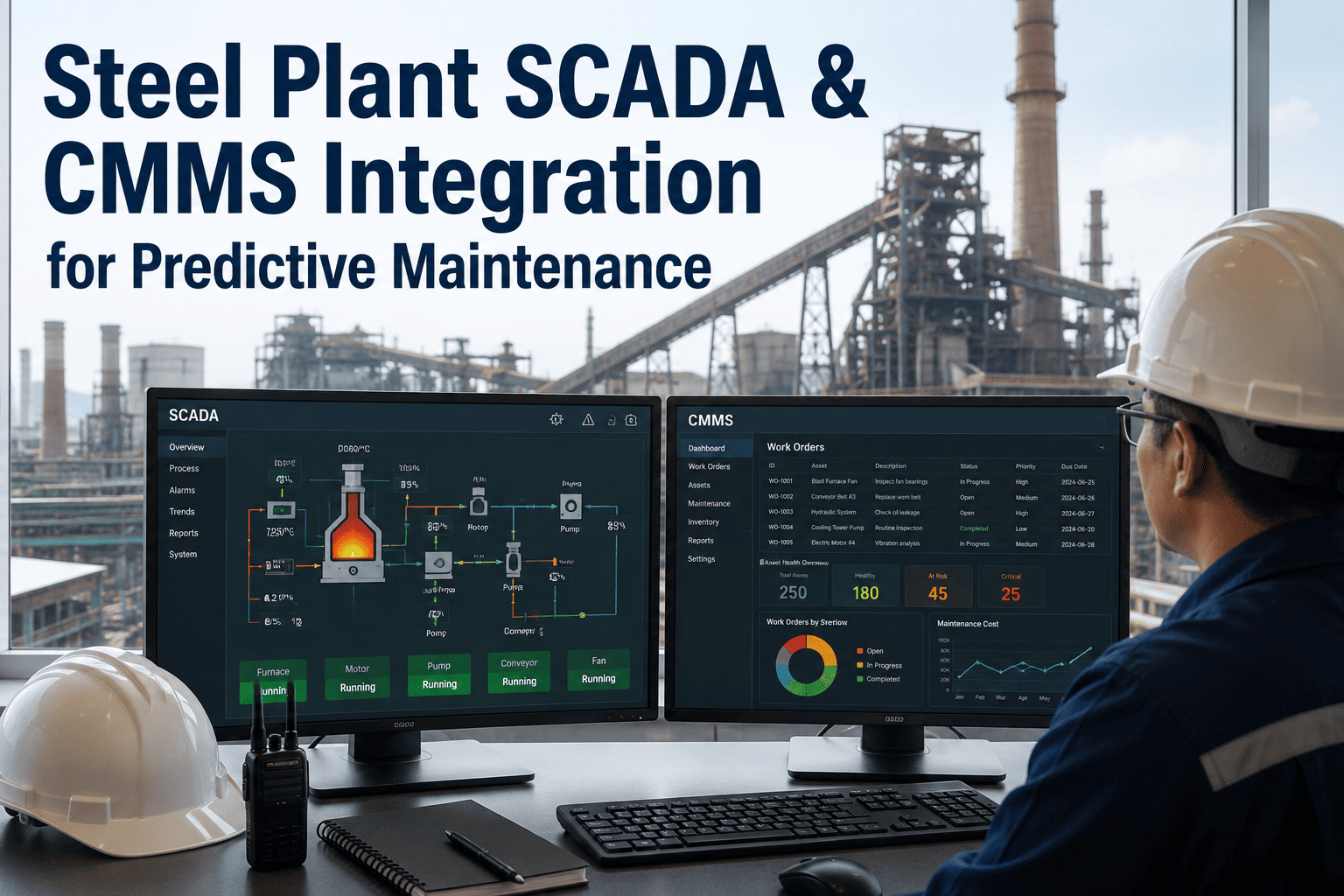
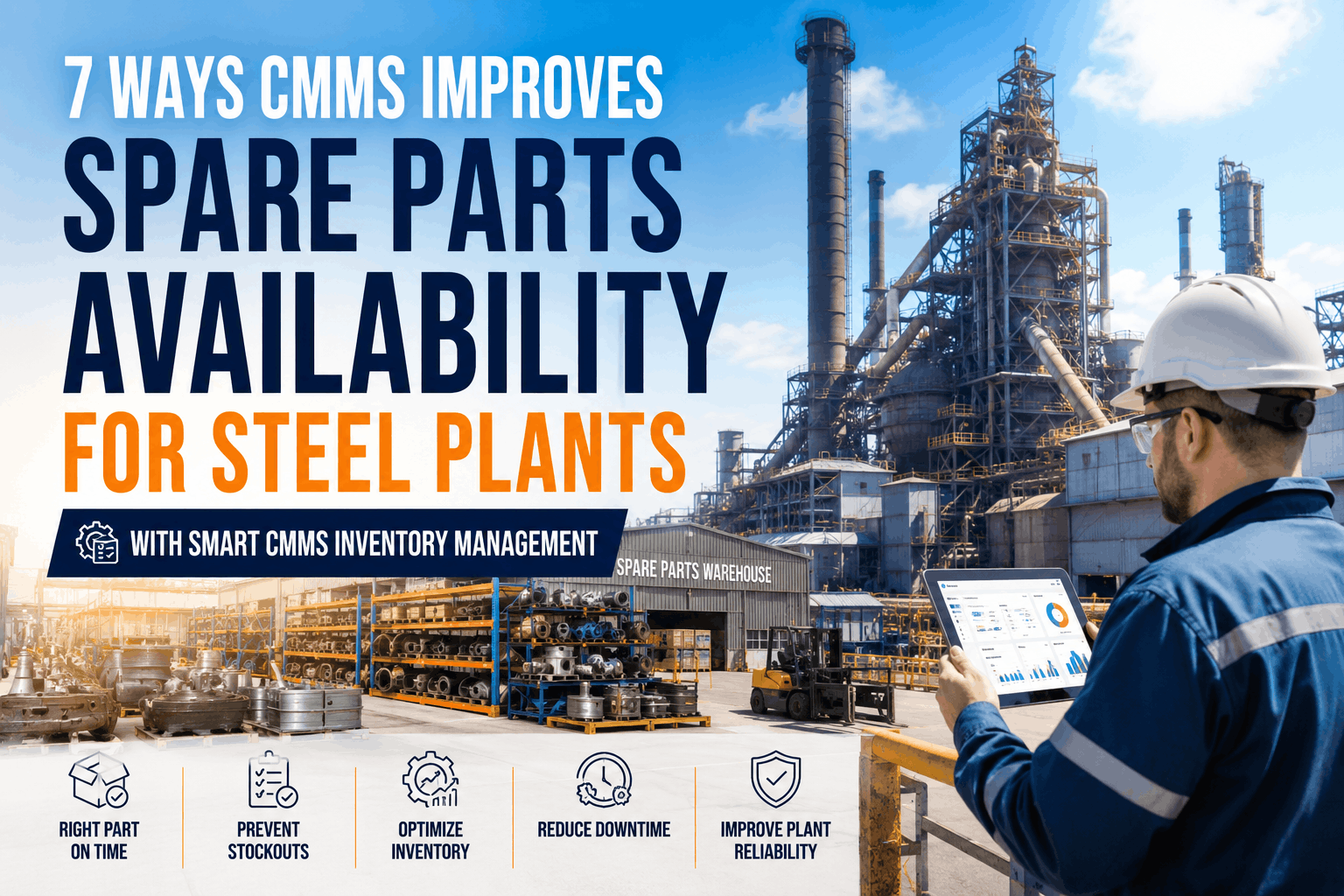
A steel plant's spare parts storeroom carries the paradox of industrial maintenance: $12 million in inventory that still runs out of the one bearing that stops production. Most MRO stocking decisions are made with static reorder points set years ago, based on average consumption patterns that bear no relationship to current asset condition, upcoming maintenance schedules, or the 90-day failure probability of the critical pump operating at elevated vibration. The result is simultaneous overstock and stockout — cash locked in parts that will never be used, and emergency premium freight for parts that should have been on the shelf weeks ago. OxMaint's inventory optimization AI connects asset condition data, maintenance schedules, failure history, and supplier lead times into a single forecasting engine — so replenishment signals fire before the failure window opens, not after production stops waiting for parts.
Inventory · Steel Industry
Steel Plant Spare Parts Optimization AI
Right Part. Right Shelf. Right Time — Before the Work Order Fires.
AI-powered inventory forecasting connected to asset health scores, maintenance PM schedules, and supplier lead times — automatically adjusting stocking levels and firing replenishment signals weeks before parts are needed.
The Spare Parts Paradox
↑
30–50%
of MRO parts not moved in 24 months — dead stock tying up capital
↑
4–5×
cost premium on emergency procurement vs. planned purchase orders
✓
20–40%
fewer emergency orders with AI-driven predictive replenishment
✓
15–30%
reduction in total inventory carrying cost — without increasing stockouts
The 4-Quadrant Stocking Model
OxMaint classifies every SKU across two axes — asset criticality and supply reliability — to apply the right stocking policy. AI forecasting delivers its highest impact in Quadrant 1: critical equipment with long or unreliable lead times, where a stockout means a production shutdown.
Reliable Supply
Long / Unreliable Lead Time
High Criticality
Q2 — Local Safety Stock
Blast furnace cooling pumps, caster rolls. Reliable supply means smaller buffer but mandatory local stock. AI triggers replenishment at defined run-rate thresholds.
Safety stock mandatory • AI schedules reorder timing
Q1 — AI Priority Forecast
Blast furnace tuyeres, rolling mill backup roll bearings — long lead times, critical application. A stockout = production shutdown. AI forecasting maximises impact here.
Local stock mandatory • AI forecasts 30–90 days ahead
Low Criticality
Q4 — Vendor-Managed
Standard fasteners, consumables, filters. Easy to source from multiple suppliers. No internal safety stock required — vendor-managed or just-in-time procurement.
VMI or JIT • Minimal internal stock • No AI priority
Q3 — Obsolescence Watch
Non-critical, hard-to-source legacy components. Hold minimum safety stock. AI flags obsolescence risk before parts age into write-off territory.
Minimal stock • AI flags slow-mover obsolescence
How the AI Replenishment Signal Works
01
Asset Condition Triggers Demand Signal
When OxMaint’s condition monitoring flags a degrading asset — elevated vibration on a rolling mill gearbox, temperature rise on a blast furnace blower motor — the system identifies the associated BOM and calculates probability-weighted demand for the relevant parts. The replenishment signal fires before the work order, so stock is arriving as the work order is being planned.
02
PM Schedule Feeds Forward Demand
Every scheduled PM in OxMaint generates a forward demand signal for the parts it will consume — lubricants, filters, belts, seals — weeks before the planned date. Parts are reserved in inventory and a procurement trigger fires if stock falls below the quantity needed. No more discovering at 06:00 that the PM scheduled for 08:00 needs a filter that is not in stock.
03
Lead Time Adjusted Safety Stock
OxMaint tracks actual supplier lead times per SKU and per vendor — not the theoretical lead time entered at setup. When a supplier’s actual lead time drifts 9 days beyond contracted terms, the safety stock model adjusts automatically. The reorder point shifts out before the stockout risk materialises, without a planner manually reviewing supplier performance.
04
Obsolescence and Dead Stock Detection
OxMaint continuously monitors parts with zero consumption for 18+ months and cross-references them against asset records. Parts stocked for assets that have been decommissioned or upgraded are flagged for disposal review — recovering working capital from inventory that would otherwise sit until a physical audit discovers it years later.
Your Asset Data Is Already Predicting Which Parts You Need Next. OxMaint Reads It.
Every vibration trend, every PM schedule, every supplier lead time feeds the replenishment model — so the right part is on the shelf before the technician needs it.
Key Metrics OxMaint Tracks on Every SKU
Service Level %
Parts availability rate when demanded — target 98%+ on Q1 critical SKUs. OxMaint flags any SKU falling below threshold by asset criticality tier.
Emergency Order %
Percentage of procurement events triggered by emergency vs. planned purchase order. AI-driven plants target below 5%. Industry average without forecasting: 25–35%.
Inventory Turns
Total annual consumption ÷ average inventory value. Low turns indicate over-stocking; high turns on Q1 parts indicate stockout risk. AI balances both simultaneously.
Dead Stock Value
Value of parts with zero consumption for 18+ months. Average steel plant carries 30–50% dead stock by SKU count. OxMaint surfaces write-off candidates before they compound.
“
We had $12 million in inventory and still paid emergency freight premiums on 28% of our procurement events. The problem was not the stocking policy — it was that the stocking policy was static and the asset condition was dynamic. A bearing that had been consuming at two per year for three years suddenly needed four in one quarter because operating conditions had changed. The static model could not see that. When we connected inventory to asset condition data, the demand signal for that bearing fired six weeks before the failure — enough time for standard freight, planned work order, and scheduled downtime. The emergency order rate on Q1 parts dropped from 28% to under 7% in the first year. The carrying cost reduction paid for the platform in the first quarter.
Marcus Eidenschink, B.Eng (Mechanical), CRL
Maintenance Manager — voestalpine Stahl GmbH (Linz) • 21 Years Steel Plant Maintenance Management • Certified Reliability Leader (SMRP) • Specialist in CMMS inventory integration and condition-based replenishment for integrated steelworks
Frequently Asked Questions
Does OxMaint integrate with SAP or existing ERP systems for procurement?
Yes. OxMaint connects to SAP PM, SAP MM, Oracle eAM, and other ERP systems via REST API. When OxMaint’s AI generates a replenishment signal, it can push a purchase requisition directly into SAP MM for approval — eliminating the manual step of transcribing inventory alerts into procurement requests. The inventory record reflects real-time stock levels pulled from the ERP, ensuring the forecasting model always operates on current on-hand quantities.
Book a demo to review integration options for your specific ERP environment.
How does OxMaint handle spare parts for assets with intermittent or unpredictable failure patterns?
Intermittent demand is handled through probabilistic models rather than average consumption rates. For Q1 critical parts, OxMaint calculates the probability distribution of demand over the lead time horizon using the asset’s full failure history, current condition score, and operating environment. The safety stock recommendation targets a configurable service level (typically 98–99% for Q1 parts) against that distribution — not against a static average. Plants using risk-segmented AI stock policies achieve near-perfect service while holding 23% less inventory than static reorder point systems (Bain 2024).
Start your free trial to begin classifying your storeroom SKUs by the 4-quadrant model.
What is the typical ROI timeline for spare parts optimisation with OxMaint?
Most steel plants begin seeing improved part availability and reduced emergency orders within 60–90 days. Full inventory rebalancing — reducing dead stock and right-sizing safety stock on Q1 parts — typically completes over 6–12 months. A single prevented unplanned shutdown on a blast furnace or caster ($50K–$200K per event) typically recovers the full annual platform cost. Emergency order premium elimination (4–5× standard cost) on even a modest procurement volume delivers payback within the first quarter for most operations.
Inventory Optimization AI — OxMaint
Stop Running Out of the Parts That Stop Production. Stop Paying to Store the Parts That Never Move.
OxMaint’s inventory AI connects asset condition scores, PM schedules, failure history, and supplier lead times into a single replenishment model — firing procurement signals before the failure window opens, and flagging dead stock before it compounds into a write-off.