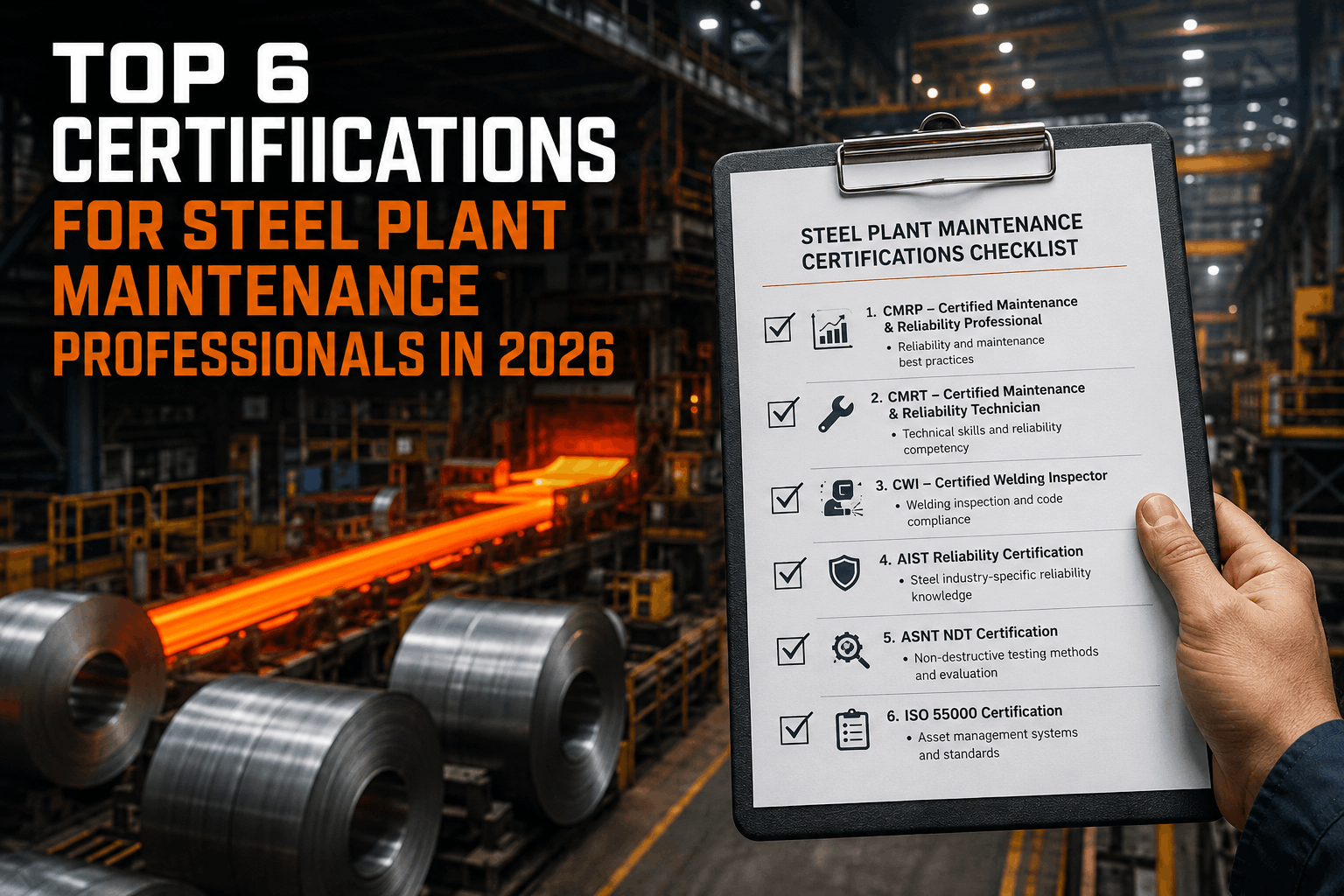
Steel plant maintenance careers in the U.S. have never been more technically demanding — or more financially rewarding for professionals who hold the right credentials. With integrated mills running BF-BOF routes at 2–4 million tonnes per year, EAF mini-mills expanding across the Midwest and South, and major U.S. producers investing billions in modernization, the demand for credentialed maintenance and reliability engineers is outpacing supply across every production zone. The right steel plant maintenance certifications in 2026 signal to employers that you can manage blast furnace campaign life, interpret NDT data on refractory walls, lead an OSHA-compliant crane inspection program, and translate asset condition data into maintenance decisions worth millions of dollars. This guide ranks the top 6 certifications for steel plant maintenance professionals — what each covers, who should pursue it, what U.S. exam requirements look like, and how Oxmaint's CMMS infrastructure supports your preparation and ongoing credential maintenance. Sign Up Free and see how Oxmaint tracks technician certification status, renewal dates, and work order eligibility across your entire steel plant crew.
SEO META BLOCK (hidden)Oxmaint Tracks Your Team's Certifications So No Credential Lapses Before a Work Order Goes Live
Assign work orders only to technicians with current credentials — crane operators, hot work supervisors, NDT inspectors, and confined space attendants. Renewal alerts fire automatically before expiry dates hit.
Why Certifications Matter More in Steel Plant Maintenance Than Almost Any Other Industry
A steel plant maintenance professional without documented credentials is not just a career liability — they are a compliance and operational risk. OSHA 1910.179 requires crane operators to be specifically designated by their employer. ASME B30 series standards mandate documented competency for overhead equipment operation. EPA NESHAP requires certified technicians for coke oven monitoring. Hot work supervisors in confined spaces at BF casthouse temperatures must carry documented safety training. And at the management level, reliability engineers making multi-million-dollar PM scheduling and CapEx decisions are increasingly expected to hold the CMRP or equivalent credential as a baseline professional qualification. The steel plant career certifications listed in this guide are not academic credentials — they are operational qualifications that determine what work you are authorized to perform, what roles you are eligible to fill, and what salary bands are open to you in every major U.S. steelmaker's compensation structure. Book a demo to see how Oxmaint's workforce module manages credential tracking across your full maintenance team.
The Top 6 Certifications for Steel Plant Maintenance Professionals in 2026
Cert 01: CMRPCMRP — Certified Maintenance & Reliability Professional (SMRP)
Management TierThe CMRP is the most widely recognized maintenance and reliability credential in U.S. heavy industry — and the benchmark qualification for plant-level reliability engineers and maintenance managers in steel operations. It is the only maintenance certification accredited by the American National Standards Institute (ANSI) under globally recognized ISO standards, which means it carries the most consistent weight with HR departments at U.S. Steel, Nucor, Cleveland-Cliffs, and Steel Technologies. The exam covers five pillars of the SMRP Body of Knowledge: Business & Management, Equipment Reliability, Manufacturing Process Reliability, Organization & Leadership, and Work Management. In a steel plant context, the equipment reliability pillar maps directly to blast furnace campaign management, caster PM program design, and rolling mill MTBF improvement — exactly the competencies that determine whether a maintenance engineer earns a $95K or a $140K total compensation package. There are no experience or education prerequisites — any working maintenance professional can sit for the CMRP at a Pearson VUE testing center. See how Oxmaint tracks CMRP renewal dates for your entire maintenance team.
CMRT — Certified Maintenance & Reliability Technician (SMRP)
Technician TierThe CMRT is the field-level counterpart to the CMRP — designed for maintenance technicians, mechanics, and multi-craft workers who perform hands-on maintenance on steel plant equipment rather than managing the program at the engineering level. It tests competency in specific technical skills: lubrication application, bearing installation, alignment procedures, vibration recognition, and basic reliability principles that prevent repeat failures. In a steel plant context, a CMRT-credentialed technician on the caster platform or at the rolling mill stand demonstrates a validated baseline of technical knowledge that distinguishes them from uncredentialed peers during both hiring decisions and craft upgrade evaluations. For technicians who aspire to a reliability engineering role, the CMRT is the natural stepping stone to the CMRP — and many SMRP chapters offer study groups that prepare candidates for both exams simultaneously. Schedule a workforce management demo to see how Oxmaint tracks CMRT status across your technician roster.
CWI — Certified Welding Inspector (AWS)
Structural / Inspection TierThe AWS Certified Welding Inspector credential is arguably the most operationally critical certification in a steel plant maintenance context — because weld failures in structural supports, ladle shells, BF shell, and rolling mill stands are among the highest-consequence failure modes in the entire production chain. A CWI-certified inspector can evaluate welding processes, interpret inspection records, assess compliance with AWS D1.1 Structural Welding Code, and make fitness-for-service determinations on repaired structural components. In U.S. steel plants, CWI credentials are typically required for anyone signing off on structural weld repairs in critical zones — BF casthouse, BOF vessel support structures, continuous caster frame repairs, and crane runway structural maintenance. The exam is three-part: fundamentals, welding inspection and metallurgy, and practical codebook application. Prerequisites include a combination of formal education and welding fabrication or inspection experience per AWS guidelines. See CWI compliance tracking in Oxmaint's workforce module.
ASNT NDT — Nondestructive Testing Certification (Level II / III)
Inspection TierNDT certifications from ASNT are essential for maintenance professionals responsible for inspecting the most failure-critical components in a steel plant — blast furnace shells, BOF vessel trunnions, ladle shells, rolling mill housings, and structural welds — without removing them from service. The five primary NDT methods each serve a specific steel plant inspection scenario: Ultrasonic Testing (UT) for thickness measurement on BF cooling staves and refractory-lined vessels; Magnetic Particle Testing (MT) for surface and near-surface cracks in rolling mill rolls and crane hooks; Penetrant Testing (PT) for surface defects in welds and castings; Radiographic Testing (RT) for subsurface weld defects in critical pressure-containing components; and Eddy Current Testing (ET) for heat exchanger tube inspection and surface crack detection. ASNT Level II certification qualifies the technician to perform, calibrate, and interpret results. Level III qualifies them to establish and approve procedures, interpret codes, and train Level I and II technicians. For U.S. steel plant maintenance programs, Level II is the baseline field qualification and Level III is the supervisory standard for NDT program management. See how Oxmaint manages NDT inspection records and assigns work orders based on technician certification level.
AIST — Association for Iron & Steel Technology Education Programs
Industry-Specific TierAIST — the Association for Iron & Steel Technology — is the primary professional body for the North American steel industry, and its education programs represent the most steel-specific technical development available to U.S. maintenance professionals. Unlike generalist credentials, AIST coursework covers steelmaking-specific maintenance challenges: blast furnace cooling system management, BOF vessel lining practices, continuous casting defect prevention, rolling mill drive train maintenance, and reheating furnace combustion system reliability. AIST's annual AISTech conference in Pittsburgh draws 8,000+ steel industry professionals and offers structured technical sessions that count toward CMRP recertification points. For any U.S. steel plant maintenance professional, AIST membership and documented participation in its education programs are the most direct way to demonstrate deep industry knowledge alongside a generalist credential like the CMRP. The AIST Steel Technology and Management program offers structured curricula for engineers at various career stages, from early-career process engineers to senior reliability and maintenance leaders. Sign up free and connect your Oxmaint account to track AIST CPD hours alongside your workforce's other credential renewal requirements.
ISO 55001 / IAM Certified Asset Management Professional
Strategic / Executive TierISO 55001 is the international standard for asset management systems — and for U.S. steel plants undergoing operational transformation, merger integration, ESG compliance programs, or capital investment reviews, ISO 55001 certification of the organization's asset management system is increasingly a prerequisite for lender requirements, insurance underwriting, and institutional investor due diligence. The IAM Certificate in Asset Management aligned with ISO 55001 is the individual credential that demonstrates professional competency in asset management strategy, lifecycle cost optimization, risk-based maintenance prioritization, and long-term CapEx planning — exactly the skills that plant managers, maintenance directors, and VP-level engineering leaders are expected to bring to the BF reline decision, the EAF conversion feasibility study, or the multi-year reliability improvement plan. Oxmaint's CMMS architecture is aligned with ISO 55001 requirements — tracking asset data, maintenance records, condition history, and cost attribution in a format that supports ISO 55001 certification audit evidence. Book a demo to see how Oxmaint's documentation output supports ISO 55001 compliance documentation at your plant.
Steel Plant Certification Roadmap by Career Stage
SVG Horizontal Career RoadmapHow Oxmaint Supports Steel Plant Certification Programs
Oxmaint stores every technician's certification portfolio — CMRT, ASNT NDT Level, AWS CWI, crane operator, hot work supervisor — with expiry dates and renewal alert logic. Work orders requiring specific credentials cannot be assigned to uncertified technicians, creating an automatic compliance gate that protects the plant from OSHA violations before they occur. When a CWI's 3-year renewal window approaches, the maintenance planner receives advance notification — no more expired credentials discovered during audits.
Professionals preparing for the CMRP use Oxmaint daily in ways that directly build exam competency — tracking PM compliance rates, analyzing MTBF trends, managing work order backlogs, and interpreting maintenance cost data. The Work Management and Equipment Reliability pillars of the CMRP align almost exactly with the operational workflows inside Oxmaint's CMMS dashboard. Candidates who use Oxmaint for 6+ months before their exam consistently report finding the practical application sections of the exam highly intuitive.
Organizations pursuing ISO 55001 organizational certification need documented evidence of systematic asset management — maintenance records, condition history, risk-based PM rationale, CapEx lifecycle data, and compliance documentation. Oxmaint generates all of this as a natural output of daily operations — no additional documentation effort required. Audit packages for ISO 55001 assessments are exportable from Oxmaint in hours rather than weeks of manual record compilation.
ASNT-certified NDT technicians performing ultrasonic thickness measurements on BF cooling staves or magnetic particle testing on crane hooks generate inspection records that must be stored in the asset's service history — not in a separate NDT binder. Oxmaint captures NDT findings directly as work order completion records, with method, technician level, instrument calibration reference, and reading data stored alongside all other maintenance history for the same asset. This integration is what makes ASNT inspection data operationally useful rather than compliance-filing-only.
"I passed my CMRP on the first attempt after 8 weeks of study — and I genuinely believe that two years of daily Oxmaint use was half my preparation. The PM compliance tracking, MTBF dashboards, and work order cost attribution in Oxmaint map almost exactly to the Work Management and Equipment Reliability exam pillars. When the exam asked about leading indicators for maintenance program health, I was describing our Oxmaint dashboard from memory. Beyond my personal exam prep, Oxmaint's workforce module has transformed how we manage our team's credentials across 340 maintenance technicians. Zero lapsed certifications since deployment — the automated renewal alerts caught 12 upcoming expiries that would have been OSHA violations."
Never Let a Steel Plant Credential Lapse Again
Oxmaint tracks every certification across your maintenance workforce — CMRT, CMRP, CWI, ASNT, crane operator, hot work supervisor — with automatic renewal alerts and work order assignment gating that prevents credential violations before they happen.
Frequently Asked Questions: Steel Plant Maintenance Certifications 2026
The CMRP (Certified Maintenance & Reliability Professional) from SMRP is the highest-value single credential — recognized across all U.S. steel producers and consistently correlating with a $12K+ salary premium. For engineers wanting maximum industry relevance, the CMRP plus AIST membership is the most effective combination.
Professionals with 3+ years of steel plant maintenance experience and daily CMMS use typically find the CMRP achievable with 6–10 weeks of structured study. The Work Management and Equipment Reliability pillars align closely with real daily work; Business & Management requires the most additional study for technical professionals without financial management exposure.
Ultrasonic Testing (UT) for BF shell and refractory vessel thickness measurement and Magnetic Particle Testing (MT) for surface crack detection on rolling mill rolls, crane hooks, and ladle shells are the two highest-demand methods in U.S. steel plant operations. Radiographic Testing (RT) is essential for pressure-containing weld inspection.
Most major U.S. steelmakers — Nucor, Cleveland-Cliffs, U.S. Steel, Steel Technologies — cover CMRP and CWI exam fees and preparation materials under tuition assistance or professional development programs. Many also provide paid study time as part of their reliability engineer development track.
ISO 55001 defines the requirements for an asset management system — covering asset strategy, risk-based maintenance, lifecycle cost analysis, and documented continuous improvement. For U.S. steel plants, ISO 55001 certification is increasingly requested by institutional lenders and insurance carriers as evidence of systematic asset management governance during major capital events.
Yes — the CMRT is the most widely recognized transition credential for technicians moving toward reliability engineering. Many U.S. steel producers use CMRT attainment as a formal prerequisite for reliability technician classification upgrades, and it is the standard stepping stone before pursuing the CMRP at the engineering level.
AIST (Association for Iron & Steel Technology) is the primary professional organization for the North American steel industry. Its education programs, annual AISTech conference, and technical publications are the most steel-specific professional development available — providing industry knowledge depth that no generalist credential replicates.
Yes — Oxmaint's workforce module stores each technician's full certification portfolio with expiry dates, renewal alerts, and work order assignment gating. Work order types requiring specific credentials (crane operator, CWI sign-off, ASNT NDT Level II) cannot be assigned to technicians without current credentials in the system.
Ready to Build a Credentialed, Compliant Steel Plant Maintenance Team?
Start your free Oxmaint trial and configure your workforce credential tracking, work order certification gating, and renewal alert system — across your full maintenance roster — in under 24 hours.


.png)
