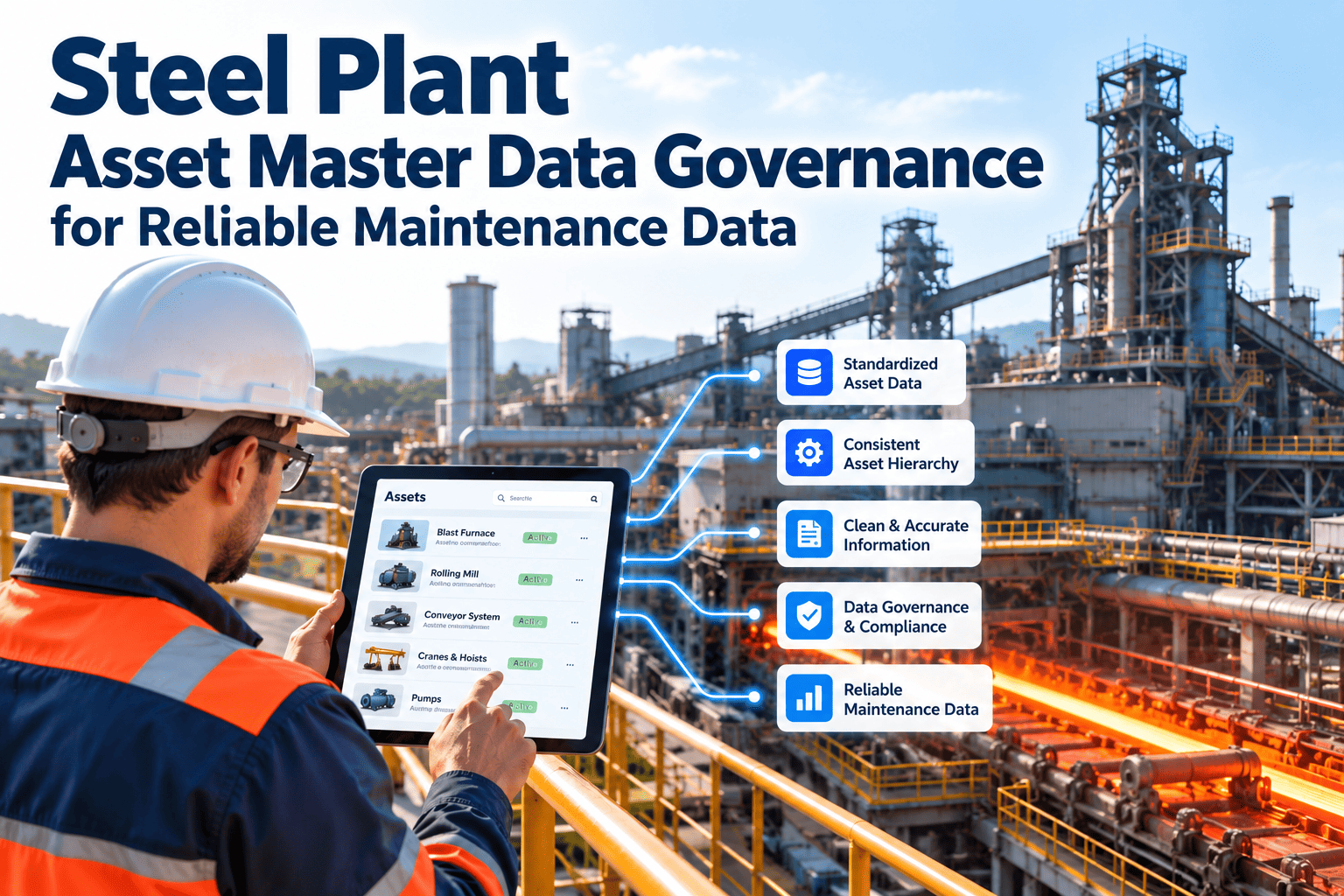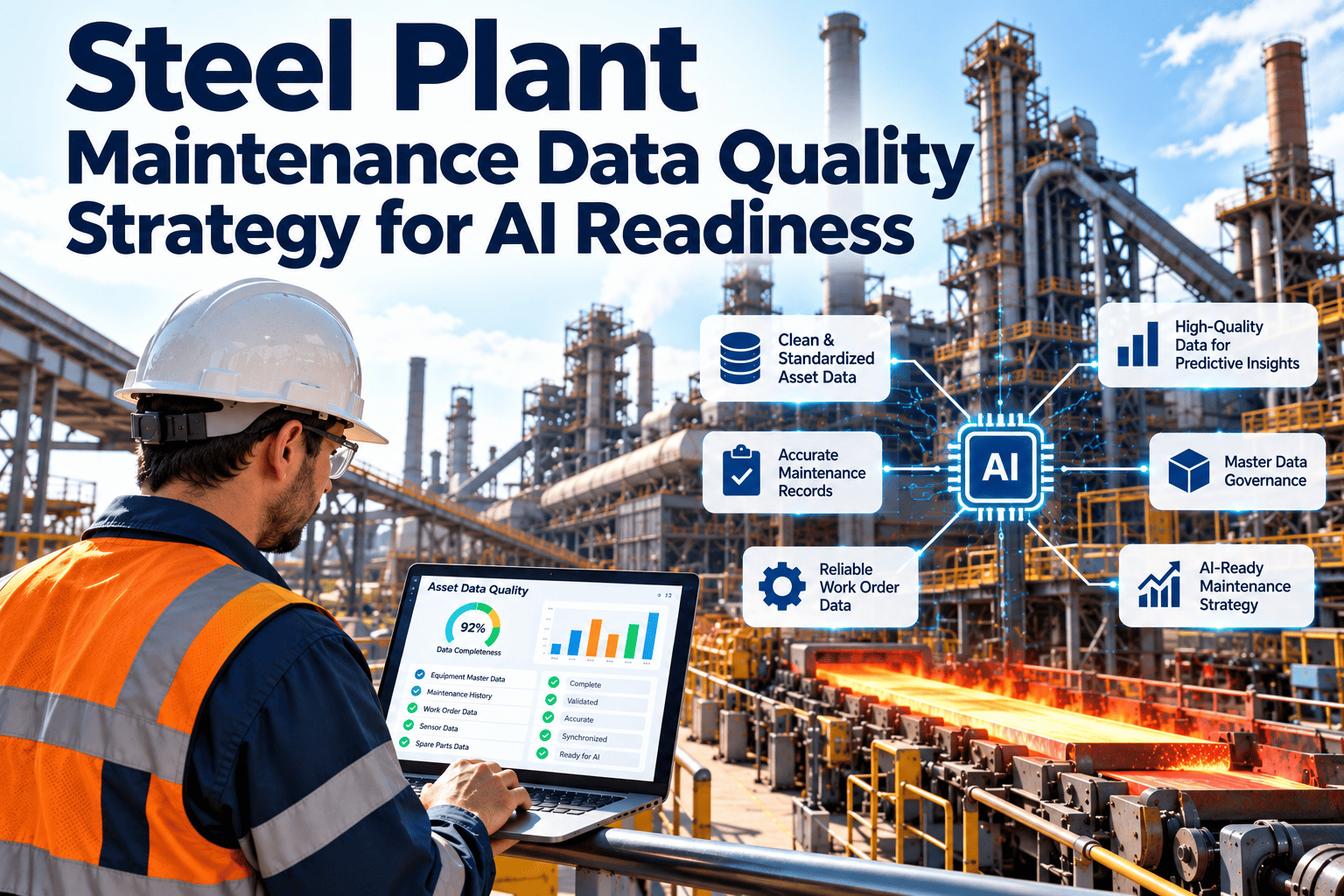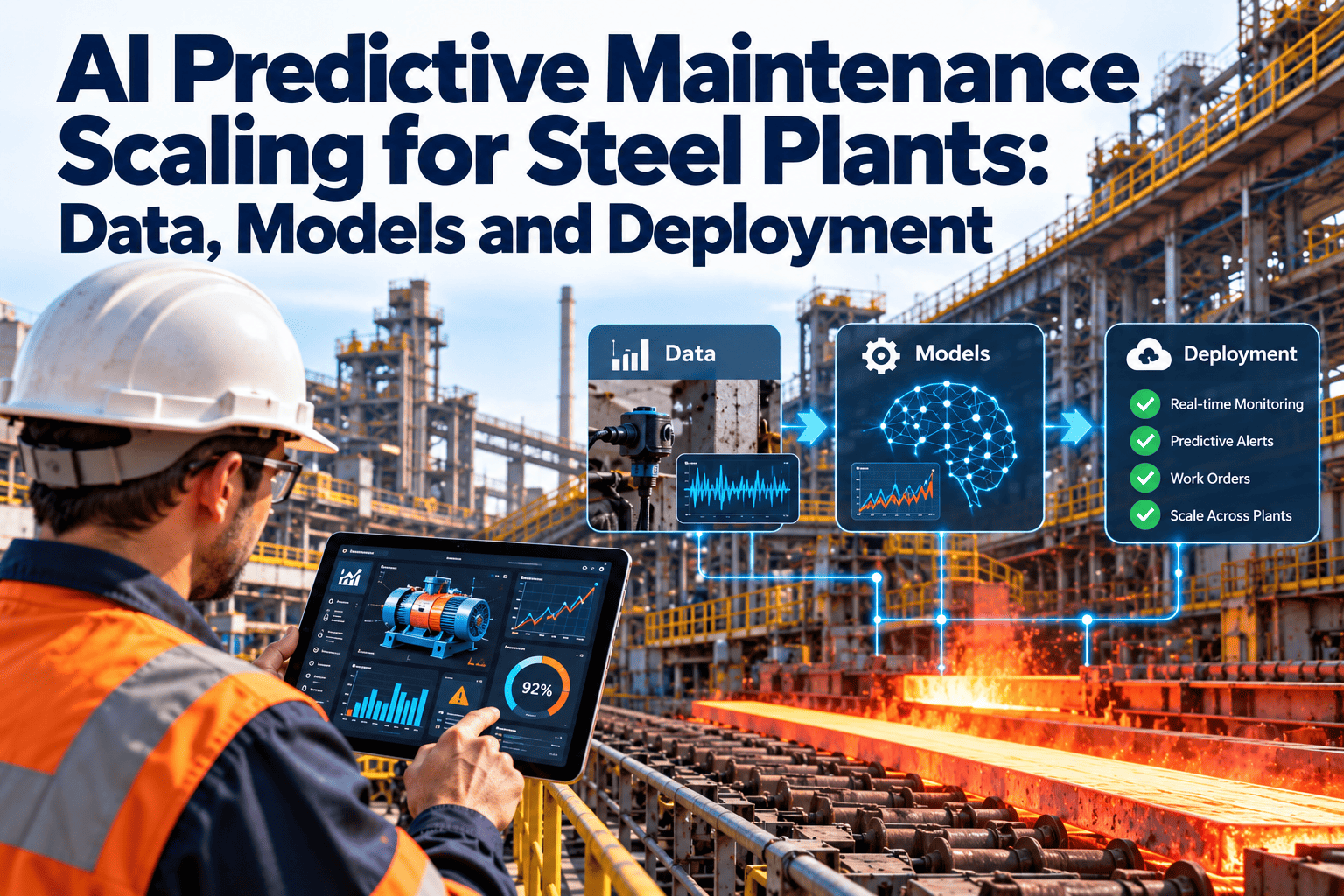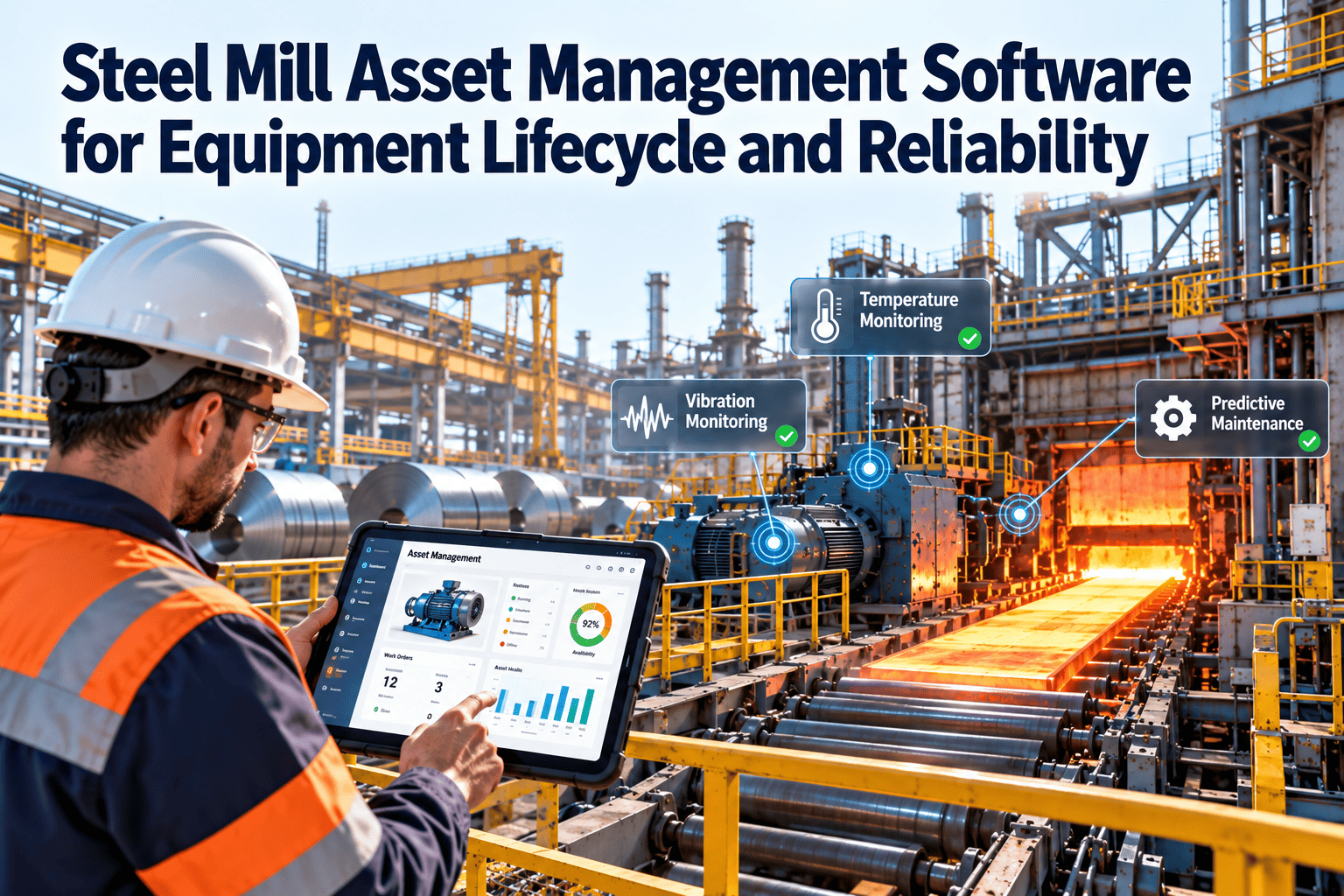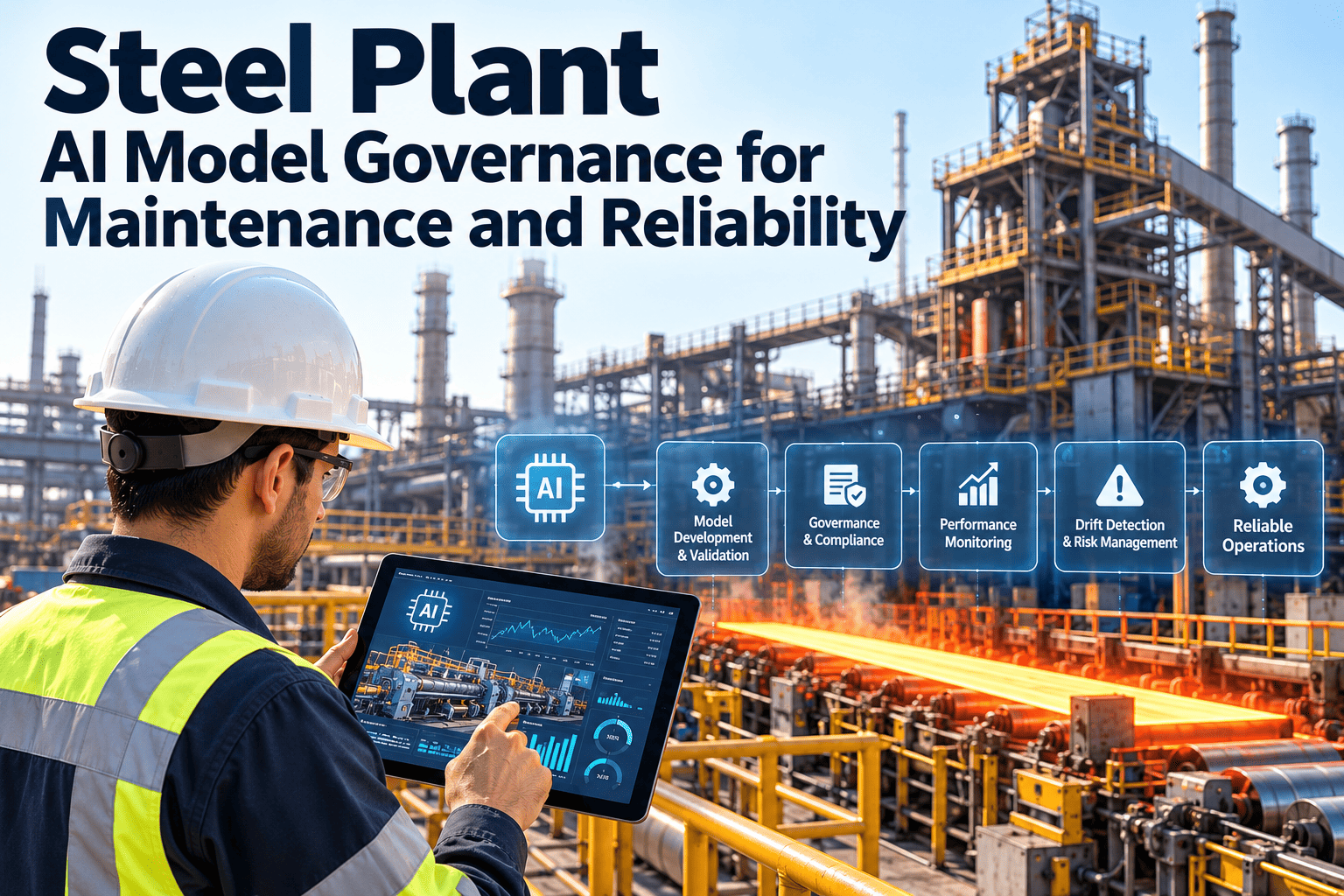
Steel plants are adding machine learning to maintenance faster than they are adding rules for how those models are built, trusted and retired. A bearing model on a hot strip mill or a vibration model on a blast furnace blower can be accurate in a pilot and unreliable six months later. AI model governance closes that gap by defining who owns a model, which data feeds it, how its alerts become work, and when it must be retrained. It is the difference between a clever demo and a dependable reliability tool, and it works best when the model runs inside a steel plant maintenance management platform where every alert has a home.
Steel Plant AI Model Governance for Maintenance and Reliability
Put ownership, data quality and approval rules around every maintenance model, so predictions from furnaces, mills, casters and cranes turn into trusted work orders instead of ignored alarms.
Why ungoverned maintenance AI fails in a steel plant
What usually goes wrong
- A model is built by a vendor or data team and nobody in maintenance owns its alerts.
- Sensor tags are renamed during a shutdown and the model silently reads the wrong signal.
- Failure history is recorded as "repair" with no component or cause, so labels are weak.
- Production changes, such as a new grade or rolling schedule, shift normal behavior and trigger false alarms.
- Crews see alerts in a separate dashboard, so they never become scheduled work.
What governance changes
- Every model has a named business owner and a technical owner.
- Input signals are tied to registered assets and monitored for drift and gaps.
- Failure codes and cause fields make labels consistent across sites and crews.
- Changes to production conditions trigger a documented model review.
- Alerts land as draft work orders in the same system the planner already uses.
Where steel plants use maintenance models, and what to control
Steel is a continuous, high-temperature, heavy-load process, so a few assets carry most of the risk. Governance should start where a wrong prediction costs the most.
| Asset area | Typical signals | Model purpose | Governance focus |
|---|---|---|---|
| Blast furnace blowers and stoves | Vibration, bearing temperature, pressure, valve cycles | Early fault detection | Operating-mode context so startups are not flagged as faults |
| Basic oxygen and electric arc furnaces | Transformer temperature, electrode movement, cooling water flow, hydraulics | Condition scoring, wear estimates | Heat-cycle segmentation and sensor validity checks |
| Continuous casters | Mold oscillation, segment roll vibration, cooling circuit data | Roll and bearing degradation | Strong failure labels from roll change records |
| Hot and cold rolling mills | Motor current, gearbox vibration, lubrication condition, drive data | Gearbox and drive anomaly detection | Product and speed changes that alter baselines |
| Overhead cranes and ladle handling | Hoist current, brake wear, rope inspection findings | Safety-critical condition trending | Human approval before any deferral of inspection |
| Pumps, fans and compressors | Vibration, temperature, motor current, flow | Remaining useful life estimates | Alert thresholds tuned to avoid nuisance dispatches |
The model governance lifecycle for maintenance teams
Treat every maintenance model like an asset with a lifecycle: it is commissioned, monitored, changed under control and eventually retired.
Define the use case and owner
Write down the failure mode, the asset, the decision the model supports and the person accountable for it. A model without a decision attached is a report, not a maintenance tool.
Qualify the data
Confirm that tags map to registered assets, units are consistent, timestamps align and gaps are filled or flagged. Poor data quality is the most common reason a model underperforms.
Validate before release
Test on periods the model has not seen, including at least one known failure. Record precision, missed events and the alert volume a crew can realistically handle.
Run in shadow mode
Compare model alerts with existing condition monitoring and inspection findings before any alert dispatches a crew. Engineers confirm or dismiss each one.
Release with an approval gate
Alerts create draft work orders that a reliability engineer approves. Autonomy is widened only when confirmed catches justify it.
Monitor, retrain and retire
Track drift, false alarms and missed failures. Retrain on a defined trigger, version every change and retire models whose asset or process no longer exists.
Asset data readiness checklist
Governance fails when the maintenance record is thin. Check these items before a model is trusted with a critical asset.
Asset register
- Unique asset IDs from plant to component level
- Parent-child hierarchy for each line
- Criticality ranking agreed with operations
Failure records
- Failure mode, cause and component fields completed
- Start and end times of each stoppage
- Parts used and labor hours logged
Sensor and signal data
- Tag-to-asset mapping reviewed after each shutdown
- Calibration dates recorded
- Operating mode captured with the signal
Inspection history
- Findings stored as structured entries, not free text only
- Photos and readings attached to the asset
- Follow-up work orders linked to findings
Before and after: an alert with and without governance
Without governance
- Alert appears in an analytics screen outside the shift routine
- Nobody is sure which version of the model produced it
- Planner cannot see the asset history behind the score
- Crew dismisses the alert after two false alarms
- Failure later recorded as a generic breakdown
With governance
- Alert creates a draft work order against the registered asset
- Model version, inputs and confidence are logged with it
- Planner sees past repairs, parts and inspections together
- Engineer confirms or dismisses, and the decision is stored
- Outcome feeds the next retraining review
Model risk matrix for steel maintenance
Rate each model risk by likelihood and consequence, then assign a control. The table below shows common examples.
| Risk | Likelihood | Consequence | Control |
|---|---|---|---|
| Data drift after a grade or schedule change | High | Medium | Review trigger tied to production change records |
| Sensor fault feeding false inputs | Medium | Medium | Input validity checks and flatline detection |
| Weak or biased failure labels | High | High | Mandatory failure codes and engineer label review |
| Missed failure on a safety-critical asset | Low | Severe | Model never replaces statutory inspection |
| Alert fatigue from false positives | Medium | High | Alert volume limits and dismissal feedback |
| Unversioned model change | Medium | Medium | Change log and approval before release |
Who decides what: roles and decision rights
Reliability engineer
Owns failure modes, reviews alerts, confirms or dismisses predictions and signs off on thresholds.
Maintenance planner
Turns approved alerts into scheduled work, checks parts and aligns tasks with planned outages.
Operations lead
Confirms operating context, grade changes and run conditions that affect model baselines.
Data or IT owner
Maintains historian connections, tag mapping, access control and the security of the operational network.
Safety and compliance
Ensures no model output overrides statutory inspections, permits or lockout procedures.
Steel-specific data problems that undermine models
Steel operations create data conditions that generic AI tools often ignore. Governance should name them explicitly.
Extreme operating conditions
- Heat, dust, scale and water cause sensors to drift or fail quietly.
- A flat or frozen signal can look healthy to a model.
- Validity checks should reject suspect readings before scoring.
Batch and cyclic behavior
- Furnace heats, casting sequences and rolling campaigns create repeating cycles.
- Models must compare like with like, not a tapping phase with an idle phase.
- Segmenting data by operating state reduces false alarms.
Frequent product changes
- New grades, widths and thicknesses shift loads and temperatures.
- A baseline learned on one product may not apply to another.
- Production changes should be logged as events the model can see.
Repairs that erase evidence
- Components are often replaced and discarded without a recorded cause.
- Without a cause, the failure cannot become a reliable label.
- A short teardown form on the work order preserves the evidence.
Rules for handling model alerts
Every alert has a destination
An alert must become a draft work order, an inspection task or a documented dismissal. Alerts that go nowhere teach crews to ignore the system.
Severity matches consequence
A warning on a spare pump should not carry the same urgency as one on a casting machine drive. Link alert priority to asset criticality.
Humans keep the safety decisions
A model may recommend a task, but it should never defer a statutory inspection or override a lockout or permit process.
Dismissals need a reason
When an engineer closes an alert as false, record why. Those reasons become the most valuable input for the next retraining review.
Model change control: what to record
| Record | What to capture | Why it matters |
|---|---|---|
| Model card | Purpose, asset class, inputs, known limits and owner | New engineers understand what the model can and cannot do |
| Version history | Training period, changes made, approver and release date | Any alert can be traced to the exact model that produced it |
| Validation results | Test period, caught events, misses and false alarms | Supports the decision to release or hold a model |
| Review log | Drift findings, alert outcomes and retraining decisions | Shows the model is actively managed, not left running |
| Retirement note | Reason for removal and replacement plan | Prevents obsolete models from scoring changed equipment |
Questions to ask any maintenance AI vendor or internal team
About data and models
- Which signals and records does the model need, and how are gaps handled?
- How does it deal with start-ups, shutdowns and product changes?
- How was it validated on failures it had not seen before?
- Can we see why a particular alert was raised?
- How are model versions tracked and rolled back?
About workflow and accountability
- Where does an alert go, and who approves the resulting work?
- Can engineers record why they dismissed an alert?
- Who owns retraining, and what triggers it?
- How is access to operational data secured and audited?
- What happens to our history if we change tools?
Governance checkpoints before a model goes live
- The owner, the asset and the decision the model supports are written down.
- Input signals are mapped to registered assets and tested for gaps and flatlines.
- Validation covered at least one known failure and a normal operating period.
- Shadow mode results were reviewed by a reliability engineer.
- The alert path ends in a work order, inspection task or documented dismissal.
- Review triggers for drift, product change and equipment change are agreed.
Give every prediction an owner and a work order
See how asset records, failure codes and approval workflows can sit behind your maintenance models in one system.
Standards and frameworks worth aligning with
No single rule governs maintenance AI in steel, but several recognized frameworks give a sound starting point.
| Framework | Relevance to maintenance AI |
|---|---|
| ISO 55000 series | Asset management principles, including decisions based on reliable asset information |
| ISO 14224 | Structure for collecting equipment reliability and maintenance data, useful for failure codes |
| NIST AI Risk Management Framework | Voluntary approach to governing, mapping, measuring and managing AI risk |
| ISO/IEC 42001 | Management system requirements for organizations developing or using AI |
| IEC 62443 | Security practices for industrial automation and control systems |
Plants should also follow local safety law and statutory inspection rules for cranes, pressure systems and electrical equipment. Model output supports those duties and never replaces them.
KPIs that show whether a model deserves trust
How Oxmaint supports governed maintenance decisions
Oxmaint is maintenance management software, so it supplies the operational side of governance: the records models depend on and the workflow they trigger.
A 90-day governance rollout for one critical line
Foundation
Select one critical line, clean the asset hierarchy, standardize failure codes and name model owners.
Validation and shadow mode
Validate on historical failures, then compare model alerts with inspections while engineers review each one.
Controlled release
Release draft work orders with approval, set review triggers and measure the KPIs before expanding to other lines.
Frequently asked questions
What is AI model governance in a steel plant?
It is the set of ownership, data, validation and change rules that keep maintenance models accurate, accountable and safe to act on.
Do we need perfect data before starting?
No, but you need consistent asset IDs and failure codes on the first line. A short demo can show how to structure them.
Who should own a maintenance model?
A reliability engineer should own the use case and decisions, with IT owning data connections and security.
How often should models be reviewed?
Review on a fixed cycle and after major process, grade or equipment changes, or when drift or false alarms rise.
Where does a CMMS fit in?
It holds the asset history and work orders models rely on. You can get started here to connect alerts to action.
Build maintenance AI your crews can trust
Bring asset data, work orders and review workflows together so every model decision is traceable and useful on the plant floor.