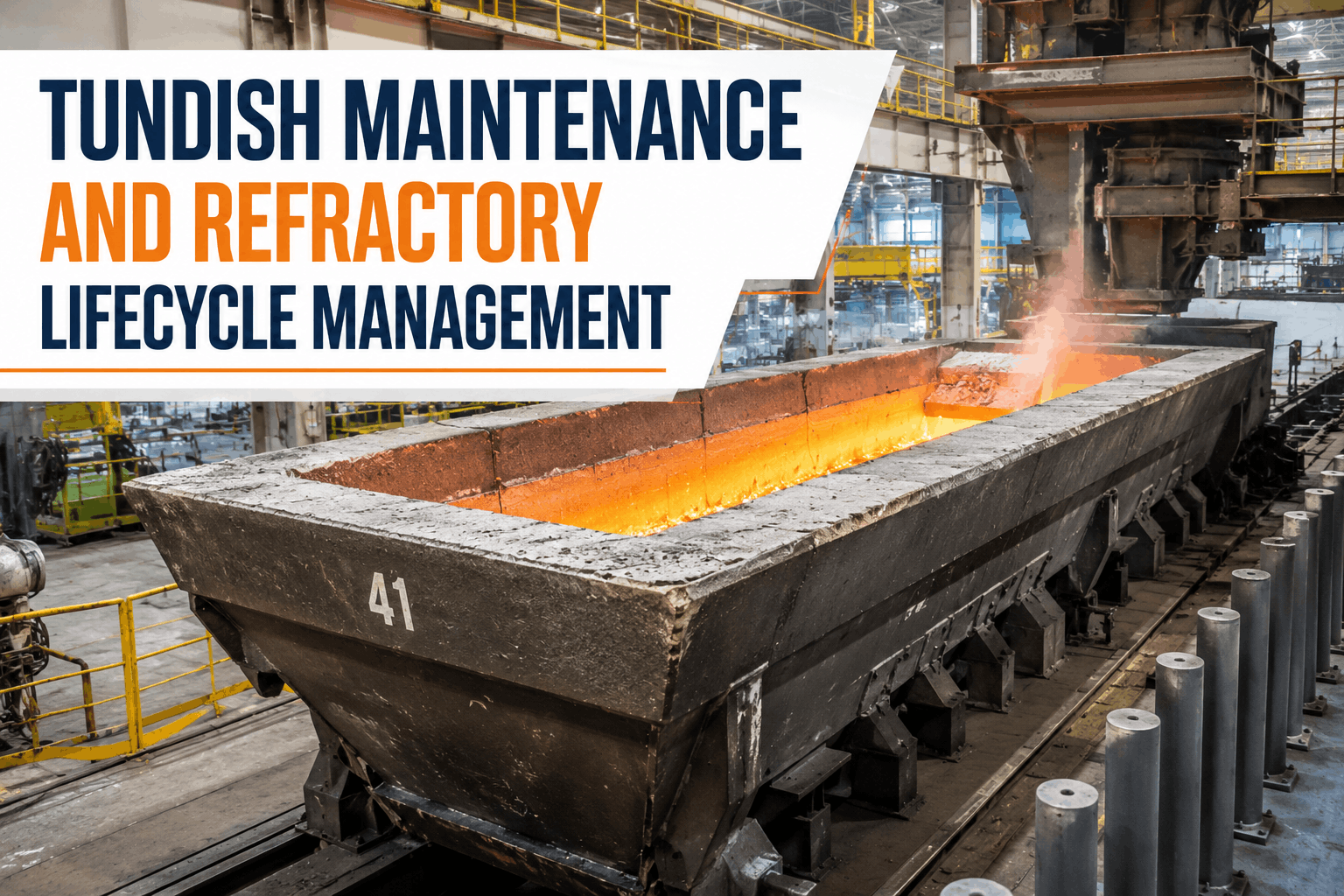
A tundish failure mid-sequence in a continuous casting operation is not recoverable without a sequence break — and every sequence break means refractory drain, cool-down, rebuild, and preheat before the next heat can start. At typical caster productivities, that sequence interruption costs between $80,000 and $300,000 in lost production and emergency refractory spend. The overwhelming majority of tundish failures are preventable with systematic refractory preparation, stopper rod condition tracking, and SEN management discipline. Start managing your tundish consumables digitally with Oxmaint.
Tundish Maintenance and Preparation: Refractory, Stopper Rod and Nozzle Management for Steel Casting
Complete guide to tundish refractory preparation, stopper rod system maintenance, submerged entry nozzle management, preheat procedures, and flow control inspection — with digital turnaround tracking using CMMS.
The Real Causes of Tundish Failures and Sequence Breaks
The tundish is the last metallurgical vessel before steel enters the mould. It performs four simultaneous functions: temperature buffer between ladle and mould, inclusion flotation chamber, flow distribution manifold across multiple strands, and the containment vessel for emergency ladle-to-tundish transition. Any failure in refractory integrity, stopper rod control, or nozzle flow threatens all four functions simultaneously.
Tundish failures cluster around three root causes: inadequate refractory preparation before the sequence start, stopper rod or nozzle wear that progresses beyond its service limit without detection, and preheat procedures that leave thermal gradients in the lining that cause spalling on first contact with liquid steel. All three are controllable with systematic digital tracking. Oxmaint's consumable tracking module gives casting teams per-heat visibility across all tundish consumables — from refractory application through to post-sequence inspection.
Tundish Refractory Preparation: Inspection, Lining and Coating
Tundish refractory preparation begins the moment the previous sequence ends. Post-sequence inspection determines whether the working lining can be repaired for the next heat or requires a full reline. Incorrect residual lining thickness measurement, missed hot spots, or inadequate coating application are the primary contributors to mid-sequence lining failures that force emergency sequence termination.
The single most common preventable tundish failure is a refractory repair that was sized based on visual inspection rather than thickness measurement. A visually acceptable lining with below-minimum residual thickness at the nozzle surround will fail during the second or third heat of the sequence — producing an emergency event that paper-based systems rarely predict. Digital thickness measurement logging in Oxmaint creates the per-heat trend that identifies linings approaching minimum before they reach it.
Stopper Rod Maintenance: Condition Monitoring and Replacement Criteria
The stopper rod system controls steel flow from the tundish to the mould — typically the most mechanically stressed component in the tundish assembly. Stopper rod degradation mechanisms include thermal cycling cracking, steel penetration at the rod joint, argon purging system blockage, and tip erosion that widens the seated bore beyond acceptable control range. Each mechanism has a detectable signal in the casting data before it causes a loss-of-control event. Track stopper rod service life per heat in Oxmaint to build the per-rod condition history that drives replacement decisions.
Submerged Entry Nozzle Management: Clogging Prevention and Change Criteria
Submerged entry nozzle clogging is the highest-frequency cause of casting sequence disruption across the global steel industry. Alumina inclusion deposition in the bore — accelerated by high aluminium content steel grades and inadequate argon stirring — is a process mechanism that CMMS tracking can help control by enforcing change intervals, logging argon flow at every heat, and correlating grade chemistry with observed clogging rates to optimise change frequency by grade.
Tundish Preheat Procedures: Thermal Profile Requirements
Inadequate tundish preheat is a predictable cause of thermal shock spalling in the working lining and SEN failure in the first heat of a sequence. The preheat protocol must bring the entire refractory mass to the correct temperature profile — not just the surface — while managing the rate of temperature rise to prevent cracking. Logging preheat data digitally, per tundish, per sequence, creates the traceability that identifies preheat-related failures and corrects procedures before they repeat.
Ambient Temperature Soak — 2 to 4 Hours
After coating application and before burner ignition, the tundish must complete a minimum ambient temperature soak period to allow coating moisture to escape without steam-driven spalling. Duration depends on ambient humidity and coating thickness — minimum 2 hours in dry conditions, 4 hours in high humidity. Log start time and ambient conditions in the CMMS work order.
Low-Fire Phase — Target 200 to 400°C
Initial burner phase at reduced fire to drive off remaining moisture and begin thermal soak of the working lining mass. Rate of rise must not exceed the specification limit for the lining material — typically 50–80°C per hour for magnesia-based working linings. Record temperature at 30-minute intervals and log against the time-temperature curve specification.
High-Fire Phase — Target 1000 to 1100°C
Full-fire phase brings the working lining surface temperature to the pre-casting target. Minimum holding time at target temperature must be achieved before ladle open can be called. Record final preheat temperature and hold time against the heat sequence record. Any shortfall from target temperature must be documented as a deviation with the casting supervisor sign-off.
Transfer to Casting Position and Pre-Opening Checks
Following preheat completion, the tundish is moved to the casting position. Maximum time between burner-off and ladle open must not exceed the specification limit or the tundish surface temperature will fall below the minimum acceptable level. Log transfer time, final temperature check, stopper rod seating confirmation, and SEN installation status before calling ladle open. Oxmaint turnaround tracking timestamps each step automatically when completed on mobile by the casting crew.
Tundish Maintenance — Inspection Schedule Reference
All critical tundish maintenance tasks mapped by system, frequency, and responsible role. Configure all tasks as automated work orders in Oxmaint so nothing is missed between sequences.
| System | Task | Frequency | Responsible | Criticality |
|---|---|---|---|---|
| REF — Refractory | Residual lining thickness measurement | Post-sequence | Refractory Engineer | Critical |
| REF — Refractory | Hot spot and crack inspection | Post-drain | Refractory Engineer | Critical |
| REF — Refractory | Working lining application and verification | Per reline | Refractory Crew | Critical |
| STP — Stopper Rod | Pre-installation inspection | Pre-cast | Casting Engineer | Critical |
| STP — Stopper Rod | Stopper position vs cast speed logging | Every heat | Caster Operator | High |
| STP — Stopper Rod | Post-sequence tip erosion measurement | Post-sequence | Casting Engineer | High |
| SEN — Nozzle | Bore and flange dimensional check | Pre-install | Casting Engineer | Critical |
| SEN — Nozzle | Preheat temperature verification | Pre-cast | Casting Operator | Critical |
| SEN — Nozzle | Argon injection flow rate logging | Every heat | Caster Operator | Critical |
| PHT — Preheat | Preheat temperature profile logging | Every preheat | Casting Operator | Critical |
| PHT — Preheat | Transfer time and pre-opening checklist | Every sequence | Casting Supervisor | Critical |
Swipe right to view all columns on smaller screens
Manual Tundish Tracking vs Oxmaint Digital CMMS
How CMMS Transforms Tundish Consumable Tracking
Tundish management generates more data per heat than most production equipment generates per year — refractory thickness measurements, stopper rod positions, argon pressures, preheat temperatures, and consumable batch numbers all need to be captured, stored, and trended to drive better preparation decisions. Oxmaint makes this data capture fast and mobile so casting crews log the data during the turnaround, not after it.
Consumable Tracking Per Heat
Every SEN, stopper rod, and refractory application is logged against the specific heat number, tundish identity, and steel grade. Batch numbers, installation dates, and service life in heats are tracked per item — enabling supplier quality comparison and service life optimisation by grade.
Turnaround Step Tracking
Each tundish preparation step — post-sequence inspection, lining, coating, preheat, transfer, and pre-opening checks — is tracked with a timestamp and responsible person. The turnaround timeline is visible in real time to the casting supervisor, with automatic alert if any step runs overdue against the sequence schedule.
Threshold-Based Alerts
Configure numeric alert limits for stopper rod position drift, SEN argon pressure, and refractory thickness. When a reading crosses the threshold, Oxmaint routes an escalation to the casting engineer before the next heat starts — not after the sequence break happens.
Mobile Offline Execution
Casting crew complete tundish preparation checklists on smartphone or tablet — including photo capture for refractory defects and numeric entry for all measurements. Offline operation ensures data capture even in network-limited areas of the casting floor.
Sequence Break Root Cause Record
When a sequence break occurs, Oxmaint creates a structured failure record linking the event to the last available inspection data — refractory thickness at last measurement, argon pressure trend, stopper position history. This turns each failure into a learning event rather than an isolated incident.
Grade-Specific PM Intervals
SEN change intervals and stopper rod replacement criteria are configured per steel grade. High-aluminium grades trigger shorter SEN change intervals automatically. The system adapts PM schedules to the actual casting programme rather than applying a generic interval across all grades.
Replace Reactive Sequence Management with Digital Tundish Tracking
Casting teams using Oxmaint reduce unplanned sequence breaks, improve consumable service life visibility, and build the per-heat data infrastructure that separates world-class caster availability from industry average. Start tracking your tundish turnarounds digitally — no IT project required.
Tundish Maintenance: Frequently Asked Questions
What is the main cause of SEN clogging and how can it be predicted?
Alumina inclusion deposition in the SEN bore is the dominant clogging mechanism for aluminium-killed steel grades. The deposition rate accelerates with higher steel Al content, lower tundish temperature, and insufficient argon stirring through the SEN purge system. The earliest detectable signal is rising argon injection pressure required to maintain target flow rate — this trend is detectable 20–40 minutes before flow restriction becomes casting-critical. Logging argon pressure every heat in Oxmaint builds the per-grade trend that makes this signal actionable rather than reactive.
How many heats should a stopper rod last, and what determines the replacement interval?
Stopper rod service life varies from 3 to 15 heats depending on steel grade, argon flow, and operational parameters — not a fixed interval. The replacement decision should be driven by stopper position drift data: when the stopper position required to achieve target cast speed at set mould level drifts beyond the grade-specific control band, the rod has eroded beyond its serviceable range and requires replacement at the next sequence end. Per-heat stopper position logging is the only reliable replacement criterion — visual inspection of the used rod tip after the fact is not preventive.
What are the minimum refractory thickness criteria before condemning a tundish lining?
Minimum acceptable residual working lining thickness varies by tundish design, lining material specification, and casting schedule — typically 30–50mm for the bottom and side walls, with tighter limits (25–35mm) at the nozzle surround and impact zone where thermal and erosion loading is highest. The specific condemn limit should be established in the caster's refractory management specification for each zone. What matters for reliability is that the measurement is taken at every post-sequence inspection and logged against the tundish identity — Oxmaint stores this trend per tundish so approaching-minimum linings are flagged before they reach the condemn threshold.
What preheat temperature is required before the first heat of a sequence?
Target preheat temperature for continuous casting tundishes is typically 1000–1100°C at the working lining surface, with a minimum hold time of 30–60 minutes at target temperature before ladle open. The specific requirement depends on the refractory material and the caster's operational procedure. More important than the nominal target is that any shortfall below the minimum is documented as a deviation with a casting supervisor sign-off — because under-preheated tundishes have a statistically higher rate of working lining spalling in the first 2–3 heats, and this correlation is invisible without a digital record linking preheat data to subsequent failure events. Book a demo to see how Oxmaint handles preheat deviation tracking.
Can Oxmaint track consumable batch traceability for tundish refractory and nozzles?
Oxmaint allows every consumable installation — SEN, stopper rod, working lining material, coating — to be logged with its supplier batch or lot number against the work order and heat number. This creates a full traceability chain: if a batch of SEN from a specific supplier shows shorter service life than the previous batch, the correlation is visible in the consumable analytics report within the campaign rather than being discovered at the next annual supplier review.
How quickly can a caster team deploy Oxmaint for tundish turnaround tracking?
Most continuous casting maintenance teams are running digital tundish turnaround checklists within 2–3 days of Oxmaint account setup. The tundish asset register, consumable tracking templates, and preparation step checklists can all be configured from existing paper forms. No IT integration is required — the system runs on the smartphones your casting crew already carry on the floor. Sign up free and deploy your first tundish turnaround checklist today.