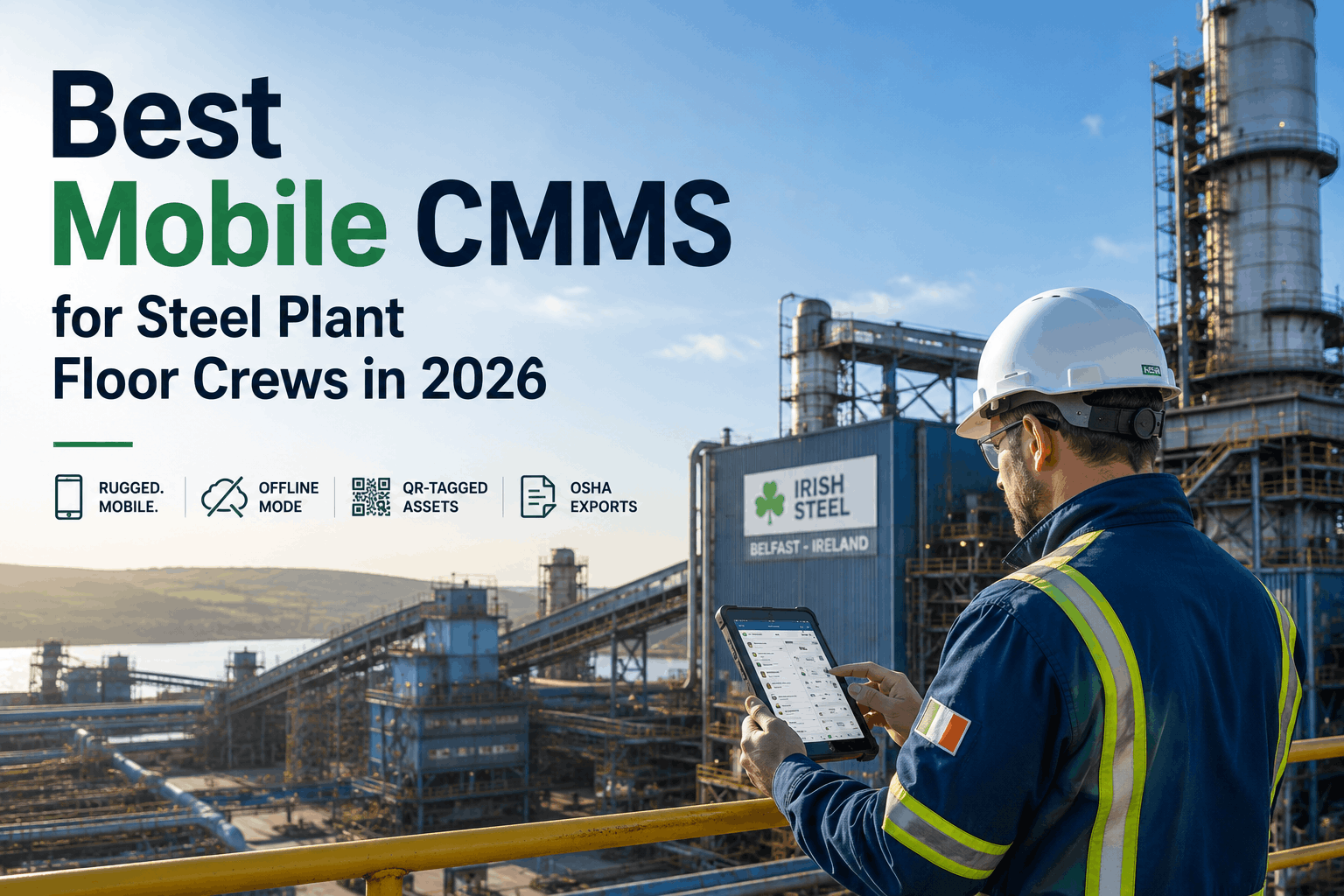
Ultimate Guide: Choosing the Right Maintenance Software for Your Steel Plant
By James smith on March 17, 2026
Most steel plant maintenance software decisions go wrong, starting with a vendor demo, leading to a shortlist based on first impressions and sales team responsiveness, and ending with a price-driven decision. Six months after go-live, the platform may handle general work orders but fail to address specific needs like refractory lifecycle tracking or integration with the Level 2 historian. The gap between promises and reality widens over time. Sign up for Oxmaint — built specifically for the complexity of steel plant maintenance, not retrofitted from a general manufacturing template.Oxmaint, built specifically for steel plant maintenance complexity, offers a complete evaluation framework to guide the selection process. It covers 50+ criteria, a vendor comparison framework, implementation questions, and a change management strategy for successful adoption. Book a platform evaluation session to walk through these criteria against Oxmaint's capabilities for your specific facility type.
67%
Of CMMS implementations fail to meet their stated objectives within 24 months
$2.4M
Average cost of a failed CMMS implementation at a mid-size steel plant including rework, retraining, and productivity loss
50+
Technical criteria that differentiate steel-capable CMMS platforms from general manufacturing tools
18 mo
Average time to measurable ROI when selection process includes steel-specific technical criteria validation
Why Most CMMS Selections Fail in Steel Plants
General manufacturing CMMS platforms are built for discrete manufacturing — production lines where assets are machines with defined service intervals, work orders are generated from calendars, and the primary value is digitizing paper-based PM records. Steel plant maintenance has a fundamentally different structure. Refractory is a consumable with a heat-count and temperature-exposure lifecycle, not a machine. Roll wear is a continuous degradation curve that interacts with product grade sequence and campaign length, not a scheduled replacement. Blast furnace cooling stave monitoring requires condition-based logic tied to thermal sensor feeds, not a 90-day PM task. When a general CMMS encounters these requirements, it forces workarounds — manual tracking in spreadsheets, custom fields that cannot drive logic, and reporting that requires data export to Excel before it becomes useful. The platform gets underutilized, adoption falls, and the ROI never materializes.
73%
Of steel plant maintenance managers who evaluated a general CMMS before selecting it reported that at least three critical steel-specific requirements were not met at go-live. The most common gaps: refractory lifecycle tracking (61%), roll wear curve integration (54%), and Level 2 historian data connectivity (49%). All three were identified as "yes, we can do that" in the vendor sales process.
The 50+ Evaluation Criteria Framework
The following criteria are organized into six categories. Each criterion should be tested in a structured proof-of-concept — not accepted on vendor claims. The standard for any criterion is: "Show me how this works for a steel plant blast furnace refractory reline" or "Demonstrate this with a rolling mill roll wear curve scenario." Vendors who can demonstrate these scenarios have built for steel plant complexity. Vendors who cannot have not. Sign in to Oxmaint to see every one of these criteria demonstrated in a live steel plant configuration.
CAT 1
Asset Management — Steel-Specific Requirements
The asset registry must handle steel plant asset classes that do not exist in general manufacturing CMMS platforms. These are non-negotiable for a steel plant deployment.
Refractory lifecycle tracking — heat count, temperature exposure time, visual condition score, remaining life projection. Must drive maintenance scheduling, not just store data.
Roll wear curve modeling — tonnes-per-campaign tracking against roll grade wear curves with forced campaign end projection integrated into production scheduling visibility.
Consumable asset classes — assets with finite life measured by consumption (electrodes, tuyeres, ladle linings) managed separately from durable equipment.
Parent-child asset hierarchy — blast furnace → cooling stave system → individual stave → thermocouple, with maintenance cost rolled up and failure traced down.
GIS / spatial positioning — physical location of assets on plant layout diagram for inspection route planning and mobile navigation.
Digital nameplate storage — OEM documentation, inspection certificates, pressure vessel certifications stored at asset level.
CAT 2
Preventive Maintenance Engine
The PM engine must support all four RCM task types and the production-maintenance coordination requirements unique to steel operations.
Multi-trigger PM scheduling — calendar time, runtime hours, production tonnage, heat count, OR condition-based triggers. All four must be native, not configured through workarounds.
Production schedule integration — PM windows visible to production planners before schedule lock, with conflict detection and deferral escalation logic.
Work order bundling — automatic grouping of PM tasks due within a rolling window into combined outage packages to minimize total downtime events.
PM compliance tracking with deferral escalation — cumulative risk scoring for deferred PMs with management escalation at configurable thresholds.
Seasonal and campaign-aware scheduling — adjusting PM intervals based on production campaign type (standard vs. high-alloy) that affects wear rates differently.
CAT 3
Integration and Data Connectivity
A CMMS that cannot connect to your existing data infrastructure will force manual data re-entry — eliminating 30–40% of its potential value before deployment completes.
Level 2 historian connectivity — direct API or OPC-UA connection to OSIsoft PI, Wonderware, or equivalent historian for sensor data ingestion into work order and asset condition records.
ERP integration — bidirectional data exchange with SAP PM, Oracle eAM, or Microsoft Dynamics for purchase order generation, cost booking, and asset master synchronization.
MES integration — production order, actual tonnage, and OEE data feeds from Level 3 MES for maintenance-production coordination and downtime cost calculation.
IoT / sensor platform connectivity — MQTT, REST API, and OPC-UA support for vibration, thermal, pressure, and acoustic sensors from major industrial vendors.
Laboratory / LIMS integration — oil analysis, water chemistry, and metallurgical test results linked to asset condition records automatically.
CAT 4
Analytics and Reporting
Analytics that require data export to Excel before they produce useful output are not analytics — they are storage with extra steps. Every metric below must be natively calculable inside the platform.
Four-category downtime cost calculation — production loss, energy waste, quality impact, and customer penalty calculated per downtime event from integrated production and energy data.
Maintenance cost per tonne trending — rolling 12-month cost per tonne vs. global benchmark ranges by facility type, updated as work orders close.
MTBF / MTTR per asset system — calculated from work order open and close timestamps with drill-down to failure mode and root cause classification.
Planned vs. reactive ratio dashboard — real-time planned maintenance ratio with trend and target variance, by area and asset criticality tier.
Predictive failure scoring — AI-generated failure probability score per asset, updated as sensor and inspection data accumulates, driving proactive work order creation.
Executive KPI dashboard — single-page leadership view of OEE, maintenance cost, compliance rate, and top-10 downtime drivers, exportable to PDF without configuration.
CAT 5
Mobile and Field Execution
Steel plant field execution happens in environments that challenge most mobile CMMS implementations — extreme temperatures, electromagnetic interference, limited connectivity in pit and furnace areas, and PPE requirements that prevent keyboard-intensive interfaces.
Offline mobile operation — full work order execution capability without network connectivity, with automatic sync when connection is restored. Non-negotiable for BOF vessel and blast furnace areas.
QR / RFID asset identification — scan-to-access asset records and work orders from the field, eliminating manual asset number entry in PPE-restricted environments.
Photo and video capture in work orders — in-field evidence documentation at the asset, attached to the work order record with timestamp and GPS location.
Large-button / gloved-hand interface — touch targets minimum 48px, readable at outdoor light levels, operable with safety gloves without stylus.
Voice-to-text work order notes — hands-free documentation in high-noise environments where keyboard entry is impractical during active maintenance work.
CAT 6
Implementation and Support
The best platform on paper becomes the worst deployment in practice without adequate implementation support. These criteria separate vendors with genuine steel plant implementation experience from those learning your business at your expense.
Steel plant reference customers — minimum 3 live reference customers in integrated steel operations willing to discuss implementation experience. No references means no proven steel deployment.
Named implementation consultant with steel experience — confirm which specific consultant will manage your deployment and verify their steel plant implementation track record before contract signature.
Data migration from existing CMMS — confirmed methodology for migrating asset records, work order history, and PM schedules from your current system without manual re-entry.
Contractual go-live timeline with milestones — specific deliverable dates in the contract, not a project plan in a proposal deck. "We typically complete in 90 days" is not a contractual commitment.
24/7 support with steel industry SLA — response time commitments for critical work order system outages during production hours, not general business hours SLAs.
Must-have — eliminate vendor from consideration if not met Important — weight in scoring but not disqualifying
Oxmaint meets every must-have criterion in all six categories. See each requirement demonstrated live in a steel plant configuration — not a generic manufacturing demo. Our team will walk through your specific asset types, integration requirements, and implementation timeline in a single session.
Vendor Evaluation Scorecard: Questions That Reveal Real Capability
The following questions are designed to force demonstration rather than assertion. Every item below has been answered incorrectly or misleadingly by at least one CMMS vendor during a steel plant evaluation. Use these exact phrasings in your evaluation — the difference between "yes we can do that" and "let me show you exactly how we do that for refractory on a blast furnace" tells you everything about whether the vendor has built for your environment.
Vendor Evaluation Question Bank — Steel Plant Specific
Ask These Verbatim
Category
Evaluation Question
What a Strong Answer Looks Like
Red Flag Response
Asset Management
"Show me how you track refractory remaining life on a blast furnace and use it to schedule a reline."
Live demo with heat count triggers, temperature exposure accumulation, and automatic PM generation at configurable threshold.
"We can configure a custom field for that" or "our professional services team can build that workflow."
PM Engine
"How does your system handle a PM window that conflicts with an active production campaign?"
Shows real-time conflict detection with production calendar integration, deferral risk scoring, and automated escalation workflow.
"The maintenance planner manages that manually" or "we integrate with your scheduling tool separately."
Integration
"Show me how sensor data from a vibration monitor on a rolling mill bearing flows into a work order automatically."
Live demonstration of sensor threshold alert → condition-based work order creation → assignment → closure with evidence, in one continuous workflow.
"We have an API" or "we can connect to that — our integration team will scope it during implementation."
Analytics
"Show me a downtime event cost report that includes production loss, energy waste, quality rejects, and customer penalties in one record."
Pulls from integrated production, energy, and quality data feeds automatically. Displays four-category cost breakdown per event without manual compilation.
"You can build that report with our reporting module" or "that requires exporting to your BI tool."
Mobile
"Does the mobile app work fully offline in the blast furnace pit area with no WiFi or cellular signal?"
Confirms full work order execution, inspection data capture, and photo attachment in offline mode with automatic sync on reconnection. Shows this in the demo.
"Most of our customers have good WiFi coverage" or "offline mode supports read-only access."
Implementation
"Can I speak with the specific consultant who will run our implementation, and can you give me three steel plant reference contacts?"
Provides name and calendar access to implementation lead immediately. Supplies three reference contacts, at least two in integrated steel operations.
"We'll assign a consultant after contract signature" or "our references are under NDA" (for all of them).
Any vendor who deflects a live demonstration request with a promise to "configure it in professional services" has not built the capability. Scope creep in implementation always reflects gaps in the base product.
Swipe horizontally on smaller screens to view all columns
Your 90-Day Implementation Roadmap
Once the platform is selected and contracted, implementation success depends more on organizational preparation than on software configuration. The following roadmap reflects the deployment sequence used by Oxmaint's steel plant implementations — structured to deliver measurable value within the first 30 days while building the foundation for full-platform value over 90 days. Sign up for Oxmaint and your implementation team will build a customized version of this roadmap for your specific facility type and asset count.
Days 1–30
Foundation and Asset Register
Migrate or build asset register for top-200 critical assets. Configure steel-specific asset classes (refractory, rolls, ladles, vessels). Deploy mobile to maintenance supervisors and leads. Digitize PM schedules for highest-consequence assets. Establish baseline metrics: current planned ratio, PM compliance rate, and average MTTR per area. Most plants identify their first cost-reduction opportunities during the asset register review — finding assets with maintenance histories that justify PM interval extension or immediate attention.
Target outcome: Asset register live, first digital work orders executed, baseline KPIs established
Days 31–60
Integration and Condition Monitoring
Connect historian and MES data feeds for the highest-consequence asset systems. Activate condition-based PM triggers for assets with existing sensor infrastructure. Deploy spare parts module with parts-to-asset linkage. Establish production-maintenance schedule coordination workflow for weekly planning cycle. Begin tracking downtime events with four-category cost calculation. By day 60, maintenance managers typically have their first complete view of total downtime cost — often the first time this number has been calculated correctly.
Target outcome: Sensor-to-work-order workflows active, full downtime cost visibility live, parts tracking operational
Days 61–90
Full Deployment and Analytics Activation
Expand asset register to full plant coverage. Roll out mobile to all technicians with training. Activate analytics dashboard with benchmark comparison. Begin FMEA / RCM task structure for blast furnace and continuous caster if using RCM framework. Deliver first monthly KPI report to maintenance leadership showing planned ratio, PM compliance, downtime cost, and MTTR trends vs. baseline. This report typically generates immediate management attention — for most facilities, it is the first time these metrics have been presented together with causal links visible.
Activate predictive analytics as failure history accumulates. Expand RCM FMEA analysis to remaining critical asset systems. Implement TPM operator abnormality reporting through mobile. Begin multi-site benchmarking if applicable. Target cost-per-tonne reduction of 25–40% over 18–30 months through compounding gains in planned ratio, PM compliance, parts optimization, and contractor cost governance.
Target outcome: Top-quartile benchmarks on planned ratio, OEE, cost per tonne achieved within 18–30 months
European Flat-Rolled Producer
30 days
To First Measurable Cost Reduction
Asset register migration completed in 3 weeks. First digital work orders identified $180K in unnecessary PM tasks on assets with documented run-to-failure designation. PM schedule was rationalized before month one closed.
North American Long Products Mill
61 days
To Full Sensor Integration Live
Historian integration connecting 340 sensor points to Oxmaint asset conditions completed on day 61. First condition-based work order generated automatically on day 63 — a bearing approaching thermal threshold on the #2 bar mill.
We evaluated seven CMMS platforms over four months. Six of them answered "yes" to every question about refractory lifecycle tracking and production schedule integration. When we asked each of them to show us — live, on-screen, no slides — how a blast furnace reline window gets scheduled based on heat count and thermal history and communicated to the production planning team before the weekly schedule locks, only Oxmaint could actually demonstrate it. That was the decision.
QWhat is the typical total cost of ownership for a steel plant CMMS deployment over three years?
Total three-year TCO for a 2–4 MTPA steel plant CMMS deployment ranges from $180,000 to $520,000 depending on platform, facility size, integration complexity, and training scope. License costs typically run $40,000–$120,000 annually for a full-plant deployment. Implementation costs add $60,000–$180,000 in year one. Ongoing training and optimization support adds $20,000–$40,000 annually. The correct comparison is this TCO against the downtime cost reduction, parts savings, and labor efficiency gains achieved — documented outcomes at steel plants range from $1.5M to $5M+ annually, producing 3–10× ROI on the platform investment. Sign up for Oxmaint to review our pricing structure for your facility size.
QHow do you handle change management when technicians resist transitioning from paper-based work orders to a digital CMMS?
The most effective change management approach for steel plant CMMS deployments involves three elements: visible leadership commitment with a named executive sponsor who uses the platform data in weekly meetings, early involvement of maintenance supervisors in configuration decisions so the system reflects how work is actually done rather than how management thinks it is done, and early wins that are visibly attributed to the platform — when a technician sees that a work order they created on the mobile app prevented a bearing failure that would have cost 18 hours of downtime, adoption self-reinforces. Oxmaint's implementation team provides a standard change management playbook adapted to steel plant shift structure and supervisor accountability patterns. Book a demo to discuss change management strategy for your team composition.
QShould we implement CMMS as a standalone system or integrated with our SAP PM module?
The answer depends on how your SAP PM module is currently configured and used. Plants where SAP PM is the system of record for asset master data and cost center booking benefit from a CMMS that bi-directionally integrates — synchronizing asset data from SAP, generating work orders in the CMMS for field execution, and posting costs back to SAP for financial reporting. Plants where SAP PM is minimally used or poorly configured often achieve better outcomes by deploying Oxmaint as the primary maintenance system of record and using a lightweight integration to push cost summaries to the ERP for financial reporting. Oxmaint supports both models. The integration architecture decision should be made before contract signature, not during implementation.
QHow many assets should be in scope for the initial deployment versus a phased rollout?
The recommended initial scope is the top-200 critical assets by maintenance consequence — typically covering the primary process route (blast furnace / BOF / caster / hot strip mill or equivalent) plus the highest-downtime-frequency support systems. This scope produces 80% of the eventual value in 20% of the implementation effort, enables early wins within 30 days, and avoids the common failure mode of attempting full-plant deployment before the team has built confidence in the platform and process. The remaining asset population (utility systems, facilities, mobile equipment) is added in months 2–4 as deployment teams gain proficiency.
QWhat contractual protections should we require in a CMMS vendor agreement for a steel plant deployment?
Minimum contractual protections for a steel plant CMMS deployment: (1) defined go-live milestones with financial remedies for vendor delay — not just best-effort language; (2) data ownership clause confirming all work order history, asset data, and analytics remain your property and are exportable in standard formats if you exit the platform; (3) SLA for critical system availability with financial credits for outages during production hours; (4) integration commitments specifying which systems will be connected, what data will flow, and the timeline — not deferred to "professional services scoping"; (5) reference customer clause allowing you to contact steel plant customers before contract signature. Sign in to Oxmaint to review our standard contract terms for steel plant deployments.
Ready to Select the Right Maintenance Software for Your Steel Plant?
Use the evaluation framework in this guide to assess every vendor — including Oxmaint. We are confident our platform meets every must-have criterion. Book an evaluation demo and we will demonstrate each one live, with your specific asset types and integration requirements, before you make any commitment.



.png)