Most steel plants leave 15–25% of total energy on the table — not from inefficient production, but from under-maintained waste heat recovery systems. A fouled WHR boiler, a degraded turbine seal, or a scaled heat exchanger doesn't trip an alarm. It just quietly costs you ₹3–8 crore per year while your energy reports look normal. OxMaint's Energy Equipment PM module makes every WHR asset visible, scheduled, and tracked — start free in 48 hours.
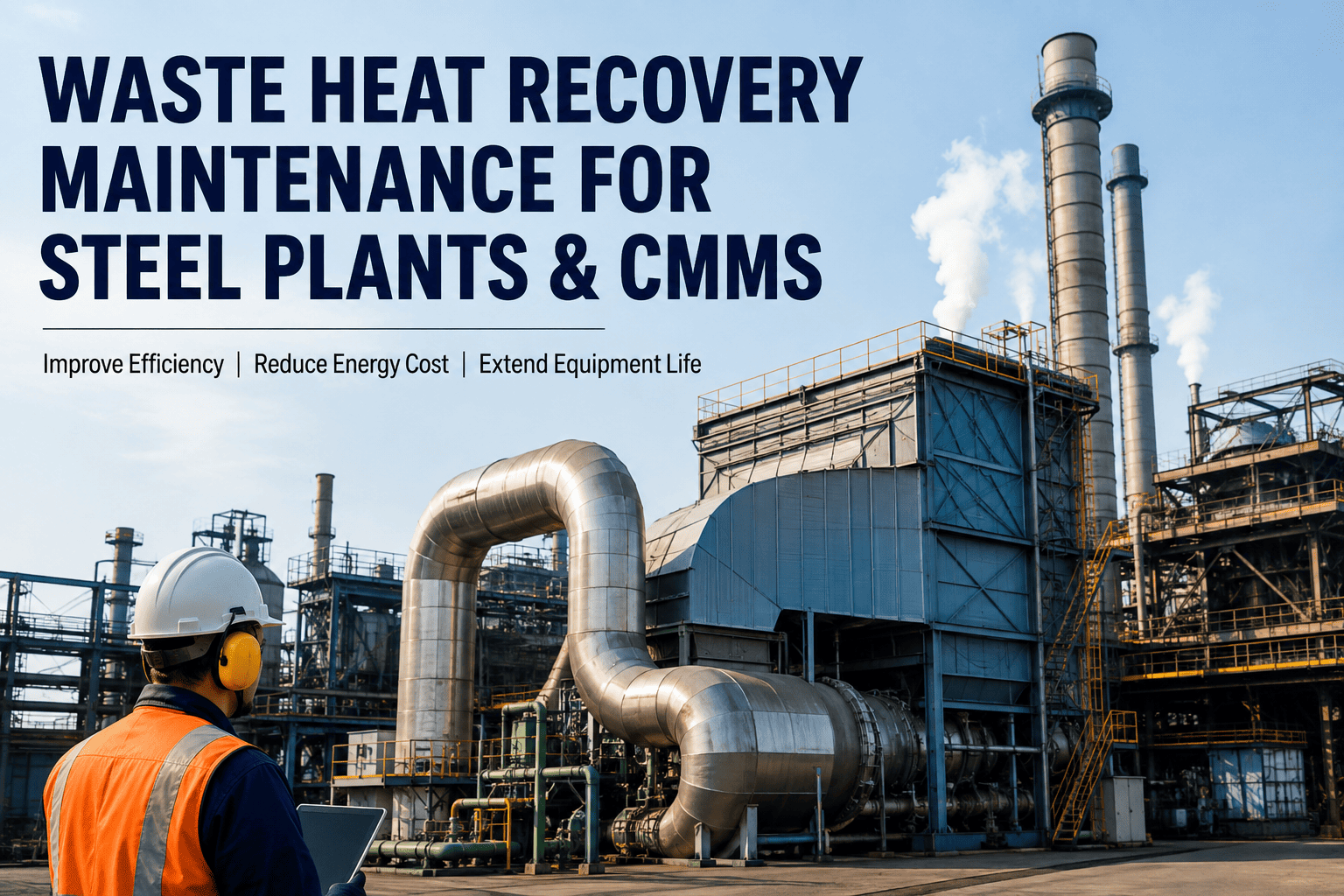
Waste Heat Recovery Maintenance: WHR Boiler, Turbine & Heat Exchanger Guide
How integrated steel plants capture — and lose — recoverable energy, and the maintenance disciplines that close the gap between theoretical and actual WHR performance.
Your WHR System Is Running — Just Not at the Efficiency You Think
Walk into any integrated steel plant and ask the energy manager about WHR performance. The answer is almost always "running fine." But the numbers tell a different story. A WHR boiler generating 18 t/hr of steam on day one of the campaign produces 14.2 t/hr eighteen months later — with no alarms, no visible failure, and no work order ever raised. The loss is invisible because nobody is tracking approach temperature, flue gas exit temperature, or steam generation per tonne of hot metal simultaneously.
Scale and ash deposits on boiler tubes create thermal resistance that cuts steam generation 12–22% before any pressure or temperature alarm trips. Most plants notice only at annual outage.
Steam turbine labyrinth seals in WHR service wear faster than conventional turbines due to cyclic load following heat source variation. A 0.3 mm gap increase cuts isentropic efficiency by 4–6%.
Cooling water hardness deposits on shell-and-tube surfaces. A 0.5 mm calcium carbonate layer increases thermal resistance by 300% compared to a clean surface — invisible on a flow meter.
Coke dry quenching systems lose 8–15% steam recovery to poor sealing at the charging shaft and lift pot. The loss is continuous, unmetered, and mistaken for process variation by shift operators.
How a 3 MT/yr Plant Loses ₹6.4 Crore Quietly
- Capacity3 MT/yr integrated mill
- WHR Assets2× WHR boilers, 1× CDQ, 1× BF TRT
- Steam generationRated 280 t/hr WHR
- PM programAnnual outage only
- MonitoringManual shift readings
Zero predictive or condition-based work orders were raised on any WHR asset. All losses attributed to "process variation" in shift reports.
Maintenance Standards for Each WHR Asset Class
Each WHR asset class has distinct failure modes, monitoring parameters, and intervention frequencies. Generic PM schedules applied uniformly across all heat recovery equipment is one of the most common causes of chronic under-performance.
4 Maintenance Mistakes That Destroy WHR Efficiency
WHR boilers and turbines are scheduled for maintenance only at major outages because they're classified as "energy utilities" rather than production assets. The result: no daily performance tracking, no degradation trend, no early intervention. A WHR boiler losing 1% efficiency per month goes unnoticed for 8 months.
Fixed-interval soot blowing is both insufficient and wasteful. During high-sulphur campaigns, fouling accumulates in 6 hours. During clean campaigns, blowing every 2 hours wastes steam and erodes tubes. Need-based soot blowing triggered by flue gas exit temperature reduces tube erosion by 30% and keeps boilers cleaner between outages.
Annual cleaning schedules are arbitrary. A cooling water circuit with high hardness fouls a heat exchanger to cleaning threshold in 4 months. Calendar-based cleaning wastes outage time and allows performance losses to accumulate between arbitrary intervals.
A WHR turbine operating at 86% isentropic efficiency will still pass a nameplate-referenced check if the acceptance criterion is 80%. The real loss — 6% isentropic efficiency representing ₹40–80 lakh/year in lost generation — goes undetected indefinitely.
How OxMaint Manages WHR Asset Performance End-to-End
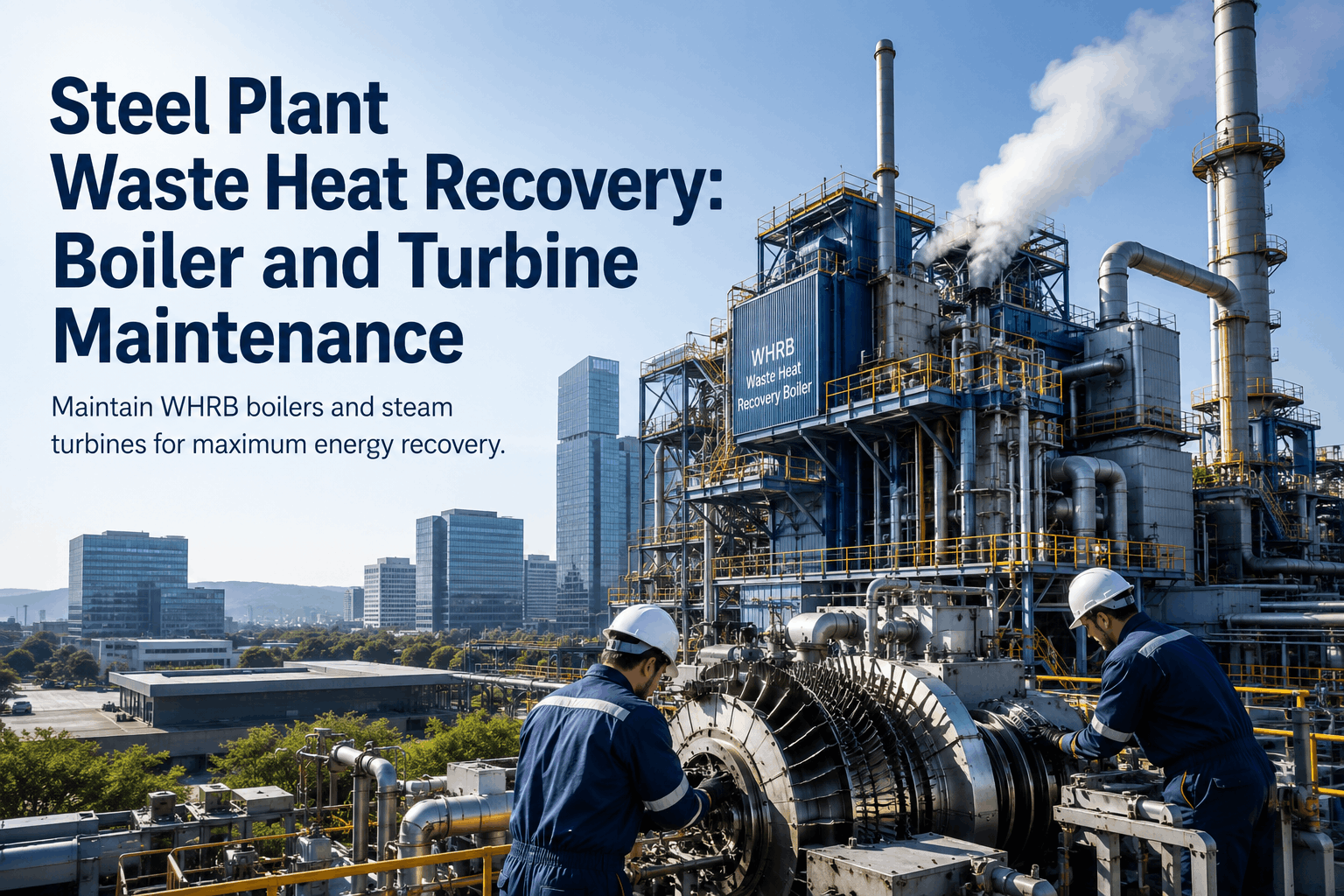
OxMaint's Energy Equipment PM module connects your WHR asset register, sensor data, and maintenance workflows in one platform. From per-charge CDQ steam yield to monthly fouling resistance calculations on heat exchangers — every parameter is tracked, every threshold triggers a work order, and every loss is quantified in ₹ before it accumulates.
Import your WHR boiler, turbine, heat exchanger, CDQ, and TRT assets into a pre-built steel plant energy equipment hierarchy. PM schedules, criticality ratings, and performance KPIs are pre-loaded and ready to customise. No blank-slate setup.
Connect to your DCS historian via OPC-UA or REST API for automatic parameter ingestion. Plants without full instrumentation use mobile shift entry. OxMaint flags which parameters are measured vs. estimated so your team knows confidence level on every KPI.
OxMaint builds a normal performance model for each WHR asset accounting for campaign age, load variation, and seasonal ambient conditions. Deviations from the model — not just alarm thresholds — trigger early-warning work orders. First alerts typically appear within 60–90 days of deployment.
Real-time parameters trigger immediate alerts. Daily calculations trigger shift-end review tasks. Monthly trend calculations trigger inspection work orders. Annual outage tasks are pre-scheduled with parts and labour requirements. No manual scheduling, no missed intervals.
Every performance deviation is translated into a ₹/day energy loss estimate using your current substitute fuel cost. Monthly energy loss reports by asset and root cause show exactly where WHR performance is being left on the table — and build the maintenance investment case automatically.
What Changes When WHR Maintenance Is Managed Proactively
WHR Maintenance — Key Questions Answered
How often should WHR boiler tubes be inspected in a steel plant?
At a minimum, boroscope inspection of the convective section should be conducted quarterly, and a full tube inspection with NDT at every annual outage. However, the more reliable trigger is performance-based: if flue gas exit temperature rises more than 30°C above baseline, or approach ΔT exceeds 35°C, an unscheduled inspection should be initiated regardless of calendar timing. Tube skin temperature IR scans weekly catch localised hot spots that routine inspections miss.
What is the financial impact of a 10% WHR boiler efficiency loss in a 3 MT/yr plant?
At a 3 MT/yr plant generating approximately 280 t/hr of WHR steam at design, a 10% efficiency loss reduces steam output by 28 t/hr. At a substitute fuel cost of ₹2,800–3,200/GJ, this translates to ₹4–6 crore annually in additional fuel cost — assuming no production impact. The loss typically accumulates over 12–18 months without a single work order being raised, because no individual shift reading shows an alarming deviation.
How does OxMaint detect WHR turbine degradation before a trip?
OxMaint tracks three leading indicators simultaneously: heat rate deviation from a rolling 90-day baseline, steam consumption vs. power output ratio against the design curve, and vibration spectrum trending at bearing housings. A trip is typically preceded by 4–6 weeks of detectable drift in all three parameters. OxMaint generates a maintenance recommendation when any single indicator deviates by more than 5% from baseline — well before the 8–10% deviation that typically precedes a forced outage.
Can OxMaint work with plants that have incomplete WHR instrumentation?
Yes. OxMaint supports three instrumentation scenarios. Fully metered plants ingest flow meter and temperature data automatically via SCADA historian integration. Partially metered plants use process parameters to estimate unmeasured flows, with uncertainty bands clearly displayed. Plants with minimal instrumentation use mobile shift entry — operators log key readings on smartphones and OxMaint calculates efficiency, fouling resistance, and heat rate from those entries. Even at shift-entry resolution, daily balance reconciliation identifies large performance gaps.
What is the right heat exchanger cleaning interval for WHR service?
There is no universally correct interval — it depends entirely on fouling rate, which varies with cooling water hardness, process gas composition, and operating temperature. The correct approach is to calculate fouling resistance monthly from logged inlet and outlet temperatures on both sides. Clean when calculated Rf exceeds 0.0004 m²K/W regardless of calendar date. This data-driven approach typically reveals that some units need cleaning every 4 months while others run 18 months clean.
How long does it take to set up OxMaint for a WHR asset programme?
The WHR asset register, pre-built PM schedules, and performance KPI templates are live within 48 hours of sign-up. SCADA historian integration via OPC-UA or REST API typically takes 3–5 working days depending on IT access. The AI baseline model requires 60–90 days of operating data before generating predictive alerts. Plants using manual shift entry can start tracking performance gaps from day one of deployment without any IT integration.
Your WHR System Is Losing Energy Right Now. You Just Can't See It Yet.
OxMaint makes every WHR performance gap visible within 48 hours — and turns the loss into a scheduled work order before the next billing cycle closes. No hardware. No IT project. Just a CMMS that actually tracks energy equipment performance.
-programs.png)