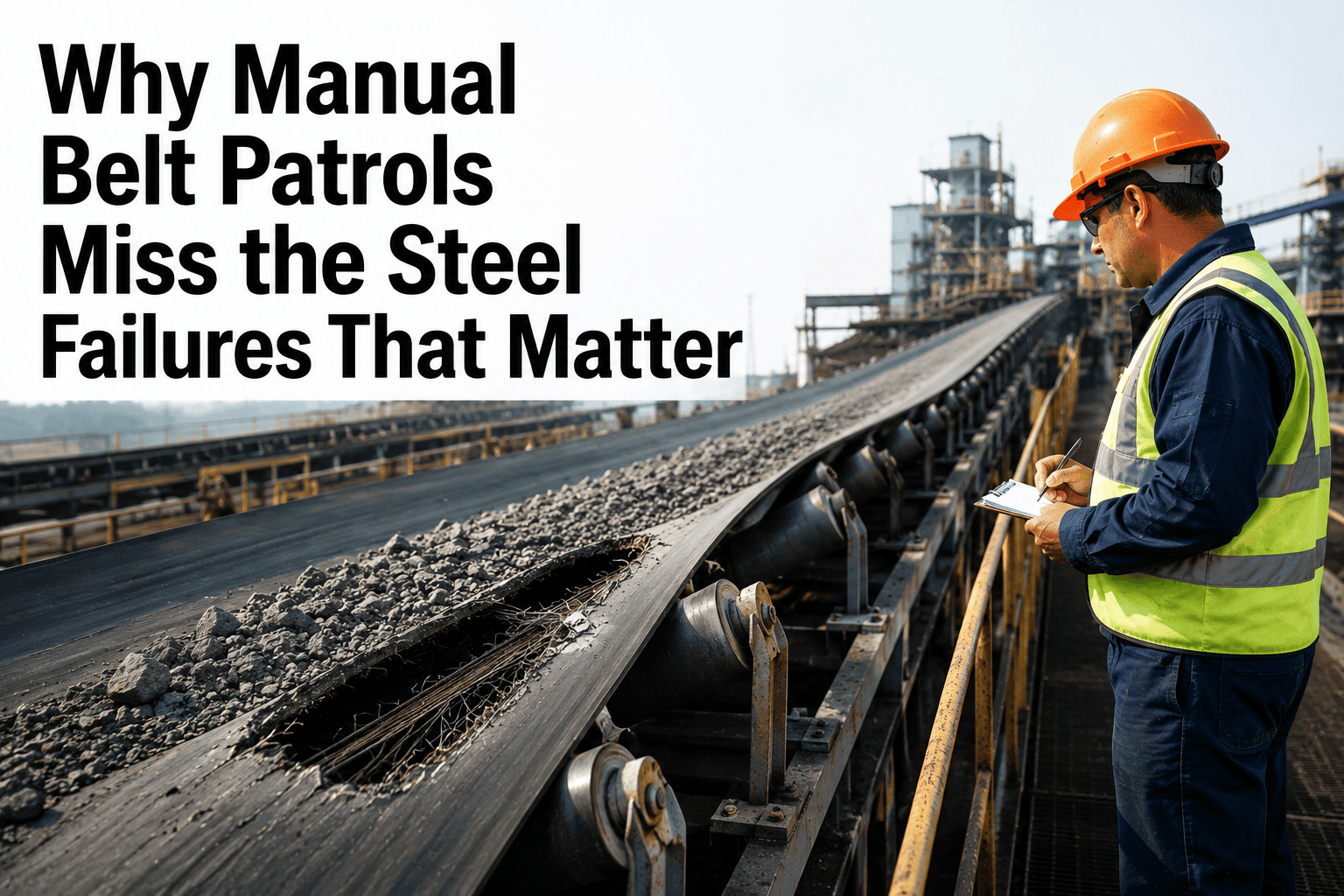
A technician walks the length of a 400-metre ore conveyor twice a shift, checking idlers by eye and by ear the way patrols have worked for decades. Three weeks later, one of those idlers seizes, drags against the belt, and shuts the line down for two days. Nothing on that patrol's paper checklist was wrong — every box was ticked, every signature was in place. The seal degradation that let dust into the bearing had been building for over a month, and a walking patrol has no way to hear or feel that kind of gradual, sub-surface wear before it is nearly done failing. Book a demo to see what a digital inspection catches that a walking patrol cannot.
Field Notes · Steel Plant Conveyor Maintenance
Why Manual Belt Patrols Miss the Steel Failures That Matter
A walking patrol is built to catch what a person can see and hear in the moment — a torn belt, a screeching pulley. It is structurally blind to the slower failures that cause most of the damage, and it leaves no record strong enough to prove otherwise.
Three Structural Blind Spots of Manual Patrol Rounds
These are not failures of effort. A conscientious technician walking a patrol route is still limited by what a paper checklist and human senses can register in the time available — the blind spots below exist regardless of how carefully the round is walked.
Blind Spot 1
Inspection quality depends on who is walking today
Human eyes and ears catch obvious damage — a torn cover, a screeching pulley — but bearing degradation inside a roller develops for three to six weeks with no external sound or visible sign until it is nearly done failing.
Blind Spot 2
A finding on paper has no owner and no deadline
A noted abnormality goes into a folder. Five separate paper forms filed across five weeks look like five isolated notes rather than one developing pattern on the same idler — the pattern that would justify a proactive repair stays invisible.
Blind Spot 3
A paper record cannot prove an inspection happened
Pre-signed and backdated checklists are common enough that incident investigators routinely find every box checked on the morning of a failure, with no way to confirm the walk itself ever took place.
See the Findings a Paper Patrol Would Have Missed
Oxmaint replaces the clipboard with a mobile, photo-first checklist that timestamps every finding at the asset location and routes it straight to a work order — closing every one of the three blind spots above.
What a Walking Patrol Catches vs What It Misses
Some conveyor failures announce themselves. Others build silently for weeks inside a bearing housing or across five separate patrol shifts. The table below lines the two up against each other.
| Failure Signature |
Catchable by Eye/Ear |
Digital Capture Method |
Lead Time Gained |
| Torn or cut belt cover |
Yes, if the patrol walks past it |
Photo-flagged finding with severity tag |
Same shift |
| Belt mistracking, edge wear |
Yes, visible drift toward one side |
Pass/fail check with a required cause code |
Days |
| Bearing wear inside idler housing |
No external sign until near failure |
Vibration and thermal reading logged at inspection |
3–6 weeks |
| Return-side carryback buildup |
Only if the patrol checks the return side |
Scraper condition checklist with photo evidence |
1–2 weeks |
| Recurring mistracking, same zone |
No, looks like isolated events on paper |
Trend history per asset with pattern flag |
Weeks to months |
| Pre-signed or skipped inspection |
Not self-detectable |
Timestamped, geotagged photo requirement |
Immediate |
The Cost of a Missed Signal
None of the three blind spots are abstract. Each one has a direct line to production loss, safety exposure, or an audit finding that a paper trail cannot defend against.
<4 hours
The runtime a blast furnace has left once a critical feed conveyor is starved by an undetected belt failure.
60%+
Share of total conveyor maintenance cost that traces back to rollers — the component a walking patrol is least equipped to assess internally.
3–6 weeks
How far ahead vibration and thermal data can flag a bearing failure before a walking patrol would notice anything at all.
Expert Review — What an Incident Investigation Actually Finds
I have conducted incident investigations where the paper inspection record showed the asset was inspected the morning of the failure, with every box checked, and there was almost certainly no way that inspection had actually happened. There is no way to distinguish a real inspection from a fabricated one on paper. What I consistently see once a plant moves to digital checklists with required photo fields is that inspection quality improves on its own, because the technician knows the record is real and searchable. Behaviour changes when accountability is tangible.
Industrial Safety Auditor
Incident Investigator · 25 years in high-consequence maintenance environments
Frequently Asked Questions
Why do manual belt patrols miss bearing and idler failures specifically?
Bearing degradation inside an idler develops gradually over three to six weeks with no external sound or visible change until it is nearly done failing, which puts it outside what a walking patrol's eyes and ears can register.
Can a paper checklist prove an inspection actually took place?
Not reliably. Paper forms can be pre-signed or backdated, and investigators regularly find fully completed checklists dated the morning of a failure with no way to confirm the round was walked.
How does a digital inspection close the accountability gap?
A required, timestamped, geotagged photo at the asset location replaces a signature that can be added from anywhere.
Start a free trial to see how the requirement works in the field.
What happens to a finding after a manual patrol logs it on paper?
It typically goes into a folder with no assigned owner or deadline, and recurring findings on the same asset across separate forms are hard to connect into one pattern until the failure makes the pattern obvious.
Is switching from paper patrols to digital inspection a large operational change?
The checklist content stays close to what a plant already inspects — the change is in enforcement and routing.
Book a demo to see a zone-specific checklist configured for your conveyor network.
Give Your Conveyor Network an Inspection Record That Holds Up
Oxmaint replaces the paper patrol with a mobile checklist that captures photo evidence at the asset, routes every failed finding to a work order automatically, and turns scattered notes into one trend line per idler.