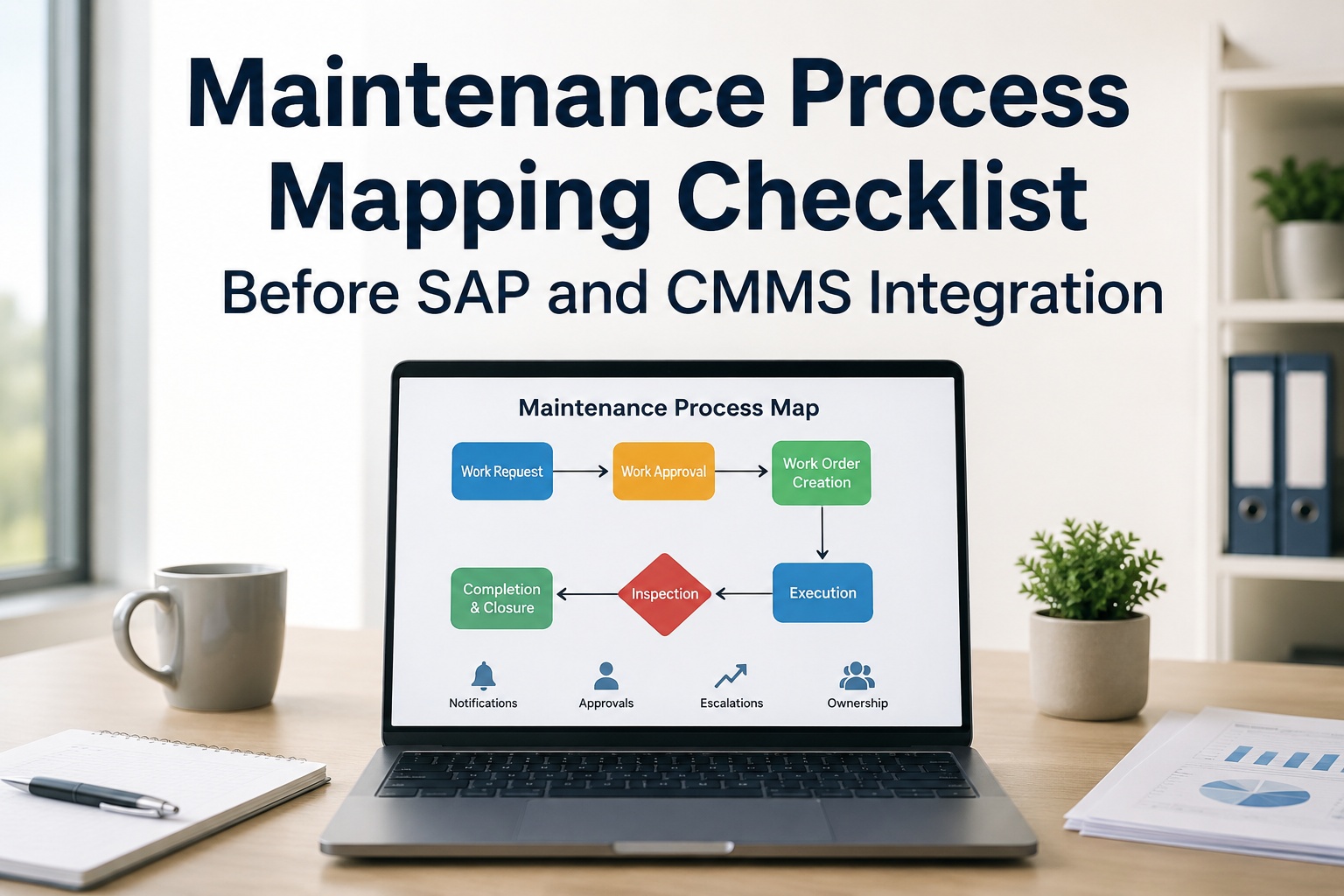
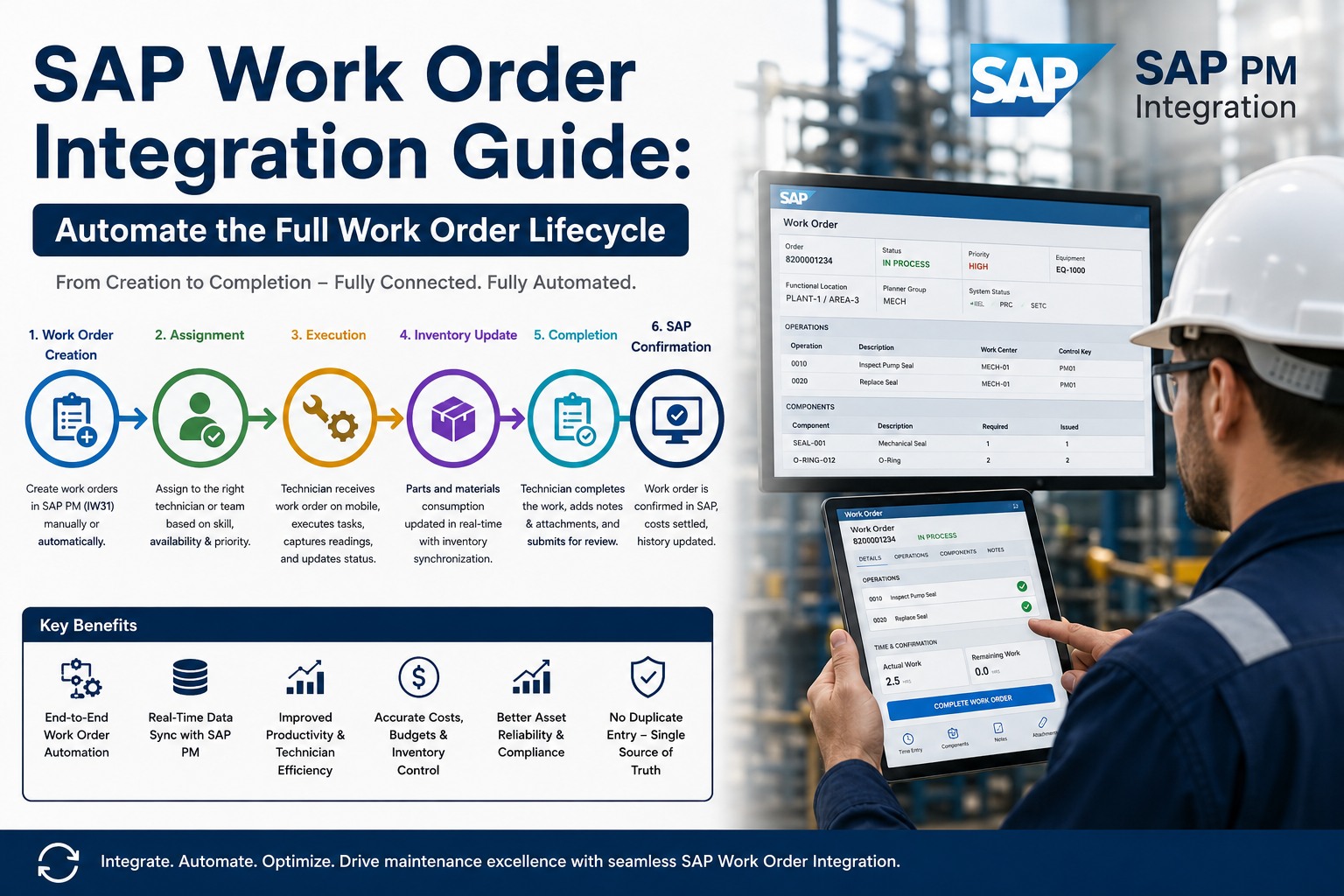
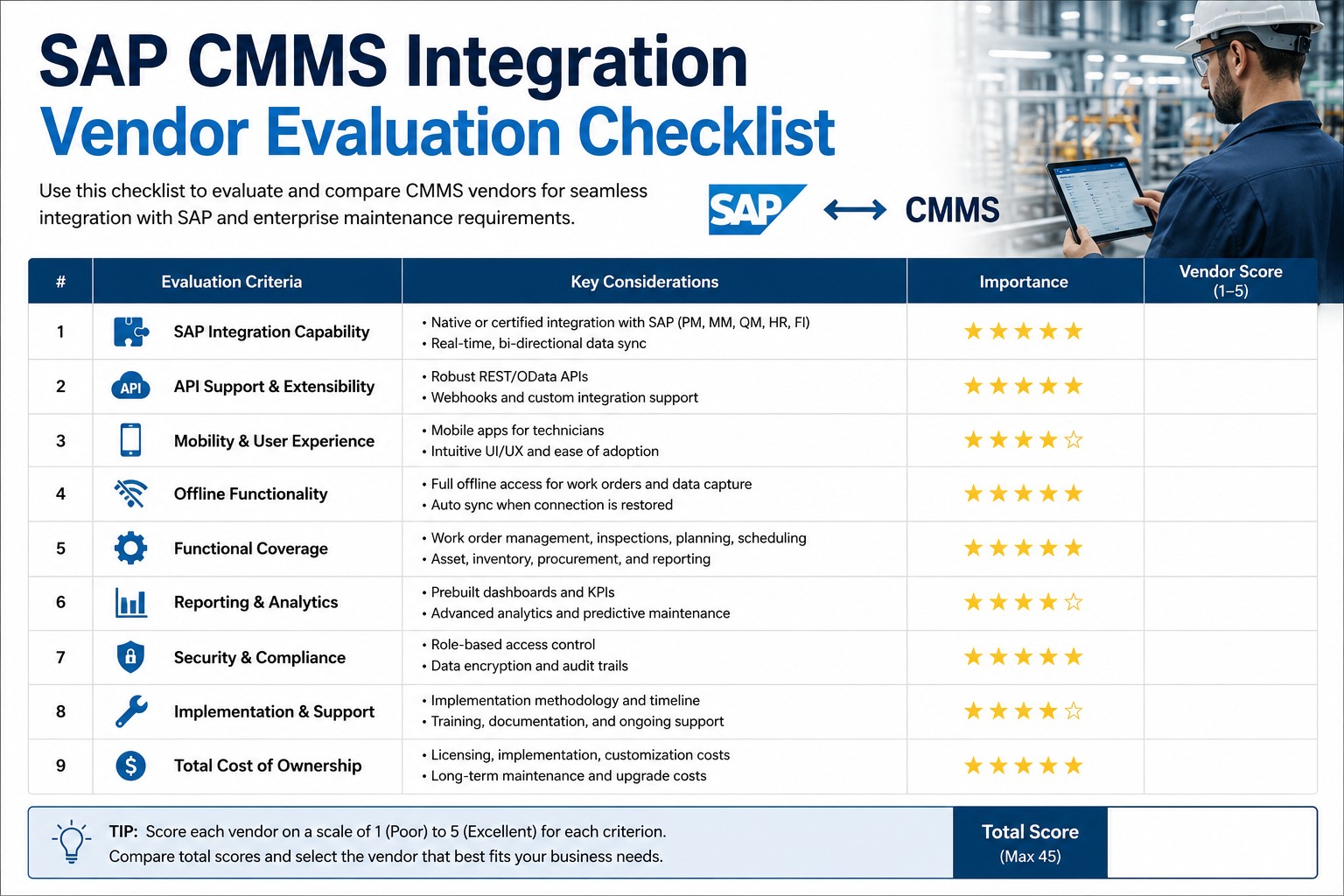
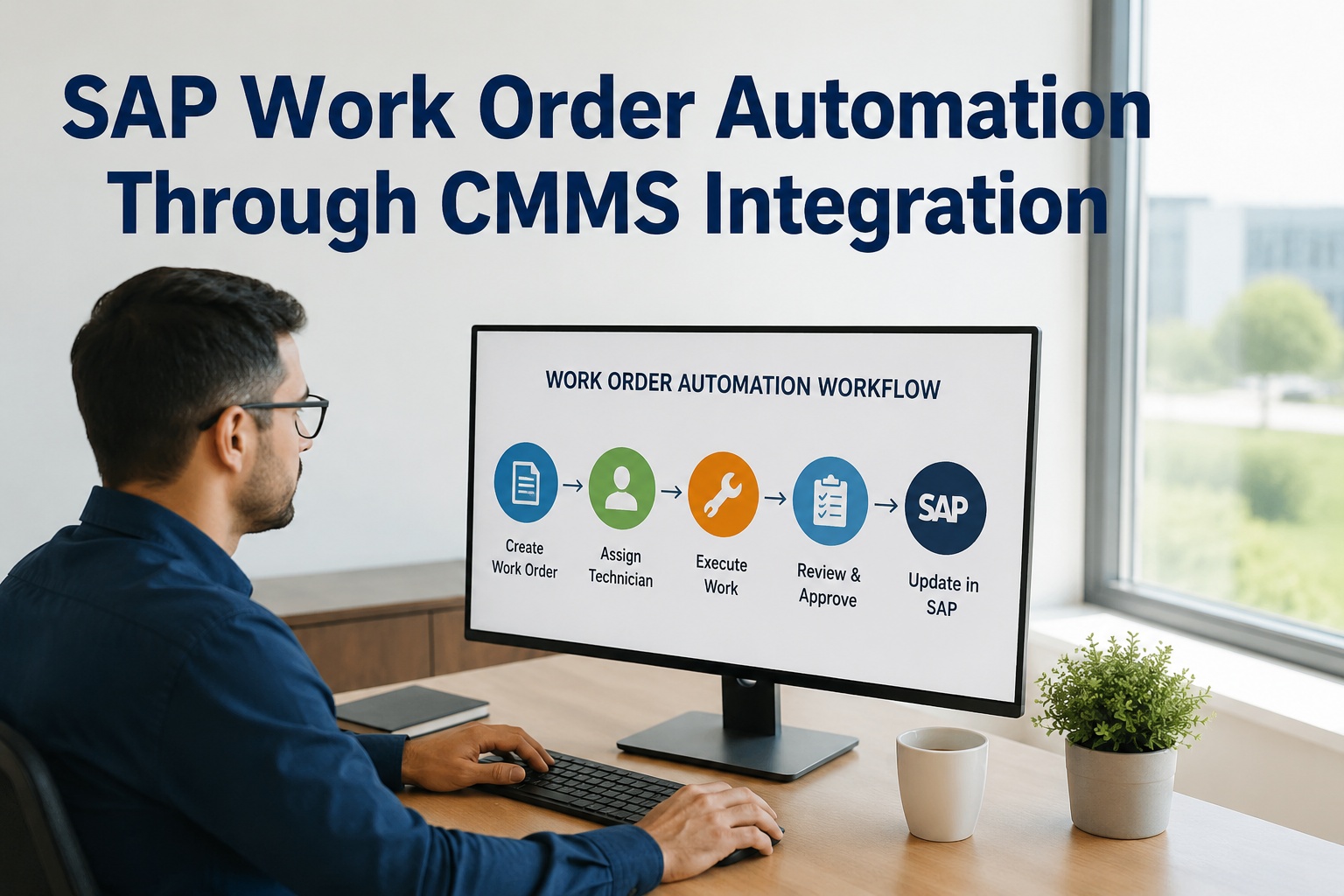
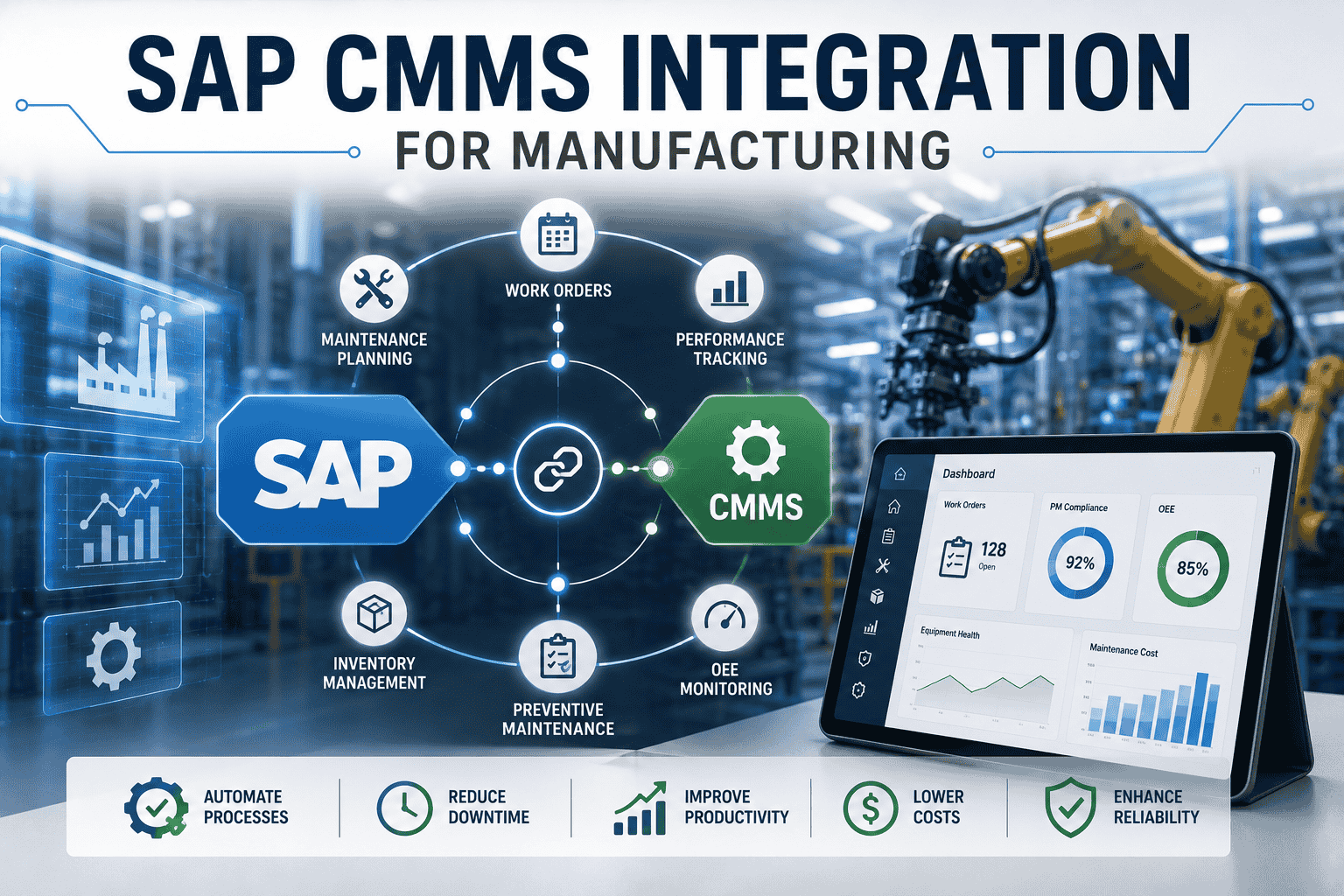
SAP and CMMS configuration is the easy part. The hard part is the maintenance process the configuration is supposed to support—the actual handoffs, approvals, escalations, and decisions that happen between Operations, planning, technicians, storeroom, and finance. Skip process mapping and the integration ends up automating dysfunction at scale. Done properly, process mapping produces the documented workflow that lets configuration decisions be defensible, training be accurate, and post-go-live troubleshooting traceable. This six-role, 30-item checklist covers what disciplined teams document before any configuration begins. Book a free demo to walk through process mapping.
65-80%
Of SAP / CMMS integration delays trace to incomplete or absent process mapping in discovery
Source: Integration project benchmarks
6
Functional roles whose workflows must be mapped before SAP-CMMS configuration begins
Source: This checklist scope
30
Specific process artifacts to document across all six roles and the full work order lifecycle
Source: This page
3-5×
Cost of fixing process gaps post-go-live versus catching them during pre-integration mapping
Source: SAP implementation research
Why Process Mapping Before Integration Is Non-Negotiable
Most SAP-CMMS integrations that struggle don't fail because of technology choices. They fail because the maintenance process the technology was supposed to support wasn't documented before the configuration started. The integration team configured against assumed workflows that turn out not to match what actually happens at the plant—and the gaps surface in production, where they're three to five times more expensive to fix than they would have been in discovery. Process mapping is the discipline that prevents this. It produces the documented AS-IS workflow that lets configuration decisions be made against real operating reality rather than against assumptions about it.
The mapping exercise also surfaces the tribal knowledge that lives in people's heads but isn't written down anywhere—the unwritten rules about who gets called for emergency parts, the informal coordination between Operations and Maintenance, the workaround that compensates for a missing approval step. This knowledge has to be visible in the AS-IS map before it can be either preserved in the new configuration or deliberately retired as part of the integration. Maintenance and integration leads ready to apply this discipline to their current project can Sign up free to begin process mapping on a live integration project.
The Six-Role Process Mapping Checklist
The swim-lane checklist below organizes mapping work by functional role across the full work order lifecycle. Each lane represents one role; the five items inside each lane are what to document for that role across notification, planning, scheduling, execution, and closure. Work the lanes in sequence—the upstream roles (Operations, Planning) feed the downstream ones (Storeroom, Finance), and the maps depend on each other.
WORK ORDER LIFECYCLE FLOW
Notification
→
Planning
→
Scheduling
→
Execution
→
Closure
- Failure / condition reporting channels mapped (call, app, log, sensor)
- Notification severity & priority criteria documented
- Operations sign-off authorities identified by area
- Downtime / shutdown coordination flow captured
- Restart-after-repair handoff & verification process
- Work order intake & triage process mapped
- Asset criticality classification system documented
- Parts identification & sourcing workflow captured
- Planning lead-time requirements by work type documented
- Job plan / task list usage protocols mapped
- Weekly scheduling cadence & input sources documented
- Resource availability inputs mapped (crews, contractors)
- Production schedule coordination protocols captured
- Slot allocation & shift planning rules documented
- Emergency override & re-prioritization rules captured
- Work order dispatch & acknowledgment flow mapped
- Permit-to-work & safety check process documented
- Field data capture protocols (time, parts, observations)
- Hand-off between shifts / crews documented
- Completion confirmation & sign-off process mapped
- Parts requisition flow from work order documented
- Goods movement & issuing protocols mapped
- Reservation, kitting, & return flows captured
- Stock replenishment triggers documented (min/max, ROP)
- Cycle counting & adjustment workflows mapped
- Cost center assignment rules documented per work type
- Labor & material settlement flow mapped
- Cost approval thresholds & escalation paths captured
- Capital vs operational classification rules documented
- Month-end maintenance close process mapped
5
Lifecycle Stages Covered
AS-IS
Documented Before Configuration
The pivotal lane in the swim-lane structure is R3—Maintenance Scheduling—because it sits at the intersection of every other role. Schedulers consume planning output, coordinate with Operations on production windows, allocate technicians, and trigger storeroom kitting. A scheduling process that isn't documented becomes the bottleneck where every other role's mapped workflow stalls. Teams ready to deepen their mapping on the highest-leverage lanes can Sign up free to operationalize the swim-lane mapping for their plant.
Three Mapping Gaps That Doom Integration Projects
Three specific mapping gaps account for most "the system doesn't work the way we expected" complaints that surface six to nine months after SAP-CMMS go-live. Each is preventable through disciplined upfront documentation.
Gap 1
Tribal Knowledge Undocumented
The "how things actually get done" workflow that lives in long-tenured staff's heads but isn't written anywhere. Configuration is built against documented workflows that don't include the workaround the plant has used for fifteen years. Typical impact: 30-40% of workflows need rework within the first quarter post-go-live.
Prevented By
Interview-based mapping with long-tenured staff captured in items across all six lanes, especially R1 (Operations) and R4 (Field Technician)
Gap 2
Approval Paths Underspecified
The map shows "work order goes to approver" without specifying who, by what threshold, on what timeline, with what escalation if delayed. Configuration ends up with arbitrary defaults that don't match operating reality. Typical impact: 40-60% of work orders trapped in unclear approval states in week 1.
Prevented By
R6 (Finance) cost approval thresholds and R2 (Planning) authorization mapping done with explicit role names, dollar thresholds, and time SLAs
Gap 3
Inter-Role Handoffs Skipped
Each lane mapped well in isolation, but the transitions between lanes—planner-to-scheduler, scheduler-to-storeroom, technician-to-finance—aren't documented as explicit events. Configuration ends up with implicit handoffs that drop work between roles. Typical impact: continuous low-grade coordination problems that erode user trust.
Prevented By
Explicit handoff events documented between each pair of adjacent lanes (R1→R2, R2→R3, R3→R4, R3→R5, R4→R6)
The unifying theme across all three gaps: each is a question that someone on the project team didn't ask during discovery. The swim-lane checklist exists specifically to force those questions before they become production incidents. Project leads ready to compare their current discovery scope against this checklist can Sign up free to run a discovery gap diagnostic against the swim-lane framework.
See Process Mapping Done Right Before SAP-CMMS Configuration
Walk through swim-lane mapping on an actual maintenance operation, with role-by-role documentation feeding directly into configuration decisions. 30-minute live demonstration.
From Process Map to System Configuration: The Translation Discipline
Documented process maps only deliver value if they actually drive configuration decisions. The translation discipline below shows how successful programs convert AS-IS process maps into TO-BE system configuration, with each step producing audit-traceable evidence.
Step 1
AS-IS Mapping Complete
All six swim lanes documented with role names, thresholds, SLAs, and handoff events. Tribal knowledge captured via interviews. Pain points and waste explicitly flagged.
Step 2
TO-BE Design Workshop
Each lane reviewed: what stays, what changes, what gets retired. Decisions documented with explicit rationale. Process owners sign off on the TO-BE map before configuration starts.
Step 3
Configuration Traceability
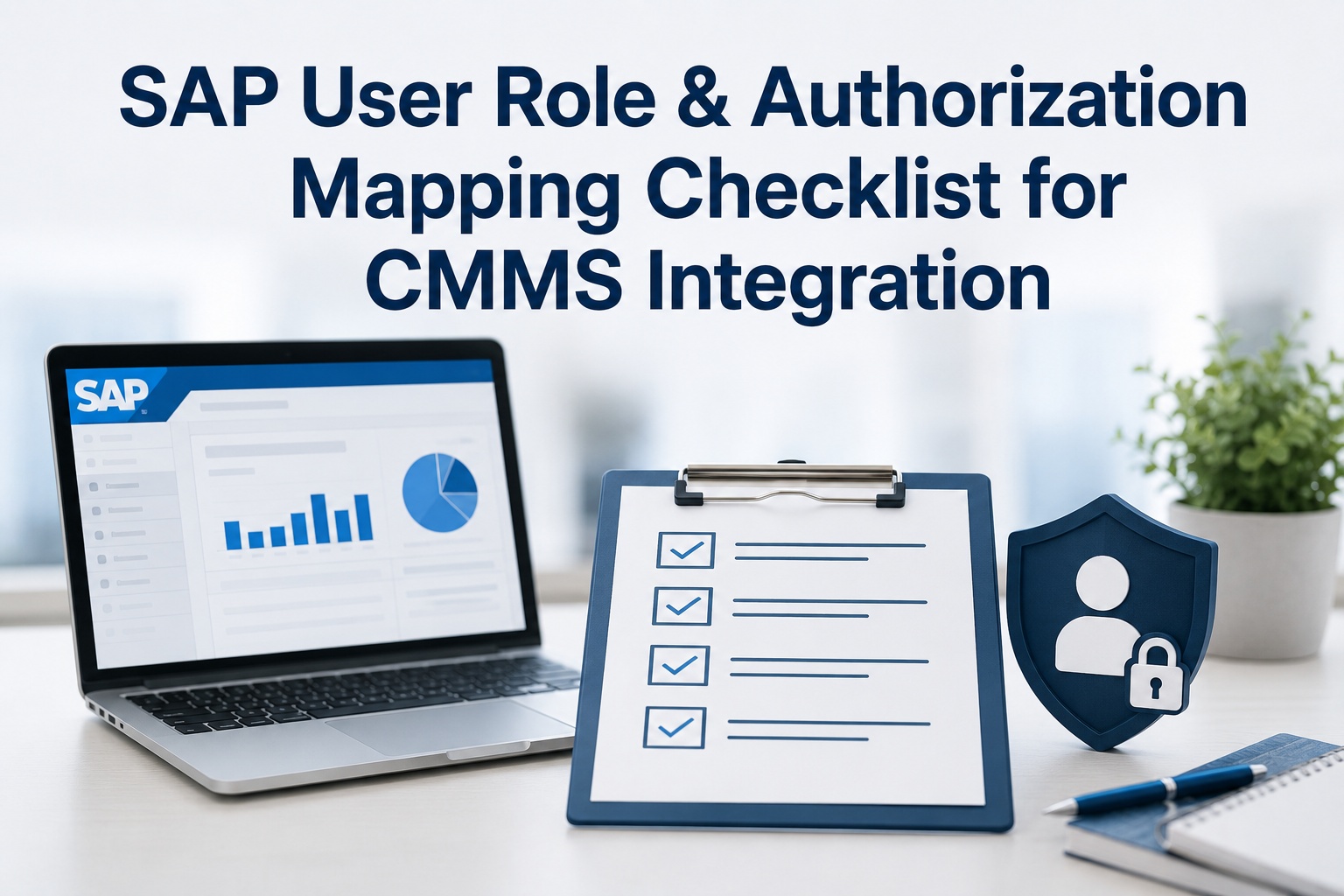
Each configuration decision traces to a specific TO-BE map element. RBAC roles map to lane owners. Approval workflows map to documented thresholds. SAP user roles map to functional swim lanes.
Step 4
Training & Go-Live Validation
Training content built directly from TO-BE maps. UAT scenarios validate each handoff event. Day-1 success criteria reference the documented workflow stages.
By the end of Step 4, every configuration decision is traceable to a documented process choice that someone with operational authority signed off on. That traceability is what turns a SAP-CMMS go-live into a documented business transformation rather than a software deployment. Project teams ready to walk this translation discipline on their current program can Book a free demo to walk through the AS-IS to TO-BE translation framework.
Expert Perspective: What Distinguishes Effective Process Mapping
The maintenance process maps I've seen actually drive successful integrations share a property that's easy to dismiss: they're done by people who know the work, not by consultants drawing boxes on whiteboards. The fastest way to spot a bad process map is to find the lane that the integration team mapped without sitting with the actual role. The technician lane mapped without watching technicians is fiction. The storeroom lane mapped without working the cage during a shift change is theatre. The good maps reflect what really happens, including the ugly parts—the workarounds, the informal calls, the unwritten rules. The integration teams that capture those honestly produce configurations that match operating reality. The ones that map an idealized version produce configurations that produce post-go-live emergencies.
Map What Is, Not What Should Be
AS-IS mapping captures reality including workarounds, informal coordination, and tribal knowledge. Idealized maps produce configurations that don't survive contact with the actual operation.
Sit With the Role
The best lane maps come from spending shift hours alongside the role. Whiteboard interviews capture the official story; shadowing captures what actually happens when nobody's watching.
Make Handoffs Explicit
The transitions between lanes are where work gets dropped. Document each handoff as an explicit event with sender, receiver, trigger condition, and expected response time.
Make Your Next Integration the One That Actually Worked
Six swim lanes. Thirty mapped artifacts. Translation discipline that turns AS-IS into TO-BE. See the framework running on a live maintenance organization preparing for SAP-CMMS integration.
Frequently Asked Questions
How long does the swim-lane process mapping exercise take for a typical plant?
A focused mapping exercise for a mid-size manufacturing or process plant runs three to five weeks of elapsed time, with two to three full-time-equivalent people on the discovery side. The cadence is typically one lane per week, with the first week spent on Operations and Planning (the upstream lanes that feed everything else), the middle week on Scheduling and Field Technician, and the final week on Storeroom and Finance. Multi-site or multi-plant operations may need additional time for cross-site consolidation, where common workflows are identified and site-specific variations are explicitly catalogued.
Should we use BPMN or another formal notation for the maps?
The notation matters less than the discipline. BPMN works well if the integration team and the operations team are both fluent in it; otherwise, the formal notation becomes a barrier rather than a clarity aid. Many successful programs use simplified swim-lane diagrams with role columns, lifecycle-stage rows, and plain-language process descriptions. The minimum requirement is that the map captures roles, handoffs, thresholds, SLAs, and decision points unambiguously—however that's notated. Sophistication of notation is irrelevant if the underlying content is incomplete.
What's the difference between AS-IS and TO-BE mapping?
AS-IS mapping documents how the maintenance process actually operates today—including workarounds, informal coordination, and tribal knowledge. TO-BE mapping documents how the process will operate after the SAP-CMMS integration goes live. Successful programs always do AS-IS first, then design TO-BE with explicit decisions about what stays, what changes, and what gets retired. Skipping AS-IS and going straight to TO-BE produces configurations that work in theory but fail when they meet the operational reality the AS-IS would have surfaced.
Who should own process mapping in a SAP-CMMS integration project?
Process mapping ownership belongs with the maintenance organization, not with the system integrator. The SI can facilitate, document, and challenge—but the content has to come from the people who run the maintenance operation. Specifically: a senior maintenance leader as overall sponsor, lane owners drawn from each functional role (a planner for the Planning lane, a senior technician for the Technician lane, etc.), and an integration architect from the SAP side to ensure the maps capture what the configuration will need to consume. The integration team facilitates; the maintenance team owns.
How do we handle process variations between multiple plants or sites?
Multi-site operations require a layered approach. Start with the common process spine—the workflow elements that should be standardized across sites for consistency, comparability, and shared system configuration. Then explicitly catalog the site-specific variations that genuinely differ for operational or regulatory reasons. The configuration accommodates both: standardized workflows for common elements, site-specific configuration variants where variations are documented and justified. The mistake to avoid is either forcing artificial standardization that breaks site operations or accepting every variation without examination, which produces configurations too complex to maintain.