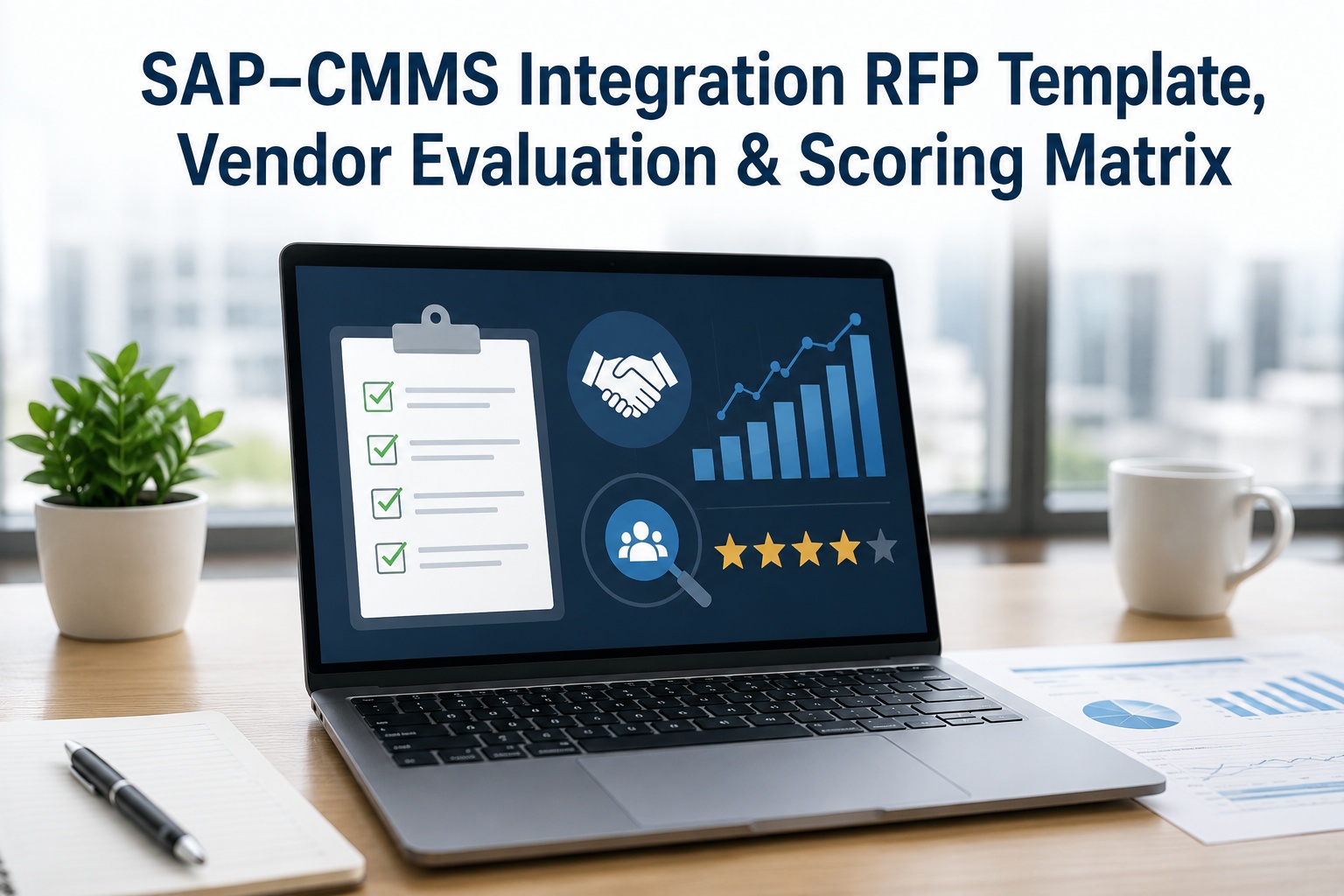
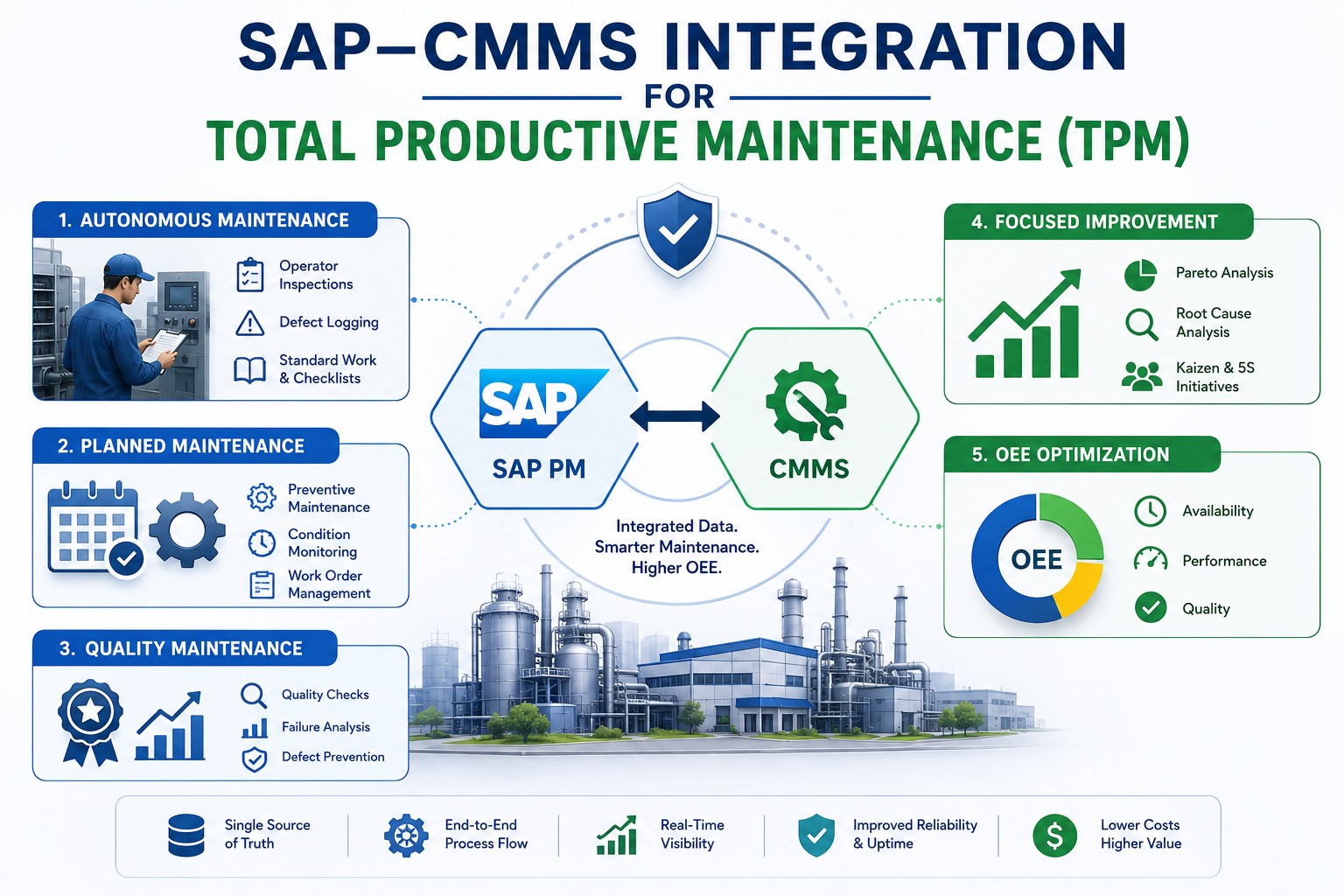
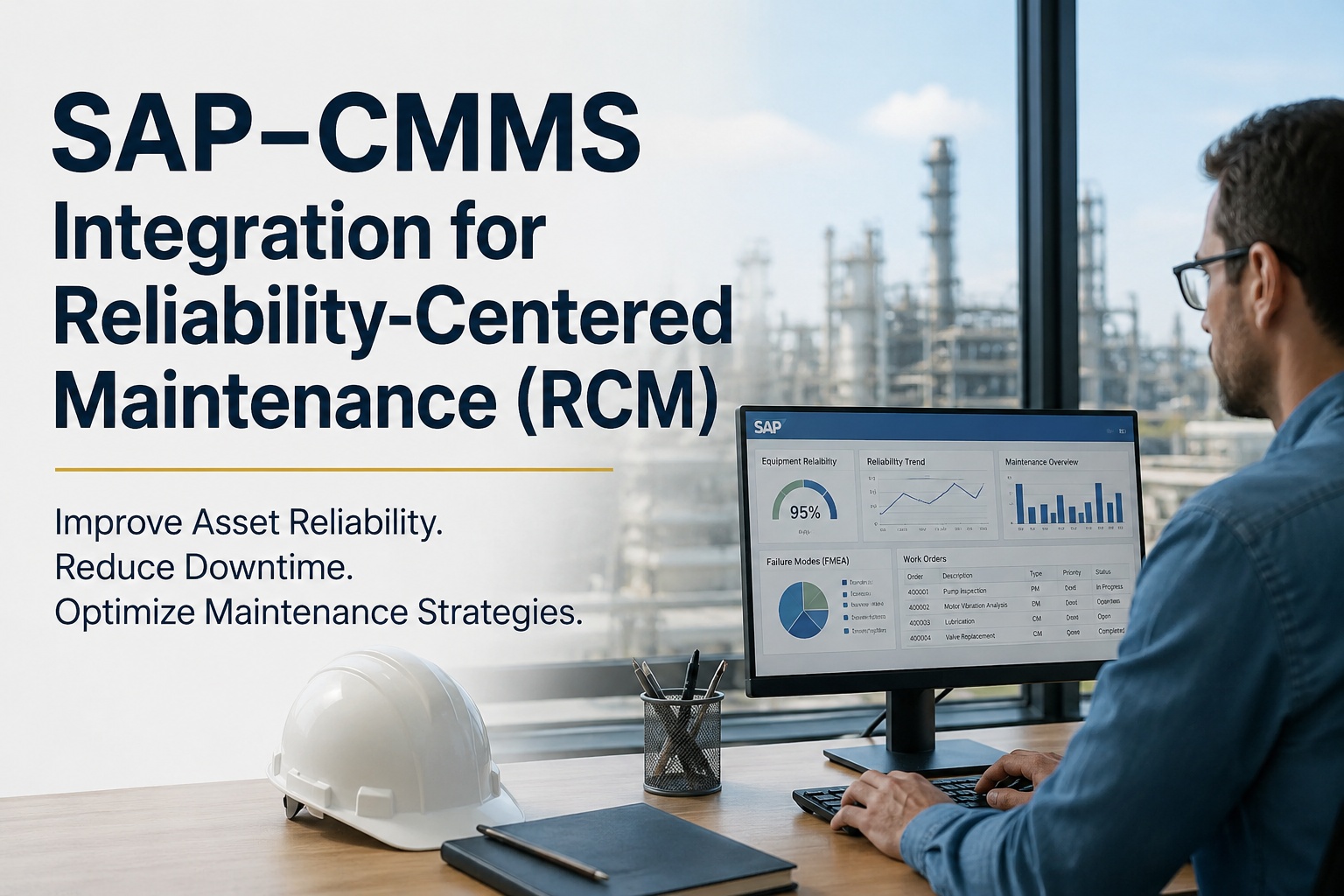
Selecting the wrong SAP-CMMS integration vendor doesn't just slow your implementation—it can permanently cap your maintenance organization's productivity. The wrong vendor produces fragile integrations that break with every SAP upgrade, mobile apps your technicians refuse to use, and total costs that triple by year three. The right vendor delivers a system your team actually adopts, integrations that survive SAP migrations, and a partnership that compounds value over time. This checklist gives you the eight evaluation domains and specific criteria to distinguish them. Book a free demo to see vendor evaluation in practice.
VENDOR SELECTION REALITY
Why Vendor Choice Determines Your Integration Outcome
60%
Failed Implementations
5-10x
Cost of Wrong Choice
Why Vendor Selection Determines Integration Success
Industry research shows that 60% of failed SAP-CMMS integrations trace back to vendor selection mistakes rather than implementation execution. The pattern is consistent: organizations evaluate vendors on features and price, miss the architectural and partnership dimensions, then discover the gaps during go-live when course correction becomes expensive. The cost categories below show where the damage from wrong vendor choice actually accumulates.
The right vendor selection doesn't require more time—it requires better structure. Eight evaluation domains, scored against specific criteria, applied consistently across the shortlist. Maintenance leaders ready to structure vendor evaluation can Sign up free to begin a structured vendor evaluation process.
Where the Hidden Costs of Wrong Vendor Selection Actually Land
The cost categories below show where damage from wrong vendor choice accumulates over the partnership lifecycle—often invisible during selection but unavoidable once contracts are signed.
Failed Projects
60%
linked to vendor
Integration failures traced to vendor selection mistakes, not implementation execution
Hidden TCO
30-50%
of total cost
Services, support, and customization fees not visible in the license quote
Switching Cost
5-10x
vs first-time
Cost to switch vendors compared to selecting the right one initially
Time Lost
6-18 mo
project delay
Average timeline impact of wrong vendor decision before recovery begins
The 8-Domain SAP-CMMS Vendor Evaluation Framework
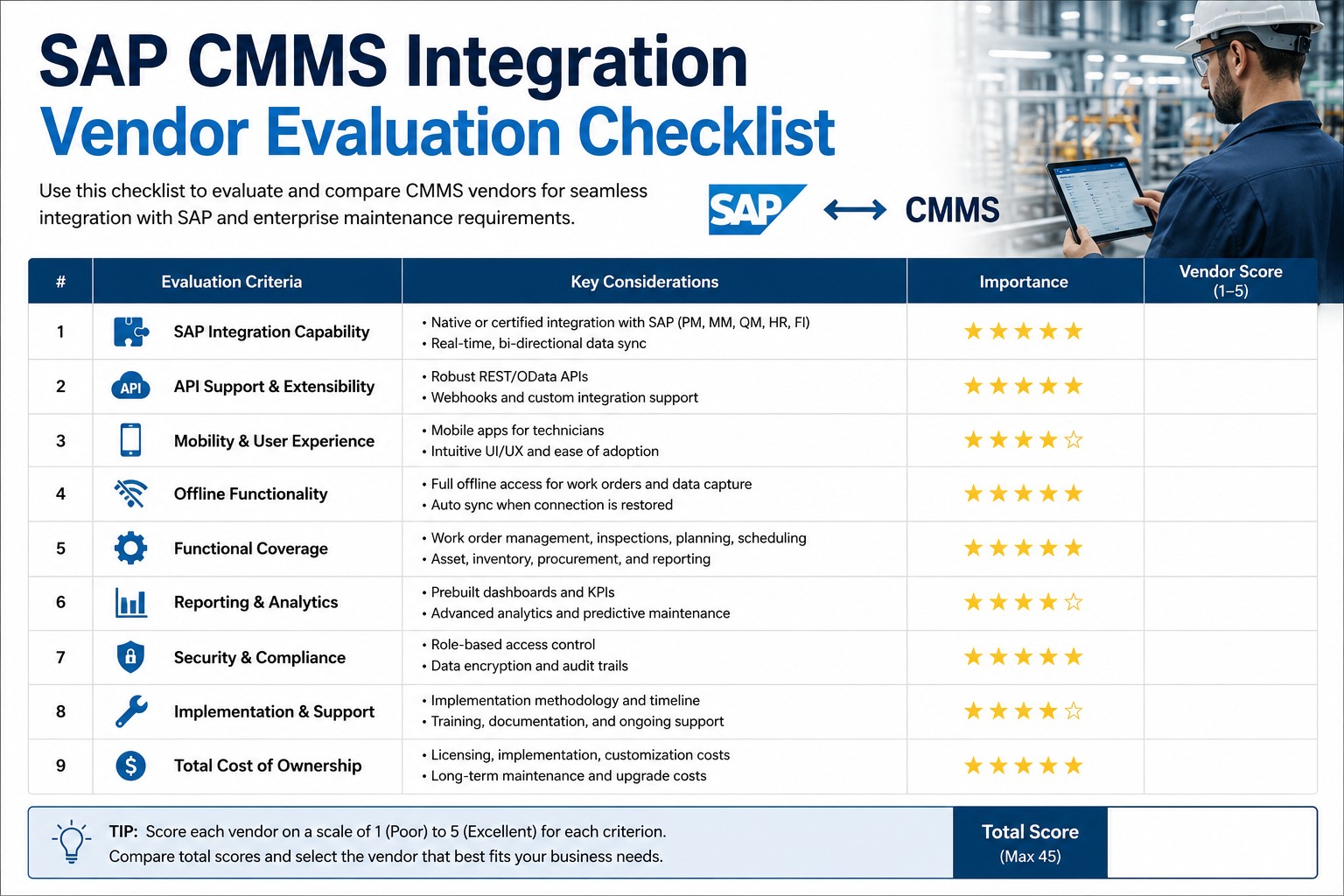
The framework below covers the eight evaluation domains that distinguish successful SAP-CMMS integrations from failures. Each domain has four specific criteria with importance ratings. Apply the scorecard consistently across every vendor in your shortlist for comparable evaluation.
8 DOMAINS · 32 CRITERIA · VENDOR SCORECARD
SAP-CMMS Vendor Evaluation Framework
PHASE A · Technical Foundation
PHASE B · Trust & Scale
PHASE C · Partnership
SAP Integration Architecture FOUNDATION · CRITICAL
Critical
Native BAPI/RFC support without custom ABAP development
Both SAP ECC 6.0 and S/4HANA fully supported
Bidirectional sync for WOs, materials, master data
REL → TECO status sync and cost center posting
Mobile & Field Execution
Critical
Native iOS and Android apps (not just mobile web)
Full offline mode with automatic sync queue
Barcode, QR code, and asset tag scanning built-in
Photos, voice notes, and digital signatures supported
Implementation & Onboarding
High
Time-to-value under 12 weeks for pilot site
Pilot-then-scale methodology, not big bang rollout
Parallel SAP run during cutover phase included
Change management and field adoption planning
Security & Compliance
Critical
SOC 2 Type II certification (current and audited)
ISO 27001 information security certification
SSO/SAML and role-based access control built-in
GDPR compliant with regional data residency options
Scalability & Performance
High
Multi-site and multi-language deployment proven
1,000+ concurrent user capacity demonstrated
100,000+ work orders per month throughput tested
Reference customers at your scale and industry
Total Cost of Ownership
High
Transparent licensing with no hidden customization fees
All integration costs included in initial quote
Predictable annual price escalation contractually defined
Support tier included in base license, not an add-on
Support & Partnership
Medium
Dedicated customer success manager named at signing
24/7 critical issue response with 15-minute SLA
Industry-specific implementation experience documented
Reference customers willing to take direct calls
Innovation & Roadmap
Medium
AI/ML predictive maintenance capabilities native
IoT sensor integration platform without middleware
Built-in analytics and BI dashboards included
Public product roadmap with quarterly release cadence
Apply the scorecard consistently across every vendor in your shortlist. A vendor passing 28+ of 32 criteria is a viable final round candidate. A vendor passing fewer than 24 belongs back in the long list or off it entirely. Procurement leaders ready to run the scorecard against current shortlist can Sign up free to apply the scorecard to your vendor shortlist.
SEE IT IN PRACTICE
Watch a Vendor Be Scored Live Against the Framework
30-minute walkthrough applying the 8-domain framework to a working SAP-CMMS integration. See every criterion evaluated against real architecture.
Red Flags That Should Disqualify a Vendor Immediately
Some signals indicate fundamental architecture or business model issues that no amount of feature compensation can fix. If any of these red flags appears during evaluation, the vendor belongs off the shortlist regardless of other strengths.
Custom ABAP Required
Vendor requires custom ABAP development to integrate with SAP. Creates ongoing maintenance burden and breaks on SAP upgrades.
No True Offline Mobile
"Mobile web" or "responsive design" without native iOS/Android offline mode. Field adoption will fail in poor connectivity areas.
No Current SOC 2 / ISO 27001
Missing or expired security certifications. Indicates immature security program and creates enterprise procurement blockers.
Wants to Replace SAP PM
Vendor pitches replacing SAP PM rather than integrating with it. Indicates architectural mismatch with your enterprise system of record.
Each red flag points to a structural issue that compounds over the partnership lifecycle. A vendor showing multiple red flags isn't a candidate that needs more evaluation—it's a candidate to remove. Teams ready to validate vendor shortlists against the disqualifier framework can Sign up free to validate your shortlist against disqualifier criteria.
How to Run a Structured 90-Day Vendor Selection Process
The 90-day RFP cadence below produces a defensible vendor decision backed by structured evidence rather than vendor pitch energy. Each phase has specific deliverables and decision gates.
90-DAY VENDOR SELECTION ROADMAP
From Requirements to Signed Contract
DAYS 1–15
01
Requirements & RFP Design
Define use cases, weight evaluation categories, draft RFP with specific criteria. Sponsor sign-off on requirements and scoring methodology.
DAYS 16–40
02
Long List & RFP Distribution
Identify 5-8 candidate vendors. Distribute RFP with structured response format. Collect and score responses against scorecard.
DAYS 41–65
03
Shortlist Demos & POC
Down-select to 3 vendors. Scripted demos against your scenarios. Optional 2-4 week proof-of-concept with one vendor against real integration.
DAYS 66–90
04
References & Decision
Reference customer calls (3-5 per finalist). Final negotiation on pricing, SLAs, exit terms. Contract signature and project kickoff.
By day 90, the decision is backed by documented scoring, scripted demos, validated references, and negotiated contract terms. Procurement and operations leaders ready to run the structured process can Book a free demo as part of structured shortlist evaluation.
ROI of Choosing the Right Integration Partner
The ROI gap between right and wrong vendor choice doesn't show up in year one—it compounds across years two through five. The comparison below captures the operating performance delta between vendors selected through structured evaluation versus those selected through feature comparison alone.
FEATURE-COMPARISON SELECTION vs STRUCTURED EVALUATION
5-Year Performance Delta by Vendor Selection Method
Implementation Timeline
−85%
User Adoption Rate
+50 pts
3-Year Total Cost of Ownership
−60%
Maintenance Productivity Gain
+30 pts
SAP Upgrade Compatibility
Critical
90 days
Recommended structured evaluation cycle for SAP-CMMS vendors
5-10x
Cost penalty for skipping structured evaluation upfront
Expert Perspective: Vendor Selection Is a 5-Year Partnership Decision
"
The procurement leaders I've seen consistently make good SAP-CMMS vendor decisions share an unusual property: they spend more time talking to reference customers than they spend in vendor demos. The demo shows what the product can do in a controlled environment. The reference calls reveal what the partnership feels like at month 12, month 24, month 48. That's where you discover whether the vendor still answers the phone when something breaks, whether the integration survived the last SAP upgrade, whether the roadmap commitments materialized or quietly disappeared. Vendor selection isn't a feature comparison—it's a five-year partnership decision being made in a 90-day window.
01
References Reveal What Demos Cannot
Demos show controlled capability; references reveal real-world partnership. Spend more time with references than with vendor sales teams.
02
Architecture Outlasts Features
Features evolve quickly; architecture decisions compound for years. Score architecture criteria with significantly higher weight than feature checklists.
03
Trust Is Earned in Year Two
Year one looks fine with every vendor. The real test is year two when novelty fades and operational reality sets in. Reference customers at year 2+ tell the truth.
START THE EVALUATION
Score Your Vendor Shortlist With the 8-Domain Framework
Apply 32 criteria across 8 domains to every vendor in your shortlist. Score them consistently. Make a defensible decision backed by structured evidence.
Frequently Asked Questions
How many vendors should we evaluate in a structured selection process?
The proven cadence: identify 5-8 candidates in the long list, narrow to 3-4 vendors for the RFP shortlist, take 2-3 vendors through scripted demos, and run a proof-of-concept with 1 vendor before final selection. Fewer than 3 vendors in shortlist removes competitive pressure on pricing and terms; more than 4 vendors dilutes evaluation rigor across too many candidates. The 3-vendor shortlist with one POC is the cadence enterprise procurement teams converge on after running multiple selection cycles.
Should we hire an external consultant to help with vendor selection?
Consultants add value when your team lacks recent SAP-CMMS integration experience or when stakes are very high (multi-million dollar contracts, multi-plant rollouts). They add less value when your team already has the domain knowledge and just needs to run the process. The risk with consultants is they sometimes have undisclosed vendor relationships—always require explicit disclosure of any commercial relationships with vendors being evaluated. The structured 8-domain framework runs effectively whether evaluated internally or with consultant support.
How do we properly validate vendor references?
Reference calls reveal partnership reality that vendor sales teams obscure. Best practices: insist on speaking with reference customers at 24+ months of usage (year-one references give optimistic answers), ask about specific failure scenarios ("walk me through the most recent serious outage"), validate that the integration survived the customer's most recent SAP upgrade, ask about renewal terms and what changed, and request at least one reference customer who is no longer using the vendor to understand why. References at your scale and industry are more valuable than larger references in different industries.
What's typically negotiable on enterprise CMMS pricing?
Most enterprise SAP-CMMS contracts have meaningful negotiation room on: per-user pricing tiers (volume discounts), implementation services (often discounted or included), annual price escalation cap (typically 5-7% baseline, negotiable to 3-4%), SLA commitments with financial penalties, exit terms and data portability provisions, multi-year commitment discounts, and reference customer commitments. Less negotiable: core platform pricing, security requirements, basic support tiers. Pricing flexibility increases significantly when multiple vendors remain competitive late in the cycle.
How do we ensure the integration survives future SAP upgrades?
SAP upgrade survival depends entirely on the integration architecture. Vendors using SAP's standard interfaces (BAPI, RFC, OData) with no custom ABAP development have integrations that typically survive SAP upgrades with minimal effort. Vendors requiring custom ABAP, proprietary middleware, or non-standard interfaces produce integrations that break or require significant rework with each major SAP upgrade. For organizations on the ECC-to-S/4HANA migration path (December 31, 2027 deadline), architectural choice matters more than usual—standard-interface integrations migrate seamlessly while custom-code integrations often require complete rebuilds.